



Build Your Custom Market Intelligence Report
Customize Your ReportThailand Battery Energy Storage System Market Key Highlights
By Battery Type:
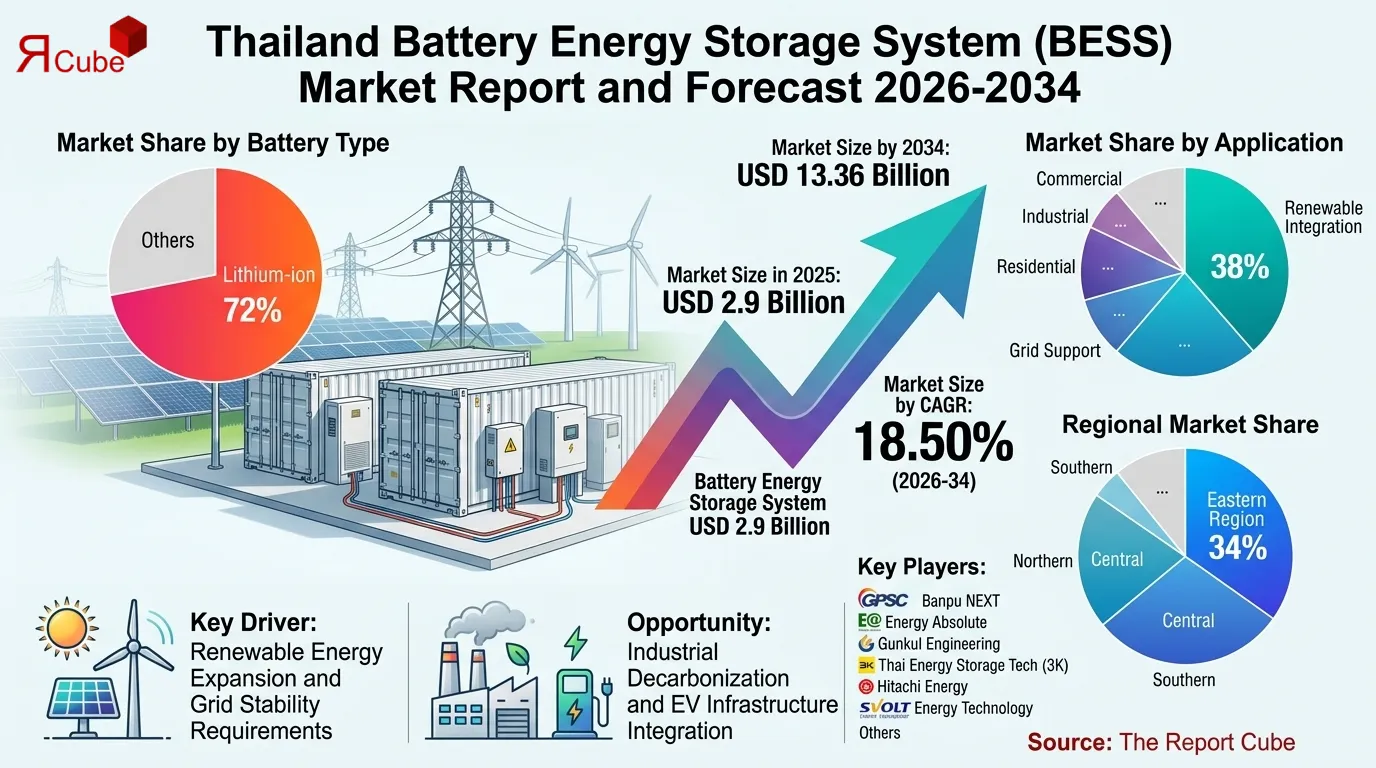
Lithium-ion Battery segment leads the market, with around 72% share.
By Application:
Renewable Integration segment dominates the market, accounting for nearly 38% of total revenue.
Regional Outlook:
Eastern region dominates the thailand battery energy storage system market, with around 34% share.
Government Initiatives & Policies
- Thailand Power Development Plan (PDP 2024-2037, updated 2025): Targets higher renewable penetration and large-scale energy storage deployment to stabilize grids.
- Thailand National Energy Plan 2025 (NEP 2025): Supports battery storage integration, smart grids, and clean energy investment incentives under the Ministry of Energy.
Thailand Battery Energy Storage System Market Insights & Analysis
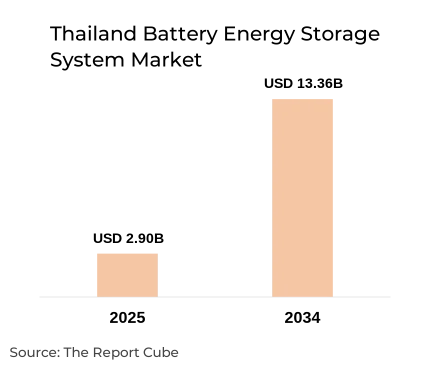
The Thailand Battery Energy Storage System Market is anticipated to register a CAGR: 18.50% during 2026-34. The market size was valued at USD 2.9 billion in 2025 and is projected to reach USD 13.36 billion by 2034. Rapid renewable expansion, grid modernization, and industrial decarbonization are shaping the country’s large-scale and distributed storage deployment strategy.
Thailand’s renewable capacity has exceeded 15 GW, with solar accounting for a dominant share. As solar penetration rises, grid operators face intermittency challenges, creating structural demand for battery energy storage systems (BESS). Under the updated Power Development Plan, Thailand aims to increase renewable share to more than 50% of total generation by 2037, requiring flexible storage assets for frequency regulation and peak shaving. Grid-scale BESS installations are accelerating in the Eastern Economic Corridor (EEC), where industrial demand density is highest.
Private sector participation is expanding rapidly. Companies such as GPSC (Global Power Synergy PCL), Banpu NEXT, and Energy Absolute are investing in integrated solar-plus-storage platforms targeting industrial estates and commercial customers. By 2025, cumulative installed BESS capacity in Thailand is estimated to surpass 1.2 GW, with lithium-ion systems representing over two-thirds of deployments. Commercial and industrial (C&I) customers increasingly deploy behind-the-meter storage to manage demand charges and ensure power reliability.
Technological advancements are strengthening cost competitiveness. Lithium Iron Phosphate (LFP) batteries are gaining traction due to improved safety, longer lifecycle performance exceeding 6,000 cycles, and declining system costs below USD 400 per kWh for utility-scale projects. Hybrid battery configurations combining solar, storage, and EV charging infrastructure are emerging across industrial parks. These integrated models align with Thailand’s ambition to position itself as a regional clean energy hub in Southeast Asia.
Thailand Battery Energy Storage System Market Dynamics
Key Driver: Renewable Energy Expansion and Grid Stability Requirements
Thailand’s commitment to renewable integration is the primary driver for BESS deployment. Solar generation variability creates midday oversupply and evening peak demand gaps. Battery systems provide frequency regulation, voltage support, and peak load management. Industrial electricity tariffs with time-of-use pricing encourage companies to adopt storage for cost optimization. Government-backed auctions increasingly bundle renewable projects with mandatory storage capacity, accelerating market growth. By 2030, grid-scale storage capacity is projected to exceed 3 GW, reinforcing Thailand’s energy security strategy.
Book your FREE 30-minute expert consultation today
Contact UsIndustry Trends: Hybrid Solar-Storage Systems and AI-Enabled Energy Management
Hybrid systems integrating solar panels, BESS, and smart energy management platforms are expanding across industrial estates. AI-driven energy optimization software analyzes consumption patterns and dynamically controls charging-discharge cycles, improving system efficiency by up to 15%. Cloud-based monitoring and predictive maintenance reduce operational downtime. Lithium-ion LFP batteries are replacing NMC in stationary storage due to enhanced thermal stability. Additionally, pilot microgrids in remote provinces are combining storage with renewable sources to reduce diesel dependency, signaling a shift toward decentralized energy ecosystems.
Major Challenge: High Capital Investment and Grid Integration Complexity
Utility-scale BESS projects require significant upfront investment, often exceeding USD 300 million for large installations. Financing remains sensitive to tariff structures and regulatory clarity. Grid interconnection processes can be complex, requiring coordination with EGAT and regional distribution authorities. Technical challenges related to battery degradation, thermal management, and recycling also require structured lifecycle planning. While costs are declining, long-term revenue certainty through ancillary service markets remains critical for investor confidence.
Opportunity: Industrial Decarbonization and EV Infrastructure Integration
Thailand’s automotive manufacturing base is transitioning toward EV production, increasing demand for charging infrastructure supported by battery storage. Transportation hubs and industrial zones are deploying fast-charging stations integrated with on-site storage to reduce grid stress. Corporate net-zero commitments are further driving storage investments. Third-party ownership and energy-as-a-service models are lowering entry barriers for SMEs. As carbon pricing discussions advance regionally, storage-backed renewable systems will gain stronger economic justification.
Thailand Battery Energy Storage System Market Segment-wise Analysis
By Battery Type:
- Lithium-ion Battery
- Lithium Iron Phosphate (LFP) Battery
- Lithium Nickel Manganese Cobalt (NMC) Battery
- Others
- Lead-acid Battery
- Valve Regulated Lead-acid (VRLA) Battery
- Flooded Lead-acid Battery
- Flow Battery
- Vanadium Redox Flow Battery
- Zinc-based Flow Battery
- Sodium-based Battery
- Others
Lithium-ion batteries account for nearly 72% of total installations in 2025, led by LFP variants. LFP technology offers enhanced cycle life and lower fire risk, making it ideal for grid-scale projects. System costs have declined approximately 18% year-over-year, improving project economics. NMC batteries remain relevant in high-density applications but are gradually losing share in stationary storage. Flow batteries are emerging in pilot projects due to long-duration storage capabilities exceeding eight hours. However, lithium-ion dominance is expected to continue through 2034 due to supply chain maturity and falling cell prices.
By Application:
- Renewable Integration
- Solar-plus-Storage
- Wind-plus-Storage
- Grid-scale Energy Storage
- Frequency Regulation
- Peak Shaving
- Voltage Support
- Commercial and Industrial Energy Storage
- Load Shifting
- Backup Power
- Demand Charge Management
- Residential Energy Storage
- Microgrid and Off-grid Energy Storage
- Others
Renewable integration represents approximately 38% of total revenue, driven by solar-plus-storage deployments. Solar farms in the Eastern and Central regions are increasingly paired with 2-4 hour storage systems to smooth output variability. Grid-scale frequency regulation projects are expanding under EGAT procurement programs. C&I adoption is accelerating among manufacturing facilities seeking energy resilience. Residential storage remains nascent but is expected to grow with rooftop solar expansion. Renewable integration will remain the leading application as Thailand scales clean energy capacity.
Regional Projection of Thailand Battery Energy Storage System Industry
- Northern
- Northeastern (Isan)
- Central
- Eastern
- Western
- Southern
The Eastern region leads with around 34% share, driven by the Eastern Economic Corridor’s industrial concentration and renewable investments. Large manufacturing clusters require stable power, encouraging BESS integration. Central Thailand follows due to Bangkok’s commercial load density and rooftop solar adoption. Northeastern provinces are developing solar farms paired with storage, benefiting from land availability. Southern regions are exploring microgrid projects to support tourism infrastructure and remote islands. Regional growth is closely tied to industrial expansion and renewable deployment intensity.
Thailand Battery Energy Storage System Market Recent Developments
- 2025: Banpu NEXT announced a comprehensive clean energy growth strategy positioning ESS among its core Smart Energy Solutions, integrating AI, big data, and cloud platforms to deliver advanced energy storage services for industrial and commercial customers.
- 2025: SVOLT Energy Technology (Thailand) revealed its roadmap toward ESS pack assembly and local cell manufacturing, partnering with Banpu NEXT to establish integrated solar-storage-charging pilot projects.
- 2025: Gunkul Engineering PCL secured a THB 675 million EGAT contract for a 500 kV transmission line supporting renewable integration and future large-scale battery deployment in the Eastern Economic Corridor.
Need insights for a specific region within this market?
Request Regional DataWhy Choose This Report?
- Provides a comprehensive overview of the overall market analysis, encompassing key trends, consumer behavior analysis, and risk assessment to support strategic decision-making.
- Provides accurate, up-to-date insights into market size, segmentation, and emerging opportunities, helping to minimize risk & capitalizing on growth.
- Gives deep understanding of target audience preferences, investment habits, and communication channels for enhanced product development & marketing effectiveness.
- Delivers competitive analysis & benchmarking, uncovering the strengths & weaknesses of market competitors to guide strategies.
- Consolidate comprehensive market intelligence, reducing reasoning & streamlining research efforts.
- Facilitates customized market segmentation & risk mitigation strategies, fine-tuned to the business objectives.
- Aids in identifying both market challenges & untapped opportunities within the industry to drive long-term business growth.
- Provides valuable information based on actual customer data & search trends.
Table of Contents
- Introduction
- Objective of the Study
- Product and Category Definition
- Market Segmentation
- Study Variables
- Research Methodology
- Secondary Data Points
- Breakdown of Secondary Sources
- Primary Data Points
- Breakdown of Primary Interviews
- Secondary Data Points
- Executive Summary
- Market Dynamics
- Drivers
- Challenges
- Opportunity Assessment
- Recent Trends and Developments
- Regulatory and Policy Landscape
- Thailand Battery Energy Storage System Market Overview (2021-2034)
- Market Size, By Value (USD Billion)
- Market Share, By Battery Type
- Lithium-ion Battery
- Lithium Iron Phosphate (LFP) Battery
- Lithium Nickel Manganese Cobalt (NMC) Battery
- Others
- Lead-acid Battery
- Valve Regulated Lead-acid (VRLA) Battery
- Flooded Lead-acid Battery
- Flow Battery
- Vanadium Redox Flow Battery
- Zinc-based Flow Battery
- Sodium-based Battery
- Others
- Lithium-ion Battery
- Market Share, By Connection Type
- On-grid Battery Energy Storage System
- Off-grid Battery Energy Storage System
- Hybrid Battery Energy Storage System
- Market Share, By Application
- Renewable Integration
- Solar-plus-Storage
- Wind-plus-Storage
- Grid-scale Energy Storage
- Frequency Regulation
- Peak Shaving
- Voltage Support
- Commercial and Industrial Energy Storage
- Load Shifting
- Backup Power
- Demand Charge Management
- Residential Energy Storage
- Microgrid and Off-grid Energy Storage
- Others
- Renewable Integration
- Market Share, By Ownership Model
- Utility-owned Battery Energy Storage System
- Independent Power Producer-owned Battery Energy Storage System
- Customer-owned Battery Energy Storage System
- Third-party/Leased Battery Energy Storage System
- Market Share, By End User
- Utilities and Power Producers
- Industrial and Manufacturing
- Commercial and Institutional
- Residential
- Transportation and E-mobility Infrastructure
- Others
- Market Share, By Region
- Northern
- Northeastern (Isan)
- Central
- Eastern
- Western
- Southern
- Market Share, By Company
- Revenue Shares & Analysis
- Competitive Landscape
- Northern Thailand Battery Energy Storage System Market
- Market Size, By Value (USD Billion/Million)
- Market Share, By Battery Type
- Market Share, By Connection Type
- Market Share, By Application
- Market Share, By End User
- Northeastern (Isan) Thailand Battery Energy Storage System Market
- Market Size, By Value (USD Billion/Million)
- Market Share, By Battery Type
- Market Share, By Connection Type
- Market Share, By Application
- Market Share, By End User
- Central Thailand Battery Energy Storage System Market
- Market Size, By Value (USD Billion/Million)
- Market Share, By Battery Type
- Market Share, By Connection Type
- Market Share, By Application
- Market Share, By End User
- Eastern Thailand Battery Energy Storage System Market
- Market Size, By Value (USD Billion/Million)
- Market Share, By Battery Type
- Market Share, By Connection Type
- Market Share, By Application
- Market Share, By End User
- Western Thailand Battery Energy Storage System Market
- Market Size, By Value (USD Billion/Million)
- Market Share, By Battery Type
- Market Share, By Connection Type
- Market Share, By Application
- Market Share, By End User
- Southern Thailand Battery Energy Storage System Market
- Market Size, By Value (USD Billion/Million)
- Market Share, By Battery Type
- Market Share, By Connection Type
- Market Share, By Application
- Market Share, By End User
- Competitive Outlook and Company Profiles
- GPSC (Global Power Synergy PCL)
- Company Overview
- Product Portfolio
- Strategic Alliances/Partnerships
- Recent Developments
- Banpu NEXT
- Company Overview
- Product Portfolio
- Strategic Alliances/Partnerships
- Recent Developments
- Energy Absolute (Amita Thailand)
- Company Overview
- Product Portfolio
- Strategic Alliances/Partnerships
- Recent Developments
- Delta Electronics
- Company Overview
- Product Portfolio
- Strategic Alliances/Partnerships
- Recent Developments
- Gunkul Engineering PCL
- Company Overview
- Product Portfolio
- Strategic Alliances/Partnerships
- Recent Developments
- Thai Energy Storage Tech (3K Battery)
- Company Overview
- Product Portfolio
- Strategic Alliances/Partnerships
- Recent Developments
- Hitachi Energy
- Company Overview
- Product Portfolio
- Strategic Alliances/Partnerships
- Recent Developments
- SVOLT Energy Technology
- Company Overview
- Product Portfolio
- Strategic Alliances/Partnerships
- Recent Developments
- ITL-Engineering & Solution
- Company Overview
- Product Portfolio
- Strategic Alliances/Partnerships
- Recent Developments
- SCG International (Solar/ESS)
- Company Overview
- Product Portfolio
- Strategic Alliances/Partnerships
- Recent Developments
- BYD
- Company Overview
- Product Portfolio
- Strategic Alliances/Partnerships
- Recent Developments
- Constant Energy
- Company Overview
- Product Portfolio
- Strategic Alliances/Partnerships
- Recent Developments
- Neo Clean Energy
- Company Overview
- Product Portfolio
- Strategic Alliances/Partnerships
- Recent Developments
- Thai Solar Power
- Company Overview
- Product Portfolio
- Strategic Alliances/Partnerships
- Recent Developments
- Fox ESS
- Company Overview
- Product Portfolio
- Strategic Alliances/Partnerships
- Recent Developments
- Green Energy Storage Co.
- Company Overview
- Product Portfolio
- Strategic Alliances/Partnerships
- Recent Developments
- Others
- GPSC (Global Power Synergy PCL)
- Contact Us and Disclaimer
Top Key Players & Market Share Outlook
- GPSC (Global Power Synergy PCL)
- Banpu NEXT
- Energy Absolute (Amita Thailand)
- Delta Electronics (Thailand)
- Gunkul Engineering PCL
- Thai Energy Storage Tech (3K Battery)
- Hitachi Energy (Thailand)
- SVOLT Energy Technology (Thailand)
- ITL-Engineering & Solution
- SCG International (Solar/ESS)
- BYD (Thailand)
- Constant Energy
- Neo Clean Energy
- Thai Solar Power
- Fox ESS (Thailand)
- Green Energy Storage Co.
Frequently Asked Questions






