



Build Your Custom Market Intelligence Report
Customize Your ReportGlobal Floating Solar Market Insights & Analysis
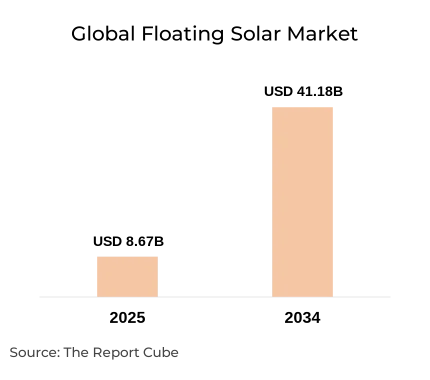
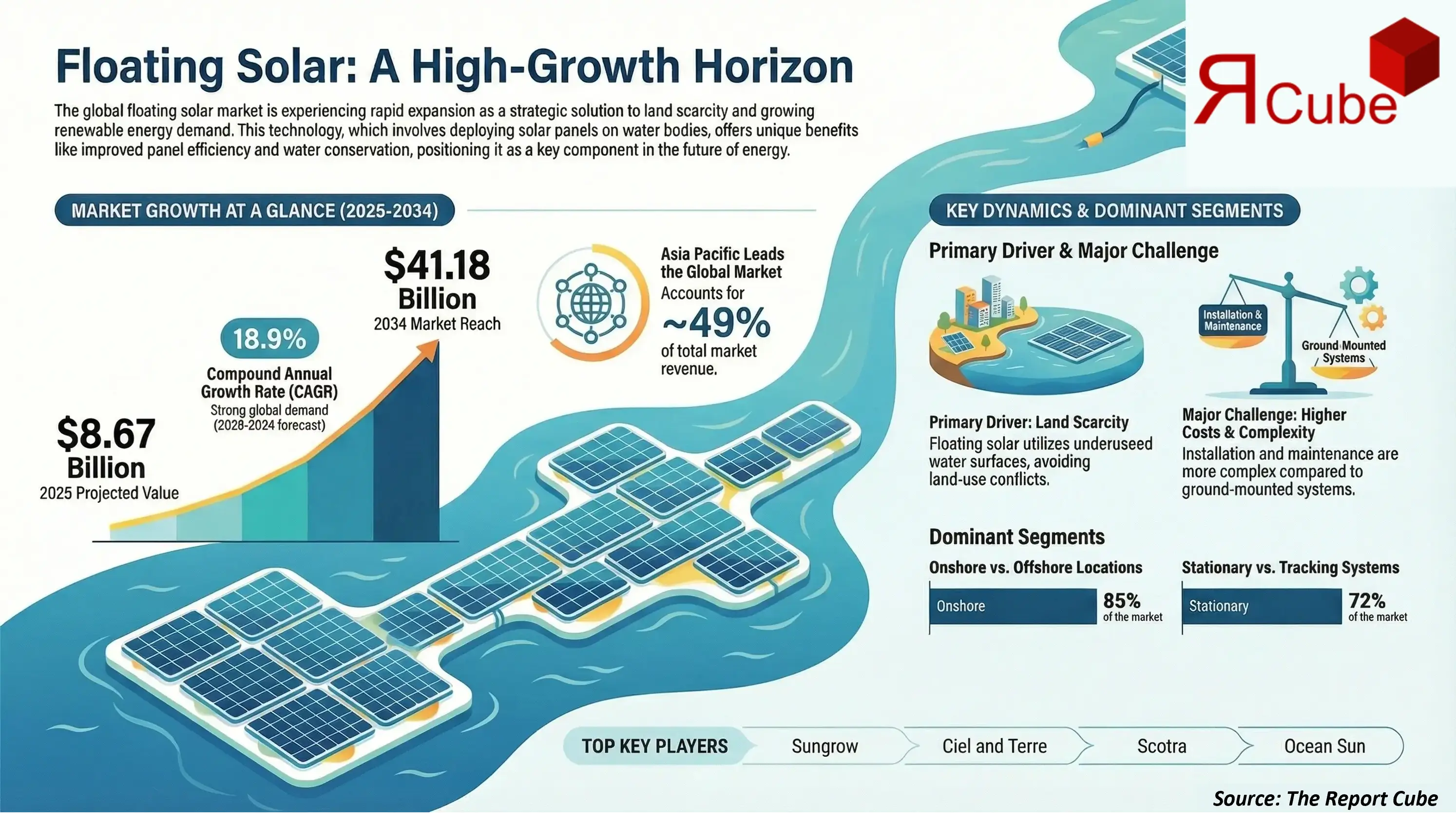
The Global Floating Solar Market is anticipated to register a CAGR of 18.9% during the forecast period 2026-2034. The market size was valued at USD 8.67 Billion in 2025 and is projected to reach USD 41.18 Billion by 2034. This strong growth reflects the increasing global focus on maximizing renewable energy generation while addressing land constraints, water evaporation losses, and grid stability challenges. Floating solar, also known as floating photovoltaic (FPV) systems, is emerging as a strategic solution that allows solar power generation on water bodies such as reservoirs, lakes, irrigation ponds, and near-shore coastal areas.
The adoption of floating solar systems is accelerating as governments and utilities seek innovative ways to expand renewable capacity without competing for scarce land resources. FPV installations offer multiple advantages, including improved panel efficiency due to the cooling effect of water, reduced evaporation from water bodies, and synergy with existing hydropower infrastructure. As energy transition goals intensify and solar capacity additions scale globally, floating solar is moving from pilot projects to large-scale commercial deployments. This evolution is positioning FPV as a key component of diversified and resilient renewable energy portfolios.
Global Floating Solar Market Recent Developments
- 2025: Sungrow expanded its floating solar inverter and system solutions for large-scale reservoir-based projects.
- 2025: Ciel and Terre deployed new high-capacity floating solar installations integrated with hydropower assets.
Government Initiatives & Policies
- India National Floating Solar Program: Promotes floating solar deployment on reservoirs and dams.
- EU Renewable Energy Directive: Encourages innovative solar technologies, including floating PV systems.
Global Floating Solar Market Dynamics
Key Driver: Land Scarcity and Efficient Use of Water Bodies
The primary driver of the global floating solar market is the increasing scarcity of suitable land for large-scale solar installations, particularly in densely populated and agriculturally intensive regions. Floating solar systems utilize underutilized water surfaces, allowing energy generation without displacing agricultural land or natural habitats. Additionally, FPV installations reduce water evaporation by up to 30–40% in some climates, delivering added value for water management. These combined benefits are making floating solar an attractive option for governments and utilities seeking efficient, multi-benefit renewable energy solutions.
Major Challenge: Higher Installation and Maintenance Complexity
A major challenge facing the floating solar market is the higher initial installation cost and operational complexity compared to ground-mounted systems. Floating structures, anchoring systems, corrosion-resistant materials, and specialized electrical components increase project costs. Maintenance activities can also be more complex due to access constraints and water conditions. However, technological advancements, standardization of floating platforms, and economies of scale are gradually reducing these challenges, improving the long-term cost competitiveness of floating solar systems.
Industry Trends: Integration with Hydropower and Energy Storage
An important trend shaping the floating solar market is the integration of FPV systems with existing hydropower plants and energy storage solutions. Hybrid solar-hydro projects leverage shared grid infrastructure, enhance energy output stability, and improve overall asset utilization. Floating solar paired with battery storage further enhances grid reliability and enables higher renewable penetration. These integrated solutions are gaining traction as utilities seek flexible and dispatchable renewable energy systems to support grid modernization.
Opportunity Ahead: Expansion in Emerging Economies and Offshore FPV
Significant growth opportunities exist in emerging economies with abundant water bodies and rising electricity demand. Asia Pacific, Africa, and parts of Latin America offer substantial untapped potential for floating solar deployment. Additionally, offshore and near-shore floating solar systems are emerging as a new frontier, particularly in regions with limited inland water resources. Advances in floating platform design and anchoring technology are opening new application areas, creating long-term growth prospects for FPV developers and suppliers.
Global Floating Solar Market Segment-wise Analysis
By System Type:
- Stationary Floating Solar Systems
- Tracking Floating Solar Systems
Stationary floating solar systems dominate the market, accounting for approximately 72% of total revenue in 2025. These systems are widely deployed due to lower complexity, proven reliability, and cost efficiency. Tracking floating solar systems, while still emerging, offer higher energy yields by following the sun’s movement and are gaining interest for large-scale projects where maximizing output is a priority. As tracking technologies mature, their adoption is expected to increase gradually.
By Location:
- Onshore Water Bodies
- Offshore and Near Shore Water Bodies
Onshore water bodies represent the largest location segment, contributing nearly 85% of market revenue in 2025. Reservoirs, lakes, irrigation canals, and mining ponds provide stable and sheltered environments ideal for FPV deployment. Offshore and near-shore installations remain a smaller segment but offer long-term potential, particularly in regions with limited inland water resources and high coastal energy demand.
Regional Projection of Global Floating Solar Industry
- North America
- Europe
- Asia Pacific
- Middle East and Africa
- South America
Asia Pacific leads the global floating solar market, accounting for approximately 49% of total revenue in 2025. China, Japan, South Korea, and India are at the forefront of FPV deployment due to supportive policies, large reservoirs, and strong renewable energy targets. Europe follows, driven by land constraints and decarbonization mandates. North America shows steady growth through pilot projects and utility-scale adoption. The Middle East and Africa and South America present emerging opportunities linked to water management needs and renewable expansion.
Why Choose This Report?
- Provides a comprehensive overview of the floating solar market and renewable energy innovation trends.
- Delivers accurate, up-to-date insights into market size, segmentation, and long-term growth opportunities.
- Offers deep understanding of FPV system designs, deployment models, and performance factors.
- Presents competitive analysis & benchmarking of leading global floating solar players.
- Consolidates market intelligence to support strategic planning and investment decisions.
- Supports customized segmentation and regional market assessments.
- Identifies challenges and untapped opportunities in floating solar deployment.
- Grounded in real-world renewable energy policies, projects, and technology advancements.
Table of Contents
- Introduction
- Objective of the Study
- Product and Category Definition
- Market Segmentation
- Study Variables
- Research Methodology
- Secondary Data Points
- Breakdown of Secondary Sources
- Primary Data Points
- Breakdown of Primary Interviews
- Secondary Data Points
- Executive Summary
- Market Dynamics
- Drivers
- Challenges
- Opportunity Assessment
- Recent Trends and Developments
- Regulatory and Policy Landscape
- Global Floating Solar Market Overview (2020-2034)
- Market Size, By Value (USD Billion)
- Market Share, By System Type
- Stationary Floating Solar Systems
- Tracking Floating Solar Systems
- Market Share, By Location
- Onshore Water Bodies
- Offshore and Near Shore Water Bodies
- Market Share, By Capacity
- Up to 5 Megawatt
- 5 to 50 Megawatt
- Above 50 Megawatt
- Market Share, By Connectivity
- On Grid Floating Solar Systems
- Off Grid Floating Solar Systems
- Hybrid Floating Solar Systems
- Market Share, By Component
- Solar Modules
- Floating Structures and Pontoons
- Mooring and Anchoring Systems
- Inverters and Power Conditioning Units
- Cables and Balance of System Components
- Market Share, By Application
- Utility Scale Power Plants
- Industrial and Commercial Facilities
- Agricultural and Irrigation Reservoirs
- Water Utilities and Hydropower Reservoirs
- Others
- Market Share, By End User
- Power Utilities and Independent Power Producers
- Industrial and Commercial Users
- Government and Public Sector Agencies
- Others
- Market Share, By Region
- North America
- Europe
- Asia Pacific
- Middle East and Africa
- South America
- Market Share, By Company
- Revenue Shares
- Competitive Landscape
- North America Floating Solar Market
- Market Size, By Value (USD Billion)
- Market Share, By System Type
- Market Share, By Location
- Market Share, By Capacity
- Market Share, By Connectivity
- Market Share, By Application
- Market Share, By End User
- Market Share, By Country
- United States
- Canada
- Mexico
- Europe Floating Solar Market
- Market Size, By Value (USD Billion)
- Market Share, By System Type
- Market Share, By Location
- Market Share, By Capacity
- Market Share, By Connectivity
- Market Share, By Application
- Market Share, By End User
- Market Share, By Country
- Germany
- United Kingdom
- France
- Italy
- Spain
- Northern and Nordic Countries
- Rest of Europe
- Asia Pacific Floating Solar Market
- Market Size, By Value (USD Billion)
- Market Share, By System Type
- Market Share, By Location
- Market Share, By Capacity
- Market Share, By Connectivity
- Market Share, By Application
- Market Share, By End User
- Market Share, By Country
- China
- Japan
- South Korea
- India
- Indonesia
- Rest of Asia Pacific
- Middle East and Africa Floating Solar Market
- Market Size, By Value (USD Billion)
- Market Share, By System Type
- Market Share, By Location
- Market Share, By Capacity
- Market Share, By Connectivity
- Market Share, By Application
- Market Share, By End User
- Market Share, By Country
- Saudi Arabia
- United Arab Emirates
- South Africa
- Rest of Middle East and Africa
- South America Floating Solar Market
- Market Size, By Value (USD Billion)
- Market Share, By System Type
- Market Share, By Location
- Market Share, By Capacity
- Market Share, By Connectivity
- Market Share, By Application
- Market Share, By End User
- Market Share, By Country
- Brazil
- Argentina
- Rest of South America
- Competitive Outlook and Company Profiles
- Sungrow
- Company Overview
- Floating Solar Solutions Portfolio
- Strategic Alliances and Partnerships
- Recent Developments
- Ciel and Terre
- Company Overview
- Floating Solar Solutions Portfolio
- Strategic Alliances and Partnerships
- Recent Developments
- Scotra
- Company Overview
- Floating Solar Solutions Portfolio
- Strategic Alliances and Partnerships
- Recent Developments
- Ocean Sun
- Company Overview
- Floating Solar Solutions Portfolio
- Strategic Alliances and Partnerships
- Recent Developments
- Xiamen Mibet Energy
- Company Overview
- Floating Solar Solutions Portfolio
- Strategic Alliances and Partnerships
- Recent Developments
- Zimmermann
- Company Overview
- Floating Solar Solutions Portfolio
- Strategic Alliances and Partnerships
- Recent Developments
- Kyocera
- Company Overview
- Floating Solar Solutions Portfolio
- Strategic Alliances and Partnerships
- Recent Developments
- JA Solar
- Company Overview
- Floating Solar and Module Portfolio
- Strategic Alliances and Partnerships
- Recent Developments
- Trina Solar
- Company Overview
- Floating Solar and Module Portfolio
- Strategic Alliances and Partnerships
- Recent Developments
- BayWa re
- Company Overview
- Floating Solar Project Portfolio
- Strategic Alliances and Partnerships
- Recent Developments
- Others
- Sungrow
- Contact Us and Disclaimer
Top Key Players & Market Share Outlook
- Sungrow
- Ciel and Terre
- Scotra
- Ocean Sun
- Xiamen Mibet Energy
- Zimmermann
- Kyocera
- JA Solar
- Trina Solar
- BayWa re
- Others
Frequently Asked Questions






