




Build Your Custom Market Intelligence Report
Customize Your ReportGlobal Battery Passport Market Key Highlights
By Component:
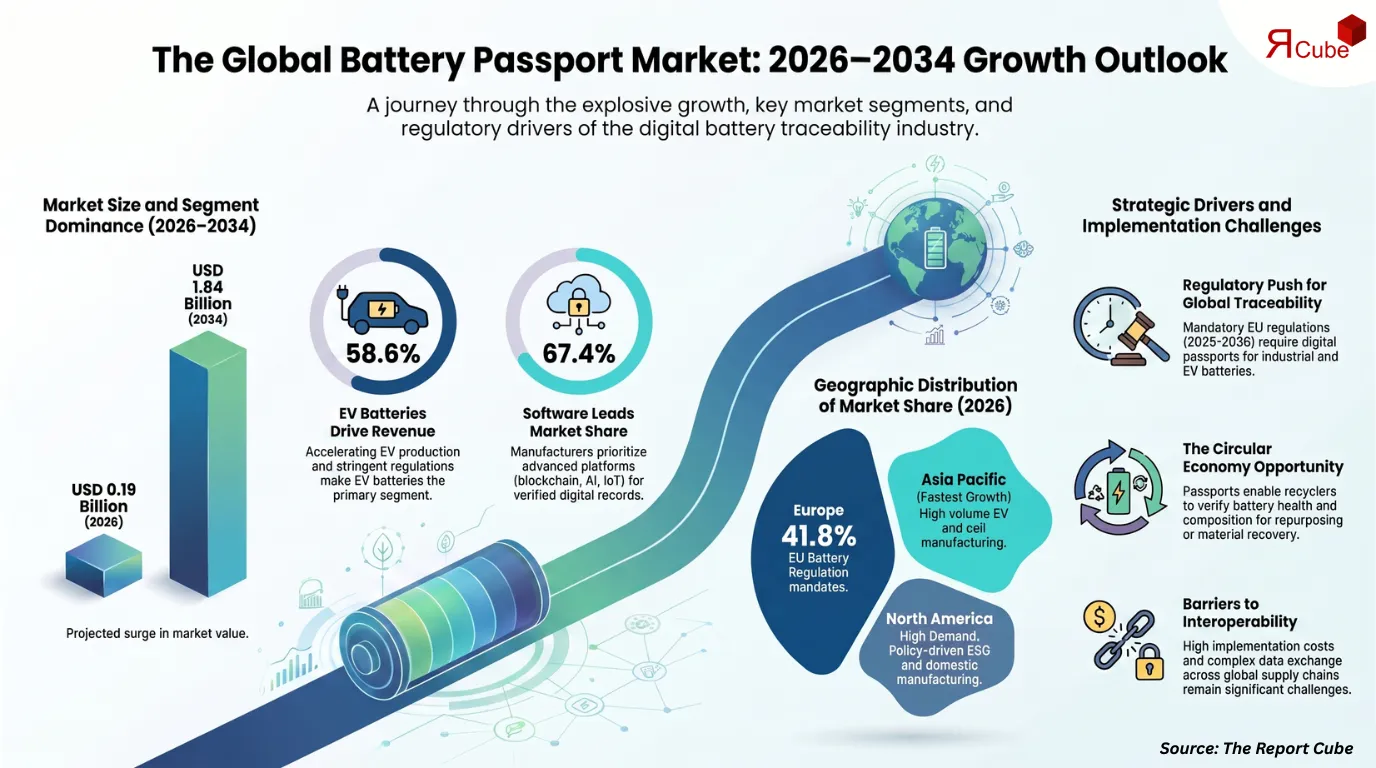
Software segment leads the market with approximately 67.4% share.
By Battery Type:
EV Batteries segment dominates the market with nearly 58.6% of total revenue.
Regional Outlook:
Europe dominates the Global Battery Passport Market with around 41.8% share.
Global Battery Passport Market Insights & Analysis
The Global Battery Passport Market is anticipated to register a CAGR of around 32.8% during the forecast period of 2026-2034. The market size is valued at USD 0.19 billion in 2026 and is projected to reach USD 1.84 billion by 2034. The market is gaining momentum as battery value chains become increasingly data-driven and sustainability regulations move from voluntary disclosure toward mandatory compliance. Manufacturers of electric vehicle batteries, industrial batteries, and stationary energy storage systems are investing in advanced Battery Passport software to create a verified digital record covering material sourcing, battery chemistry, production history, carbon emissions, repair activities, and end-of-life recycling. The transition toward transparent battery ecosystems is encouraging battery producers and automotive OEMs to modernize their digital infrastructure, ensuring compliance with evolving environmental standards while improving operational efficiency across global supply networks.
Investment activity throughout the battery ecosystem continues to strengthen the commercial outlook for the Battery Passport Market. Technology providers are introducing integrated Battery Passport systems that combine blockchain, cloud computing, artificial intelligence, IoT connectivity, and digital identity technologies into a unified compliance platform. These solutions enable trusted information exchange among battery manufacturers, raw material suppliers, logistics companies, recyclers, and regulatory agencies. Industry collaborations involving automotive OEMs, battery producers, and digital technology companies are accelerating interoperability across international supply chains, while government-led circular economy initiatives continue to encourage lifecycle traceability and responsible mineral sourcing. As battery production capacity expands worldwide, demand for scalable Battery Passport solutions capable of supporting cross-border compliance, carbon accounting, and lifecycle management is expected to increase significantly throughout the forecast period.
Global Battery Passport Market Impact Analysis
| Factor | Type | Specific Impact on Market | Magnitude | Business Implication |
|---|---|---|---|---|
| Regulatory Push for Traceability | Regulatory | Mandated digital passports increase compliance led adoption pace. | High | Battery makers must invest in data systems to keep market access. |
| Growth of EV and Storage Demand | Market | Rising battery volumes expand addressable passport solutions base. | High | Vendors can scale platforms with core EV and grid battery clients. |
| Sustainability and ESG Transparency | Consumer | Need for carbon and sourcing data boosts certified passport use. | High | Firms gain differentiation by offering auditable ESG grade data. |
| Standardization by Global Alliances | Technological | Common frameworks reduce fragmentation and ease cross border rollout. | Medium | Solutions aligned with GBA rules win faster multi region adoption. |
| High Implementation and Integration Costs | Environmental | Complex data capture may slow uptake among smaller producers. | Medium | Creates space for modular, low cost passport service offerings. |
| Data Security and Interoperability Needs | Technological | Secure sharing across platforms shapes buyer trust and vendor choice. | Medium | Vendors must ensure robust, interoperable architectures to scale use. |
| Circular Economy and Recycling Focus | Market | Passports support reuse valuation and end of life recovery planning. | Medium | Operators can monetize lifecycle data for recycling and second use. |
Global Battery Passport Market Dynamics
Key Driver: Regulatory Compliance Accelerating Digital Battery Traceability
Regulatory developments across major battery-producing economies are reshaping how organizations manage battery lifecycle information. The implementation of stricter sustainability requirements, particularly for electric vehicle batteries, is driving widespread adoption of Battery Passport software that records product origin, carbon footprint, recycled material content, critical mineral sourcing, and end-of-life recovery data. Rather than treating compliance as a reporting exercise, manufacturers are embedding digital traceability into production and quality management processes. This shift is creating long-term demand for comprehensive Battery Passport systems that improve transparency while supporting responsible manufacturing practices throughout increasingly complex global supply chains.
Commercial benefits extend well beyond regulatory compliance. Battery manufacturers and automotive OEMs are using digital passport platforms to improve inventory visibility, strengthen supplier verification, reduce counterfeit battery risks, and simplify warranty management. Verified lifecycle records also enable more efficient battery refurbishment and recycling, supporting circular economy objectives while lowering operational costs. These advantages continue to reinforce investment in advanced Battery Passport solutions, making digital battery traceability a strategic business capability rather than solely a regulatory requirement.
Industry Trends: Intelligent Digital Platforms Reshaping Battery Lifecycle Management
Technology innovation remains central to the evolution of the Battery Passport Market. Modern platforms increasingly combine blockchain-enabled traceability, artificial intelligence, cloud computing, digital identity technologies, and IoT-enabled battery monitoring within a single ecosystem. This integrated approach enables organizations to capture trusted lifecycle information from raw material extraction through manufacturing, transportation, vehicle operation, second-life applications, and recycling. The result is a more transparent battery value chain capable of supporting sustainability reporting while improving operational decision-making across multiple stakeholders.
Software developers are also expanding platform capabilities beyond regulatory reporting by incorporating predictive analytics, battery health monitoring, automated carbon footprint calculations, digital product documentation, and real-time compliance dashboards. Cloud-native deployment models allow manufacturers operating across multiple countries to securely exchange standardized battery information with suppliers, logistics partners, and recyclers. These technology advancements are positioning the Battery Passport system as an essential digital infrastructure component supporting future battery manufacturing, energy storage deployment, and circular economy initiatives.
Book your FREE 30-minute expert consultation today
Contact UsMajor Challenge: Achieving Secure and Standardized Data Exchange Across Global Supply Chains
Although digital battery traceability is advancing rapidly, achieving consistent data interoperability remains a significant industry challenge. Battery supply chains involve mining companies, material processors, cell manufacturers, pack assemblers, automotive OEMs, logistics providers, and recycling facilities, each operating different enterprise software environments. Harmonizing these systems into a unified Battery Passport solution requires standardized data models, secure communication protocols, and substantial investment in digital infrastructure. Variations in regulatory requirements across different regions further increase implementation complexity for multinational organizations.
Protecting commercially sensitive information while maintaining regulatory transparency presents another important consideration. Battery manufacturers must balance data accessibility with cybersecurity, intellectual property protection, and confidential supplier relationships. Organizations also face implementation costs associated with software integration, employee training, and ongoing system maintenance. Small and medium-sized suppliers often encounter additional financial and technical constraints, slowing adoption across some segments of the battery ecosystem despite growing regulatory expectations.
Opportunity: Circular Economy Initiatives Creating Long-Term Growth Potential
The rapid expansion of electric mobility and renewable energy storage is expected to generate millions of batteries reaching refurbishment, repurposing, and recycling stages over the next decade. This structural shift is creating substantial opportunities for providers of Battery Passport software capable of maintaining accurate lifecycle records from production through end-of-life recovery. Digital battery identities enable recyclers and second-life operators to verify battery composition, remaining capacity, maintenance history, and material recovery potential, supporting more efficient resource utilization while reducing environmental impact.
Growing investments in battery recycling infrastructure, sustainable mineral sourcing, and carbon neutrality initiatives are expected to reinforce demand for scalable Battery Passport systems. Market participants are increasingly seeking integrated platforms that combine lifecycle analytics, carbon accounting, compliance reporting, predictive maintenance, and secure data exchange within a single digital environment. As governments continue strengthening circular economy policies and battery sustainability standards, the Battery Passport Market is positioned for sustained long-term expansion supported by continuous innovation in digital traceability technologies.
Global Battery Passport Market Segment-wise Analysis
By Battery Type:
- Consumer Electronics Batteries
- Energy Storage Batteries
- Industrial Batteries
- EV Batteries
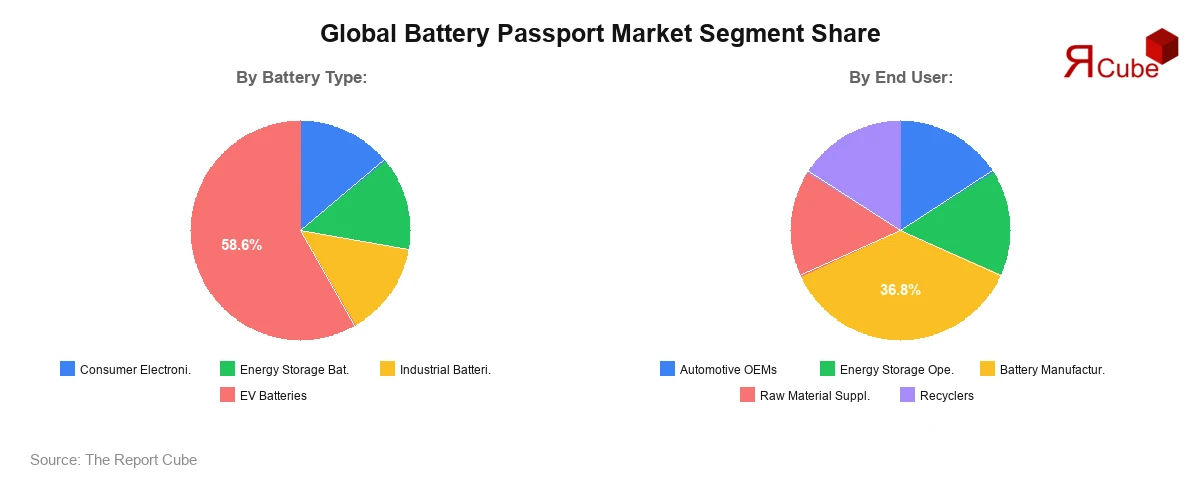
EV Batteries remain the leading battery type, accounting for approximately 58.6% of the Global Battery Passport Market. Accelerating electric vehicle production, rising battery manufacturing capacity, and increasingly stringent sustainability regulations are driving demand for comprehensive Battery Passport solutions. Every battery pack contains valuable lifecycle information that supports compliance, warranty management, second-life applications, and responsible recycling. Automotive manufacturers are integrating digital battery records into production workflows to improve traceability from raw material sourcing through vehicle deployment and end-of-life recovery.
Increasing investments in battery gigafactories, expanding EV charging infrastructure, and government support for low-carbon transportation continue to reinforce this segment's dominant position. As battery recycling and circular economy initiatives mature, demand for intelligent battery lifecycle management platforms is expected to grow alongside global electric vehicle production.
By End User:
- Automotive OEMs
- Energy Storage Operators
- Battery Manufacturers
- Raw Material Suppliers
- Recyclers
Battery Manufacturers accounted for nearly 36.8% of the Global Battery Passport Market, making them the largest end-user segment. Manufacturers are adopting comprehensive Battery Passport solutions to strengthen production traceability, improve supplier verification, automate sustainability reporting, and enhance product quality management. Digital battery records support complete visibility from raw material procurement through cell manufacturing, module assembly, distribution, operational use, and recycling. These capabilities help manufacturers comply with emerging international regulations while improving operational efficiency and reducing administrative complexity.
Rapid expansion of lithium-ion battery production for electric vehicles, renewable energy storage systems, and industrial applications continues to increase demand for advanced digital lifecycle management platforms. Strategic partnerships between battery manufacturers and software providers are expected to accelerate innovation and strengthen adoption across global production facilities.
Regional Projection of Global Battery Passport Market
- North America
- Europe
- Asia Pacific
- Middle East and Africa
- South America
Europe held the largest share of the Global Battery Passport Market, accounting for nearly 41.8% of global revenue in 2026. Regional leadership is supported by robust environmental legislation, rapid electric vehicle adoption, expanding battery manufacturing capacity, and a well-established digital innovation ecosystem. The implementation of the European Union Battery Regulation has accelerated investment in Battery Passport systems that improve traceability, verify carbon footprint data, document recycled content, and support responsible sourcing of critical minerals.
Automotive manufacturers, battery producers, software developers, and recycling companies are actively collaborating to establish interoperable digital platforms capable of securely exchanging battery information across international supply chains. Europe also benefits from strong public and private investment in battery gigafactories, recycling infrastructure, renewable energy storage projects, and circular economy initiatives. While Europe maintains market leadership, Asia Pacific is projected to register the fastest growth through expanding battery production, and North America continues strengthening domestic battery manufacturing and digital supply chain capabilities through significant industrial investments.
Need insights for a specific region within this market?
Request Regional DataRegional Analysis of Global Battery Passport Market
The battery passport market is expanding fast across all major regions on the back of regulatory push, EV penetration, and supply chain traceability needs.
| Region | Demand Level | Key Areas | System Dominance | Core Demand Logic | Growth Nature |
|---|---|---|---|---|---|
| North America | High | U.S., Canada | Digital passport & traceability SaaS | EV policies and ESG compliance | Policy-driven acceleration |
| Europe | Very High | Germany, France, Nordics | Regulation-led battery passports | EU Batteries Regulation mandates | Fastest regulatory-led growth |
| Asia Pacific | Very High | China, Japan, South Korea | OEM-integrated passport platforms | EV and cell manufacturing hubs | Volume-led rapid expansion |
| Middle East & Africa | Medium | GCC, South Africa | Mining-linked traceability tools | Critical minerals and exports | Resource-driven gradual growth |
| South America | Medium | Brazil, Chile, Argentina | Raw material tracking systems | Lithium and nickel value chains | Upstream-focused expansion |
Government Initiatives & Policies
- European Union Battery Regulation (Implementation Phase 2025-2026): The regulation introduces mandatory digital Battery Passports for selected industrial and electric vehicle batteries, promoting lifecycle transparency, carbon footprint disclosure, recycled content reporting, and responsible sourcing across the battery supply chain.
- Global Battery Alliance Battery Passport Initiative (2025-2026): The Global Battery Alliance continues expanding its Battery Passport framework with governments and industry partners to establish globally harmonized sustainability data standards, trusted digital information exchange, and improved battery traceability across international supply chains.
Global Battery Passport Industry Recent Developments
- 2026: CATL and the BMW Group entered into a memorandum of understanding to strengthen collaboration on Battery Passport implementation and carbon footprint reduction throughout the battery supply chain. The partnership focuses on cross-border battery data transfer pilots, standardized carbon footprint measurement methodologies, and secure information exchange through the Catena-X network to support compliance with emerging China and European Union battery regulations.
- 2025: Tata Elxsi and MineSpider launched MOBIUS+, a comprehensive battery lifecycle traceability solution designed to enable Digital Battery Passports. The platform combines blockchain-based supply chain transparency, carbon footprint management, lifecycle monitoring, and regulatory compliance capabilities to help manufacturers prepare for upcoming European Battery Passport requirements.
- 2025: Zenfinity Energy and Chargeup introduced India's first blockchain-enabled Battery Passport pilot covering approximately 3,000 batteries with a total storage capacity of 15 MWh across major cities. The initiative provides every battery with a unique digital identity capable of storing manufacturing information, operational history, battery health data, and lifecycle records using blockchain technology.
- 2025: ITC and the Global Battery Alliance (GBA) signed a partnership agreement to advance Battery Passport certification and sustainability standards. The collaboration focuses on building trusted digital infrastructure that enhances battery traceability, transparent data exchange, and implementation of globally recognized sustainability reporting frameworks.
Why Choose This Report?
- Provides a comprehensive overview of the overall market analysis, encompassing key trends, consumer behavior analysis, and risk assessment to support strategic decision-making.
- Provides accurate, up-to-date insights into market size, segmentation, and emerging opportunities, helping to minimize risk while capitalizing on growth.
- Gives deep understanding of target audience preferences, investment habits, and communication channels for enhanced product development and marketing effectiveness.
- Delivers competitive analysis and benchmarking, uncovering the strengths and weaknesses of market competitors to guide business strategies.
- Consolidates comprehensive market intelligence, reducing research effort and streamlining strategic planning.
- Facilitates customized market segmentation and risk mitigation strategies that align with business objectives.
- Aids in identifying both market challenges and untapped opportunities within the industry to drive long-term business growth.
- Provides valuable information based on actual customer data, industry trends, and search behavior.
Table of Contents
- Introduction
- Objective of the Study
- Product and Category Definition
- Market Segmentation
- Study Variables
- Research Methodology
- Secondary Data Points
- Breakdown of Secondary Sources
- Primary Data Points
- Breakdown of Primary Interviews
- Secondary Data Points
- Executive Summary
- Market Dynamics
- Emerging Opportunities
- Adoption Trends
- Demand Drivers
- Disruption Analysis (Challenges)
- Industry Analysis & Strategic Insights
- Supply/Value Chain Analysis
- Pricing Analysis
- Go-To-Market (GTM) Strategy
- BCG Matrix
- Recent Trends and Developments
- Import and Export Analysis
- Regulatory and Policy Landscape
- Region-wise policies
- Government Initiatives
- Global Battery Passport Market Overview and Forecast Analysis (2021-2034)
- Market Size, By Value, By Growth Rate (CAGR/USD Billion)
- Market Share, By Component
- Services
- Software
- Market Share, By Technology
- Cloud Computing
- Digital Identity Technologies
- AI & Analytics
- Blockchain
- IoT
- Market Share, By Deployment Mode
- Hybrid
- Cloud-Based
- On-Premise
- Market Share, By Battery Type
- Consumer Electronics Batteries
- Energy Storage Batteries
- Industrial Batteries
- EV Batteries
- Market Share, By End User
- Automotive OEMs
- Energy Storage Operators
- Battery Manufacturers
- Raw Material Suppliers
- Recyclers
- Market Share, By Region
- North America
- Europe
- Asia Pacific
- Middle East and Africa
- South America
- Market Share, By Company
- Revenue Shares & Analysis
- Competitive Landscape
- North America Battery Passport Market Overview and Forecast Analysis (2021-2034)
- Market Size, By Value, By Growth Rate (CAGR/USD Billion/Million)
- Market Share, By Component
- Market Share, By Technology
- Market Share, By Deployment Mode
- Market Share, By Battery Type
- Market Share, By End User
- Market Share, By Country
- United States
- Canada
- Mexico
- Rest of North America
- Europe Battery Passport Market Overview and Forecast Analysis (2021-2034)
- Market Size, By Value, By Growth Rate (CAGR/USD Billion/Million)
- Market Share, By Component
- Market Share, By Technology
- Market Share, By Deployment Mode
- Market Share, By Battery Type
- Market Share, By End User
- Market Share, By Country
- Germany
- United Kingdom
- France
- Italy
- Spain
- Netherlands
- Russia
- Poland
- Belgium
- Sweden
- Rest of Europe
- Asia Pacific Battery Passport Market Overview and Forecast Analysis (2021-2034)
- Market Size, By Value, By Growth Rate (CAGR/USD Billion/Million)
- Market Share, By Component
- Market Share, By Technology
- Market Share, By Deployment Mode
- Market Share, By Battery Type
- Market Share, By End User
- Market Share, By Country
- China
- India
- Japan
- South Korea
- Australia
- Indonesia
- Thailand
- Malaysia
- Vietnam
- Philippines
- Singapore
- New Zealand
- Rest of Asia-Pacific
- Middle East and Africa Battery Passport Market Overview and Forecast Analysis (2021-2034)
- Market Size, By Value, By Growth Rate (CAGR/USD Billion/Million)
- Market Share, By Component
- Market Share, By Technology
- Market Share, By Deployment Mode
- Market Share, By Battery Type
- Market Share, By End User
- Market Share, By Country
- Saudi Arabia
- United Arab Emirates
- South Africa
- Egypt
- Nigeria
- Morocco
- Turkey
- Rest of Middle East & Africa
- South America Battery Passport Market Overview and Forecast Analysis (2021-2034)
- Market Size, By Value, By Growth Rate (CAGR/USD Billion/Million)
- Market Share, By Component
- Market Share, By Technology
- Market Share, By Deployment Mode
- Market Share, By Battery Type
- Market Share, By End User
- Market Share, By Country
- Brazil
- Argentina
- Chile
- Colombia
- Peru
- Rest of South America
- Competitive Analysis, 2026
- Market Share of Key Players
- Competitive Mapping for Each Component, Technology, Deployment Mode, Battery Type, and End User
- North America Battery Passport Companies Share & Competitive Analysis, 2026
- Europe Battery Passport Companies Share & Competitive Analysis, 2026
- Asia Pacific Battery Passport Companies Share & Competitive Analysis, 2026
- Middle East and Africa Battery Passport Companies Share & Competitive Analysis, 2026
- South America Battery Passport Companies Share & Competitive Analysis, 2026
- Company Profile (Partial List)
- SAP
- Company Overview
- Product Portfolio
- Strategic Alliances/Partnerships
- Recent Developments
- Glassdome
- Company Overview
- Product Portfolio
- Strategic Alliances/Partnerships
- Recent Developments
- AVL
- Company Overview
- Product Portfolio
- Strategic Alliances/Partnerships
- Recent Developments
- MineSpider
- Company Overview
- Product Portfolio
- Strategic Alliances/Partnerships
- Recent Developments
- iPoint-systems
- Company Overview
- Product Portfolio
- Strategic Alliances/Partnerships
- Recent Developments
- TATA Elxsi
- Company Overview
- Product Portfolio
- Strategic Alliances/Partnerships
- Recent Developments
- Everledger
- Company Overview
- Product Portfolio
- Strategic Alliances/Partnerships
- Recent Developments
- OPTEL Group
- Company Overview
- Product Portfolio
- Strategic Alliances/Partnerships
- Recent Developments
- Circulor
- Company Overview
- Product Portfolio
- Strategic Alliances/Partnerships
- Recent Developments
- Siemens
- Company Overview
- Product Portfolio
- Strategic Alliances/Partnerships
- Recent Developments
- Others (Partial List)
- SAP
- Contact Us and Disclaimer
Top Key Players & Market Share Outlook
- SAP
- Glassdome
- AVL
- MineSpider
- iPoint-systems
- TATA Elxsi
- Everledger
- OPTEL Group
- Circulor
- Siemens
- Others
Frequently Asked Questions






