


Build Your Custom Market Intelligence Report
Customize Your ReportKey Highlights
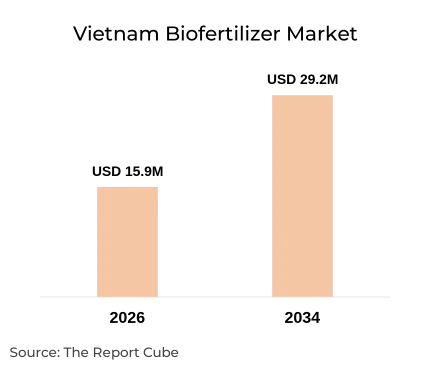
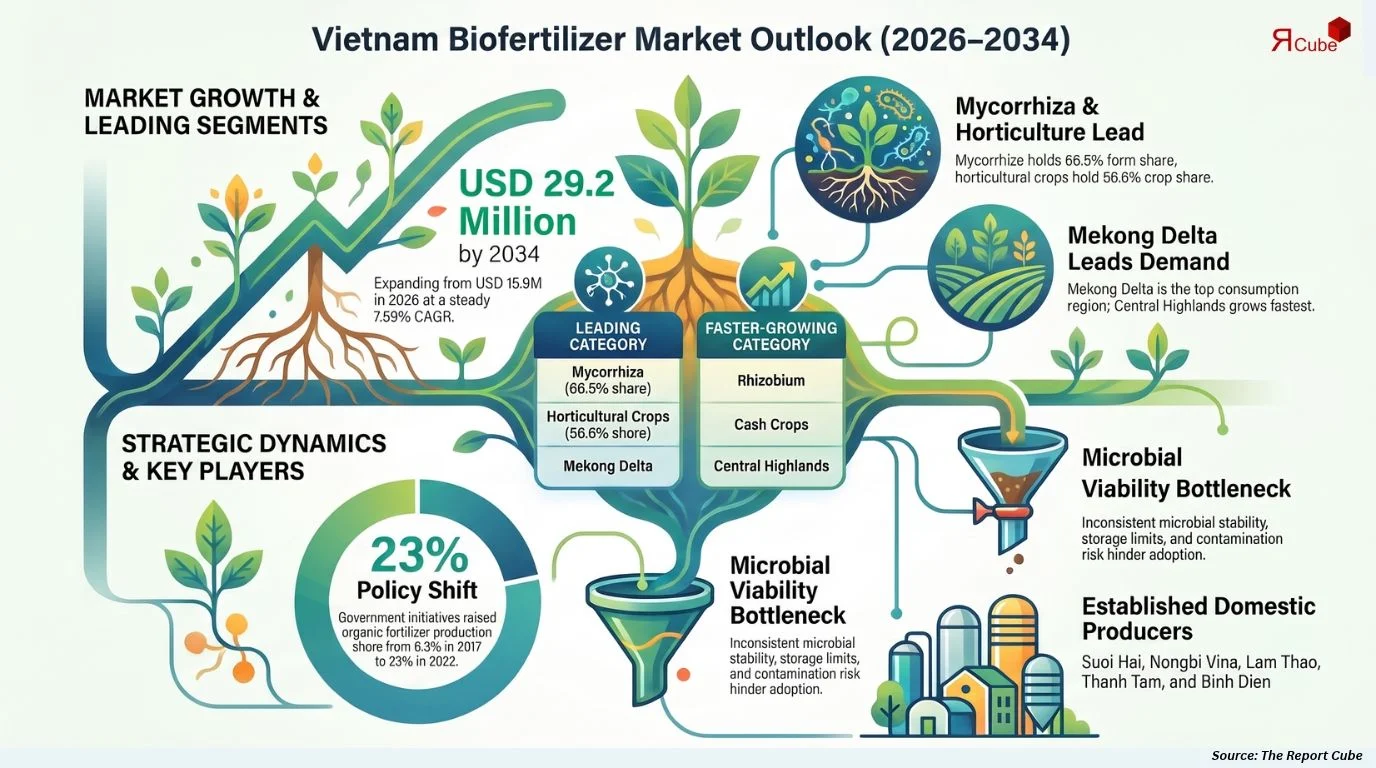
- The Vietnam Biofertilizer Market is estimated at USD 15.9 million in 2026, based on the supplied 2025 value of USD 14.7 million and the forecast growth rate.
- Market size is projected to reach USD 29.2 million by 2034.
- The market is expected to expand at a CAGR of approximately 7.89% during 2026–2034.
- By form, mycorrhiza led with a 66.5% share in 2025, while Rhizobium is identified as the faster-growing category.
- By crop type, horticultural crops led with a 56.6% share in 2025, while cash crops are identified as the faster-growing category.
- Mekong Delta is the leading identified consumption region, and the Central Highlands is the faster-growing region.
- Strategically, the Vietnam Biofertilizer Market is shifting from general organic fertilizer promotion to quality-assured, crop-specific microbial products, where viability, field evidence and distribution reach determine commercial success.
Market Outlook
Biofertilizers contain living microorganisms that improve nutrient availability, support biological nitrogen fixation, solubilize phosphorus and potassium, and strengthen root-soil interactions. In Vietnam, the market is developing alongside the shift towards sustainable agriculture, where soil health and nutrient efficiency are receiving growing attention from producers and policymakers.
Demand in the Vietnam Biofertilizer Market comes from rice, horticulture, plantation crops and export-oriented farming. Nitrogen-fixing organisms, phosphate-solubilizing bacteria, potassium-solubilizing microorganisms and mycorrhizal fungi form the core product base. Adoption depends on proven field performance, microbial stability, farmer awareness and distribution infrastructure, particularly outside commercial farms.
The market is valued at USD 15.9 million in 2026 and is forecast to reach USD 29.2 million by 2034, a CAGR of approximately 7.89%. Growth is supported by government encouragement of organic inputs and waste-based fertilizer raw materials. Competition spans established fertilizer manufacturers and specialized microbial producers, with crop-specific formulations and quality assurance shaping future direction.
Government Regulations
Fertilizer production, trading and quality in Vietnam are governed by Decree No. 84/2019/ND-CP, issued by the Government on 14 November 2019 and effective from 1 January 2020, and later amended, including by Decree No. 130/2022/ND-CP. The framework covers manufacturing conditions, product registration, quality management and commercialization, and is administered by the agriculture ministry and its Plant Protection Department. The Ministry of Agriculture and Rural Development also set an action plan for organic fertilizer production and consumption for 2022–2025, encouraging the use of agricultural and livestock waste as fertilizer inputs. The Plant Protection Department reported that organic fertilizers made up about 23% of total fertilizer production in 2022, compared with 6.3% in 2017. For biofertilizer producers, compliance with registration and quality-control requirements is essential because products contain living microorganisms, which raises testing, storage and labelling demands and favors well-resourced operators. These organic fertilizer figures describe the broader category and are not biofertilizer revenue.
Vietnam Biofertilizer Market Dynamics
Vietnam’s biofertilizer demand is shaped by the move towards sustainable agriculture, interest in soil health, official support for organic fertilizer production and expanding domestic manufacturing capability. At the same time, microbial product quality, farmer awareness and commercialization costs influence how quickly biofertilizers are adopted across agricultural regions.
|
Factor |
Type |
Specific Impact on Market |
Magnitude |
|---|---|---|---|
|
Government support for sustainable agriculture |
Driver |
Organic fertilizer action plans and waste-utilization policy build a supportive input ecosystem |
High |
|
Soil health and nutrient efficiency needs |
Driver |
High fertilizer use per hectare raises interest in microbial inputs that complement conventional products |
Medium–High |
|
Crop-specific microbial formulations |
Opportunity |
Differentiated products for rice, coffee, rubber, pepper and fruit improve adoption among commercial farmers |
Medium–High |
|
Product quality and microbial viability |
Challenge |
Storage, contamination and inconsistent concentrations reduce performance and farmer confidence |
High |
|
Circular agriculture and organic waste use |
Trend |
Waste processing linked with microbial manufacturing supports value-added inputs |
Medium |
Growth Drivers: Government Support for Sustainable Agricultural Inputs
Vietnam has introduced measures to raise organic fertilizer production and use agricultural and livestock waste as raw material, including a 2022–2025 action plan. Organic fertilizers rose from about 6.3% of total fertilizer production in 2017 to roughly 23% in 2022, according to the Plant Protection Department. This institutional momentum widens the base for microbial fertilizers and integrated biological nutrient-management products, even though organic and microbial fertilizers remain separate product categories.
Market Opportunities: Crop-Specific Microbial Fertilizer Development
Vietnam’s regions differ in soils, crops and nutrient needs, creating room for formulations tailored to rice, coffee, rubber, pepper, cashew, vegetables and fruit. Ministry of Agriculture and Environment data show about 800 fertilizer production facilities in June 2025, indicating a manufacturing base that can support specialized microbial lines. Crop-specific products can improve differentiation, strengthen distributor partnerships and raise adoption among commercial growers. The reported organic fertilizer capacity of 4.7 million tonnes should not be read as biofertilizer capacity.
Industry Challenges: Product Quality and Microbial Viability
Biofertilizers depend on living organisms, so effectiveness is sensitive to fermentation conditions, formulation quality, temperature, moisture and contamination. Inconsistent microbial concentrations or poor storage can reduce results and weaken farmer trust, particularly where farmers are used to conventional fertilizers and need clear evidence of benefit. Manufacturers must invest in quality control, stability testing, suitable distribution and field demonstrations, all of which raise commercialization costs and favor producers with technical depth.
Need Specific Data, Let’s Customize the Report for You
Request CustomizationMarket Trends: Development of Specialized Microbial Formulations
Manufacturers are moving towards products that combine several beneficial organisms, such as nitrogen-fixing bacteria, phosphate-solubilizing microorganisms and mycorrhizal fungi, to improve nutrient availability and soil biological activity. Microbial consortia allow products to be matched to specific crops and soil conditions. Research institutions, including the Soils and Fertilizers Research Institute, have published work on soil amendments containing nitrogen-fixing, phosphate-solubilizing and potassium-solubilizing organisms, showing domestic technical capability behind this shift.
Vietnam Biofertilizer Market Segment Analysis
The Vietnam Biofertilizer Market is segmented by form, crop type, application method, formulation, distribution channel and region. Segment shares shown below are supplied 2025 estimates, and shares are displayed only for leading segments where supplied.
By Form / Microorganism
- Mycorrhiza
- Rhizobium
- Azotobacter
- Azospirillum
- Phosphate-solubilizing bacteria
- Others
Mycorrhiza leads the form segment with a 66% share in 2025. These fungal products form associations with plant roots and support nutrient uptake, particularly phosphorus, with applications in horticulture and plantation agriculture. Rhizobium is identified as the faster-growing form, linked to nitrogen fixation in soybean and other leguminous crops, though no verified ranking of second place is available. Azotobacter, Azospirillum, phosphate-solubilizing bacteria and other formulations serve nitrogen-fixation, cereal and phosphorus-availability needs, and their shares were not supplied.
By Crop Type
- Horticultural crops
- Cash crops
- Row crops
Horticultural crops lead the crop segment with a 56% share in 2025, covering vegetables, fruits, flowers and ornamentals. Demand reflects high-value production, the need for specialized nutrient management and sustainable cultivation practices. Cash crops, including coffee, rubber, tea, pepper and cashew, are identified as the faster-growing category, supported by export-oriented agriculture and soil-health management. Row crops such as rice, maize and soybean use biofertilizers for nitrogen fixation, phosphorus solubilization and root development, with no share supplied.
Vietnam Biofertilizer Market Regional Analysis
Regional demand in the Vietnam Biofertilizer Market follows crop patterns, with rice and fruit in the south, plantation crops in the highlands and mixed production in the north and centre. Regional market shares were not supplied or reliably verified, so none are shown.
|
Region |
Key Growth Factors |
Industry Trends |
|---|---|---|
|
Northern Vietnam |
Rice, vegetable, tea and fruit cultivation |
Interest in soil fertility and horticultural inputs |
|
Central Vietnam |
Cash crops, vegetables and regionally important crops |
Emerging commercial opportunity |
|
Southern Vietnam |
Horticulture, plantation agriculture and extensive cultivation |
Important consumption region |
|
Mekong Delta |
Rice, fruit and vegetable production |
Leading identified consumption region |
|
Central Highlands |
Coffee and pepper plantation agriculture |
Faster-growing identified region |
Mekong Delta is identified as the leading consumption region, and the Central Highlands as the faster-growing one, but numerical shares are unavailable from approved sources, and regional percentages from narrower product studies are not applied to this market definition.
Competitive Landscape
The Vietnam Biofertilizer Market includes established fertilizer manufacturers, specialized microbial producers and research organizations. Competition varies by manufacturing capacity, microbial research, product range, distribution reach and farmer relationships. No verified national market-share ranking of companies is available, so the table reflects general capability only.
|
Company |
Competitive Strength |
Primary Segment Served |
|---|---|---|
|
Suoi Hai Fertilizer |
Organic mineral microbial fertilizers including SH01, SH02 and VN3 |
Rice, potato and soybean applications |
|
Nongbi Vina |
Microbial fermentation and biological inputs from organic raw materials |
Specialized biological inputs |
|
Lam Thao Fertilizers |
Established manufacturer with organic microbial products and wide distribution |
Coffee, tea, vegetables and ornamentals |
|
Thanh Tam Fertilizer |
Organic and bio-organic products including VN-HUMIX |
Nutrient management |
|
Binh Dien Fertilizer |
Established brand and broad distribution network |
General agriculture |
Suoi Hai Fertilizer: Suoi Hai Fertilizer offers organic mineral microbial fertilizers, including SH01, SH02 and VN3, formulated for crops such as rice, potatoes and soybeans. Its portfolio shows direct participation in Vietnam’s microbial and organic fertilizer market. Its competitive position rests on crop-specific formulations; company-specific details should be confirmed against official company disclosures before publication.
Lam Thao Fertilizers: Lam Thao Fertilizers is an established Vietnamese fertilizer manufacturer with a broad agricultural portfolio. It offers organic microbial fertilizer products for coffee, tea, vegetables and ornamental plants. Its long-standing distribution network gives it a potential advantage in reaching farmers, though no verified market-share ranking is available. Company details should be confirmed against official disclosures.
Recent Developments and Updates
- June 2025: Data from the Ministry of Agriculture and Environment indicated about 800 fertilizer production facilities in Vietnam, with annual organic fertilizer capacity near 4.7 million tonnes, reflecting a manufacturing base that can support microbial product development.
- 2025: The 2022–2025 organic fertilizer action plan of the Ministry of Agriculture and Rural Development reached its closing year, shaping policy support for waste-based and biological inputs; its successor measures should be confirmed with official publications.
Vietnam Biofertilizer Market Future Outlook
The Vietnam Biofertilizer Market Forecast points to growth from USD 15.9 million in 2026 to USD 29.2 million by 2034, a CAGR of approximately 7.89%. Early years should benefit from wider product availability, official support for sustainable inputs and specialized microbial formulations. Mid-period growth is likely to focus on fermentation technology, differentiation and better distribution, with crop-specific products gaining ground towards 2034.
Competition is expected to centre on quality assurance, field-performance evidence and distribution partnerships, with established manufacturers and microbial specialists both investing. Key risks include inconsistent product quality, limited farmer awareness, regulatory compliance costs and price pressure. Actual growth will depend on farmer adoption and on manufacturers demonstrating measurable agronomic and economic benefits.
Vietnam Biofertilizer Market Report Coverage
This Vietnam Biofertilizer Market Report summarizes the supplied valuation, forecast, segmentation, regional framework and competitive ecosystem for the market.
|
Parameter |
Details |
|---|---|
|
Market Name |
Vietnam Biofertilizer Market |
|
Market Size (Base Year) |
USD 15.9 million (2026, derived estimate) |
|
Market Size (Forecast Year) |
USD 29.2 million (2034) |
|
CAGR |
Approximately 7.89% |
|
Base Year |
2026 |
|
Historical Period |
2021–2025 |
|
Forecast Period |
2026–2034 |
|
Geographic Scope |
Vietnam |
|
Segmentation |
By Form / Microorganism; By Crop Type; By Application Method; By Formulation; By Distribution Channel |
|
Regions Covered |
Northern Vietnam, Central Vietnam, Southern Vietnam, Mekong Delta, Central Highlands |
|
Key Companies |
Suoi Hai Fertilizer; Nongbi Vina; Lam Thao Fertilizers; Thanh Tam Fertilizer; Binh Dien Fertilizer |
|
Customization |
Available as per requirement |
Why Choose This Vietnam Biofertilizer Market Report?
- Presents the 2026 base value, 2034 forecast and CAGR with stated assumptions.
- Covers all supplied segments by form, crop, application, formulation and channel.
- Reviews drivers, challenges, trends and opportunities with government-sourced evidence.
- Provides regional context across five Vietnamese regions, with unsupplied shares disclosed.
- Profiles domestic fertilizer and microbial producers by capability and segment served.
- Highlights crop-specific formulations and circular-agriculture opportunities.
- Supports investment, product and distribution decisions with transparent data limitations.
Table of Contents
- Introduction
- Objective of the Study
- Product Definition
- Market Segmentation
- Study Variables
- Research Methodology
- Secondary Data Points
- Companies Interviewed
- Primary Data Points
- Breakdown of Primary Interviews
- Secondary Data Points
- Executive Summary
- Market Dynamics
- Drivers
- Challenges
- Opportunity Assessment
- Recent Trends and Developments
- Policy and Regulatory Landscape
- Vietnam Biofertilizer Market Overview and Forecast Analysis (2021-2034)
- Market Size, By Value, By Growth Rate (CAGR/USD Millions)
- Demand – Supply Trends
- Market Share, By Application Method
- Soil application
- Seed treatment
- Root dipping
- Fertigation
- In-furrow application
- Compost and organic matter enrichment
- Market Share, By Formulation
- Liquid biofertilizers
- Powder biofertilizers
- Granular biofertilizers
- Carrier-based microbial formulations
- Market Share, By Distribution Channel
- Agricultural input distributors
- Agricultural cooperatives
- Agrochemical retailers
- Direct sales to commercial farms
- Online agricultural platforms
- Market Share, By Region
- Northern Vietnam
- Central Vietnam
- Southern Vietnam
- Mekong Delta
- Central Highlands
- Market Share, By Competitors
- Competition Characteristics
- Revenue Shares
- Soil application Vietnam Biofertilizer Market Overview, 2021-2034F
- By Value (USD Million)
- By Formulation – Market Size & Forecast 2021-2034, USD Million
- Liquid biofertilizers
- Powder biofertilizers
- Granular biofertilizers
- Carrier-based microbial formulations
- Seed treatment Vietnam Biofertilizer Market Overview, 2021-2034F
- By Value (USD Million)
- By Formulation – Market Size & Forecast 2021-2034, USD Million
- Liquid biofertilizers
- Powder biofertilizers
- Granular biofertilizers
- Carrier-based microbial formulations
- Root dipping Vietnam Biofertilizer Market Overview, 2021-2034F
- By Value (USD Million)
- By Formulation – Market Size & Forecast 2021-2034, USD Million
- Liquid biofertilizers
- Powder biofertilizers
- Granular biofertilizers
- Carrier-based microbial formulations
- Fertigation Vietnam Biofertilizer Market Overview, 2021-2034F
- By Value (USD Million)
- By Formulation – Market Size & Forecast 2021-2034, USD Million
- Liquid biofertilizers
- Powder biofertilizers
- Granular biofertilizers
- Carrier-based microbial formulations
- In-furrow application Vietnam Biofertilizer Market Overview, 2021-2034F
- By Value (USD Million)
- By Formulation – Market Size & Forecast 2021-2034, USD Million
- Liquid biofertilizers
- Powder biofertilizers
- Granular biofertilizers
- Carrier-based microbial formulations
- Compost and organic matter enrichment Vietnam Biofertilizer Market Overview, 2021-2034F
- By Value (USD Million)
- By Formulation – Market Size & Forecast 2021-2034, USD Million
- Liquid biofertilizers
- Powder biofertilizers
- Granular biofertilizers
- Carrier-based microbial formulations
- Competitive Outlook (Company Profile – Partial List)
- Suoi Hai Fertilizer
- Company Overview
- Business Segments
- Strategic Alliances/Partnerships
- Recent Developments
- Nongbi Vina
- Company Overview
- Business Segments
- Strategic Alliances/Partnerships
- Recent Developments
- Lam Thao Fertilizers
- Company Overview
- Business Segments
- Strategic Alliances/Partnerships
- Recent Developments
- Thanh Tam Fertilizer
- Company Overview
- Business Segments
- Strategic Alliances/Partnerships
- Recent Developments
- Binh Dien Fertilizer
- Company Overview
- Business Segments
- Strategic Alliances/Partnerships
- Recent Developments
- Suoi Hai Fertilizer
- Contact Us & Disclaimer
Top Key Players & Market Share Outlook
- Suoi Hai Fertilizer
- Nongbi Vina
- Lam Thao Fertilizers
- Thanh Tam Fertilizer
- Binh Dien Fertilizer
Frequently Asked Questions