



Build Your Custom Market Intelligence Report
Customize Your ReportJapan Blockchain Supply Chain Market Key Highlights
By Component:
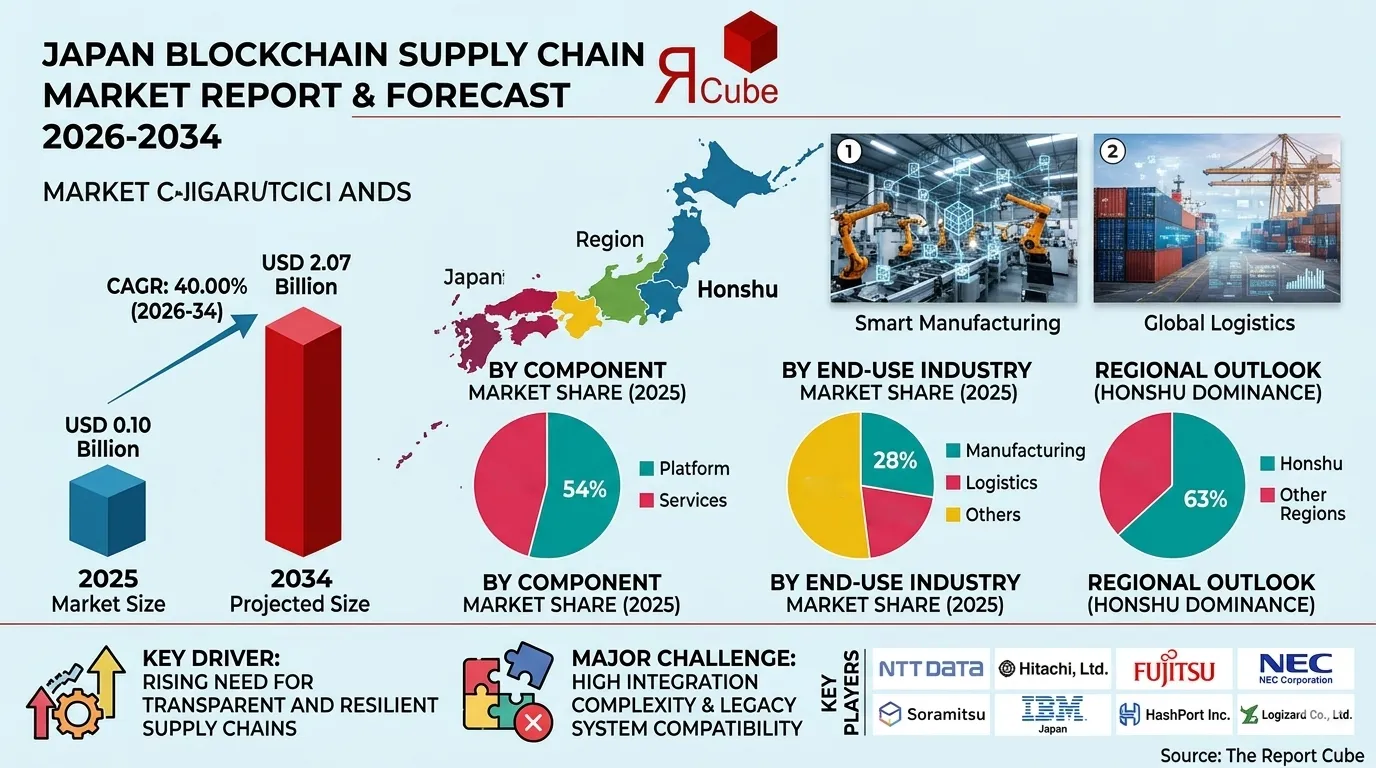
Platform segment leads the market, with around 54% share.
By End-use Industry:
Manufacturing segment dominates the market, accounting for nearly 28% of total revenue.
Regional Outlook:
Honshu region dominates the Japan blockchain supply chain market, with around 63% share.
Government Initiatives & Policies
- Japan Digital Agency Web3 and Blockchain Promotion Strategy (2025 Update): Supports enterprise blockchain adoption, digital identity infrastructure, and supply chain transparency initiatives.
- METI Green Growth Strategy & Digital Supply Chain Reform Program (2025 Roadmap): Encourages blockchain-based traceability and carbon accounting systems across manufacturing and logistics sectors.
Japan Blockchain Supply Chain Market Insights & Analysis
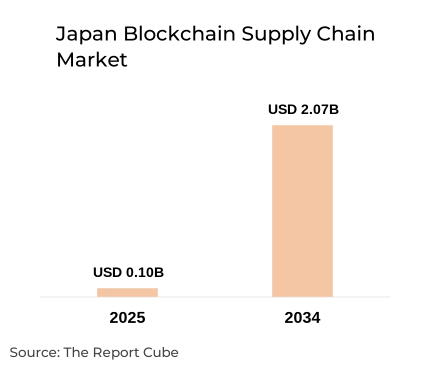
The Japan Blockchain Supply Chain Market is anticipated to register a 40.00% during 2026-34. The market size was valued at USD 0.10 billion in 2025 and is projected to reach USD 2.07 billion by 2034. Rapid digital transformation across Japan’s manufacturing, automotive, retail, and logistics sectors is accelerating blockchain integration to improve traceability, operational transparency, and supply chain resilience.
Japan’s supply chain ecosystem is among the most advanced globally, yet it faces persistent structural pressures including labor shortages, aging workforce demographics, and rising compliance requirements. By 2025, over 60% of large Japanese enterprises reported supply chain disruptions linked to geopolitical uncertainty and raw material price volatility. Blockchain platforms are emerging as a strategic infrastructure layer to ensure immutable data sharing across suppliers, manufacturers, distributors, and financial institutions. Enterprise pilots have moved from proof-of-concept to scaled deployments, particularly in automotive components tracking, food provenance monitoring, and pharmaceutical serialization.
The government’s push toward Web3 integration and carbon-neutral supply chains is further expanding use cases. Blockchain-enabled digital MRV (Monitoring, Reporting, and Verification) systems are supporting carbon credit validation, sustainable sourcing verification, and ESG reporting. Japanese conglomerates are embedding blockchain within IoT-enabled logistics systems, allowing real-time shipment authentication and automated compliance documentation. As digital transformation budgets expand, blockchain is increasingly viewed as foundational infrastructure rather than experimental technology.
Investment momentum is supported by Japan’s strong enterprise IT ecosystem, including major players such as NTT DATA, Hitachi, Ltd., Fujitsu Limited, NEC Corporation, IBM Japan, and Mitsubishi Corporation. Consortium blockchain networks are particularly prominent, aligning with Japan’s collaborative industrial culture. With rapid expansion expected across logistics, manufacturing, and trade finance applications, the market is positioned for exponential growth through 2034.
Japan Blockchain Supply Chain Market Dynamics
Key Driver: Rising Need for Transparent and Resilient Supply Chains
Japanese enterprises are prioritizing supply chain resilience following disruptions in semiconductors, energy imports, and logistics operations. Manufacturing accounts for nearly 20% of Japan’s GDP, making supply chain continuity a national economic priority. Blockchain enables tamper-proof transaction records, reducing fraud risks and improving supplier accountability. Automotive manufacturers are deploying blockchain to trace multi-tier suppliers, improving recall management efficiency by up to 30%. Food and beverage companies are leveraging provenance tracking to meet strict safety regulations and enhance consumer trust. Trade finance digitization is another growth lever, as blockchain reduces documentation processing time from days to hours. These operational improvements directly contribute to enterprise-level ROI, accelerating adoption rates.
Book your FREE 30-minute expert consultation today
Contact UsIndustry Trends: Integration of AI, IoT, and Consortium Blockchain Networks
Blockchain platforms are increasingly integrated with AI-driven analytics and IoT-based asset monitoring. Smart sensors capture shipment conditions, while blockchain secures the data trail, ensuring authenticity. Consortium blockchain models are gaining traction across Japan’s keiretsu-style industrial groups, where multiple stakeholders share infrastructure. Hybrid deployment modes are expanding as enterprises balance transparency with data confidentiality. Smart contracts are automating procurement, invoicing, and compliance reporting processes, reducing administrative overhead by an estimated 25-35%. Carbon credit tokenization and digital trade documentation are emerging as high-growth verticals, aligning with Japan’s decarbonization and digital trade ambitions.
Major Challenge: High Integration Complexity and Legacy System Compatibility
Japan’s enterprise IT landscape includes deeply embedded legacy ERP systems, making blockchain integration technically complex. Interoperability between different blockchain protocols remains limited, complicating cross-industry collaboration. Initial deployment costs and the need for specialized blockchain developers add to implementation barriers. Small and medium enterprises face resource constraints, limiting participation in large consortium networks. Regulatory clarity on digital asset classification and cross-border data governance is evolving, requiring continuous compliance adjustments. These structural challenges may slow adoption among mid-sized firms, though large enterprises continue scaling deployments.
Opportunity: Expansion of Carbon Credit Supply Chains and Digital Trade Finance
Japan’s 2050 carbon neutrality target is accelerating demand for blockchain-based carbon tracking systems. Digital MRV frameworks support accurate emissions accounting and tradable carbon credit validation. Trade finance modernization is another high-growth opportunity, as blockchain can reduce fraud risks and enhance cross-border payment transparency. Logistics providers are exploring decentralized documentation systems to streamline customs clearance. As Asia-Pacific trade corridors expand, Japan is positioned to become a regional hub for blockchain-enabled digital trade infrastructure, unlocking significant long-term growth potential.
Japan Blockchain Supply Chain Market Segment-wise Analysis
By Component:
- Platform
- Services (Integration and Deployment, Consulting, Support and Maintenance, Managed Services)
The platform segment holds approximately 54% market share in 2025, reflecting enterprise demand for proprietary blockchain infrastructure. Large corporations prefer in-house or consortium platforms that allow customization and integration with ERP and IoT systems. Platform investments are capital-intensive but provide scalable long-term value. Service components, including consulting and managed services, are growing rapidly as enterprises require technical expertise for deployment and optimization. However, platform dominance continues as enterprises seek ownership of critical supply chain data infrastructure.
By End-use Industry:
- Manufacturing
- Automotive
- Food and Beverages
- Pharmaceuticals and Healthcare
- Retail and E-commerce
- Logistics and Transportation
- Energy and Utilities
- Others
Manufacturing accounts for nearly 28% of total revenue, driven by Japan’s industrial base and global export orientation. Blockchain enables multi-tier supplier traceability and quality verification across complex production networks. Automotive manufacturers utilize smart contracts for supplier payments and compliance tracking. Pharmaceutical companies adopt blockchain for serialization and anti-counterfeit measures. Logistics and transportation segments are expanding rapidly as digital freight documentation reduces processing delays. Manufacturing’s structural importance ensures its continued leadership throughout the forecast period.
Regional Projection of Japan Blockchain Supply Chain Industry
- Hokkaido
- Honshu
- Shikoku
- Kyushu
Honshu dominates with approximately 63% market share due to concentration of industrial and corporate headquarters in Tokyo, Osaka, and Nagoya. Major automotive, electronics, and manufacturing clusters are located in this region, driving blockchain deployment. Kyushu follows with growing semiconductor and manufacturing investments. Hokkaido and Shikoku demonstrate emerging adoption, particularly in agriculture traceability and regional logistics modernization initiatives. Urban digital infrastructure maturity in Honshu continues to anchor market leadership.
Japan Blockchain Supply Chain Market Recent Developments
- 2025: Fujitsu Limited launched an open joint transportation and delivery platform leveraging blockchain-based data sharing to improve cross-company logistics efficiency and enhance sustainable domestic supply chain coordination.
- 2025: Hitachi, Ltd. partnered with Kirin Holdings to develop digital MRV systems and unalterable databases supporting verified forest-based carbon credit supply chains.
- 2025: NEC Corporation introduced an Automated Negotiation AI Agent Service optimizing procurement terms and strengthening resilient, data-driven supply chain operations across enterprises.
- 2025: IBM Japan launched ‘Supply Chain Ensemble,’ integrating AI and blockchain-enabled real-time supply chain optimization to enhance inventory efficiency and resilience.
Need insights for a specific region within this market?
Request Regional DataWhy Choose This Report?
- Provides a comprehensive overview of the overall market analysis, encompassing key trends, consumer behavior analysis, and risk assessment to support strategic decision-making.
- Provides accurate, up-to-date insights into market size, segmentation, and emerging opportunities, helping to minimize risk & capitalizing on growth.
- Gives deep understanding of target audience preferences, investment habits, and communication channels for enhanced product development & marketing effectiveness.
- Delivers competitive analysis & benchmarking, uncovering the strengths & weaknesses of market competitors to guide strategies.
- Consolidate comprehensive market intelligence, reducing reasoning & streamlining research efforts.
- Facilitates customized market segmentation & risk mitigation strategies, fine-tuned to the business objectives.
- Aids in identifying both market challenges & untapped opportunities within the industry to drive long-term business growth.
- Provides valuable information based on actual customer data & search trends.
Table of Contents
- Introduction
- Objective of the Study
- Product and Category Definition
- Market Segmentation
- Study Variables
- Research Methodology
- Secondary Data Points
- Breakdown of Secondary Sources
- Primary Data Points
- Breakdown of Primary Interviews
- Secondary Data Points
- Executive Summary
- Market Dynamics
- Drivers
- Challenges
- Opportunity Assessment
- Recent Trends and Developments
- Regulatory and Policy Landscape
- Japan Blockchain Supply Chain Market Overview (2021-2034)
- Market Size, By Value (USD Billion)
- Market Share, By Component
- Platform
- Services
- Integration and Deployment
- Consulting
- Support and Maintenance
- Managed Services
- Market Share, By Provider Type
- Application Providers
- Infrastructure Providers
- Middleware Providers
- Market Share, By Organization Size
- Small Enterprises
- Medium Enterprises
- Large Enterprises
- Market Share, By Deployment Mode
- Public Blockchain
- Private Blockchain
- Consortium Blockchain
- Hybrid Blockchain
- Market Share, By Application
- Provenance Tracking
- Smart Contracts
- Inventory Management
- Logistics and Transportation
- Trade Finance
- Compliance and Reporting
- Others
- Market Share, By End-use Industry
- Manufacturing
- Automotive
- Food and Beverages
- Pharmaceuticals and Healthcare
- Retail and E-commerce
- Logistics and Transportation
- Energy and Utilities
- Others
- Market Share, By Region
- Hokkaido
- Honshu
- Shikoku
- Kyushu
- Market Share, By Company
- Revenue Shares and Analysis
- Competitive Landscape
- Hokkaido Blockchain Supply Chain Market
- Market Size, By Value (USD Billion/Million)
- Market Share, By Component
- Market Share, By Provider Type
- Market Share, By Organization Size
- Market Share, By Deployment Mode
- Market Share, By Application
- Market Share, By End-use Industry
- Honshu Blockchain Supply Chain Market
- Market Size, By Value (USD Billion/Million)
- Market Share, By Component
- Market Share, By Provider Type
- Market Share, By Organization Size
- Market Share, By Deployment Mode
- Market Share, By Application
- Market Share, By End-use Industry
- Shikoku Blockchain Supply Chain Market
- Market Size, By Value (USD Billion/Million)
- Market Share, By Component
- Market Share, By Provider Type
- Market Share, By Organization Size
- Market Share, By Deployment Mode
- Market Share, By Application
- Market Share, By End-use Industry
- Kyushu Blockchain Supply Chain Market
- Market Size, By Value (USD Billion/Million)
- Market Share, By Component
- Market Share, By Provider Type
- Market Share, By Organization Size
- Market Share, By Deployment Mode
- Market Share, By Application
- Market Share, By End-use Industry
- Competitive Outlook and Company Profiles
- NTT DATA
- Company Overview
- Product Portfolio
- Strategic Alliances/Partnerships
- Recent Developments
- Hitachi, Ltd.
- Company Overview
- Product Portfolio
- Strategic Alliances/Partnerships
- Recent Developments
- Fujitsu Limited
- Company Overview
- Product Portfolio
- Strategic Alliances/Partnerships
- Recent Developments
- NEC Corporation
- Company Overview
- Product Portfolio
- Strategic Alliances/Partnerships
- Recent Developments
- Soramitsu
- Company Overview
- Product Portfolio
- Strategic Alliances/Partnerships
- Recent Developments
- IBM Japan
- Company Overview
- Product Portfolio
- Strategic Alliances/Partnerships
- Recent Developments
- HashPort Inc.
- Company Overview
- Product Portfolio
- Strategic Alliances/Partnerships
- Recent Developments
- Logizard Co., Ltd.
- Company Overview
- Product Portfolio
- Strategic Alliances/Partnerships
- Recent Developments
- Zenport Inc.
- Company Overview
- Product Portfolio
- Strategic Alliances/Partnerships
- Recent Developments
- Datachain
- Company Overview
- Product Portfolio
- Strategic Alliances/Partnerships
- Recent Developments
- Curvegrid
- Company Overview
- Product Portfolio
- Strategic Alliances/Partnerships
- Recent Developments
- Chaintope
- Company Overview
- Product Portfolio
- Strategic Alliances/Partnerships
- Recent Developments
- Earlyworks
- Company Overview
- Product Portfolio
- Strategic Alliances/Partnerships
- Recent Developments
- SotaTek Japan
- Company Overview
- Product Portfolio
- Strategic Alliances/Partnerships
- Recent Developments
- DLT Labs Japan
- Company Overview
- Product Portfolio
- Strategic Alliances/Partnerships
- Recent Developments
- Mitsubishi Corporation
- Company Overview
- Product Portfolio
- Strategic Alliances/Partnerships
- Recent Developments
- Mitsui & Co.
- Company Overview
- Product Portfolio
- Strategic Alliances/Partnerships
- Recent Developments
- Others
- NTT DATA
- Contact Us and Disclaimer
Top Key Players & Market Share Outlook
- NTT DATA
- Hitachi, Ltd.
- Fujitsu Limited
- NEC Corporation
- Soramitsu
- IBM Japan
- HashPort Inc.
- Logizard Co., Ltd.
- Zenport Inc.
- Datachain
- Curvegrid
- Chaintope
- Earlyworks
- SotaTek Japan
- DLT Labs Japan
- Mitsubishi Corporation
- Mitsui & Co.
Frequently Asked Questions






