



Build Your Custom Market Intelligence Report
Customize Your ReportEgypt BNPL Market Insights & Analysis
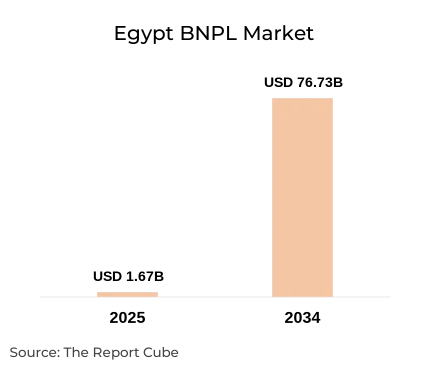
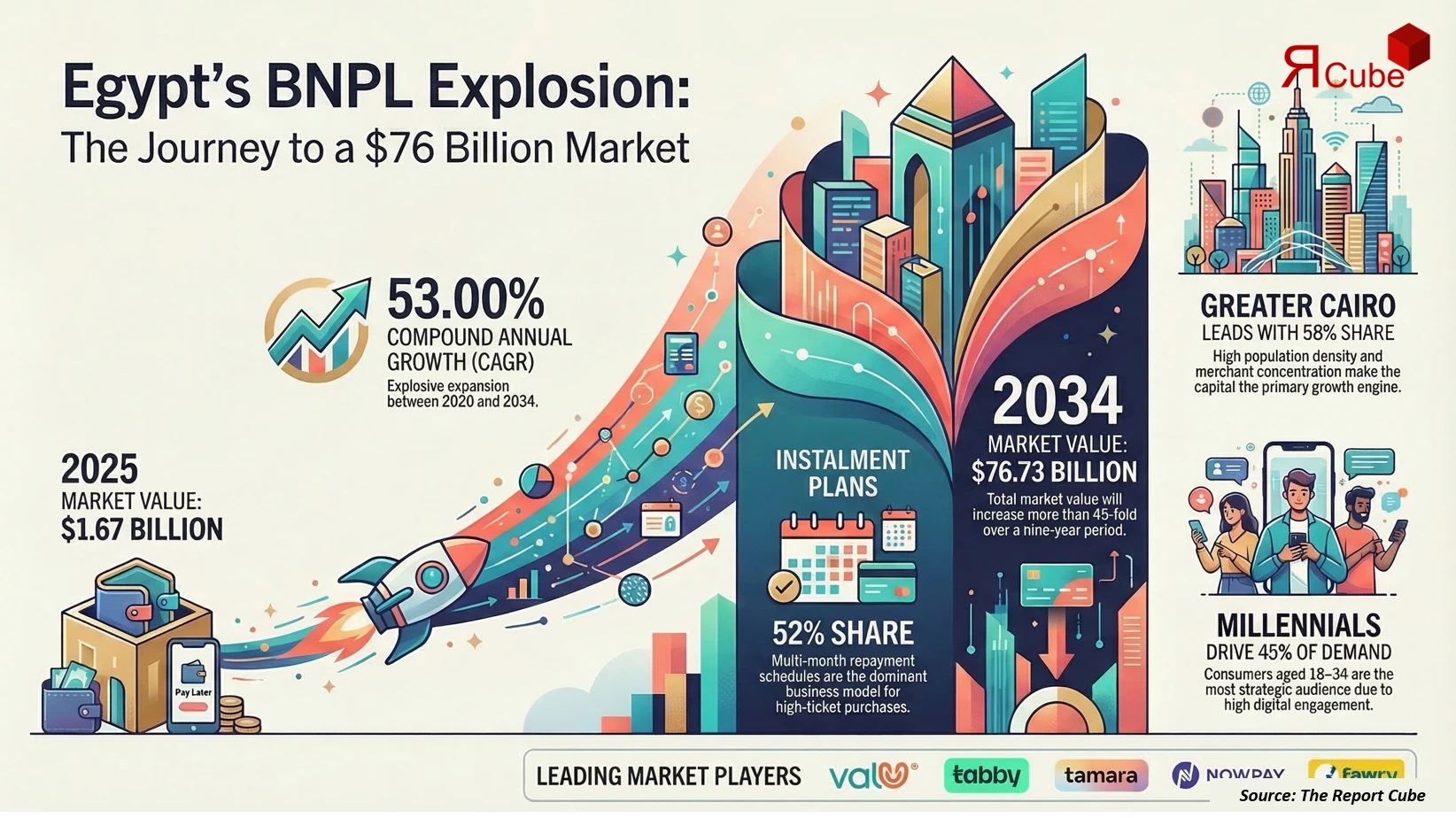
The Egypt BNPL Market is projected to grow at a 53.00% CAGR during 2026-2034. The market stood at USD 1.67 billion in 2025 and is expected to reach USD 76.73 billion by 2034. Rapid digitization of retail payments, expanding smartphone penetration, and growing consumer comfort with short-term credit are driving aggressive adoption. Merchants increasingly integrate BNPL at checkout to boost conversion, average order value, and repeat purchase rates. Local fintechs and bank-led instalment products compete with global BNPL brands to capture urban and youth segments. Strong e-commerce growth and a maturing payments infrastructure reduce friction for onboarding, while partnerships between acquirers, issuers and alternative-lending platforms accelerate nationwide scale. As awareness rises, regulatory attention and responsible-lending practices will shape long-term adoption and commercial models across financial and retail ecosystems.
Market structure shows a mix of merchant-funded short-term BNPL offers, card-linked pay-later products, and instalment financing. The Egypt BNPL Market combines consumer-facing apps, point-of-sale integrations and card-based installment features to serve both online and offline purchases. Banks and large PSPs increasingly white-label BNPL, while fintech startups focus on speed of underwriting and digital onboarding. Many merchants adopt BNPL as a marketing tool absorbing merchant fees to gain market share whereas subscription and loyalty models bundle BNPL to raise retention. The resulting ecosystem creates recurring revenue streams from merchant fees, interest on longer instalments, and value-added services like fraud protection and customer analytics. This multi-channel evolution positions BNPL as a mainstream payment option across retail, travel, healthcare, and education verticals.
Egypt BNPL Market Recent Developments
- 2025: Several fintechs expanded merchant networks, adding thousands of SME points-of-sale and ramping BNPL acceptance across fashion and electronics categories.
- 2025: Major banks piloted card-linked pay-later programs integrated with existing debit and credit portfolios for broader consumer reach.
Government Initiatives & Policies
- Central Bank Financial Inclusion Programs: Initiatives supporting digital onboarding, e-KYC, and SME payments help broaden BNPL reach while improving consumer protection frameworks.
- Consumer Credit Guidance & Supervision: Regulatory focus on responsible lending, transparent fee disclosure, and dispute resolution is shaping BNPL product design and marketing practices.
Egypt BNPL Market Dynamics
Driver: Rapid E-commerce Growth, Youth Demand & Low Credit-Card Penetration
One dominant driver of the Egypt BNPL market is the combination of booming e-commerce and low penetration of traditional unsecured consumer credit. Young, digitally native consumers particularly Millennials and Gen Z prefer flexible payment options that let them manage cashflow without formal credit applications. BNPL fits naturally at online checkout and increasingly at physical retail counters through QR codes and POS integrations. For merchants, BNPL reduces cart abandonment and increases order sizes by as much as 20–40% in many categories, creating strong commercial incentives to offer pay-later choices. Payment acquirers, telcos, and fintechs partner to accelerate merchant acceptance, while layered risk-scoring models using alternative data enable quick approvals and low friction for first-time users. This synergy of demand, merchant economics and digital enablement underpins fast market expansion.
Challenge: Responsible Lending, Fraud Risk & Regulatory Uncertainty
Rapid growth brings challenges: BNPL providers must manage borrower over-indebtedness, prevent fraud, and operate amid evolving regulatory expectations. Limited credit bureau coverage and informal income patterns in Egypt complicate credit assessment, increasing default risk for longer-term instalments. Fraudsters may exploit weak KYC or synthetic identity channels, raising loss provisions. Meanwhile regulators are prioritizing consumer protection, requiring clearer disclosures, fair collection practices, and interoperable complaints mechanisms. Firms must invest in robust underwriting, real-time fraud detection, and transparent pricing to maintain trust and avoid regulatory penalties. Balancing growth with prudential risk management is critical to ensure sustainable scaling of BNPL services nationwide.
Opportunity: Embedded Finance, Merchant Revenue Models & Financial Inclusion
BNPL offers significant opportunities to embed financing across retail and services travel bookings, private healthcare, home appliances, and education fees. By integrating BNPL into merchant loyalty, advertising, and POS financing programs, providers can monetise both transactional fees and value-added analytics. There is also a clear financial-inclusion angle: BNPL can extend credit access to thin-file customers when combined with alternative data and mobile-activity signals, supporting responsible credit building. Partnerships with micro-finance institutions and cooperatives can reach underbanked segments while keeping underwriting prudent. Successful players will combine merchant economics, risk innovation, and financial-education initiatives to convert trial users into sustainable, creditworthy customers.
Trend: Hybrid Business Models, Data-Driven Underwriting & Subscription BNPL
The market is evolving toward hybrid models that mix short-term merchant-funded BNPL with instalment plans and card-linked pay-later products. Advanced data-science underwriting, leveraging transaction, telecom and social signals, reduces reliance on formal credit history and improves approval rates. Subscription BNPL fixed monthly micro-credit access for loyal customers emerges as a retention tool, while merchants experiment with co-funded promos and capped interest plans. Additionally, insurers and payment networks increasingly partner with BNPL providers to offer loss-mitigation services and guarantee products, further professionalising the sector. These trends create pathways to diversified revenue and lower net credit risk for leading providers.
Egypt BNPL Market Segment-wise Analysis
By Business Model:
- Buy Now Pay Later – Short Term
- BNPL Installment Plans
- Pay Later Cards
- Others
BNPL Installment Plans represent the leading business-model segment with an estimated around 52% share. Installment plansranging from three to twelve months are popular for higher-ticket purchases such as electronics, appliances, and travel packages. These plans balance merchant conversion benefits with consumer affordability and are often co-funded or subsidised by merchants. Installment BNPL typically yields higher merchant adoption in categories where average order values exceed basic discretionary spend, and where retailers compete on financing options. Providers offering flexible repayment schedules, transparent fees, and seamless checkout integrations have achieved faster merchant traction, especially among national retail chains and online marketplaces.
By End-User:
- Millennial Consumers 18–34
- Gen Z Consumers
- Families & Households
- Others
Millennial Consumers (18–34) are the primary end-user segment with an estimated about 45% share. This group demonstrates high digital engagement, frequent online shopping behaviour, and strong propensity to finance discretionary purchases via BNPL for budgeting convenience. Millennials often act as early adopters for ecosystem features subscription BNPL, loyalty-linked financing, and app-based instalment planning forcing providers to invest in UX, gamified engagement, and seamless cross-channel experiences. Their volume, transaction frequency, and lifetime value potential make them the most strategic audience for growth-stage BNPL providers in Egypt.
Regional Projection of Egypt BNPL Industry
By Region:
- Greater Cairo
- Alexandria & Delta
- Upper Egypt
- Other Regions
Greater Cairo leads the market with an estimated approximately 58% share, reflecting its high concentration of digital consumers, dense merchant networks, and advanced payment infrastructure. Cairo’s population density, high smartphone penetration, and strong e-commerce penetration create ideal conditions for BNPL adoption. Major retailers, mall chains and online marketplaces pilot BNPL products here before rolling out nationally. Financial institutions and fintechs maintain large ops, customer-service centers, and merchant-integration teams in the region, making it the natural growth engine for BNPL scale-up across Egypt.
What Does Our Egypt BNPL Market Research Study Entail?
- Provides comprehensive market sizing and forecasting from 2026–2034, showing growth from USD 1.67 billion to USD 76.73 billion at a 53.00% CAGR with scenario analysis by regulation and fuel-cost shocks.
- Delivers segmentation insights across Business Models and End-Users, identifying high-opportunity pockets such as instalment BNPL and millennial buyer cohorts.
- Offers regional mapping across Greater Cairo, Alexandria & Delta, Upper Egypt, and other regions to prioritise merchant acquisition and operations investments.
- Presents competitive profiling of key players including ValU (E-Finance), Tabby (Egypt operations), Tamara (Egypt expansion), NowPay, Fawry (BNPL services), Bank ABC Egypt, CIB Egypt, QNB Alahli, BNP Paribas Egypt, and local fintech startups.
- Reviews regulatory considerations, responsible-lending frameworks, underwriting best practices, merchant partnership models, and go-to-market recommendations for providers, banks, and retailers.
Top Key Players
ValU (E-Finance), Hawally (MenaPay), Tabby (Egypt Operations), Tamara (Egypt Expansion), NowPay, Khaled (Egypt Operations), Fawry (BNPL Services), Bank ABC Egypt (Installment Solutions), CIB Egypt (Consumer Finance), QNB Alahli (Installment Cards), BNP Paribas Egypt (Consumer Lending), Local Fintech Startups, and Others.
Table of Contents
- Introduction
- Objective of the Study
- Product/Technology Definition
- Market Segmentation
- Study Variables
- Research Methodology
- Secondary Data Points
- Breakdown of Secondary Sources
- Primary Data Points
- Breakdown of Primary Interviews
- Secondary Data Points
- Executive Summary
- Market Dynamics
- Drivers
- Challenges
- Opportunity Assessment
- Recent Trends and Developments
- Policy and Regulatory Landscape
- Egypt BNPL Market Overview (2020–2034)
- Market Size, By Volume (Transactions) & Value (USD Million)
- Market Share, By Business Model
- Buy Now Pay Later (BNPL) - Short Term
- BNPL - Installment Plans
- Pay Later Cards
- Others
- Market Share, By End-User
- Millennial Consumers (18-34 years)
- Gen Z Consumers
- Families & Households
- Others
- Market Share, By Merchant Category
- Fashion & Apparel
- Electronics & Consumer Durables
- Travel & Ticketing
- Grocery & Daily Needs
- Healthcare & Pharmacy
- Others
- Market Share, By Region
- Greater Cairo
- Alexandria & Delta
- Upper Egypt
- Other Regions
- Market Share, By Company
- Revenue Shares
- Competitive Landscape
- Segment-wise & Industry-wise Market Forecast (2026–2034)
- By Business Model
- By End-User
- By Merchant Category
- By Region
- Regional Analysis (2020–2034)
- Greater Cairo BNPL Market
- Market Size, By Volume & Value (USD Million)
- Market Share, By Business Model
- Market Share, By Merchant Category
- Market Share, By Key Cities
- Alexandria & Delta BNPL Market
- Market Size, By Volume & Value (USD Million)
- Market Share, By Business Model
- Market Share, By Merchant Category
- Market Share, By Key Cities
- Upper Egypt BNPL Market
- Market Size, By Volume & Value (USD Million)
- Market Share, By Business Model
- Market Share, By Merchant Category
- Market Share, By Key Cities
- Other Regions BNPL Market
- Market Size, By Volume & Value (USD Million)
- Market Share, By Business Model
- Market Share, By Merchant Category
- Market Share, By Key Cities
- Competitive Outlook & Company Profiles
- ValU (E-Finance)
- Company Overview
- Business Segments
- Strategic Alliances/Partnerships
- Recent Developments
- Hawally (MenaPay)
- Company Overview
- Business Segments
- Strategic Alliances/Partnerships
- Recent Developments
- Tabby (Egypt Operations)
- Company Overview
- Business Segments
- Strategic Alliances/Partnerships
- Recent Developments
- Tamara (Egypt Expansion)
- Company Overview
- Business Segments
- Strategic Alliances/Partnerships
- Recent Developments
- NowPay
- Company Overview
- Business Segments
- Strategic Alliances/Partnerships
- Recent Developments
- Khaled (Egypt Operations)
- Company Overview
- Business Segments
- Strategic Alliances/Partnerships
- Recent Developments
- Fawry (BNPL Services)
- Company Overview
- Business Segments
- Strategic Alliances/Partnerships
- Recent Developments
- Bank ABC Egypt (Installment Solutions)
- Company Overview
- Business Segments
- Strategic Alliances/Partnerships
- Recent Developments
- CIB Egypt (Consumer Finance)
- Company Overview
- Business Segments
- Strategic Alliances/Partnerships
- Recent Developments
- QNB Alahli (Installment Cards)
- Company Overview
- Business Segments
- Strategic Alliances/Partnerships
- Recent Developments
- BNP Paribas Egypt (Consumer Lending)
- Company Overview
- Business Segments
- Strategic Alliances/Partnerships
- Recent Developments
- Local Fintech Startups
- Company Overview
- Business Segments
- Strategic Alliances/Partnerships
- Recent Developments
- ValU (E-Finance)
- Contact Us / Disclaimer
"
Top Key Players & Market Share Outlook
-
ValU
-
Tabby (Egypt)
-
Tamara (Egypt)
-
NowPay
-
Fawry
-
Bank ABC Egypt
-
CIB Egypt
-
QNB Alahli
-
BNP Paribas Egypt
Frequently Asked Questions






