


Build Your Custom Market Intelligence Report
Customize Your ReportKey Takeaways
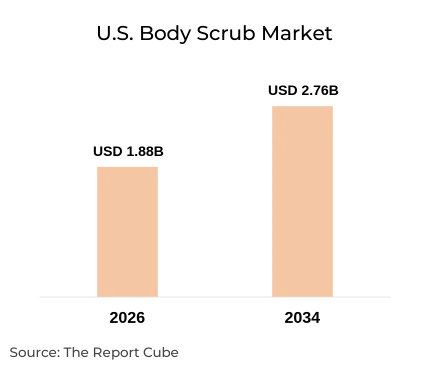
- U.S. body scrub market is valued at USD 1.88 billion in 2026.
- Market is projected to reach USD 2.76 billion by 2034 at a 4.90% CAGR.
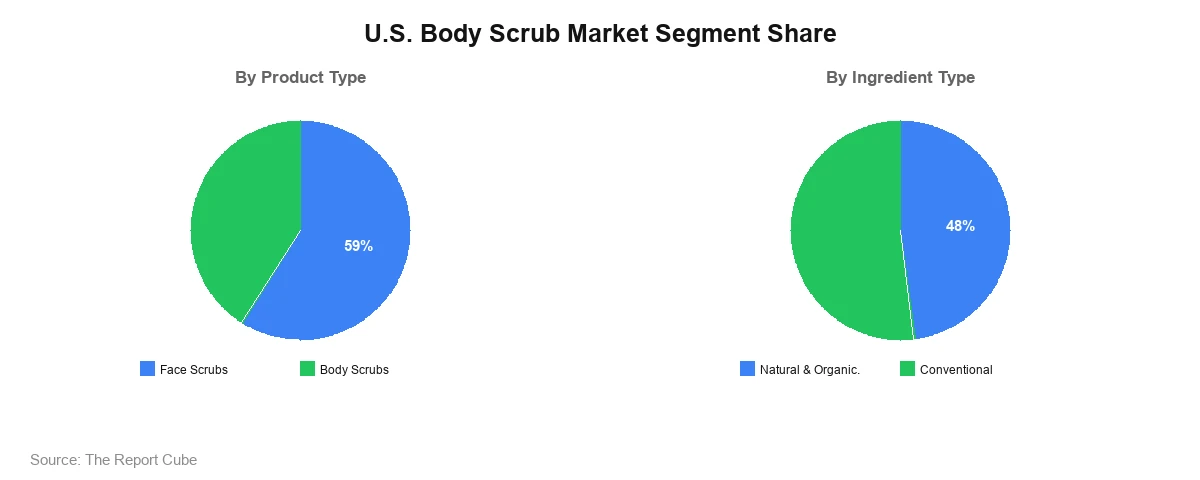
- Face scrubs lead the product type segment with an estimated 59% share in 2026.
- Natural and organic products lead the ingredient type segment with an estimated 48% share.
- North is the leading region with an estimated 31% share in 2026.
- Tree Hut, Dove, Dr Teal’s, Sol de Janeiro, Olay and Neutrogena are among the key players.
- Ingredient-focused and multifunctional formulations are shaping product development.
Market Overview
Body scrubs are exfoliating personal-care products formulated with sugar, salt, ground botanicals, or other abrasive particles, usually blended with oils, butters, and humectants. Consumers apply them during bathing to remove dead surface cells, smooth rough texture, and prepare skin for moisturizers, with formats including jars, tubes, and bars sold across mass and premium price points.
The U.S. Body Scrub Market Analysis shows demand shaped by skincare routines, ingredient-led product development, retail accessibility, and digital shopping. The Census Bureau reported USD 340.2 billion in retail e-commerce sales in the second quarter of 2026, or 17.1% of total retail sales, which indicates broader online purchasing conditions rather than body-scrub-specific demand.
Consumers use these products to address rough texture and dullness, and to support routine body care, while brands compete through fragrance, natural ingredients, and multifunctional formulations. Digital channels also widen product discovery. The market is valued at USD 1.88 billion in 2026 and is projected to grow at a CAGR of 4.90% during 2026–2034.
U.S. Body Scrub Market Dynamics
The U.S. body scrub market is influenced by consumer skincare routines, product formulation, retail accessibility, and regulatory requirements. Demand is supported by the wider personal-care market and digital shopping adoption, while manufacturers must address cosmetic safety substantiation, ingredient transparency, and accurate product claims under applicable U.S. regulations.
|
Factor |
Type |
Specific Impact on Market |
Magnitude |
|---|---|---|---|
|
Skincare and exfoliation interest |
Driver |
Supports repeat use of scrubs for texture, dullness, and uneven skin appearance |
Medium–High |
|
Online retail expansion |
Driver |
Broadens product discovery, reviews, and price comparison across brands |
Medium |
|
Natural and organic formulations |
Opportunity |
Allows differentiation through naturally derived exfoliants and botanical oils |
Medium–High |
|
Cosmetic safety regulation (MoCRA) |
Challenge |
Adds registration, product listing, and safety substantiation requirements |
Medium |
|
Environmental and natural claims |
Challenge |
Requires accurate, qualified, and supported product claims |
Medium |
|
Ingredient-focused, multifunctional products |
Trend |
Combines exfoliation with moisturizing and skin-conditioning benefits |
High |
|
Targeted exfoliation |
Trend |
Positions products around specific skin concerns |
Medium |
U.S. Body Scrub Market Growth Drivers
Consumer attention to exfoliation and skin texture supports repeat use of scrubs within bathing routines. Products are positioned to address roughness, dullness, and uneven appearance, and multifunctional claims allow brands to combine exfoliation with moisturizing benefits. These attributes widen the range of use occasions and support steady category demand without relying on a single formulation type.
Online retail gives consumers wider access to scrub formulations, brands, reviews, and price comparisons. The U.S. Census Bureau reported retail e-commerce sales of USD 340.2 billion in the second quarter of 2026, up 12.2% from a year earlier. This is general retail evidence, and it supports U.S. Body Scrub Market Growth only indirectly through improved product access.
U.S. Body Scrub Market Opportunities
Natural and organic formulations give brands room to use naturally derived exfoliants, botanical ingredients, and skin-conditioning oils. Natural and organic products hold an estimated 48% share in 2026, indicating meaningful category presence, while brands can focus product development on ingredient transparency, substantiated claims, and differentiated scent and texture profiles.
Online distribution and direct-to-consumer models allow brands to use subscriptions, product education, and customer reviews to support discovery and repeat purchases. The Census Bureau’s second-quarter 2026 data shows e-commerce at 17.1% of total U.S. retail sales, providing context for digital expansion, although body scrub sales through online channels require separate validation.
U.S. Body Scrub Industry Challenges
Under the Modernization of Cosmetics Regulation Act, applicable manufacturers and processors must register facilities with the U.S. Food and Drug Administration and renew registrations every two years. Responsible persons must list marketed cosmetic products, update listings annually, and maintain records supporting adequate safety substantiation, which adds compliance workload and documentation requirements for brands and contract manufacturers.
Brands using terms such as natural, organic, sustainable, or eco-friendly must ensure that claims are accurate and supported. The Federal Trade Commission advises marketers against broad, unqualified environmental benefit claims and recommends clear, specific qualifications, which affects packaging, advertising, ingredient lists, and product-benefit communication for natural and organic scrub positioning.
Need Specific Data, Let’s Customize the Report for You
Request CustomizationU.S. Body Scrub Market Trends
Brands are developing scrubs that pair exfoliation with moisturizing and skin-conditioning ingredients, including botanical oils and naturally derived exfoliants. This direction reflects a shift from single-purpose exfoliation toward multifunctional body care, and it gives manufacturers a way to differentiate products within crowded mass and premium shelves. U.S. Body Scrub Market Trends increasingly reflect ingredient-led formulation.
Products are increasingly positioned around specific concerns such as roughness, dullness, uneven texture, clogged pores, and body breakouts. Targeted positioning supports differentiation through specialized formulations rather than general-purpose exfoliation alone, and it is relevant to a market scope that includes both face and body scrub formats across mass and premium offerings.
U.S. Body Scrub Market Segment Analysis
U.S. Body Scrub Market Share is distributed across product type, ingredient type, price tier, and distribution channel segments. Shares for 2026 are stated only for the leading segments where figures were supplied, and these estimates require validation before publication.
By Product Type
- Face Scrubs
- Body Scrubs
Face scrubs lead the segment with an estimated 59% share in 2026, a figure supplied for report structuring that requires validation given the body-scrub scope of the market. The lead is consistent with the cross-category use of exfoliating formulas and the extension of established body scrub brands such as Tree Hut into facial care through its Sugar Face Scrub line. Body scrubs follow, supported by shea- and sugar-based products in jar formats from brands including Tree Hut and Dr Teal’s, with consumers using them for rough texture and routine body care. Competition across both formats centers on fragrance, ingredient positioning, and targeted skin-concern claims.
By Ingredient Type
- Natural & Organic
- Conventional
Natural and organic products lead the segment with an estimated 48% share in 2026, driven by interest in naturally derived exfoliants, botanical oils, and ingredient transparency. Brands including Naturium and Tree Hut emphasize ingredient-focused positioning, although claims must remain accurate and supported under Federal Trade Commission guidance. Conventional formulations follow, supported by established mass-market brands such as Dove, Olay, and Neutrogena, where familiar formats, wide retail availability, and consistent performance continue to support demand. Natural and organic scrubs also align with multifunctional formulations in which exfoliation is combined with moisturizing oils and butters. Differences between the two segments depend largely on ingredient sourcing, claim substantiation, and price positioning.
Regional Analysis
The U.S. Body Scrub Market is assessed across West, Southwest, North, and Midwest. Only the North share was supplied.
|
Region |
Estimated Market Share |
Key Growth Factors |
Industry Trends |
|---|---|---|---|
|
West |
- |
Qualitative: large population centers and developed beauty retail |
Interest in ingredient-led and natural formulations |
|
Southwest |
- |
Qualitative: population growth and expanding retail access |
Mass-market and online purchasing |
|
North |
31% |
Dense retail networks, high population concentration, and multi-channel access |
Demand across mass, specialty, and online channels |
|
Midwest |
- |
Qualitative: broad mass-retail and supermarket coverage |
Value-oriented, widely available products |
North is modeled as the leading region with an estimated 31% share in 2026. Dense retail networks, high population concentration, and broad access to mass, specialty, and online channels are the qualitative factors typically associated with higher personal-care demand, although region-specific body scrub sales data requires further validation before publication.
West, Southwest, and Midwest shares were not supplied for this report and are not estimated here. Regional differences are expected to follow population size, income levels, retail format mix, climate-related skincare habits, and online shopping access, while federal cosmetic requirements under MoCRA apply nationally and state-level ingredient rules may differ.
Market Share & Competitive Landscape
The U.S. Body Scrub Market includes personal-care multinationals, body care specialists, and ingredient-focused skincare brands. The table summarizes the supplied companies by general capability and segment. It does not represent numerical market share, and company-level shares require validation.
|
Company |
Competitive Strength |
Primary Segment Served |
|---|---|---|
|
Tree Hut |
Shea sugar body scrubs with an extension into face scrubs |
Mass market body and face scrubs |
|
Dove |
Large personal-care brand within a multinational portfolio |
Mass market body care and exfoliation |
|
Dr Teal’s |
Shea sugar and bath-focused body care products |
Mass market body scrubs |
|
First Aid Beauty |
Skincare brand with targeted body care products |
Premium body care |
|
Naturium |
Ingredient-focused skincare positioning |
Premium skincare and body care |
|
Native |
Personal care brand with body care offerings |
Natural-positioned personal care |
|
Sol de Janeiro |
Brazilian-inspired fragrance-led body care |
Premium and luxury body care |
|
Olay |
Skincare and body cleansing portfolio |
Mass market body care |
|
Neutrogena |
Skincare brand with exfoliating cleansing products |
Mass market face and body care |
|
Soap & Glory |
Body care and bath products with scrub ranges |
Mass market body care |
Key Companies in the U.S. Body Scrub Market
Tree Hut: Tree Hut is headquartered in Coppell, Texas, and was founded in March 2002 under parent Naterra. The brand is known for shea sugar body scrubs sold through retailers including Ulta Beauty and Walmart. In 2026 it launched a Jelly Soap collection at Ulta Beauty and entered Myntra in India.
Sol de Janeiro: Sol de Janeiro was founded in the United States in 2015; Paris-headquartered L’Occitane Group acquired 83% in 2021. It contributed 31.6% of group net sales of EUR 2.8 billion in the year to 31 March 2025. Its Brazilian-inspired body care range positions it in premium body care.
Recent Developments
|
Year / Month |
Company |
Development |
|---|---|---|
|
July 2025 |
L’Occitane Group (Sol de Janeiro) |
Reported net sales of EUR 2.8 billion for the year ended 31 March 2025, with Sol de Janeiro contributing 31.6%. |
|
March 2026 |
Tree Hut |
Announced launch on Myntra Beauty in India, expanding international distribution. |
|
June 2026 |
Tree Hut |
Debuted its Jelly Soap collection exclusively at Ulta Beauty (announced 30 June 2026). |
U.S. Body Scrub Market Future Outlook
The U.S. Body Scrub Market Forecast indicates growth from USD 1.88 billion in 2026 to USD 2.76 billion in 2034 at a CAGR of 4.90%. These values are supplied estimates rather than guaranteed outcomes, and they depend on stable consumer interest in exfoliation, continued retail availability, regulatory compliance, and the ability of manufacturers to introduce differentiated formulations at accessible price points.
Product development is expected to center on ingredient-focused formulations, multifunctional scrubs, and digital retail execution. Risks include MoCRA compliance workload, claim substantiation requirements under Federal Trade Commission guidance, price competition between mass and premium brands, and the need to maintain accurate product labeling. Actual outcomes will depend on consumer preferences, retailer assortment decisions, regulatory developments, and manufacturers’ investment in product differentiation.
U.S. Body Scrub Market Report Coverage
This U.S. Body Scrub Market Report summarizes the supplied valuation, forecast assumptions, segmentation, regional framework, and competitive ecosystem.
|
Parameter |
Details |
|---|---|
|
Market Name |
U.S. Body Scrub Market |
|
Market Size 2026 |
USD 1.88 billion |
|
Market Size 2034 |
USD 2.76 billion |
|
Forecast Period |
2026–2034 |
|
CAGR |
4.90% |
|
Base Year |
2026 |
|
Historical Years |
2021–2025 |
|
Forecast Years |
2026–2034 |
|
Segments Covered |
By Product Type; By Ingredient Type; By Price Tier; By Distribution Channel |
|
Regions Covered |
West, Southwest, North, Midwest |
|
Key Companies |
Tree Hut, Dove, Dr Teal’s, First Aid Beauty, Naturium, Native, Sol de Janeiro, Olay, Neutrogena, Soap & Glory |
|
Customization |
Available as per client requirements |
Why Choose This U.S. Body Scrub Market Report?
- Market coverage of body and face scrub products across mass and premium price tiers.
- Clear presentation of the 2026 valuation, 2034 forecast, and 4.90% CAGR.
- Segmentation across product type, ingredient type, price tier, and distribution channel.
- Regional framework covering West, Southwest, North, and Midwest.
- Competitive profiling of ten supplied personal-care and body care brands.
- Trend insights on ingredient-focused formulations, targeted exfoliation, and online retail.
- Context on MoCRA and Federal Trade Commission claim requirements relevant to product planning.
Table of Contents
- Introduction
- Objective of the Study
- Product Definition
- Market Segmentation
- Study Variables
- Research Methodology
- Secondary Data Points
- Companies Interviewed
- Primary Data Points
- Breakdown of Primary Interviews
- Secondary Data Points
- Executive Summary
- Market Dynamics
- Drivers
- Challenges
- Opportunity Assessment
- Recent Trends and Developments
- Policy and Regulatory Landscape
- U.S. Body Scrub Market Overview and Forecast Analysis (2021-2034)
- Market Size, By Value, By Growth Rate (CAGR/USD Billions)
- Demand – Supply Trends
- Market Share, By Product Type
- Face Scrubs
- Body Scrubs
- Market Share, By Ingredient Type
- Natural & Organic
- Conventional
- Market Share, By Price Tier
- Mass Market
- Premium & Luxury
- Market Share, By Distribution Chann
- Supermarkets & Hypermarkets
- Online / E-Commerce
- Market Share, By Region
- West
- Southwest
- North
- Midwest
- Market Share, By Competitors
- Competition Characteristics
- Revenue Shares
- Face Scrubs U.S. Body Scrub Market Overview, 2021-2034F
- By Value (USD Million)
- By Ingredient Type – Market Size & Forecast 2021-2034, USD Million
- Natural & Organic
- Conventional
- Body Scrubs U.S. Body Scrub Market Overview, 2021-2034F
- By Value (USD Million)
- By Ingredient Type – Market Size & Forecast 2021-2034, USD Million
- Natural & Organic
- Conventional
- Competitive Outlook (Company Profile – Partial List)
- Tree Hut
- Company Overview
- Business Segments
- Strategic Alliances/Partnerships
- Recent Developments
- Dove
- Company Overview
- Business Segments
- Strategic Alliances/Partnerships
- Recent Developments
- Dr Teal’s
- Company Overview
- Business Segments
- Strategic Alliances/Partnerships
- Recent Developments
- First Aid Beauty
- Company Overview
- Business Segments
- Strategic Alliances/Partnerships
- Recent Developments
- Naturium
- Company Overview
- Business Segments
- Strategic Alliances/Partnerships
- Recent Developments
- Native
- Company Overview
- Business Segments
- Strategic Alliances/Partnerships
- Recent Developments
- Sol de Janeiro
- Company Overview
- Business Segments
- Strategic Alliances/Partnerships
- Recent Developments
- Olay
- Company Overview
- Business Segments
- Strategic Alliances/Partnerships
- Recent Developments
- Neutrogena
- Company Overview
- Business Segments
- Strategic Alliances/Partnerships
- Recent Developments
- Soap & Glory
- Company Overview
- Business Segments
- Strategic Alliances/Partnerships
- Recent Developments
- Tree Hut
- Contact Us & Disclaimer
Top Key Players & Market Share Outlook
- Tree Hut
- Dove
- Dr Teal’s
- First Aid Beauty
- Naturium
- Native
- Sol de Janeiro
- Olay
- Neutrogena
- Soap & Glory
Frequently Asked Questions