



Build Your Custom Market Intelligence Report
Customize Your ReportUAE Cloud Services Market Key Highlights
By Deployment:
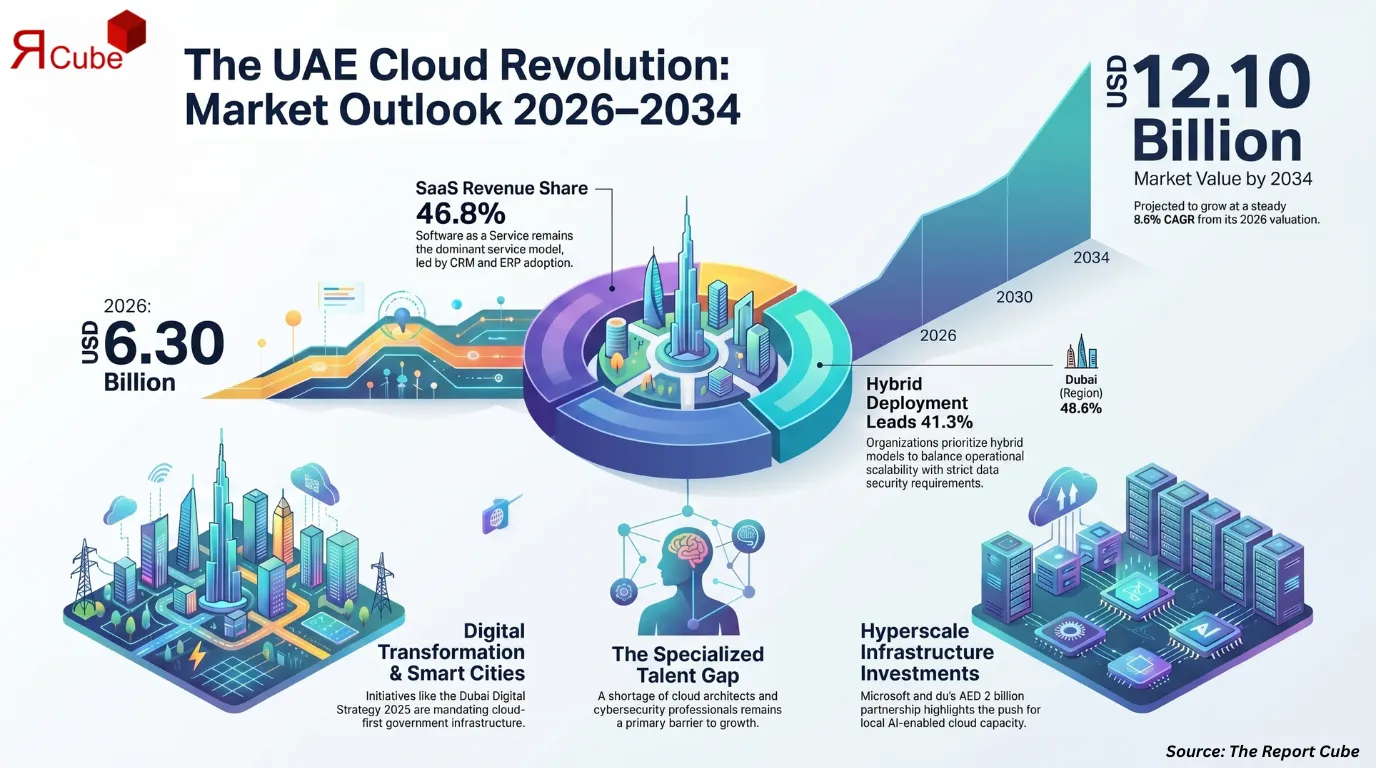
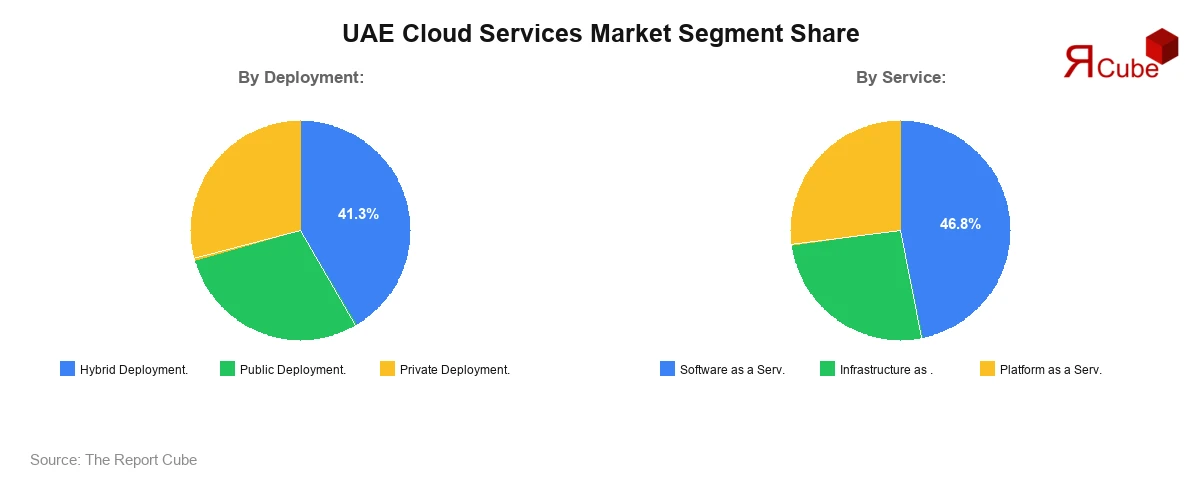
Hybrid Deployment segment leads the market with nearly 41.3% share.
By Service:
Software as a Service (SaaS) segment dominates the market with around 46.8% of total revenue.
Regional Outlook:
Dubai region dominates the UAE Cloud Services market with approximately 48.6% share.
UAE Cloud Services Market Insights & Analysis
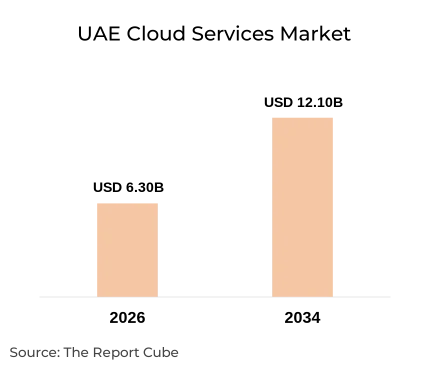
The UAE Cloud Services Market is anticipated to register a CAGR of around 8.5% during the forecast period 2026-2034. The market size is valued at USD 6.30 billion in 2026 and is projected to reach USD 12.10 billion by 2034. Strong national investments in digital infrastructure, smart governance, and artificial intelligence are creating favorable conditions for cloud platform adoption across the UAE. Enterprises are increasingly modernizing legacy IT systems to improve operational agility, cybersecurity resilience, and real-time data accessibility. Demand for cloud-native business applications, scalable storage infrastructure, and enterprise automation platforms is expanding rapidly across banking, healthcare, logistics, retail, and public administration sectors. The country’s focus on digital economy diversification and data-driven enterprise operations continues to strengthen long-term market expansion.
Technology providers are significantly increasing regional infrastructure investments to support rising demand for secure and low-latency cloud environments. Expansion of hyperscale data centers across Dubai and Abu Dhabi is enabling organizations to process critical workloads within national boundaries while improving compliance with data residency frameworks. Cloud-enabled AI applications, predictive analytics, and intelligent business management solutions are becoming central to enterprise transformation strategies. Large organizations are also increasing investments in disaster recovery services, multi-cloud architecture, and cybersecurity-focused cloud deployment models. Continuous innovation in cloud computing infrastructure and rising adoption of advanced digital services are expected to accelerate UAE cloud services market growth during the forecast period.
UAE Cloud Services Market Impact Analysis
| Factor | Type | Specific Impact on Market | Magnitude | Business Implication |
|---|---|---|---|---|
| Digital Transformation Initiatives | Market | Government smart city projects drive cloud adoption | High | Align solutions with Dubai Smart City and Vision 2030 |
| AI and IoT Integration Demand | Technological | Massive data from AI/IoT devices requires cloud scalability | High | Develop AI-enabled cloud services with edge capabilities |
| Data Sovereignty Requirements | Regulatory | Health and government data must stay within UAE borders | High | Establish local UAE data centers for compliance assurance |
| Cybersecurity Threat Escalation | Market | 32% rise in ransomware attacks heightens security concerns | High | Invest in advanced threat detection and compliance tools |
| National Cloud Security Policy | Regulatory | 2023 policy mandates strict provider security standards | High | Achieve policy certification to qualify for enterprise deals |
| BFSI Sector Cloud Adoption | Market | Banks demand scalable, secure cloud for digital banking | Medium | Tailor financial-grade SaaS and hybrid cloud offerings |
| 5G Deployment and Connectivity | Technological | 5G rollout accelerates edge computing and IoT workloads | Medium | Deploy edge cloud nodes to support low-latency services |
| SME Budget and Cyber Constraints | Consumer | SMEs face cost limits and lack advanced security resources | Medium | Offer affordable managed security and cloud starter packs |
| Data Center Infrastructure Growth | Market | $1B in new UAE data center investments by 2026 planned | Medium | Partner with local facility operators for regional presence |
| Public-Private Cloud Partnerships | Competitive | Government-backed cloud ecosystems favor local collaborators | Medium | Form alliances with UAE government and telecom providers |
UAE Cloud Services Market Dynamics
Key Driver: Accelerating Enterprise Digital Infrastructure Modernization Across the UAE
Organizations across the UAE are rapidly transitioning toward digitally connected operational ecosystems, creating sustained demand for cloud computing infrastructure and managed cloud services. Government entities, financial institutions, telecom providers, and healthcare operators are replacing traditional on-premise systems with scalable cloud environments to improve efficiency, business continuity, and service delivery capabilities. The increasing deployment of digital banking systems, telemedicine platforms, enterprise collaboration tools, and AI-powered customer engagement applications is strengthening cloud utilization across multiple industries. Businesses are also prioritizing cloud migration to reduce infrastructure complexity and improve scalability during periods of fluctuating operational demand.
National digital transformation initiatives are further accelerating enterprise cloud investments. The UAE’s commitment to smart city development, paperless government services, and artificial intelligence integration is encouraging organizations to expand cloud-based analytics, automation, and data management capabilities. Enterprises are increasingly selecting hybrid cloud models to maintain operational flexibility while ensuring regulatory compliance and data security. As cloud adoption matures across the country, investments in high-performance computing, secure hosting infrastructure, and cloud-native enterprise software are expected to continue expanding steadily.
Book your FREE 30-minute expert consultation today
Contact UsIndustry Trends: Strong Momentum Toward Sovereign Cloud and AI-Integrated Platforms
The UAE cloud services industry is witnessing a clear shift toward sovereign cloud infrastructure as organizations prioritize secure local data hosting and compliance-focused cloud operations. Public sector agencies, healthcare institutions, and financial organizations are increasingly demanding in-country cloud processing capabilities to align with evolving data governance frameworks. This transition is driving higher investments in regional data centers, secure cloud orchestration platforms, and advanced workload management solutions. Businesses are also adopting multi-cloud deployment strategies to improve operational resilience and reduce dependence on a single service provider.
Cloud platforms integrated with artificial intelligence and automation technologies are gaining rapid traction across enterprise environments. Companies are deploying AI-enabled analytics platforms, intelligent process automation tools, and cloud-based machine learning services to improve operational efficiency and customer engagement. Demand for scalable computing resources capable of supporting generative AI applications and real-time analytics is increasing significantly. In parallel, edge computing deployment is expanding across telecommunications, manufacturing, and logistics sectors where low-latency processing capabilities are becoming increasingly important for operational performance and connected infrastructure management.
Major Challenge: Limited Availability of Specialized Cloud and Cybersecurity Talent
The shortage of experienced cloud infrastructure professionals remains a significant challenge affecting the pace of digital transformation across the UAE. Demand for specialists in cloud architecture, cybersecurity management, AI operations, and enterprise automation continues to increase as organizations accelerate migration toward advanced cloud environments. However, the regional workforce pipeline remains comparatively limited in highly specialized technical roles. This imbalance is increasing recruitment competition among enterprises and raising operational costs associated with cloud deployment and infrastructure management.
Organizations are also facing difficulties in integrating complex cloud-native technologies with existing enterprise systems while maintaining security and compliance standards. Mid-sized businesses often depend heavily on managed service providers due to limited in-house technical expertise, which can increase long-term operational expenses. Although training initiatives launched by global technology companies are expected to strengthen workforce development over time, the pace of enterprise cloud adoption currently exceeds the availability of qualified professionals. Addressing this talent gap will remain essential for sustaining efficient cloud ecosystem expansion and supporting future AI-driven digital infrastructure projects.
Opportunity: Expanding Hyperscale Data Centers and Regional Digital Connectivity
The UAE is emerging as a major regional hub for hyperscale cloud infrastructure development, creating substantial growth opportunities for cloud service providers and enterprise technology vendors. Increasing investments in large-scale data centers are strengthening the country’s ability to support AI workloads, cloud-native applications, and enterprise digital operations across the Middle East. Strategic geographic positioning between Europe, Asia, and Africa also enhances the UAE’s importance as a regional connectivity and digital infrastructure center. These factors are attracting multinational enterprises seeking secure and low-latency cloud hosting capabilities.
Growing emphasis on localized data processing and digital sovereignty is expected to generate additional demand for advanced cloud hosting services and cybersecurity-focused infrastructure solutions. Industries including BFSI, healthcare, energy, and public administration are increasingly prioritizing cloud environments capable of meeting national compliance and operational resilience standards. Rising adoption of cloud-based analytics, intelligent enterprise management systems, and digital customer engagement platforms is also opening new revenue opportunities for SaaS, IaaS, and PaaS providers operating within the UAE market.
UAE Cloud Services Market Segment-wise Analysis
By Deployment:
- Hybrid Deployment
- Public Deployment
- Private Deployment
Hybrid Deployment continues to hold the leading share in the UAE cloud services market as enterprises increasingly seek flexible infrastructure models that combine scalability with enhanced data control. The segment accounts for approximately 41.3% of total market revenue due to strong adoption among government agencies, banking institutions, healthcare providers, and telecommunications companies. Organizations handling sensitive operational and customer information are prioritizing hybrid environments to maintain secure private infrastructure while benefiting from the scalability of public cloud platforms. The approach also supports business continuity, disaster recovery planning, and workload optimization across distributed enterprise environments.
Demand for hybrid cloud deployment is expanding alongside enterprise investments in AI applications, advanced analytics, and cloud-native software development. Companies are implementing integrated cloud management platforms to improve interoperability between private infrastructure and public cloud resources. Increasing cybersecurity awareness and evolving data residency requirements are further encouraging enterprises to adopt hybrid architectures capable of supporting both operational efficiency and compliance obligations. As organizations continue modernizing enterprise systems, hybrid deployment is expected to remain a preferred infrastructure strategy across the UAE.
By Service:
- Software as a Service (SaaS)
- Infrastructure as a Service (IaaS)
- Platform as a Service (PaaS)
Software as a Service (SaaS) represents the largest service segment within the UAE cloud services market, contributing nearly 46.8% of overall revenue. Enterprises are increasingly adopting subscription-based software platforms to improve operational flexibility, workforce collaboration, and digital service delivery. Customer relationship management systems, enterprise resource planning platforms, content management tools, and cloud-based productivity applications are witnessing substantial adoption across both public and private sectors. The demand for SaaS solutions is particularly strong among retail, BFSI, healthcare, and telecom organizations undergoing rapid digital transformation.
Cloud-based SaaS platforms are also benefiting from rising demand for AI-enabled automation, remote collaboration tools, and real-time business analytics capabilities. Organizations are prioritizing scalable software environments that reduce infrastructure maintenance costs while enabling continuous operational access across multiple locations. The integration of advanced cybersecurity features and compliance-focused functionalities within SaaS ecosystems is further supporting enterprise confidence in cloud-hosted software solutions. Continued expansion of digital commerce platforms and remote operational models is expected to sustain SaaS market growth across the UAE through 2034.
By End User:
- Manufacturing
- Healthcare and Life Sciences
- Retail and Consumer Goods
- Energy and Utilities
- Telecommunications
- IT and ITeS
- Media and Entertainment
- Government and Public Sector
- BFSI
- Other End Users
The BFSI sector represents one of the fastest-growing end-user segments in the UAE cloud services market due to rising digital banking adoption and increasing cybersecurity investments. Financial institutions are rapidly implementing cloud-based analytics, fraud detection systems, AI-powered customer support, and digital payment infrastructure to improve operational efficiency and customer experience. The sector contributes nearly 23.5% of overall cloud spending across the UAE as banks and insurance providers accelerate migration from legacy infrastructure to scalable cloud environments.
Regulatory focus on secure data management and disaster recovery capabilities is also encouraging financial institutions to adopt sovereign and hybrid cloud platforms. Demand for cloud-native fintech solutions, real-time transaction processing, and API-driven banking ecosystems continues to expand significantly. Growing digital wallet adoption and fintech startup activity across Dubai are expected to further strengthen cloud service demand within the BFSI segment.
Regional Projection of UAE Cloud Services Industry
- Dubai
- Abu Dhabi and Al Ain
- Sharjah and Northern Emirates
Dubai dominates the UAE cloud services market with nearly 48.6% market share supported by strong digital infrastructure development, high enterprise technology spending, and extensive hyperscale data center investments. The emirate has positioned itself as a regional technology and innovation hub, attracting global cloud providers, AI startups, fintech firms, and enterprise software vendors. Strong adoption of smart city technologies, connected government services, and digital commerce platforms continues to drive demand for scalable cloud infrastructure across Dubai’s public and private sectors.
The expansion of regional cloud zones and AI-enabled infrastructure facilities is strengthening Dubai’s role as a strategic cloud computing center within the Middle East. Financial institutions, healthcare providers, logistics companies, and retail enterprises are increasingly deploying cloud-based analytics, automation systems, and cybersecurity solutions to support digital operations. Ongoing investments in smart mobility, digital finance, and enterprise innovation ecosystems are expected to maintain strong demand for cloud services throughout the forecast period. Dubai’s favorable regulatory environment and international connectivity further support long-term market leadership within the UAE cloud computing industry.
Need insights for a specific region within this market?
Request Regional DataUAE Cloud Services Industry Regional Analysis
The UAE cloud services market varies significantly across regions due to diverse economic activity, government digital initiatives, and infrastructure concentration.
| Region | Demand Level | Key Areas | System Dominance | Core Demand Logic | Growth Nature |
|---|---|---|---|---|---|
| Dubai | Very High | DIFC, Media City, Internet City | Public & Hybrid Cloud | MNCs, startups & 1,924 new firms in 2025 | Hyperscale expansion hub |
| Abu Dhabi | Extremely High | Government sector, BFSI zone | Sovereign & Private Cloud | $3.54B digital strategy & 11M daily tasks | AI-native government 2027 |
| Al Ain | Medium | Strategic data center locations | IaaS & Colocation | 11 data centers across Abu Dhabi-Al Ain | Infrastructure backbone |
| Sharjah | High | SME clusters, industrial zones | SaaS & Public Cloud | SME digitalization & Smart Sharjah program | Cost-effective adoption |
| Northern Emirates | Medium | Fujairah, RAK, UAQ | SaaS & Managed Cloud | Expanding connectivity & government push | Emerging growth area |
Government Initiatives & Policies
- UAE National Artificial Intelligence Strategy 2031: The UAE government continues expanding AI and cloud integration initiatives to strengthen digital infrastructure, enterprise automation, and smart government services across multiple industries.
- Dubai Digital Strategy 2025: Dubai’s digital transformation policy promotes cloud-first government infrastructure, data-driven public services, and secure digital ecosystems to accelerate technology adoption across enterprises.
UAE Cloud Services Industry Recent Developments
- 2025: Microsoft Corporation partnered with du on a AED 2 billion hyperscale data center initiative in the UAE to strengthen AI-enabled cloud infrastructure and sovereign cloud capabilities. The project enhances local processing capacity for enterprise AI workloads while supporting the UAE’s broader ambition to become a regional cloud and artificial intelligence hub.
- 2025: Oracle Corporation announced a regional workforce development initiative targeting the training of 350,000 professionals in AI and digital technologies. The program aims to address growing cloud and data infrastructure talent requirements while supporting long-term enterprise digital transformation initiatives across the UAE and neighboring Gulf markets.
Why Choose This Report?
- Provides a comprehensive overview of the overall market analysis, encompassing key trends, consumer behavior analysis, and risk assessment to support strategic decision-making.
- Provides accurate, up-to-date insights into market size, segmentation, and emerging opportunities, helping to minimize risk & capitalizing on growth.
- Gives deep understanding of target audience preferences, investment habits, and communication channels for enhanced product development & marketing effectiveness.
- Delivers competitive analysis & benchmarking, uncovering the strengths & weaknesses of market competitors to guide strategies.
- Consolidate comprehensive market intelligence, reducing reasoning & streamlining research efforts.
- Facilitates customized market segmentation & risk mitigation strategies, fine-tuned to the business objectives.
- Aids in identifying both market challenges & untapped opportunities within the industry to drive long-term business growth.
- Provides valuable information based on actual customer data & search trends.
Table of Contents
- Introduction
- Objective of the Study
- Product and Category Definition
- Market Segmentation
- Study Variables
- Research Methodology
- Secondary Data Points
- Breakdown of Secondary Sources
- Primary Data Points
- Breakdown of Primary Interviews
- Secondary Data Points
- Executive Summary
- Market Dynamics
- Emerging Opportunities
- Adoption Trends
- Demand Drivers
- Disruption Analysis (Challenges)
- Industry Analysis and Strategic Insights
- Supply and Value Chain Analysis
- Pricing Analysis
- Go-To-Market Strategy
- BCG Matrix
- Recent Trends and Developments
- Regulatory and Policy Landscape
- Region-wise Policies
- Government Initiatives
- UAE Cloud Services Market Overview and Forecast Analysis (2021-2034)
- Market Size, By Value and Growth Rate (CAGR/USD Billion)
- Market Share, By Deployment
- Hybrid Deployment
- Public Deployment
- Private Deployment
- Market Share, By Service
- Software as a Service (SaaS)
- Supply Chain Management (SCM)
- Customer Relationship Management (CRM)
- Human Capital Management (HCM)
- Content Management
- Collaboration and Productivity Suites
- Enterprise Resource Management (ERM)
- Others
- Infrastructure as a Service (IaaS)
- Compute Services
- Archiving Services
- Primary Storage Services
- Disaster Recovery and Backup Services
- Platform as a Service (PaaS)
- Integration and Orchestration
- Data Management Platforms
- Analytics and Reporting Platforms
- Application Development Platforms
- Application Testing and Quality Platforms
- Software as a Service (SaaS)
- Market Share, By Organization Size
- Large Enterprises
- Small and Medium-sized Enterprises (SMEs)
- Market Share, By End User
- Manufacturing
- Healthcare and Life Sciences
- Retail and Consumer Goods
- Energy and Utilities
- Telecommunications
- IT and ITeS
- Media and Entertainment
- Government and Public Sector
- BFSI
- Other End Users
- Market Share, By Region
- Dubai
- Abu Dhabi and Al Ain
- Sharjah and Northern Emirates
- Market Share, By Company
- Revenue Shares and Analysis
- Competitive Landscape
- Dubai Cloud Services Market Overview and Forecast Analysis (2021-2034)
- Market Size, By Value and Growth Rate (CAGR/USD Billion)
- Market Share, By Deployment
- Market Share, By Service
- Market Share, By Organization Size
- Market Share, By End User
- Abu Dhabi and Al Ain Cloud Services Market Overview and Forecast Analysis (2021-2034)
- Market Size, By Value and Growth Rate (CAGR/USD Billion)
- Market Share, By Deployment
- Market Share, By Service
- Market Share, By Organization Size
- Market Share, By End User
- Sharjah and Northern Emirates Cloud Services Market Overview and Forecast Analysis (2021-2034)
- Market Size, By Value and Growth Rate (CAGR/USD Billion)
- Market Share, By Deployment
- Market Share, By Service
- Market Share, By Organization Size
- Market Share, By End User
- Competitive Analysis, 2026
- Market Share of Key Players
- Competitive Mapping for Each Segment and Companies Operating Regionally
- Dubai Cloud Services Companies Share and Competitive Analysis, 2026
- Abu Dhabi and Al Ain Cloud Services Companies Share and Competitive Analysis, 2026
- Sharjah and Northern Emirates Cloud Services Companies Share and Competitive Analysis, 2026
- Company Profiles (Partial List)
- IBM Corporation
- Company Overview
- Product Portfolio
- Strategic Alliances and Partnerships
- Recent Developments
- Google LLC
- Company Overview
- Product Portfolio
- Strategic Alliances and Partnerships
- Recent Developments
- Alibaba Cloud
- Company Overview
- Product Portfolio
- Strategic Alliances and Partnerships
- Recent Developments
- Etisalat
- Company Overview
- Product Portfolio
- Strategic Alliances and Partnerships
- Recent Developments
- Microsoft Corporation
- Company Overview
- Product Portfolio
- Strategic Alliances and Partnerships
- Recent Developments
- Salesforce, Inc.
- Company Overview
- Product Portfolio
- Strategic Alliances and Partnerships
- Recent Developments
- Adobe Inc.
- Company Overview
- Product Portfolio
- Strategic Alliances and Partnerships
- Recent Developments
- SAP SE
- Company Overview
- Product Portfolio
- Strategic Alliances and Partnerships
- Recent Developments
- Oracle Corporation
- Company Overview
- Product Portfolio
- Strategic Alliances and Partnerships
- Recent Developments
- Amazon Web Services, Inc.
- Company Overview
- Product Portfolio
- Strategic Alliances and Partnerships
- Recent Developments
- Others (Partial List)
- IBM Corporation
- Contact Us and Disclaimer
Top Key Players & Market Share Outlook
- IBM Corporation
- Google LLC
- Alibaba Cloud
- Etisalat
- Microsoft Corporation
- Salesforce, Inc.
- Adobe Inc.
- SAP SE
- Oracle Corporation
- Amazon Web Services, Inc.
Frequently Asked Questions






