



Build Your Custom Market Intelligence Report
Customize Your ReportUAE Cloud Computing Market Insights & Analysis
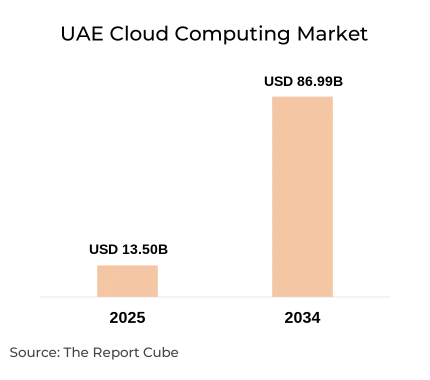
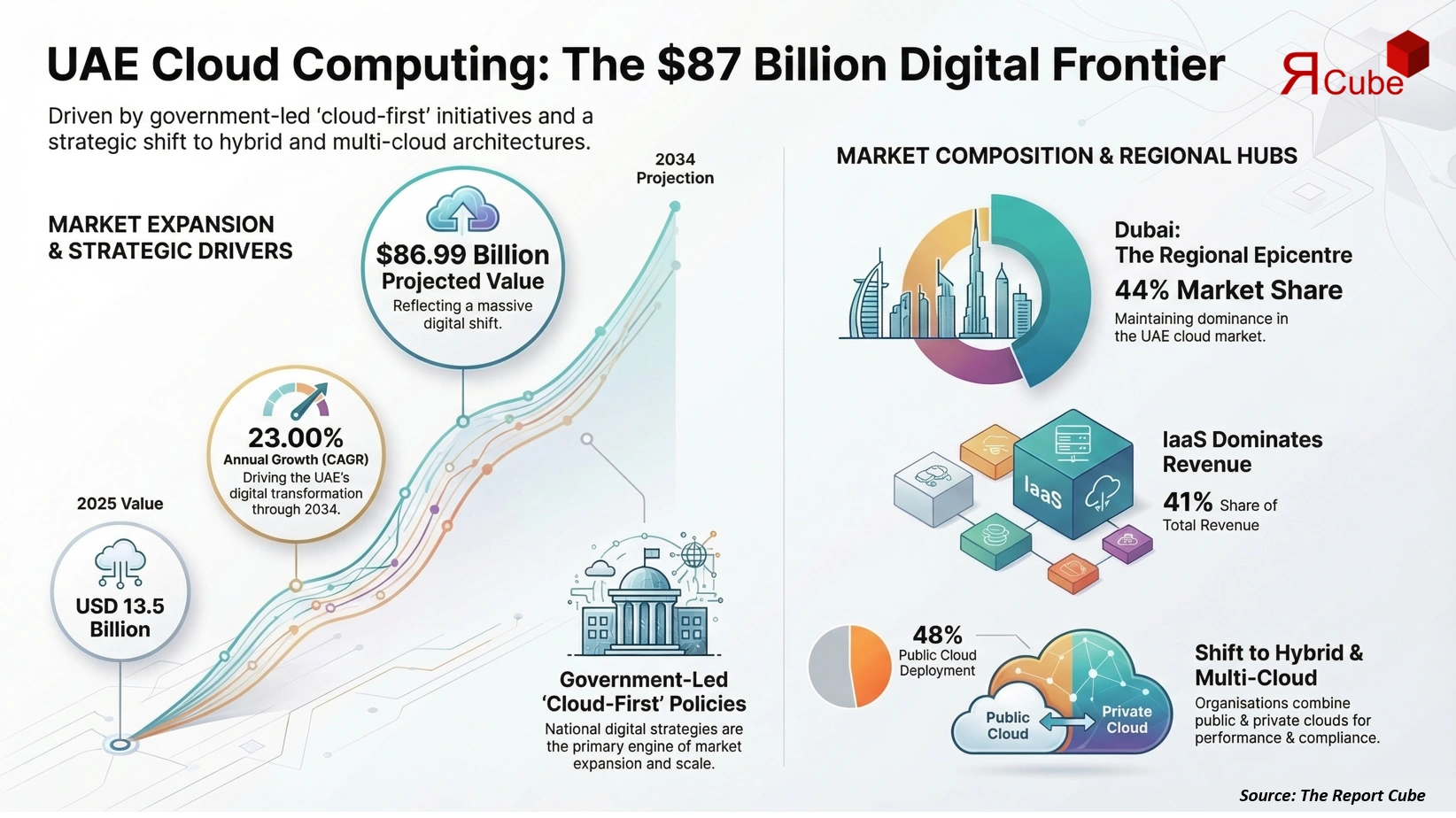
The UAE Cloud Computing Market is anticipated to register a CAGR of 23.00% during the forecast period 2026-2034. The market size was valued at USD 13.5 billion in 2025 and is projected to reach USD 86.99 billion by 2034. This exceptional growth trajectory reflects the UAE’s rapid digital transformation agenda, increasing enterprise cloud adoption, and strong government backing for smart infrastructure and data-driven economies.
The UAE has positioned itself as a regional digital hub, with cloud computing emerging as a foundational technology supporting artificial intelligence, fintech, e-commerce, smart cities, and e-government services. Enterprises across banking, healthcare, retail, logistics, and energy are migrating mission-critical workloads to the cloud to enhance scalability, resilience, and operational efficiency. At the same time, hyperscale cloud providers continue to expand local data center footprints, ensuring data sovereignty, lower latency, and regulatory compliance.
Furthermore, national strategies such as digital government platforms, cybersecurity frameworks, and innovation-driven economic diversification are accelerating cloud demand across public and private sectors. As organizations increasingly adopt hybrid and multi-cloud strategies to balance performance, security, and cost optimization, the UAE Cloud Computing Market is expected to remain one of the fastest-growing technology markets globally throughout the forecast period.
UAE Cloud Computing Market Recent Developments
- 2025: Microsoft expanded Azure cloud regions in the UAE to support AI workloads and government digital platforms.
- 2025: Amazon Web Services enhanced local data residency services for regulated industries across the UAE.
Government Initiatives & Policies
- UAE Digital Government Strategy 2025: Accelerates cloud-first adoption across federal and local government entities.
- National Cybersecurity Strategy: Strengthens secure cloud adoption and data protection frameworks nationwide.
UAE Cloud Computing Market Dynamics
Key Driver: Government-Led Digital Transformation and Cloud-First Policies
The primary driver of the UAE Cloud Computing Market is strong government-led digital transformation supported by cloud-first policies. Federal and emirate-level authorities are migrating citizen services, smart city platforms, and national data assets to secure cloud environments to improve efficiency and service delivery. This has encouraged private enterprises to follow suit, accelerating cloud adoption across sectors. Government-backed demand provides stability and scale for cloud service providers while fostering trust in cloud technologies. Additionally, regulatory clarity around data residency and cybersecurity has reduced adoption barriers, enabling organizations to confidently move workloads to the cloud. These initiatives collectively create a robust demand pipeline that continues to drive market expansion.
Book your FREE 30-minute expert consultation today
Contact UsIndustry Trends: Rapid Adoption of Hybrid and Multi-Cloud Architectures
A defining trend in the UAE Cloud Computing Market is the rapid shift toward hybrid and multi-cloud architectures. Enterprises are increasingly combining public and private cloud environments to balance performance, compliance, and cost efficiency. Regulated industries such as banking and healthcare prefer hybrid models that allow sensitive data to remain on private clouds while leveraging public clouds for scalability. Multi-cloud strategies are also gaining traction as organizations seek to avoid vendor lock-in and improve service resilience. This trend is driving demand for advanced cloud management, orchestration, and security solutions, reshaping how enterprises design and operate their IT infrastructure.
Major Challenge: Data Security and Compliance Complexity
Despite strong growth prospects, data security and compliance complexity remain key challenges for the UAE Cloud Computing Market. Organizations must navigate evolving data protection regulations, sector-specific compliance requirements, and cybersecurity risks. While cloud providers invest heavily in security, enterprises often face skills gaps in managing cloud security configurations and governance frameworks. Concerns around data breaches and regulatory penalties can delay cloud migration decisions, particularly for mission-critical workloads. Addressing these challenges requires continuous investment in cybersecurity talent, tools, and awareness, which may constrain adoption for smaller enterprises with limited resources.
Opportunity: Rising Demand for AI, Analytics, and Industry-Specific Cloud Solutions
The growing adoption of artificial intelligence, big data analytics, and industry-specific cloud platforms presents a major opportunity for the UAE Cloud Computing Market. Organizations are increasingly leveraging cloud-based AI services to enhance customer experiences, optimize operations, and enable predictive decision-making. Sectors such as finance, retail, energy, and healthcare are adopting tailored cloud solutions designed to meet their unique regulatory and operational needs. This shift toward value-added cloud services goes beyond basic infrastructure, creating new revenue streams for providers and deepening enterprise reliance on cloud ecosystems over the long term.
UAE Cloud Computing Market Segment-wise Analysis
By Service Model:
- Infrastructure as a Service (IaaS)
- Platform as a Service (PaaS)
- Software as a Service (SaaS)
Infrastructure as a Service (IaaS) leads the market, accounting for approximately 41% of total revenue in 2025. Its dominance is driven by enterprises migrating legacy data centers to scalable cloud infrastructure to reduce capital expenditure. SaaS follows closely, supported by widespread adoption of cloud-based business applications across SMEs and large enterprises. PaaS is witnessing the fastest growth rate as developers increasingly rely on cloud-native platforms to build, test, and deploy applications efficiently. Together, these service models create a balanced ecosystem supporting both foundational infrastructure and high-value digital innovation.
By Deployment Model:
- Public Cloud
- Private Cloud
- Hybrid & Multi-Cloud
Public cloud remains the largest deployment model, holding nearly 48% market share, driven by its scalability and cost efficiency. However, Hybrid & Multi-Cloud deployments are gaining momentum, accounting for around 32% share, as enterprises prioritize flexibility and compliance. Private cloud continues to play a vital role in regulated industries requiring enhanced control and data sovereignty. The increasing integration of these models reflects evolving enterprise needs and reinforces sustained demand across deployment segments.
Regional Projection of UAE Cloud Computing Industry
- Dubai
- Abu Dhabi
- Sharjah & Northern Emirates
- Rest of UAE
Dubai leads the UAE Cloud Computing Market with an estimated 44% market share, driven by its status as a regional business and technology hub. The emirate hosts a high concentration of multinational enterprises, startups, and data centers, fueling cloud demand. Abu Dhabi follows, supported by government digital initiatives and large-scale investments in smart infrastructure. Sharjah and the Northern Emirates are emerging as growth areas due to SME digitalization, while the rest of the UAE benefits from expanding connectivity and government-led cloud adoption programs.
Need insights for a specific region within this market?
Request Regional DataWhy Choose This Report?
- Provides a comprehensive overview of the overall market analysis, encompassing key trends, consumer behavior analysis, and risk assessment to support strategic decision-making.
- Provides accurate, up-to-date insights into market size, segmentation, and emerging opportunities, helping to minimize risk & capitalizing on growth.
- Gives deep understanding of target audience preferences, investment habits, and communication channels for enhanced product development & marketing effectiveness.
- Delivers competitive analysis & benchmarking, uncovering the strengths & weaknesses of market competitors to guide strategies.
- Consolidate comprehensive market intelligence, reducing reasoning & streamlining research efforts.
- Facilitates customized market segmentation & risk mitigation strategies, fine-tuned to the business objectives.
- Aids in identifying both market challenges & untapped opportunities within the industry to drive long-term business growth.
- Provides valuable information based on actual customer data & search trends.
Table of Contents
- Introduction
- Objective of the Study
- Product and Category Definition
- Market Segmentation
- Study Variables
- Research Methodology
- Secondary Data Points
- Breakdown of Secondary Sources
- Primary Data Points
- Breakdown of Primary Interviews
- Secondary Data Points
- Executive Summary
- Market Dynamics
- Drivers
- Challenges
- Opportunity Assessment
- Recent Trends and Developments
- Regulatory and Policy Landscape
- UAE Cloud Computing Market Overview (2021-2034)
- Market Size, By Value (USD Billion)
- Market Share, By Service Model
- Infrastructure as a Service (IaaS)
- Platform as a Service (PaaS)
- Software as a Service (SaaS)
- Market Share, By Deployment Model
- Public Cloud
- Private Cloud
- Hybrid & Multi‑Cloud
- Market Share, By Organization Size
- Small & Medium Enterprises
- Large Enterprises
- Market Share, By Industry Vertical
- BFSI
- Government & Public Sector
- IT & Telecom
- Healthcare
- Retail & E‑commerce
- Manufacturing
- Other Industries
- Market Share, By Region
- Dubai
- Abu Dhabi
- Sharjah & Northern Emirates
- Rest of UAE
- Market Share, By Company
- Competition Characteristics
- Revenue Shares & Analysis
- Service Model Analysis
- IaaS Market Size and Outlook
- PaaS Market Size and Outlook
- SaaS Market Size and Outlook
- Deployment Model Analysis
- Public Cloud Adoption Trends
- Private Cloud Adoption Trends
- Hybrid & Multi‑Cloud Adoption Trends
- Industry Vertical Analysis
- BFSI Cloud Adoption
- Government & Public Sector Cloud Adoption
- IT & Telecom Cloud Adoption
- Healthcare Cloud Adoption
- Retail & E‑commerce Cloud Adoption
- Manufacturing Cloud Adoption
- Other Industries Cloud Adoption
- Regional Analysis - UAE
- Dubai Cloud Computing Market
- Market Size, By Value (USD Billion)
- Key Demand Drivers
- Adoption by Industry Vertical
- Abu Dhabi Cloud Computing Market
- Market Size, By Value (USD Billion)
- Key Demand Drivers
- Adoption by Industry Vertical
- Sharjah & Northern Emirates
- Market Size, By Value (USD Billion)
- Key Demand Drivers
- Adoption by Industry Vertical
- Dubai Cloud Computing Market
- Competitive Outlook and Company Profiles
- Amazon Web Services (AWS)
- Company Overview
- Service Portfolio
- Regional Presence in UAE
- Recent Developments
- Microsoft Azure
- Company Overview
- Service Portfolio
- Regional Presence in UAE
- Recent Developments
- Google Cloud Platform
- Company Overview
- Service Portfolio
- Regional Presence in UAE
- Recent Developments
- Oracle Cloud Infrastructure
- Company Overview
- Service Portfolio
- Regional Presence in UAE
- Recent Developments
- Alibaba Cloud
- Company Overview
- Service Portfolio
- Regional Presence in UAE
- Recent Developments
- Huawei Cloud
- Company Overview
- Service Portfolio
- Regional Presence in UAE
- Recent Developments
- IBM Cloud
- Company Overview
- Service Portfolio
- Regional Presence in UAE
- Recent Developments
- Tencent Cloud
- Company Overview
- Service Portfolio
- Regional Presence in UAE
- Recent Developments
- DigitalOcean
- Company Overview
- Service Portfolio
- Regional Presence in UAE
- Recent Developments
- Linode (Akamai)
- Company Overview
- Service Portfolio
- Regional Presence in UAE
- Recent Developments
- Others
- Amazon Web Services (AWS)
- Contact Us and Disclaimer
Top Key Players & Market Share Outlook
- Amazon Web Services (AWS)
- Microsoft Azure
- Google Cloud Platform
- Oracle Cloud Infrastructure
- Alibaba Cloud
- Huawei Cloud
- IBM Cloud
- Tencent Cloud
- DigitalOcean
- Linode (Akamai)
- Others
Frequently Asked Questions






