



Build Your Custom Market Intelligence Report
Customize Your ReportPhilippines Digital Banking Market Insights & Analysis
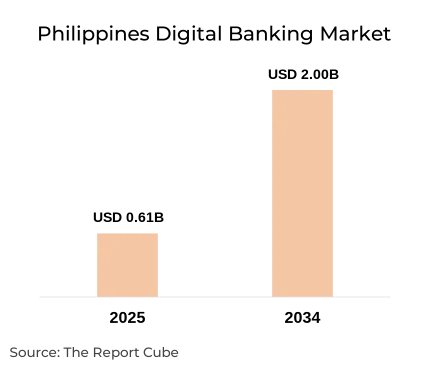
The Philippines Digital Banking Market is projected to grow at a 14.10% CAGR during 2026-2034. The market stood at USD 0.61 billion in 2025 and is expected to reach USD 2.00 billion by 2034. Growth is driven by rapid fintech expansion, increased mobile penetration, the rise of fully digital banks licensed by the Bangko Sentral ng Pilipinas (BSP), and evolving consumer financial behaviors. Digital banks such as Maya Bank, GoTyme, Tonik, UNOBank, and CIMB Bank Philippines are accelerating adoption of digital onboarding, instant loans, e-wallets, savings accounts, credit products, and embedded financial services. Rising demand for cashless transactions, expansion of e-commerce activity, and the government’s digital payments transformation roadmap continue reshaping the banking landscape. With stronger focus on underserved and unbanked populations, digital banks are expanding financial inclusion and enabling seamless low-cost transactions.
The ecosystem is also supported by improvements in the national digital infrastructure, including interoperable payment rails like InstaPay and PESONet, upgraded KYC/eKYC guidelines, and strengthened digital identity frameworks. Traditional banks are expanding digital channels and launching digital-only platforms to compete with agile fintech-driven models. SMEs and micro-entrepreneurs increasingly rely on digital banking for working-capital loans, inventory financing, supplier payments, and invoice-based credit solutions. As digital literacy improves, cloud-native banking systems, AI-driven decisioning engines, fraud analytics, and open banking APIs are enabling broader fintech–bank collaborations. Overall, digital banking is transitioning from a consumer-led payments revolution to a full-service financial ecosystem.
Philippines Digital Banking Market Recent Developments
- 2025: Leading digital banks expanded instant micro-loan programs, savings vaults, and credit-scoring models to deepen financial inclusion nationwide.
- 2025: Major banks and digital-only platforms launched interoperable QR PH-based payment features to accelerate merchant acceptance and cashless commerce.
Government Initiatives & Policies
- BSP Digital Payments Transformation Roadmap: Targets 50% of retail payments to be digital and 70% of adults financially included, accelerating digital banking adoption.
- National ID System (PhilSys): Enhances eKYC onboarding, customer verification, and fraud prevention, reducing friction for digital account creation across the country.
Philippines Digital Banking Market Dynamics
Driver: Rise of Mobile-First Consumers & Financial Inclusion Push
Mobile-first consumer lifestyles and strong demand for digital financial accessibility are major drivers of market expansion. Over 75% of the adult population previously faced barriers to traditional banking services, making digital banks the preferred alternative for fast onboarding, no maintaining balance, and frictionless transactions. Expanding e-commerce penetration and rapid QR PH adoption fuel payment digitization. Digital banks are offering micro-savings, instant loans, and embedded payment solutions that support both individual consumers and small businesses. Government-led digital payments initiatives, interoperable infrastructures, and financial inclusion programs further reinforce the shift toward digitally delivered financial products.
Challenge: Cybersecurity Risks, Fraud Management & Digital Trust
The rapid shift to digital channels increases vulnerabilities related to phishing, identity theft, account takeovers, and fraudulent transactions. Strengthening digital trust is a priority as fraud incidents can undermine user confidence. Many new-to-bank consumers require higher digital literacy to safely navigate financial services. Digital banks must also manage high compliance costs associated with BSP regulations, AML/KYC frameworks, and risk-management systems. Competition is intensifying, with traditional banks and fintech companies launching overlapping digital services. Balancing growth, profitability, and operational safeguards remains a critical challenge across the evolving digital-banking ecosystem.
Opportunity: SME Digitization, Embedded Finance & Credit Innovation
Large-scale opportunity exists in SME lending, gig-economy payments, subscription-based services, and embedded finance integrations with marketplaces and logistics platforms. Many micro-entrepreneurs require fast working capital, digital bookkeeping tools, and automated financial products that traditional institutions cannot deliver at scale. Digital banks can utilize alternative credit scoring based on payments behavior, transaction history, and mobile activity—to unlock lending opportunities. Buy Now Pay Later (BNPL), insurance micro-products, personal finance coaching, and AI-driven budgeting tools also present strong growth prospects. As open banking matures, ecosystem-based financial services will extend digital banking into new sectors.
Trend: AI-Powered Banking, Open Finance Ecosystems & Cloud-Native Platforms
A major trend shaping the market is the integration of AI for credit scoring, fraud analytics, personalization, customer service automation, and behavioral insights. Cloud-native banking cores are enabling real-time processing, scalable product deployment, and stronger data resilience. Open finance frameworks will allow data sharing across banks, fintechs, insurers, and merchants expanding multi-industry partnerships. Digital banks are also adopting advanced cybersecurity technologies, biometrics, and continuous authentication models to enhance trust. As customer expectations rise, hyper-personalized financial journeys and seamless multi-channel digital engagement will define long-term competitiveness.
Philippines Digital Banking Market Segment-wise Analysis
By Product Type:
- Digital Accounts & Wallets
- Digital Loans & Credit
- Digital Payments & Transfers
- Digital Deposits & Savings
- Digital Investments & Insurance
Digital Accounts & Wallets lead the market with an estimated around 42% share. E-wallets and digital accounts form the foundation of the country’s cashless ecosystem, enabling seamless payments, transfers, bill settlements, and merchant transactions. Their simplicity, accessibility, and low entry barriers make them the first point of engagement for millions of Filipinos shifting from cash-based financial behavior to digital financial services. Continued integration into e-commerce, ride-hailing, and in-store QR PH payments strengthens their dominance.
By End-User:
- Mass Market / Unbanked
- Middle Class Consumers
- SMEs & Micro-entrepreneurs
- Others
Mass Market / Unbanked holds the highest market share at approximately 47%. Digital banks offer accessible, no-friction onboarding and low-cost financial tools for consumers previously unable to open traditional bank accounts. This segment benefits from eKYC-enabled account creation, micro-savings, instant credit, and digital payments that reduce dependency on cash and informal lending channels.
Regional Projection of Philippines Digital Banking Industry
By Region:
- Luzon
- Visayas
- Mindanao
- Metro Manila
Metro Manila leads the market with an estimated around 55% share due to the concentration of digital-native consumers, fintech hubs, business centers, and strong mobile penetration. The region hosts major digital banks, startup accelerators, and the headquarters of financial institutions driving innovation. E-commerce adoption, high connectivity, and strong merchant acceptance of QR PH payments further reinforce NCR’s leadership position.
What Does Our Philippines Digital Banking Market Research Study Entail?
- Provides comprehensive market sizing and forecasting from 2026–2034, showing growth from USD 0.61 billion to USD 2.00 billion at a 14.10% CAGR.
- Delivers detailed segmentation across Product Types and End-User categories, highlighting digital wallets, payments, and lending as core growth drivers.
- Offers regional insights across Metro Manila, Luzon, Visayas, and Mindanao for optimized expansion strategies.
- Profiles leading digital banks and financial players including Maya Bank, GoTyme Bank, UNOBank, Tonik, CIMB, SeaBank, and traditional banks’ digital units.
- Reviews key trends across AI integration, open finance ecosystems, cybersecurity, and digital financial inclusion strategies.
Top Key Players
Maya Bank (PLDT), GoTyme Bank (Gokongwei Group), UNOBank (UnionDigital), Tonik Digital Bank, CIMB Bank Philippines (Digital), SeaBank Philippines (Digital), Rakuten Bank (Planned), BPI Digital, BDO Digital, Metrobank Digital, and Others.
Table of Contents
- Introduction
- Objective of the Study
- Product/Technology Definition
- Market Segmentation
- Study Variables
- Research Methodology
- Secondary Data Points
- Breakdown of Secondary Sources
- Primary Data Points
- Breakdown of Primary Interviews
- Secondary Data Points
- Executive Summary
- Market Dynamics
- Drivers
- Challenges
- Opportunity Assessment
- Recent Trends and Developments
- Policy and Regulatory Landscape
- Philippines Digital Banking Market Overview (2020–2034)
- Market Size, By Volume (Users / Transactions) & Value (USD Million)
- Market Share, By Product Type
- Digital Accounts & Wallets
- Digital Loans & Credit
- Digital Payments & Transfers
- Digital Deposits & Savings
- Digital Investments & Insurance
- Market Share, By End-User
- Mass Market / Unbanked
- Middle Class Consumers
- SMEs & Micro-entrepreneurs
- Others
- Market Share, By Region
- Metro Manila & NCR
- Luzon (Excluding NCR)
- Visayas
- Mindanao
- Market Share, By Company
- Revenue Shares
- Competitive Landscape
- Segment-wise & Industry-wise Market Forecast (2026–2034)
- By Product Type
- By End-User
- By Region
- Regional Analysis (2020–2034)
- Metro Manila & NCR Digital Banking Market
- Market Size, By Volume & Value (USD Million)
- Market Share, By Product Type
- Market Share, By Key Cities
- Luzon (Excluding NCR) Digital Banking Market
- Market Size, By Volume & Value (USD Million)
- Market Share, By Product Type
- Market Share, By Key Provinces
- Visayas Digital Banking Market
- Market Size, By Volume & Value (USD Million)
- Market Share, By Product Type
- Market Share, By Key Cities
- Mindanao Digital Banking Market
- Market Size, By Volume & Value (USD Million)
- Market Share, By Product Type
- Market Share, By Key Cities
- Competitive Outlook & Company Profiles
- Maya Bank (PLDT)
- Company Overview
- Business Segments
- Strategic Alliances/Partnerships
- Recent Developments
- GoTyme Bank (Gokongwei Group)
- Company Overview
- Business Segments
- Strategic Alliances/Partnerships
- Recent Developments
- UNOBank (UnionDigital)
- Company Overview
- Business Segments
- Strategic Alliances/Partnerships
- Recent Developments
- Tonik Digital Bank
- Company Overview
- Business Segments
- Strategic Alliances/Partnerships
- Recent Developments
- CIMB Bank Philippines (Digital)
- Company Overview
- Business Segments
- Strategic Alliances/Partnerships
- Recent Developments
- SeaBank Philippines (Digital)
- Company Overview
- Business Segments
- Strategic Alliances/Partnerships
- Recent Developments
- Rakuten Bank (Pending/Planned)
- Company Overview
- Business Segments
- Strategic Alliances/Partnerships
- Recent Developments
- Traditional Banks Digital Arms (BPI, BDO, Metrobank)
- Company Overview
- Business Segments
- Strategic Alliances/Partnerships
- Recent Developments
- Maya Bank (PLDT)
- Contact Us / Disclaimer
Top Key Players & Market Share Outlook
- Maya Bank (PLDT)
- GoTyme Bank (Gokongwei Group)
- UNOBank (UnionDigital)
- Tonik Digital Bank
- CIMB Bank Philippines (Digital)
- SeaBank Philippines (Digital)
- Rakuten Bank (Pending/Planned)
- BPI (Digital Arm)
- BDO (Digital Arm)
- Metrobank (Digital Arm)
Frequently Asked Questions






