




Build Your Custom Market Intelligence Report
Customize Your ReportWhat Is the Qatar Cold Chain Market Size & Value?
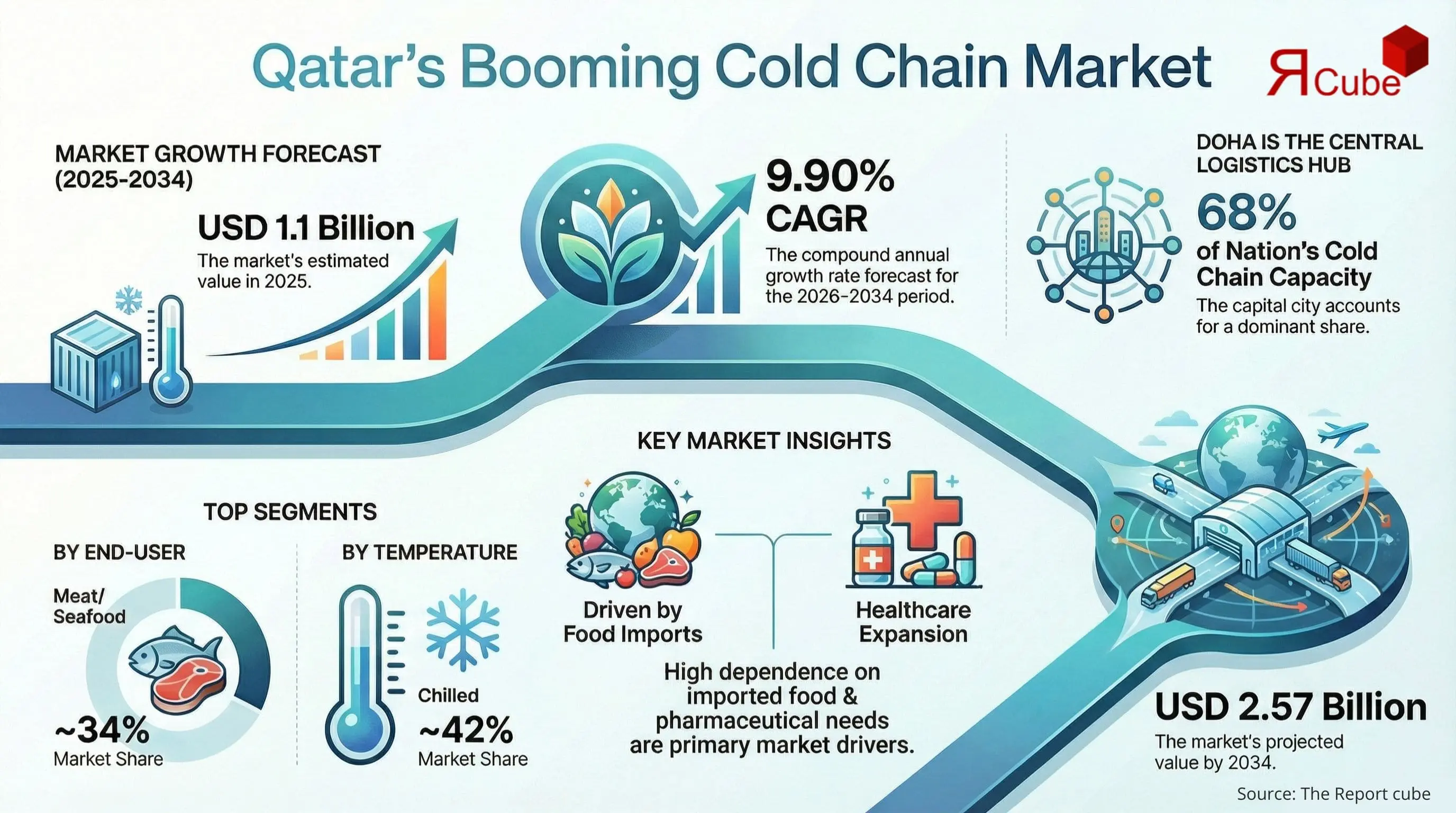
The Qatar cold chain market is anticipated to register a 9.90% CAGR during 2026–2034. The market size was valued at USD 1.1 billion in 2025 and is projected to reach USD 2.57 billion by 2034. Market growth is primarily driven by Qatar’s high dependence on imported food, rising pharmaceutical demand, and increasing emphasis on food safety and healthcare quality. Government-backed investments in logistics infrastructure, population growth, and growing consumption of frozen and temperature-sensitive products are accelerating the adoption of advanced cold storage and refrigerated transportation solutions across the country.
Qatar Cold Chain Market Key Highlights
- Heavy reliance on imported food sustains consistent demand for cold chain logistics
- Pharmaceutical and healthcare expansion increases need for compliant temperature-controlled storage
- Opportunity emerges from multi-temperature warehouses and cold chain automation
- Leading segments include meat and seafood, dairy products, and pharmaceuticals
- Doha and surrounding logistics zones dominate cold chain infrastructure utilization
- Government of Qatar supports food security and cold logistics infrastructure development
Qatar Cold Chain Industry Analysis 2026–2034
The Qatar cold chain industry includes temperature-controlled warehousing, refrigerated transportation, and cold distribution services supporting food, pharmaceutical, and agricultural supply chains. Growth is driven by rising food imports, retail modernization, healthcare expansion, and strict food safety regulations. Profitability is strongest for operators offering integrated cold storage and transportation networks with proximity to ports, airports, and urban consumption centers. The industry is closely linked to food processing, pharmaceuticals, healthcare services, retail, and international trade. Sales channels include long-term cold storage contracts, third-party cold logistics agreements, and sector-specific service partnerships. During 2024–2025, companies expanded cold storage capacity, upgraded refrigeration systems, and adopted digital temperature monitoring technologies to enhance compliance and operational efficiency.
Qatar Cold Chain Market Dynamics
Key Market Driver – Food Import Dependence and Healthcare Expansion
Qatar imports a substantial share of its food consumption, including meat, seafood, dairy, fruits, and vegetables, creating strong demand for reliable cold chain infrastructure. Growing pharmaceutical imports, vaccine distribution requirements, and expanding healthcare facilities further strengthen the need for temperature-controlled storage and transportation. Rising population levels and changing dietary preferences toward frozen and processed foods are reinforcing long-term cold chain demand.
Major Industry Challenge – High Energy Consumption and Operating Costs
Cold chain operations in Qatar face high energy usage due to climatic conditions and continuous refrigeration requirements. Significant capital investment is required for cold storage facilities, specialized vehicles, and backup power systems. Maintaining strict temperature integrity throughout storage and distribution increases operational complexity and cost pressure for logistics providers.
Emerging Trend Shaping Outlook – Specialized Cold Storage and Digital Monitoring
The market is increasingly shifting toward specialized cold storage facilities designed for pharmaceuticals, dairy, meat, and frozen foods. Adoption of IoT-enabled temperature sensors, digital monitoring systems, and warehouse management platforms is improving traceability, efficiency, and regulatory compliance. Demand for integrated cold chain solutions combining storage, transportation, and last-mile delivery is steadily increasing.
Need insights for a specific region within this market?
Request Regional DataHow Are the Qatar Cold Chain Market Segments Defined?
Market segmentation is focusing on end-user applications and temperature requirements.
By End-User Application:
- Meat/Seafood
- Dairy Products
- Pharmaceuticals
- Vegetables/Fruits
- Others
Meat and seafood dominate the Qatar cold chain market, accounting for approximately 34% of total demand, driven by high import volumes and strict freshness requirements. Dairy products follow due to daily consumption needs and limited domestic production. Pharmaceuticals represent the fastest-growing segment, supported by rising healthcare expenditure and temperature-sensitive drug distribution. Vegetables and fruits contribute steadily, particularly for imported fresh produce requiring controlled storage.
By Temperature:
- Ambient
- Chilled
- Frozen
Chilled storage accounts for nearly 42% of total cold chain capacity, supported by dairy, fresh produce, and pharmaceutical distribution. Frozen storage represents approximately 36%, driven by meat, seafood, and frozen food imports. Ambient temperature storage holds the remaining share, mainly supporting short-term handling and transitional logistics.
Qatar Cold Chain Industry: Country Insights
Key Regions
- Doha
- Al Wakrah
- Al Khor
- Mesaieed
Doha accounts for nearly 68% of total cold chain capacity due to population concentration, retail density, and proximity to Hamad Port and Hamad International Airport. Al Wakrah and Mesaieed support port-centric and industrial cold storage activities, while Al Khor serves regional food distribution needs.
Qatar Cold Chain Market: Recent Innovations (2025)
- GWC Logistics expanded multi-temperature cold storage capacity near key distribution hubs
- Milaha Cold Storage upgraded refrigeration systems to improve energy efficiency and compliance
- Qatar Logistics enhanced cold chain distribution services for food and pharmaceutical clients
- Gulf United Cold Stores strengthened warehouse automation and temperature monitoring systems
Qatar Cold Chain Market Future Outlook (2034)
By 2034, the Qatar cold chain market is expected to reach USD 2.57 billion, growing at a 9.90% CAGR. Market expansion will be driven by food import growth, healthcare demand, and logistics modernization. Technology advancement in automation, digital temperature monitoring, and energy-efficient refrigeration will improve operational reliability and cost efficiency. Future growth will favor providers offering compliant, integrated, and scalable Qatar cold chain solutions aligned with national food security and healthcare priorities.
Major Queries Answered in the Report
- What is the current and projected size of the Qatar cold chain market through 2034?
- Which end-user applications generate the highest cold chain demand in Qatar?
- How does temperature segmentation impact storage and transportation requirements?
- What factors are driving growth across food and pharmaceutical cold chains?
- Which regions dominate cold chain infrastructure and capacity utilization?
- What operational challenges affect cold chain providers in Qatar?
- Which companies are expanding capacity and investing in innovation?
- How will technology influence the future of Qatar’s cold chain market?
Table of Contents
- Introduction
- Objective of the study
- Product Definition
- Market Segmentation
- Study Variables
- Research Methodology
- Secondary Data Points
- Companies Interviewed
- Primary Data Points
- BreakDown of Primary Interviews
- Secondary Data Points
- Executive Summary
- Market Dynamics
- Drivers
- Challenges
- Opportunity Assessment
- Recent Trends and Developments
- Policy and Regulatory Landscape
- Qatar Cold Chain Market Overview (2020-2034)
- Market Size, By Value (in USD Billions)
- Market Share, By End-User Application
- Meat/seafood
- Dairy products
- Pharmaceuticals
- Vegetables/fruits
- Others
- Market Share, By Temperature
- Ambient
- Chilled
- Frozen
- Market Share, By Ownership
- Integrated
- Contract
- Market Share, By Mode of Freight
- Land
- Sea
- Air
- Market Share, By Type of Freight
- Domestic
- International
- Market Share, By Region
- Doha
- Al Wakrah
- Al Khor
- Mesaieed
- Market Share, By Competitors
- Competition Characteristics
- Revenue Shares
- Qatar Meat/seafood Cold Chain Market Overview, 2020-2034F
- By Value (USD Million)
- By Temperature- Market Size & Forecast 2020-2034, USD Million
- By Ownership- Market Size & Forecast 2020-2034, USD Million
- By Mode of Freight- Market Size & Forecast 2020-2034, USD Million
- By Type of Freight- Market Size & Forecast 2020-2034, USD Million
- Qatar Dairy products Cold Chain Market Overview, 2020-2034F
- By Value (USD Million)
- By Temperature- Market Size & Forecast 2020-2034, USD Million
- By Ownership- Market Size & Forecast 2020-2034, USD Million
- By Mode of Freight- Market Size & Forecast 2020-2034, USD Million
- By Type of Freight- Market Size & Forecast 2020-2034, USD Million
- Qatar Pharmaceuticals Cold Chain Market Overview, 2020-2034F
- By Value (USD Million)
- By Temperature- Market Size & Forecast 2020-2034, USD Million
- By Ownership- Market Size & Forecast 2020-2034, USD Million
- By Mode of Freight- Market Size & Forecast 2020-2034, USD Million
- By Type of Freight- Market Size & Forecast 2020-2034, USD Million
- Qatar Vegetables/fruits Cold Chain Market Overview, 2020-2034F
- By Value (USD Million)
- By Temperature- Market Size & Forecast 2020-2034, USD Million
- By Ownership- Market Size & Forecast 2020-2034, USD Million
- By Mode of Freight- Market Size & Forecast 2020-2034, USD Million
- By Type of Freight- Market Size & Forecast 2020-2034, USD Million
- Qatar Others Cold Chain Market Overview, 2020-2034F
- By Value (USD Million)
- By Temperature- Market Size & Forecast 2020-2034, USD Million
- By Ownership- Market Size & Forecast 2020-2034, USD Million
- By Mode of Freight- Market Size & Forecast 2020-2034, USD Million
- By Type of Freight- Market Size & Forecast 2020-2034, USD Million
- Competitive Outlook (Company Profile - Partial List)
- GWC Logistics
- Company Overview
- Business Segments
- Strategic Alliances/Partnerships
- Recent Developments
- Gulf United Cold Stores
- Company Overview
- Business Segments
- Strategic Alliances/Partnerships
- Recent Developments
- Qatar Logistics
- Company Overview
- Business Segments
- Strategic Alliances/Partnerships
- Recent Developments
- Qatar Logistical Services
- Company Overview
- Business Segments
- Strategic Alliances/Partnerships
- Recent Developments
- Tokyo Freight Services
- Company Overview
- Business Segments
- Strategic Alliances/Partnerships
- Recent Developments
- JSL Global
- Company Overview
- Business Segments
- Strategic Alliances/Partnerships
- Recent Developments
- Milaha Cold Storage
- Company Overview
- Business Segments
- Strategic Alliances/Partnerships
- Recent Developments
- Western Gulf Agency
- Company Overview
- Business Segments
- Strategic Alliances/Partnerships
- Recent Developments
- GAC
- Company Overview
- Business Segments
- Strategic Alliances/Partnerships
- Recent Developments
- Others
- GWC Logistics
- Contact Us & Disclaimer
Top Key Players & Market Share Outlook
- GWC Logistics
- Gulf United Cold Stores
- Qatar Logistics
- Qatar Logistical Services
- Tokyo Freight Services
- JSL Global
- Milaha Cold Storage
- Western Gulf Agency
- GAC
- Others
Frequently Asked Questions






