



Build Your Custom Market Intelligence Report
Customize Your ReportUS Commercial Insurance Market Insights & Analysis
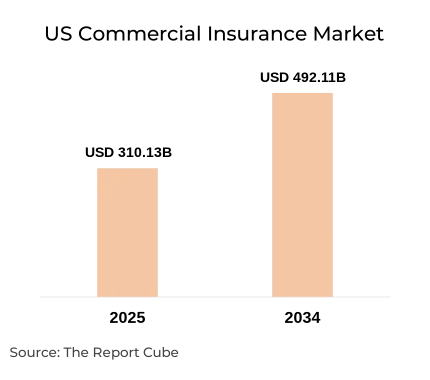
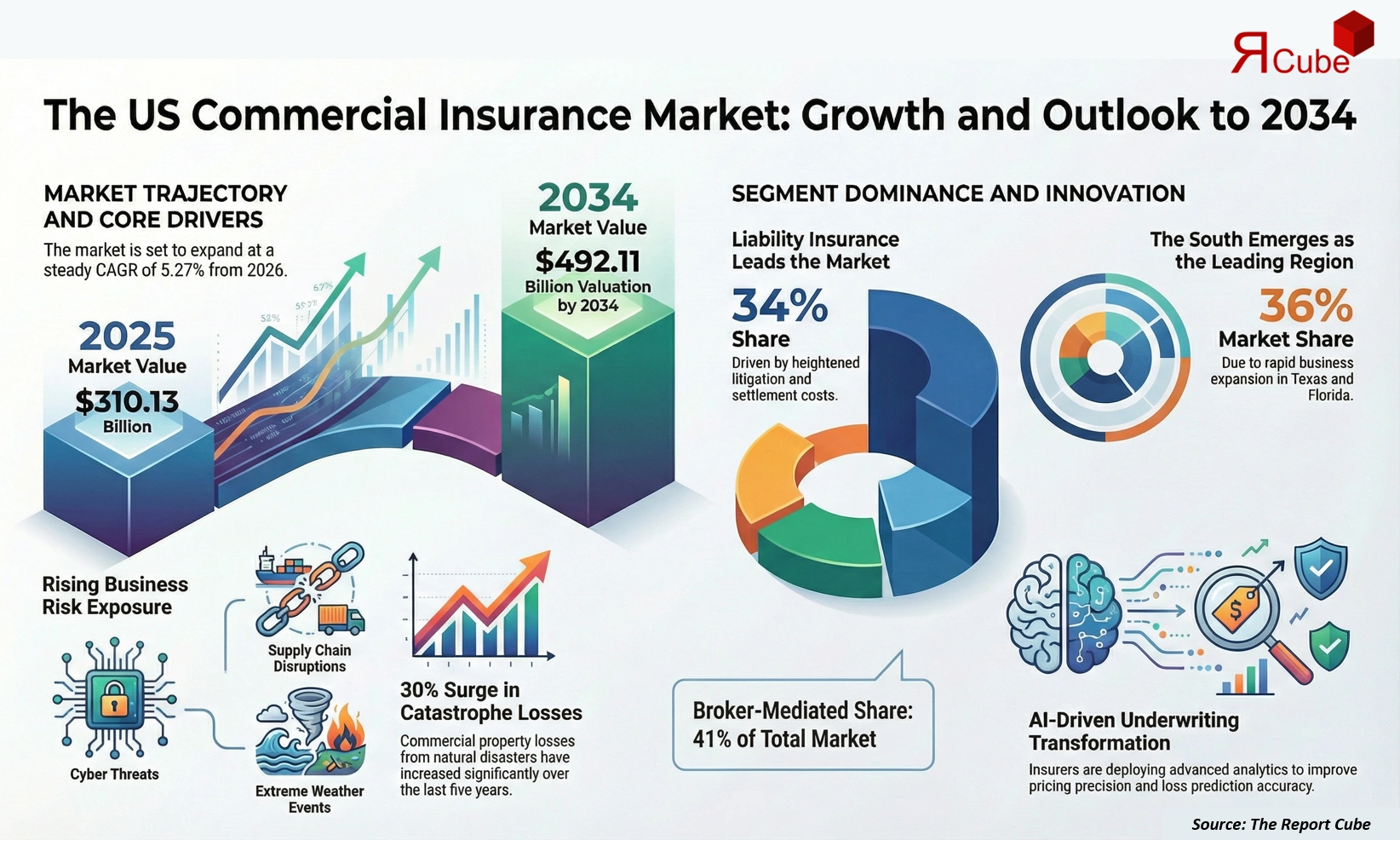
The US Commercial Insurance Market is anticipated to register a CAGR of 5.27% during the forecast period 2026-2034. The market size was valued at USD 310.13 billion in 2025 and is projected to reach USD 492.11 billion by 2034. This growth reflects the expanding scale of business operations across the United States, rising asset values, and increasing exposure to complex operational, cyber, and climate-related risks.
The US commercial insurance landscape is evolving rapidly as enterprises reassess risk management strategies amid economic volatility, regulatory changes, and technological transformation. Businesses across manufacturing, construction, healthcare, logistics, and professional services are expanding insurance coverage to protect physical assets, liability exposures, and revenue continuity. Inflation-driven increases in claim severity, combined with higher replacement costs for property and equipment, have further elevated premium volumes across most commercial lines.
At the same time, insurers are deploying advanced analytics, AI-driven underwriting, and digital distribution models to improve pricing accuracy and profitability. The growing role of brokers, specialty insurers, and excess & surplus carriers highlights a market shifting toward customized risk solutions rather than standardized policies. These interconnected forces position the US Commercial Insurance Market as a critical pillar of enterprise risk management through 2034.
US Commercial Insurance Market Recent Developments
- 2025: Chubb Limited expanded cyber and climate-risk commercial coverage tailored for mid-sized US enterprises.
- 2025: The Travelers Companies, Inc. enhanced AI-driven underwriting tools to improve loss prediction accuracy.
Government Initiatives & Policies
- US Infrastructure Investment and Jobs Act: Increased infrastructure spending, boosting demand for commercial liability and property insurance.
- National Flood Insurance Program Reforms: Updates encouraging private insurer participation in commercial flood coverage.
US Commercial Insurance Market Dynamics
Key Driver: Rising Business Risk Exposure Across Industries
The primary driver of the US Commercial Insurance Market is the steady increase in risk exposure faced by businesses of all sizes. Companies are operating in an environment marked by cyber threats, supply chain disruptions, extreme weather events, and heightened litigation. Commercial property losses from natural catastrophes have increased by over 30% in the past five years, while liability claims have grown in both frequency and severity. As a result, businesses are expanding policy limits and purchasing multi-line coverage to safeguard operations. This heightened risk awareness directly fuels premium growth, particularly in property, liability, and specialty insurance segments, reinforcing long-term market expansion.
Book your FREE 30-minute expert consultation today
Contact UsIndustry Trends: Shift Toward Specialty and Customized Insurance Solutions
A key trend shaping the market is the shift toward specialty insurance and customized coverage structures. Standardized policies are increasingly insufficient for complex risks such as cyber liability, environmental exposure, and professional indemnity. Excess & surplus insurers are gaining traction by offering flexible terms for high-risk or emerging sectors. Additionally, data-driven underwriting and usage of real-time risk monitoring tools are improving pricing precision. These trends are interconnected, as insurers leverage technology to deliver tailored products while managing underwriting discipline in a volatile risk environment.
Major Challenge: Loss Ratio Volatility and Pricing Pressure
Loss ratio volatility remains a major challenge for the US Commercial Insurance Market. Rising claim costs, driven by inflation, litigation expenses, and social inflation, are pressuring insurer profitability. Property insurers, in particular, face difficulties balancing premium adequacy with customer affordability. Regulatory scrutiny on rate increases further complicates pricing strategies. These pressures require insurers to continuously refine underwriting standards and risk selection, which can limit capacity availability in certain high-risk segments and slow market growth.
Opportunity: Digital Distribution and Advanced Analytics Adoption
The growing adoption of digital distribution channels and advanced analytics presents a significant opportunity for the market. Insurers are investing heavily in AI-based underwriting, automated claims processing, and broker-integrated platforms to improve efficiency and customer experience. Digital tools reduce administrative costs and enable faster policy issuance, especially for small and mid-sized enterprises. As technology adoption deepens, insurers can expand reach, improve risk assessment accuracy, and unlock new revenue streams, strengthening competitive positioning through 2034.
US Commercial Insurance Market Segment-wise Analysis
By Product Category:
- Commercial Property Insurance
- Liability Insurance
- Commercial Motor Insurance
- Marine Insurance
- Other Commercial Lines
Liability Insurance leads the product category segment, accounting for approximately 34% of the total market share in 2025. This dominance is driven by increasing litigation risks, higher settlement costs, and regulatory compliance requirements across industries. Commercial Property Insurance follows closely, supported by rising asset values and climate-related risk coverage. Commercial Motor Insurance maintains stable demand due to expanding logistics and transportation activities, while marine and other specialty lines benefit from international trade and niche risk needs.
By Business Model:
- Direct Written
- Broker-Mediated
- Agency-Mediated
- Excess & Surplus
- Captive Programs
Broker-Mediated distribution dominates the business model segment, holding nearly 41% market share. Complex commercial risks often require broker expertise to structure optimal coverage and negotiate terms. Excess & Surplus lines are growing rapidly, addressing coverage gaps for high-risk sectors. Captive programs are also gaining popularity among large enterprises seeking cost control and risk retention. These models collectively reflect a market moving toward flexible, advisory-driven insurance solutions.
Regional Projection of US Commercial Insurance Industry
- Northeast
- Midwest
- South
- West
The South leads the US Commercial Insurance Market with an estimated 36% share, driven by rapid business expansion, construction activity, and exposure to natural catastrophe risks. States such as Texas and Florida generate high demand for property and liability coverage. The West follows, supported by technology-driven enterprises and higher commercial asset values. The Northeast remains a mature but stable market, while the Midwest benefits from manufacturing and agricultural insurance demand. Regional growth patterns remain closely linked to economic activity and risk concentration.
Need insights for a specific region within this market?
Request Regional DataWhy Choose This Report?
- Provides a comprehensive overview of the overall market analysis, encompassing key trends, consumer behavior analysis, and risk assessment to support strategic decision-making.
- Provides accurate, up-to-date insights into market size, segmentation, and emerging opportunities, helping to minimize risk & capitalizing on growth.
- Gives deep understanding of target audience preferences, investment habits, and communication channels for enhanced product development & marketing effectiveness.
- Delivers competitive analysis & benchmarking, uncovering the strengths & weaknesses of market competitors to guide strategies.
- Consolidate comprehensive market intelligence, reducing reasoning & streamlining research efforts.
- Facilitates customized market segmentation & risk mitigation strategies, fine-tuned to the business objectives.
- Aids in identifying both market challenges & untapped opportunities within the industry to drive long-term business growth.
- Provides valuable information based on actual customer data & search trends.
Table of Contents
- Introduction
- Objective of the Study
- Product and Category Definition
- Market Segmentation
- Study Variables
- Research Methodology
- Secondary Data Points
- Breakdown of Secondary Sources
- Primary Data Points
- Breakdown of Primary Interviews
- Secondary Data Points
- Executive Summary
- Market Dynamics
- Drivers
- Challenges
- Opportunity Assessment
- Recent Trends and Developments
- Regulatory and Policy Landscape
- U.S. Commercial Insurance Market Overview (2020-2034)
- Market Size, By Value (USD Billion)
- Market Share, By Product Category
- Commercial Property Insurance
- Liability Insurance
- Commercial Motor Insurance
- Marine Insurance
- Other Commercial Lines
- Market Share, By Business Model
- Direct Written
- Broker-Mediated
- Agency-Mediated
- Excess & Surplus
- Captive Programs
- Market Share, By Enterprise Size
- Large Enterprises
- SMEs
- Market Share, By Industry Vertical
- Transportation & Logistics
- Manufacturing
- Construction
- IT & Telecom
- Healthcare
- Energy & Utilities
- Other Sectors
- Market Share, By Region
- Northeast
- Midwest
- South
- West
- Market Share, By Company
- Competition Characteristics
- Revenue Shares & Analysis
- Northeast U.S. Commercial Insurance Market
- Market Size, By Value (USD Billion)
- Market Share, By Product Category
- Market Share, By Business Model
- Market Share, By Enterprise Size
- Market Share, By Industry Vertical
- Market Share, By Sub‑Region
- New England
- Mid‑Atlantic
- Midwest U.S. Commercial Insurance Market
- Market Size, By Value (USD Billion)
- Market Share, By Product Category
- Market Share, By Business Model
- Market Share, By Enterprise Size
- Market Share, By Industry Vertical
- Market Share, By Sub‑Region
- East North Central
- West North Central
- Southern U.S. Commercial Insurance Market
- Market Size, By Value (USD Billion)
- Market Share, By Product Category
- Market Share, By Business Model
- Market Share, By Enterprise Size
- Market Share, By Industry Vertical
- Market Share, By Sub‑Region
- South Atlantic
- East South Central
- West South Central
- Western U.S. Commercial Insurance Market
- Market Size, By Value (USD Billion)
- Market Share, By Product Category
- Market Share, By Business Model
- Market Share, By Enterprise Size
- Market Share, By Industry Vertical
- Market Share, By Sub‑Region
- Mountain
- Pacific
- Competitive Outlook and Company Profiles
- Liberty Mutual Insurance Company
- Company Overview
- Product Portfolio
- Strategic Alliances/Partnerships
- Recent Developments
- The Travelers Companies, Inc.
- Company Overview
- Product Portfolio
- Strategic Alliances/Partnerships
- Recent Developments
- Chubb Limited
- Company Overview
- Product Portfolio
- Strategic Alliances/Partnerships
- Recent Developments
- American International Group, Inc. (AIG)
- Company Overview
- Product Portfolio
- Strategic Alliances/Partnerships
- Recent Developments
- Zurich Insurance Group Ltd.
- Company Overview
- Product Portfolio
- Strategic Alliances/Partnerships
- Recent Developments
- The Hartford Financial Services Group, Inc.
- Company Overview
- Product Portfolio
- Strategic Alliances/Partnerships
- Recent Developments
- CNA Financial Corporation
- Company Overview
- Product Portfolio
- Strategic Alliances/Partnerships
- Recent Developments
- State Farm Mutual Automobile Insurance Company
- Company Overview
- Product Portfolio
- Strategic Alliances/Partnerships
- Recent Developments
- Allstate Insurance Company
- Company Overview
- Product Portfolio
- Strategic Alliances/Partnerships
- Recent Developments
- Farmers Insurance Exchange
- Company Overview
- Product Portfolio
- Strategic Alliances/Partnerships
- Recent Developments
- Others
- Liberty Mutual Insurance Company
- Contact Us and Disclaimer
Top Key Players & Market Share Outlook
- Liberty Mutual Insurance Company
- The Travelers Companies, Inc.
- Chubb Limited
- American International Group, Inc. (AIG)
- Zurich Insurance Group Ltd.
- The Hartford Financial Services Group, Inc.
- CNA Financial Corporation
- State Farm Mutual Automobile Insurance Company
- Allstate Insurance Company
- Farmers Insurance Exchange
- Others
Frequently Asked Questions






