



Build Your Custom Market Intelligence Report
Customize Your ReportKenya Commercial Vehicle Market Insights & Analysis
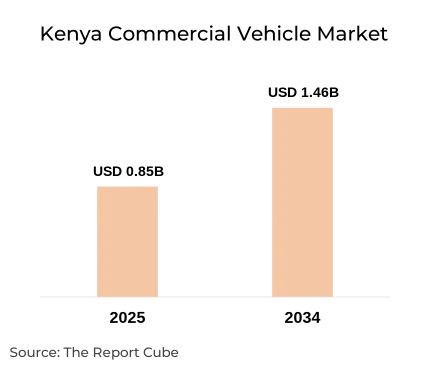
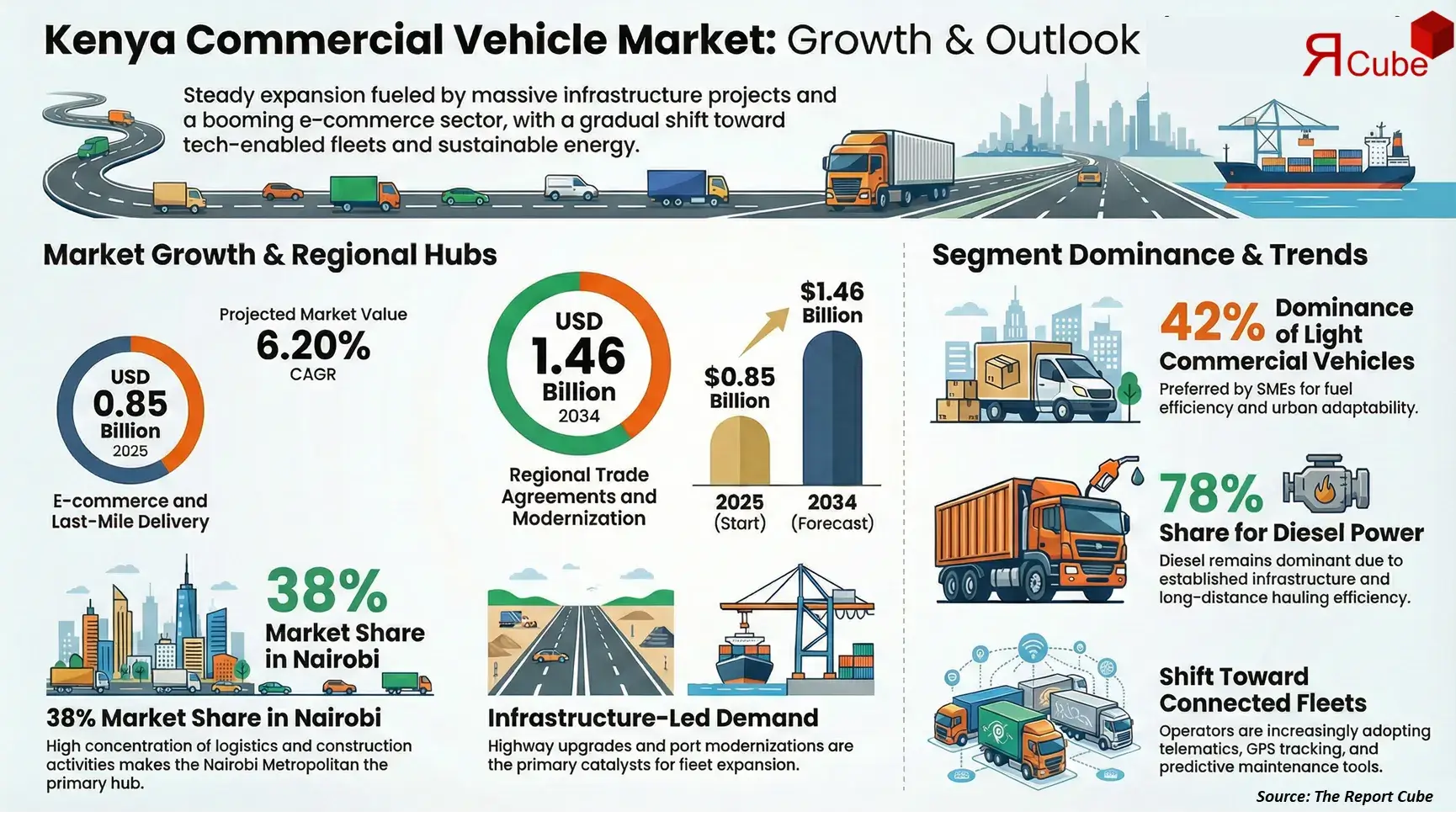
The Kenya Commercial Vehicle Market is anticipated to register a CAGR of 6.20% during 2026-2034. The market size was valued at USD 0.85 billion in 2025 and is projected to reach USD 1.46 billion by 2034. the market is undergoing steady expansion, supported by infrastructure development, logistics growth, and rising urbanization across major economic corridors. Kenya’s role as an East African trade hub has significantly increased demand for light, medium, and heavy commercial vehicles used in transportation, construction, agriculture, and public mobility. The growth of e-commerce, last-mile delivery services, and regional trade agreements has accelerated fleet expansion among logistics providers and SMEs. Light commercial vehicles remain highly preferred due to affordability, fuel efficiency, and adaptability across urban and semi-urban routes.
Public investments in road networks, ports, and rail connectivity are further strengthening demand for heavy trucks and buses. Ongoing upgrades to highways linking Nairobi to Mombasa and neighboring countries have improved freight efficiency, encouraging fleet modernization. Additionally, the public transport sector is witnessing gradual replacement of aging buses with higher-capacity, fuel-efficient models. Rising fuel prices have also pushed operators to seek durable vehicles with lower lifecycle costs.
Technological integration, including telematics, fleet monitoring, and improved emission standards, is influencing purchasing decisions. While diesel-powered vehicles dominate, electric and hybrid adoption is slowly emerging in urban centers due to sustainability initiatives and pilot programs. The presence of established global and regional manufacturers ensures competitive pricing, localized assembly, and aftersales support, reinforcing long-term market stability.
Kenya Commercial Vehicle Market Recent Developments
- 2025: Isuzu East Africa expanded its Nairobi assembly facility to increase local production capacity.
- 2025: Toyota Kenya introduced upgraded fuel-efficient light commercial vans for urban logistics fleets.
Government Initiatives & Policies
- Kenya National Transport Policy: Focuses on efficient, sustainable transport systems supporting logistics and public mobility.
- National Climate Change Action Plan: Encourages adoption of low-emission and electric commercial vehicles.
Kenya Commercial Vehicle Market Dynamics
Key Driver: Expanding Infrastructure and Logistics Networks
Large-scale infrastructure investments remain the primary driver of the Kenya commercial vehicle market. Government-backed road construction, port modernization, and special economic zones are increasing freight movement nationwide. Projects such as expressways, bypass roads, and regional transport corridors have enhanced vehicle utilization rates. As a result, fleet operators are investing in newer trucks and buses to meet rising cargo volumes and passenger demand. Agriculture and construction sectors also rely heavily on commercial vehicles for raw material transport, further stimulating demand. Improved access to financing and leasing options has enabled SMEs to acquire vehicles, accelerating overall market penetration and fleet renewal across multiple industries.
Book your FREE 30-minute expert consultation today
Contact UsIndustry Trends: Gradual Shift Toward Efficient and Connected Fleets
The market is witnessing a steady trend toward fuel-efficient, connected, and technologically enabled commercial vehicles. Fleet owners increasingly prefer vehicles equipped with telematics, GPS tracking, and predictive maintenance tools to optimize operating costs. Diesel vehicles continue to dominate, accounting for over 75% of active fleets, but interest in electric and hybrid commercial vehicles is growing in Nairobi and other urban centers. Local assembly and customization are also rising trends, allowing manufacturers to tailor vehicles to Kenyan road conditions. Additionally, demand for light commercial vehicles for last-mile delivery has surged with the growth of e-commerce and informal retail distribution networks.
Major Challenge: High Operating and Maintenance Costs
Despite strong demand, high operating expenses remain a major challenge for commercial vehicle operators in Kenya. Fuel price volatility, rising spare parts costs, and maintenance expenses significantly impact fleet profitability. Older vehicles still dominate rural fleets, increasing breakdown risks and reducing efficiency. Limited charging infrastructure also restricts faster adoption of electric commercial vehicles. Furthermore, inconsistent enforcement of vehicle standards results in prolonged use of aging fleets, affecting safety and emissions. These factors collectively restrain faster modernization and place financial pressure on small fleet owners.
Opportunity: Growth Potential for Electric and Hybrid Commercial Vehicles
The transition toward cleaner mobility presents a strong growth opportunity for the Kenya commercial vehicle market. Government-backed sustainability initiatives and pilot electric bus programs are creating awareness among operators. Electric and hybrid vehicles offer lower fuel and maintenance costs over time, making them attractive for urban logistics and public transport. With supportive policies, tax incentives, and expanding charging infrastructure, adoption rates are expected to rise steadily. Manufacturers introducing affordable electric vans and buses tailored for African conditions stand to gain significant first-mover advantages over the forecast period.
Kenya Commercial Vehicle Market Segment-wise Analysis
By Vehicle Type:
- Light Commercial Vehicles
- Medium Commercial Vehicles
- Heavy Trucks
- Buses & Coaches
Light Commercial Vehicles lead the segment, accounting for nearly 42% of the market share in 2025. Their affordability, fuel efficiency, and suitability for urban logistics make them the preferred choice for SMEs and delivery operators. Growing e-commerce and retail distribution networks continue to strengthen this dominance.
By Fuel Type:
- Diesel Vehicles
- Petrol Vehicles
- CNG & LPG
- Electric & Hybrid
Diesel vehicles dominate with approximately 78% market share due to established infrastructure, higher torque, and long-distance efficiency. However, electric and hybrid vehicles are gaining traction, especially in city-based transport and pilot public bus projects.
Regional Projection of Kenya Commercial Vehicle Industry
- Nairobi Metropolitan
- Central Kenya
- Coastal Region
- Rift Valley
- Western & Nyanza
- Eastern & Northern
The Nairobi Metropolitan region leads the market, contributing nearly 38% of total demand. High concentration of logistics firms, construction activities, and public transport services drives vehicle sales. Urban delivery demand and fleet modernization initiatives further reinforce regional dominance.
Need insights for a specific region within this market?
Request Regional DataWhy Choose This Report?
- Provides a comprehensive overview of the overall market analysis, encompassing key trends, consumer behavior analysis, and risk assessment to support strategic decision-making.
- Provides accurate, up-to-date insights into market size, segmentation, and emerging opportunities, helping to minimize risk & capitalizing on growth.
- Gives deep understanding of target audience preferences, investment habits, and communication channels for enhanced product development & marketing effectiveness.
- Delivers competitive analysis & benchmarking, uncovering the strengths & weaknesses of market competitors to guide strategies.
- Consolidate comprehensive market intelligence, reducing reasoning & streamlining research efforts.
- Facilitates customized market segmentation & risk mitigation strategies, fine-tuned to the business objectives.
- Aids in identifying both market challenges & untapped opportunities within the industry to drive long-term business growth.
- Provides valuable information based on actual customer data & search trends.
Table of Contents
- Introduction
- Objective of the Study
- Product and Category Definition
- Market Segmentation
- Study Variables and Assumptions
- Research Methodology
- Secondary Data Sources
- Primary Research Approach
- Data Triangulation
- Scope and Limitations
- Executive Summary
- Market Dynamics
- Drivers
- Restraints
- Opportunities
- Key Market Trends
- Regulatory and Policy Landscape
- Vehicle Import and Assembly Policies
- Emission and Safety Regulations
- Taxation and Incentives
- Kenya Commercial Vehicle Market Overview (2020-2034)
- Market Size, By Value and Volume
- Market Share, By Vehicle Type
- Light Commercial Vehicles
- Medium Commercial Vehicles
- Heavy Trucks
- Buses & Coaches
- Market Share, By Fuel Type
- Diesel Vehicles
- Petrol Vehicles
- CNG & LPG
- Electric & Hybrid
- Market Share, By Application
- Logistics & Transport
- Construction & Mining
- Agriculture
- Passenger Transport
- Industrial & Others
- Market Share, By End User
- Fleet Operators
- Small & Medium Enterprises
- Government & Municipal
- Individual Buyers
- Market Share, By Sales Channel
- Authorized Dealers
- Independent Dealers
- Direct Sales
- Leasing & Fleet Sales
- Market Share, By Region
- Nairobi Metropolitan
- Central Kenya
- Coastal Region
- Rift Valley
- Western & Nyanza
- Eastern & Northern
- Market Share, By Company
- Revenue Shares & Analysis
- Competition Characteristics
- Regional Market Analysis in Kenya
- Nairobi Metropolitan Commercial Vehicle Market
- Market Size, By Value and Volume
- Demand by Vehicle Type
- Key End-Use Sectors
- Central Kenya Commercial Vehicle Market
- Market Size, By Value and Volume
- Demand by Vehicle Type
- Key End-Use Sectors
- Coastal Region Commercial Vehicle Market
- Market Size, By Value and Volume
- Demand by Vehicle Type
- Key End-Use Sectors
- Rift Valley Commercial Vehicle Market
- Market Size, By Value and Volume
- Demand by Vehicle Type
- Key End-Use Sectors
- Western & Nyanza Commercial Vehicle Market
- Market Size, By Value and Volume
- Demand by Vehicle Type
- Key End-Use Sectors
- Eastern & Northern Commercial Vehicle Market
- Market Size, By Value and Volume
- Demand by Vehicle Type
- Key End-Use Sectors
- Nairobi Metropolitan Commercial Vehicle Market
- Import, Assembly and Trade Analysis
- Import Volumes and Origin Countries
- Local Assembly Plants and Capacity
- CKD/SKD vs Fully Built Units
- Export Opportunities to Neighboring Countries
- Future Outlook and Opportunities (2025-2034)
- Adoption of Electric & Alternative Fuel CVs
- Infrastructure and Logistics Corridors
- Digitalization and Telematics in Fleets
- Competitive Outlook and Company Profiles
- Isuzu East Africa
- Company Overview
- Product Portfolio
- Assembly and Distribution Network
- Recent Developments
- Toyota Kenya
- Company Overview
- Product Portfolio
- Assembly and Distribution Network
- Recent Developments
- Mitsubishi Motors
- Company Overview
- Product Portfolio
- Assembly and Distribution Network
- Recent Developments
- Tata Motors
- Company Overview
- Product Portfolio
- Assembly and Distribution Network
- Recent Developments
- Nissan Kenya
- Company Overview
- Product Portfolio
- Assembly and Distribution Network
- Recent Developments
- Mahindra & Mahindra
- Company Overview
- Product Portfolio
- Assembly and Distribution Network
- Recent Developments
- Scania East Africa
- Company Overview
- Product Portfolio
- Assembly and Distribution Network
- Recent Developments
- Volvo Trucks
- Company Overview
- Product Portfolio
- Assembly and Distribution Network
- Recent Developments
- MAN Truck & Bus
- Company Overview
- Product Portfolio
- Assembly and Distribution Network
- Recent Developments
- FAW Trucks
- Company Overview
- Product Portfolio
- Assembly and Distribution Network
- Recent Developments
- Others
- Isuzu East Africa
- Contact Us and Disclaimer
Top Key Players & Market Share Outlook
- Isuzu East Africa
- Toyota Kenya
- Mitsubishi Motors
- Tata Motors
- Nissan Kenya
- Mahindra & Mahindra
- Scania East Africa
- Volvo Trucks
- MAN Truck & Bus
- FAW Trucks
- Others
Frequently Asked Questions