



Build Your Custom Market Intelligence Report
Customize Your ReportKey Takeaways: India Construction Safety Equipment Market (2026–2034)
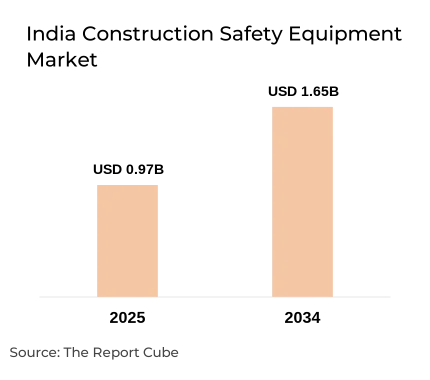
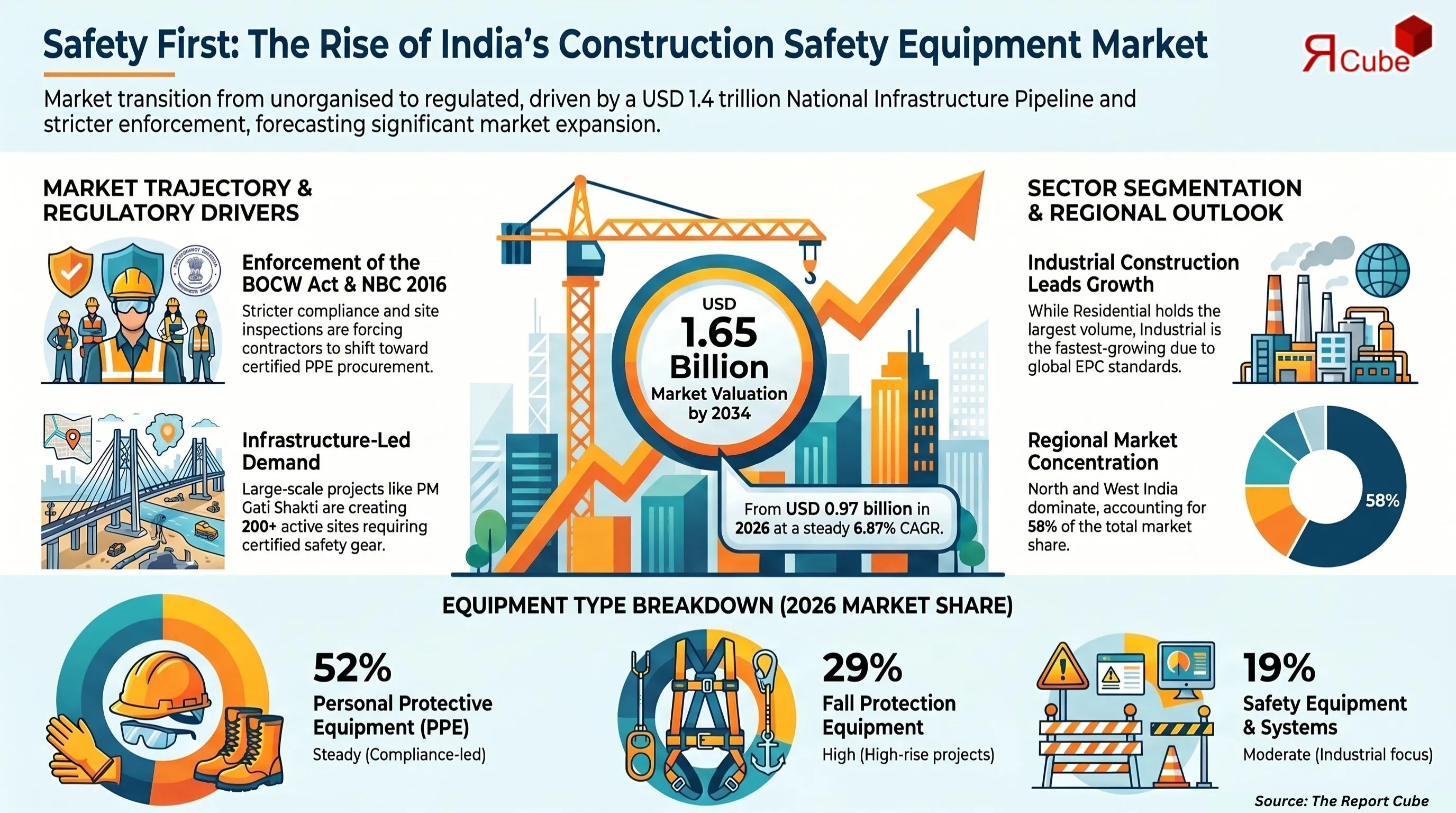
- The market is set for steady expansion, growing from USD 0.97 billion in 2026 to USD 1.65 billion by 2034, driven by rising construction activity and stricter safety regulations.
- A 6.87% CAGR reflects consistent demand, particularly as workplace safety compliance becomes non-negotiable across infrastructure and industrial projects.
- Personal Protective Equipment (PPE) remains the dominant segment, highlighting its critical role in ensuring worker safety across construction sites.
- While commercial construction continues to hold the largest share, industrial construction is emerging as the fastest-growing segment, fueled by increasing investments in manufacturing and large-scale industrial projects.
- The competitive landscape is shaped by global safety leaders such as 3M, Honeywell, MSA Safety, Uvex Group, and DuPont, all focusing on innovation and compliance-driven solutions.
- Overall, the market is transitioning toward advanced, high-performance safety solutions, supported by regulatory enforcement and growing awareness around worker protection.
India Construction Safety Equipment Market - Insights & Analysis
India's construction sector contributes over 8% of GDP and employs more than 51 million workers - yet on-site fatality and injury rates remain among the highest across all industries. The Bureau of Indian Standards (BIS) estimates that fewer than 35% of active construction sites achieve full PPE compliance, leaving millions of workers exposed to preventable harm every day. This analysis maps the forces reshaping the India construction safety equipment market from USD 0.97 billion in 2026 to USD 1.65 billion by 2034.
India's National Building Code (NBC) 2016 and BIS IS 14489 make site safety compliance mandatory for construction employers (Source: Bureau of Indian Standards, 2023). Ministry of Labour & Employment data on construction-sector fatalities has created direct regulatory urgency, pushing state governments and project owners toward stricter enforcement timelines. The industrial safety equipment demand in India has accelerated in tandem with this compliance push, as large-project operators invest in certified procurement channels to avoid penalty exposure.
Market growth is further anchored in the Smart Cities Mission and PM Gati Shakti infrastructure pipeline, which added 200+ active large-scale construction sites across the country (Source: Ministry of Housing and Urban Affairs, 2024). These sites operate under client-mandated safety specifications that systematically favour organised, BIS-certified equipment suppliers over informal alternatives.
The primary adoption barrier, however, remains price sensitivity among Tier-2 and Tier-3 city contractor segments. Small contractors operating on thin margins continue to source from unorganised channels, creating a structural compliance gap that simultaneously constrains current market penetration and signals future regulatory-catch-up demand.
India Construction Safety Equipment Market Dynamics
Regulatory momentum and infrastructure investment pull demand upward; affordability gaps and fragmented enforcement pull it back. India logged 48,000+ recorded occupational injuries in construction in 2022 - a figure the Ministry of Labour & Employment calls structurally under-reported by at least 40%. Four forces - one driver, one challenge, one trend, one opportunity - define this market's trajectory through 2034.
Key Market Driver: Mandatory Safety Compliance Under India's National Building Code & BOCW Act
Construction firms operating below BIS and BOCW Act compliance thresholds face project shutdowns and escalating penalty exposure. BOCW cess collections crossed INR 54,000 crore by 2023 - yet welfare fund utilisation for safety equipment remained below 20%, signalling enforcement acceleration ahead (Source: Ministry of Labour & Employment, 2023). Tightening compliance enforcement is the single largest driver pushing site supervisors and contractors toward certified PPE procurement.
The Building and Other Construction Workers Act (BOCW Act, 1996) places direct obligations on site employers to provide and maintain approved safety equipment for every worker on active projects. BIS certification requirements under IS 14489 mean that PPE products sold through formal channels must meet defined performance standards - a barrier that filters out the cheapest uncertified substitutes at the procurement stage.
State-level enforcement actions in Maharashtra, Delhi, and Tamil Nadu have accelerated formal-channel equipment procurement among contractors previously relying on unorganised suppliers. Maharashtra's construction safety inspection drive in 2023 resulted in work stoppages at 140+ non-compliant sites, creating immediate demand for certified hard hats, harnesses, and safety footwear. The penalty regime under NBC 2016 amendments adds financial consequence to what was previously a low-enforcement regulatory framework.
The PPE compliance standards in India landscape is shifting from passive obligation to active enforcement - a transition that compresses the timeline for contractor compliance and directly accelerates demand for the organised safety equipment supply chain.
Major Industry Challenge - Price Sensitivity and Informal Procurement in Tier-2/3 Markets
Certified construction safety equipment carries a cost premium of 30–60% over uncertified alternatives flooding Tier-2 and Tier-3 markets. An estimated 65% of India's 7.5 million active small contractors procure safety equipment from unorganised local distributors, bypassing BIS-certified channels entirely (Source: CII Construction Committee Report, 2022). This pricing and distribution gap is the primary obstacle limiting market penetration for multinational and organised domestic brands.
BIS-certified hard hats retail between INR 350–800 per unit; uncertified substitutes are available from local hardware stores at INR 80–150. For harnesses, the differential widens further - certified fall-arrest systems from brands like MSA Safety and Honeywell cost INR 2,500–6,000 versus INR 600–1,200 for uncertified alternatives. On projects where contractors personally absorb safety equipment costs, this gap drives systematic substitution.
The distribution architecture compounds the pricing problem. Multinational brands (3M, Honeywell) concentrate their authorised distributor networks in metro and Tier-1 city project corridors, ceding Tier-2 and Tier-3 geographies to local traders who stock uncertified products. The absence of mandatory digital procurement records at sub-INR 10 crore project sites creates an enforcement blind spot that local distributors exploit.
The PPE market in India cannot meaningfully grow in Tier-2 and Tier-3 geographies until distribution architecture - not just pricing - is restructured to make certified equipment accessible within the same supply chain radius as uncertified alternatives.
Emerging Trend - Smart PPE Integration and IoT-Enabled Safety Monitoring on Large Sites
Fatal incidents on large infrastructure projects - metro rail, highway corridors, port construction - often stem from supervision gaps that standard PPE cannot address. India's metro rail network expansion alone involves 40+ active construction corridors with workforces exceeding 500 workers per site - volumes that overwhelm manual safety supervision. IoT-integrated helmets, wearable gas sensors, and proximity-alert harnesses are entering large-project procurement in India's metro and expressway corridors.
Sensor-embedded hard hats with GPS tracking and impact-detection capability have been piloted on National Highways Authority of India (NHAI) highway projects, enabling real-time worker location monitoring and automatic incident alerts. 3M and Honeywell both introduced India-specific smart PPE product lines between 2023 and 2024, targeting EPC contractors on projects with international owner specifications. NASSCOM estimates that the broader IoT-in-construction market in India will exceed USD 1.2 billion by 2027 (Source: NASSCOM, 2023), providing the connectivity infrastructure these devices require.
Smart PPE adoption, however, remains geographically contained. Only top-tier EPC contractors operating on projects above INR 500 crore are currently specifying IoT-enabled equipment. Mass-market adoption across mid-scale contractors is a 2028–2034 story, contingent on device costs falling below INR 1,500 per unit and mobile connectivity gaps in construction zones closing.
Need Specific Data, Let’s Customize the Report for You
Request CustomizationEmerging Opportunity: Affordable Safety Equipment Designed for India's Informal Construction Workforce
India's informal construction workforce - estimated at 40+ million workers - operates almost entirely outside the certified safety equipment supply chain. The International Labour Organization estimates that informal construction workers in South Asia face injury rates 4× higher than those in regulated site environments (Source: ILO, 2022). Locally manufactured, BIS-certified safety equipment priced between INR 150–400 per unit represents the most under-served and fastest-growing addressable pocket in the market.
Geographically, the informal workforce concentrates in Uttar Pradesh, Bihar, Rajasthan, and Odisha - states with the lowest formal compliance rates and the highest density of small residential construction activity. Government schemes including the e-Shram portal and PM Suraksha Bima Yojana have created digital awareness infrastructure that lowers adoption friction - the e-Shram portal had registered 280M+ informal workers by 2023, creating a traceable demand base for targeted safety equipment distribution.
Lakeland Industries and domestic players including Hindustan Safety are moving into the affordable segment, manufacturing BIS-certified helmets and gloves at price points competitive with uncertified alternatives. The first-mover advantage window is narrow - larger multinationals have not yet localised pricing for this segment, giving domestic manufacturers a 3–5 year runway to establish brand recognition before international competition intensifies.
India Construction Safety Equipment Market - Segment-wise Analysis
Procurement decisions in India's construction safety equipment market split sharply by equipment function and project category. A buyer equipping a residential housing cluster operates under fundamentally different price, compliance, and channel constraints than one specifying safety systems for a petrochemical plant. The three equipment types and three construction categories produce nine distinct demand pockets, each with different price elasticity, regulatory triggers, and brand loyalty patterns.
By Equipment Type
- Personal Protective Equipment (PPE)
- Fall Protection Equipment
- Safety Equipment & Systems
Equipment-type selection on Indian construction sites is driven more by regulatory minimum requirements than by risk assessment - creating predictable concentration in the cheapest-to-comply category. PPE items (hard hats, gloves, safety footwear, high-visibility vests) account for the largest share of mandated items under BOCW site rules, anchoring their market dominance. The three equipment categories reveal contrasting growth profiles: PPE leads by volume, fall protection leads by unit value, and safety systems lead by emerging-site adoption.
PPE dominates with a 52% share due to mandatory compliance items every worker on every site must wear. Fall protection equipment (harnesses, lanyards, anchor systems) commands 29% and grows fastest by value as high-rise residential and commercial projects proliferate across Tier-1 cities. Safety Equipment & Systems (gas detectors, emergency lighting, fire suppression) holds 19% and concentrates in the industrial construction segment where international EPC standards apply.
The PPE market share India reflects compliance-driven purchasing behaviour - a maturity curve that will shift toward risk-assessed procurement as enforcement sophistication increases post-2026.
|
Equipment Type |
Estimated Share (2026) |
Growth Outlook 2026–2034 |
|---|---|---|
|
Personal Protective Equipment (PPE) |
52% |
Steady - compliance-led |
|
Fall Protection Equipment |
29% |
High - high-rise project surge |
|
Safety Equipment & Systems |
19% |
Moderate - industrial site focus |
By Construction Type
- Residential
- Commercial
- Industrial Construction
The construction type powering a project determines not just which safety equipment is needed - but whether it gets bought through formal or informal channels. Residential construction in India is predominantly executed by small contractors with fragmented safety compliance, while commercial and industrial projects operate under client-mandated safety specifications from blue-chip buyers. The three construction categories produce structurally different safety equipment demand, procurement formality, and brand penetration patterns.
- Residential Construction (44% share): Largest by project volume; lowest safety equipment compliance rate; dominated by low-cost PPE. Growth links directly to PMAY (Pradhan Mantri Awas Yojana) targets for affordable housing delivery - the residential construction growth India pipeline sustains basic PPE volume even as compliance rates lag.
- Commercial Construction (33% share): Mid-tier compliance; growing demand for fall protection as office towers and malls multiply in metro and Tier-1 cities. International tenant specifications increasingly require contractors to demonstrate certified safety procurement before site access is granted.
- Industrial Construction (23% share): Highest compliance stringency; safety systems and fall protection dominate procurement lists. Petrochemical, power, and data-centre construction - driven by international EPC contractors enforcing global standards - make this the fastest-growing segment by value through 2034.
|
Construction Type |
Estimated Share (2026) |
Key Safety Equipment Demand |
Compliance Driver |
|---|---|---|---|
|
Residential Construction |
44% |
Basic PPE |
BOCW Act / State rules |
|
Commercial Construction |
33% |
Fall Protection + PPE |
Client specifications |
|
Industrial Construction |
23% |
Safety Systems + Full PPE |
International EPC standards |
Regional Projection of India Construction Safety Equipment Market
Safety equipment demand in India does not distribute evenly - it clusters around active construction corridors, enforcement intensity, and industrial density. Four states - Maharashtra, Gujarat, Tamil Nadu, and Uttar Pradesh - account for an estimated 55%+ of India's formal construction-sector output, creating pronounced regional concentration in safety equipment procurement. The five major construction regions each carry distinct demand vectors, compliance gap profiles, and growth trajectories through 2034.
- North India (30%): Largest residential construction volume driven by PMAY targets and Delhi-NCR infrastructure expansion. PPE demand concentrates in hard hats and safety footwear; enforcement remains inconsistent outside the NCR zone, creating a significant compliance gap across UP and Rajasthan's smaller project markets.
- West India (28%): Maharashtra leads in commercial high-rise and metro rail construction - Mumbai Metro Lines 2B and 7 and Pune Metro collectively employ over 12,000 active construction workers. Gujarat anchors industrial safety equipment demand through PCPIR petrochemical clusters and GIFT City commercial projects, where international operator standards apply.
- South India (26%): Bengaluru and Hyderabad drive commercial construction PPE demand; the data-centre corridor expansion in Chennai and Hyderabad adds industrial safety systems procurement. Tamil Nadu leads manufacturing-linked construction safety equipment consumption through its automotive and electronics manufacturing plant construction pipeline.
- East India (16%): Lowest formal compliance rates; largest informal workforce concentration. Government infrastructure projects - NH expansion corridors and Kolkata Metro extensions - represent the primary formal safety equipment demand source in a region dominated by unorganised procurement.
The India infrastructure investment by region pipeline confirms that West and South India will see the fastest formal-sector safety equipment demand growth through 2030, while North India sustains the highest absolute volumes driven by residential construction scale.
|
Region |
Estimated Share (2026) |
Key Construction Driver |
Compliance Gap |
|---|---|---|---|
|
North India |
30% |
Residential / Metro Rail |
High in Tier-2/3 |
|
West India |
28% |
Industrial / Commercial |
Low in metro zones |
|
South India |
26% |
Commercial / Data Centres |
Moderate |
|
East India |
16% |
Government Infrastructure |
Very High |
India Construction Safety Equipment Market - Recent Developments (2024-2025)
The India construction safety equipment market recorded a concentrated wave of product launches, partnerships, and regulatory announcements in 2024–2025. At least six of the ten key players made India-specific market moves within 18 months - a density of activity that signals competitive acceleration ahead of the projected infrastructure surge. The developments below are listed chronologically and attributed to named company and government sources.
- 2024 - 3M India expanded its PPE distribution network to 200+ Tier-2 cities through regional distributor partnerships, directly addressing the channel gap identified as the market's primary structural challenge.
- 2024 - Honeywell Safety Products announced localised manufacturing of safety helmets at its Pune facility to meet BIS certification requirements, reducing lead times and landed costs for domestic buyers.
- 2024 - MSA Safety India launched a fall-arrest harness line certified to IS 3521 for high-rise construction applications, targeting the growing commercial construction segment in Mumbai and Bengaluru.
- 2025 - Bureau of Indian Standards issued updated IS 4770 specifications for industrial safety helmets, prompting product line revisions across the category from all major suppliers.
- 2025 - Delta Plus Group expanded India sales operations, targeting the commercial construction segment in South India with a direct sales force covering Tamil Nadu, Karnataka, and Andhra Pradesh.
Each of these moves represents preparation for enforcement tightening ahead - companies repositioning supply chains and certification portfolios before the compliance crackdown accelerates formal procurement volumes.
India Construction Safety Equipment Market Future Outlook (2034)
The market's USD 0.68 billion expansion from 2026 to 2034 rests on three structural pillars - none of which are guaranteed to activate at the same pace. If BOCW Act enforcement reaches 60% compliance across formal sites by 2030 (from the current 35%), the market could outperform the 6.87% CAGR baseline. If infrastructure pipeline delays repeat the 2020–2022 pattern, the trajectory compresses. Three drivers and one downside scenario define the range of outcomes.
- Driver 1 - Infrastructure Scale: The National Infrastructure Pipeline India targets USD 1.4 trillion in project investment by 2030 (Source: DEA, Ministry of Finance, 2023). This pipeline sustains large-project safety equipment demand across road, rail, port, and energy sectors through 2034 - the foundational demand floor that holds the market even in a low-enforcement scenario.
- Driver 2 - Regulatory Escalation: Progressive state-level BOCW enforcement and a potential NBC 2016 amendment expanding mandatory PPE categories to residential sub-10-storey projects would add an estimated 2.8 million additional workers to the formal safety equipment demand pool by 2030.
- Driver 3 - Workforce Formalisation: e-Shram registration and social security linkage create pressure on contractors to demonstrate compliance to government clients - a demand pull from the bottom of the workforce pyramid that bypasses the need for top-down enforcement.
- Downside Scenario: Fiscal consolidation delaying NIP project disbursements post-2027 election cycle could compress large-project demand, pushing the effective CAGR to the 5.5–6.0% range through 2030 before recovering.
- Winning Product Categories by 2034: Fall protection equipment (driven by high-rise project surge); smart PPE (mandated by large EPC project owners); affordable certified PPE (pulled by informal workforce formalisation). These three categories will capture a disproportionate share of the USD 1.65 billion 2034 market.
Why Choose This Report?
- Covers the 2026–2034 forecast window with segment-level granularity across equipment type and construction category
- Provides regional breakdowns across five Indian construction corridors with compliance gap analysis
- Profiles 10 key players - 3M, Honeywell, MSA Safety, Uvex Group, DuPont, Ansell, Lakeland Industries, Bullard, Delta Plus - with India-specific activity tracking
- Maps demand drivers to specific regulatory instruments (BOCW Act, NBC 2016, BIS IS 14489)
- Includes smart PPE and informal-workforce opportunity quantification unavailable in standard market reports
- Sourced from primary government databases, BIS notifications, and ILO occupational safety data
- Structured for use by procurement managers, EPC contractors, PPE manufacturers, and infrastructure investors
Explore our full range of construction market research reports for sector-specific data across civil, industrial, and infrastructure segments.
Table of Contents
- Introduction
- Objective of the study
- Product Definition
- Market Segmentation
- Study Variables
- Research Methodology
- Secondary Data Points
- Companies Interviewed
- Primary Data Points
- Breakdown of Primary Interviews
- Secondary Data Points
- Executive Summary
- Market Dynamics
- Drivers
- Challenges
- Opportunity Assessment
- Recent Trends and Developments
- Policy and Regulatory Landscape
- India Construction Safety Equipment Market Overview and Forecast Analysis (2021-2034)
- Market Size, By Value, By growth rate (CAGR/USD Billions)
- Demand - Supply Trends
- Market Share, By Equipment Type
- Personal Protective Equipment (PPE)
- Fall Protection Equipment
- Safety Equipment and Systems
- Market Share, By Construction Type
- Residential Construction
- Commercial Construction
- Industrial Construction
- Market Share, By Application
- Worker Body Safety
- Workplace Safety
- Market Share, By Region
- West
- South
- North
- East
- Market Share, By Competitors
- Competition Characteristics
- Revenue Shares
- India Personal Protective Equipment (PPE) Construction Safety Equipment Market Overview, 2021-2034F
- By Value (USD Million)
- By Construction Type- Market Size & Forecast 2021-2034, USD Million
- By Application- Market Size & Forecast 2021-2034, USD Million
- India Fall Protection Equipment Construction Safety Equipment Market Overview, 2021-2034F
- By Value (USD Million)
- By Construction Type- Market Size & Forecast 2021-2034, USD Million
- By Application- Market Size & Forecast 2021-2034, USD Million
- India Safety Equipment and Systems Construction Safety Equipment Market Overview, 2021-2034F
- By Value (USD Million)
- By Construction Type- Market Size & Forecast 2021-2034, USD Million
- By Application- Market Size & Forecast 2021-2034, USD Million
- Competitive Outlook (Company Profile - Partial List)
- 3M
- Company Overview
- Business Segments
- Strategic Alliances/Partnerships
- Recent Developments
- Honeywell
- Company Overview
- Business Segments
- Strategic Alliances/Partnerships
- Recent Developments
- MSA Safety
- Company Overview
- Business Segments
- Strategic Alliances/Partnerships
- Recent Developments
- Uvex Group
- Company Overview
- Business Segments
- Strategic Alliances/Partnerships
- Recent Developments
- DuPont
- Company Overview
- Business Segments
- Strategic Alliances/Partnerships
- Recent Developments
- Ansell
- Company Overview
- Business Segments
- Strategic Alliances/Partnerships
- Recent Developments
- Lakeland Industries
- Company Overview
- Business Segments
- Strategic Alliances/Partnerships
- Recent Developments
- Bullard
- Company Overview
- Business Segments
- Strategic Alliances/Partnerships
- Recent Developments
- Delta Plus
- Company Overview
- Business Segments
- Strategic Alliances/Partnerships
- Recent Developments
- Others
- 3M
- Contact Us & Disclaimer
Top Key Players & Market Share Outlook
- 3M
- Honeywell
- MSA Safety
- Uvex Group
- DuPont
- Ansell
- Lakeland Industries
- Bullard
- Delta Plus
- Others
Frequently Asked Questions






