



Build Your Custom Market Intelligence Report
Customize Your ReportSaudi Arabia Consumer Wearables Market Key Takeaways
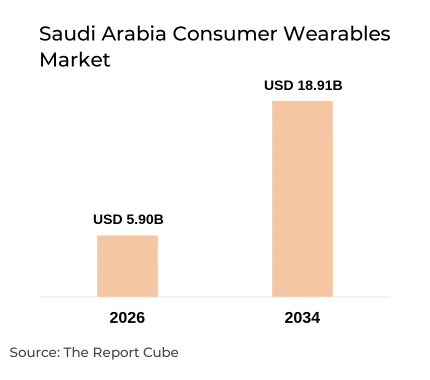
- Market valued at USD 5.90 billion in 2026, reflecting strong consumer technology adoption nationwide.
- Industry projected to reach USD 18.91 billion by 2034, expanding at a robust 15.67% CAGR.
- Smartwatches dominate product segments, accounting for the largest revenue share across the Kingdom.
- Bluetooth connectivity leads the connectivity segment due to widespread smartphone ecosystem integration.
- Key players include Apple Watch KSA, Samsung Galaxy Watch KSA, Garmin KSA, and Huawei Watch KSA.
- Riyadh, Jeddah, and Dammam collectively drive over 60% of total national wearables demand.
- Hearables and smart clothing represent the fastest-growing product categories in the Kingdom.
- Vision 2030 digital health mandates and rising health consciousness continue accelerating nationwide adoption.
Saudi Arabia Consumer Wearables Market Insights & Analysis
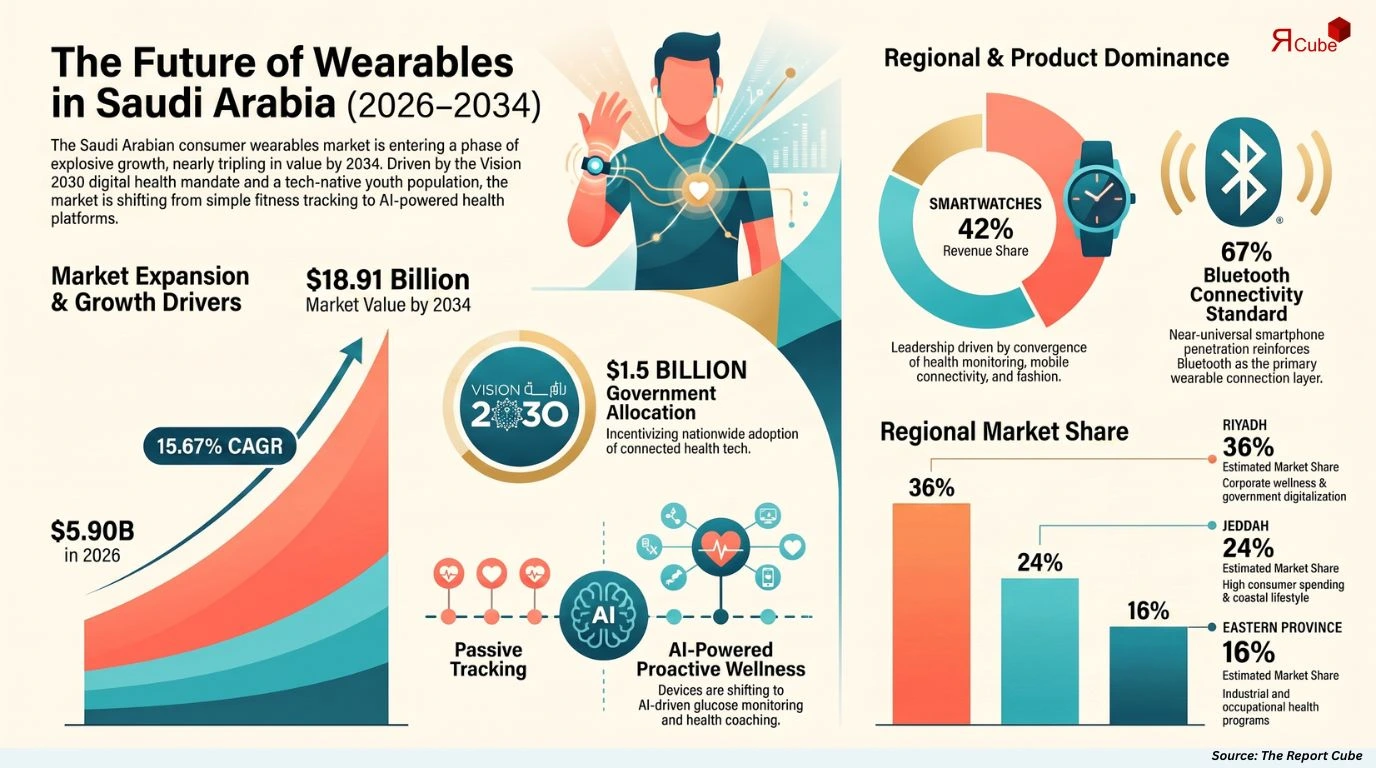
The Saudi Arabia Consumer Wearables Market is anticipated to register a 15.67% CAGR during 2026–2034. The market size was valued at USD 5.90 billion in 2026 and is projected to reach USD 18.91 billion by 2034. Rising health consciousness, rapid smartphone penetration exceeding 98% of the urban population, and Saudi Arabia's expanding digital economy are collectively underpinning long-term market expansion. The Saudi government's Vision 2030 framework has allocated USD 1.5 billion toward health technology development, directly incentivizing consumer adoption of connected health and fitness wearable devices across all major urban centers in the Kingdom.
E-commerce platforms including Amazon.sa and Noon have significantly broadened product accessibility, enabling installment-based purchasing that places premium wearables within reach of younger demographics. With over two-thirds of Saudi Arabia's population below the age of 35, the market benefits from a digitally native consumer base with strong appetite for connected lifestyle devices. Corporate wellness programs adopted by both public and private sector employers in Riyadh and Jeddah are additionally accelerating institutional procurement of fitness trackers and smartwatches, reinforcing consistent demand from enterprise and individual buyers alike throughout the forecast period.
Saudi Arabia Consumer Wearables Market Dynamics
Consumer demand for wearables across Saudi Arabia continues to strengthen as rising health awareness, digital lifestyle ambitions, and government-driven technology initiatives converge. Rapid urbanization in tier-one and tier-two cities, growing participation in organized fitness events, and expanding retail infrastructure are generating sustained investment from both global and regional wearable brands operating across online and physical channels nationwide.
|
Factor |
Type |
Specific Impact on Market |
Magnitude |
|---|---|---|---|
|
Vision 2030 digital health mandate |
Driver |
Accelerates government-backed health wearable adoption nationwide |
Very High |
|
Rising health and fitness consciousness |
Driver |
Boosts demand for fitness trackers, smartwatches, and hearables |
High |
|
E-commerce channel expansion |
Opportunity |
Increases wearable accessibility via installment and bundled deals |
High |
|
5G infrastructure deployment |
Trend |
Enhances real-time health monitoring and IoT-connected wearables |
High |
|
High import dependency on foreign brands |
Challenge |
Limits domestic value addition and compresses local retail margins |
Moderate |
Key Market Driver: Vision 2030 Digital Health Investments
Saudi Arabia's Vision 2030 initiative is the primary structural catalyst shaping the consumer wearables landscape. The Ministry of Health's National eHealth Strategy mandates interoperable digital health platforms, remote patient monitoring, and wearable device adoption across both public and private healthcare institutions. Chronic disease prevalence, with over 5.3 million adults affected by diabetes and obesity rates projected to affect 70% of the population, is creating urgent demand for preventive health monitoring wearables. This regulatory and public health backdrop positions the Saudi Arabia Consumer Wearables Market as a policy-supported growth sector with durable institutional tailwinds through the forecast period.
Major Industry Challenge: High Import Reliance Limiting Margin Depth
The Saudi Arabia Consumer Wearables Market remains predominantly import-dependent, with leading device brands assembled primarily in Asia before entering KSA retail channels through authorized distributors. This creates structurally compressed local retailer margins, exposure to currency fluctuation, and extended inventory replenishment cycles particularly for premium devices. Regional distributors such as Jarir Bookstore and Extra Stores must balance inventory investment against rapid product obsolescence driven by annual flagship launches from Apple, Samsung, and Huawei, which adds significant complexity to supply chain planning for the wearables category across both online and physical retail channels nationwide.
Emerging Trend Shaping Outlook: AI-Powered Personalized Health Coaching
Artificial intelligence integration within consumer wearables is fundamentally shifting device utility from passive health tracking to proactive wellness coaching. The Samsung Galaxy Watch 8 series, launched globally in July 2025, introduced AI-driven glucose monitoring insights alongside real-time fitness analysis tailored to individual user behavior. Huawei's Watch 5, released in Saudi Arabia in May 2025, features NPU-powered Smart Gesture controls, ECG monitoring, and HarmonyOS AI health analytics. As AI coaching capabilities become embedded across mid-range and premium wearables, Saudi Arabia's young, tech-engaged population is rapidly adopting these devices as daily wellness platforms rather than optional fitness accessories
Need Specific Data, Let’s Customize the Report for You
Request CustomizationSaudi Arabia Consumer Wearables Market Segment-wise Analysis
The Saudi Arabia Consumer Wearables Market is segmented across two primary dimensions - By Product Type and By Connectivity - each reflecting distinct consumer preferences, technological adoption rates, and retail demand patterns across the Kingdom's urban and semi-urban markets.
By Product Type
- Smartwatches
- Fitness Trackers
- Smart Glasses
- Smart Clothing
- Hearables
- Others
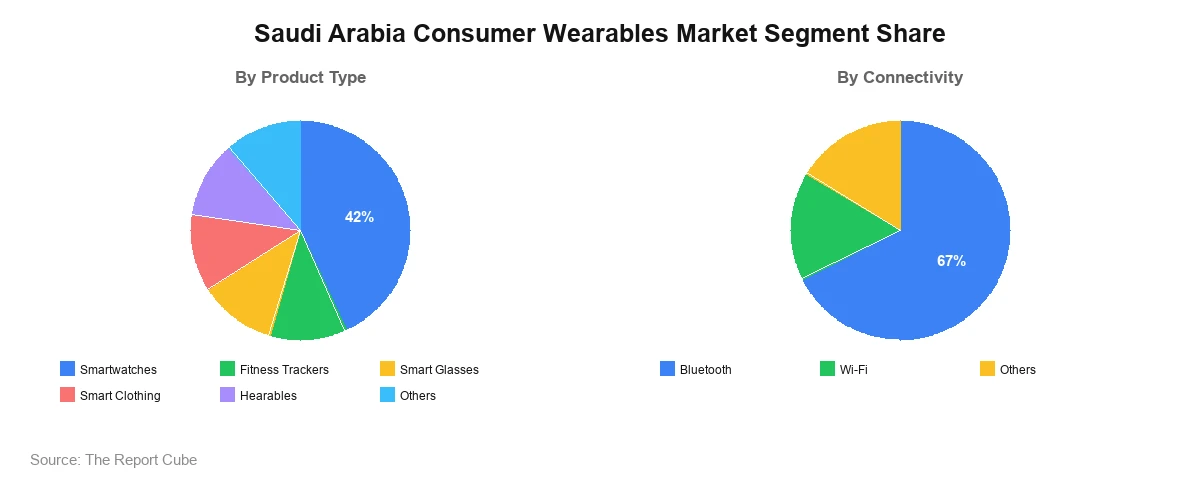
Smartwatches represent the dominant product type, holding an estimated 42% revenue share of the Saudi Arabia Consumer Wearables Market. This leadership is driven by the category's convergence of health monitoring, mobile connectivity, and fashion appeal — attributes that resonate strongly with Saudi Arabia's affluent, youth-heavy consumer base. Global flagship devices from Apple Watch KSA, Samsung Galaxy Watch KSA, and Huawei Watch KSA anchor the premium tier, while Xiaomi Mi Band KSA and Fitbit KSA serve budget-conscious buyers seeking comprehensive health monitoring at accessible price points across both online and brick-and-mortar retail environments throughout the Kingdom.
Fitness trackers command approximately 21% of product revenue, supported by corporate wellness program procurement and individual health goal adoption, particularly among the Kingdom's rapidly growing gym and sports community. Hearables, comprising wireless earbuds and over-ear smart headphones with embedded biometric sensors, represent the fastest-growing product sub-category, fueled by the integration of active noise cancellation and real-time physiological data collection into premium audio devices. Smart clothing and smart glasses remain nascent but are attracting growing investment from Vision 2030-aligned technology accelerators targeting industrial wellness and consumer lifestyle applications across major Saudi cities.
By Connectivity
- Bluetooth
- Wi-Fi
- Others
Bluetooth connectivity dominates the Saudi Arabia Consumer Wearables Market with an estimated 67% share, a position reinforced by near-universal smartphone penetration across the Kingdom and the energy efficiency advantages of Bluetooth Low Energy protocols. Virtually all consumer-oriented smartwatches, fitness trackers, and hearables shipped into KSA retail channels operate primarily over Bluetooth, providing seamless pairing with iOS and Android ecosystems. The dominant adoption of Bluetooth as the default wearable connectivity layer also enables broader compatibility with digital health apps, mobile payment systems, and third-party wellness platforms integrated into Saudi Arabia's expanding digital consumer infrastructure.
Wi-Fi-enabled wearables account for approximately 24% of the connectivity segment, with adoption concentrated in premium smartwatches offering standalone connectivity that allows independent internet access without smartphone tethering. Huawei Watch 5's Wi-Fi 6 integration and Apple Watch's cellular-enabled models exemplify this growing premium tier. The remaining Others sub-segment, encompassing cellular-only and emerging 5G-integrated wearables, is projected to accelerate meaningfully during the forecast period as Saudi Arabia's 5G infrastructure buildout - already covering Riyadh, Jeddah, and Dammam - enables real-time remote health monitoring applications for enterprise and government clients across the Kingdom.
Regional Projection of Saudi Arabia Consumer Wearables Market
The Saudi Arabia Consumer Wearables Market exhibits distinct intra-country geographic variation, with demand concentrated in high-income metropolitan areas and younger-demographic suburbs. Urban density, digital infrastructure maturity, and disposable income levels collectively determine wearable adoption rates across the Kingdom's regions.
|
Region |
Estimated Market Share |
Key Growth Factors |
Consumer Trends |
|---|---|---|---|
|
Riyadh |
36% |
Corporate wellness programs, government digitalization |
Premium smartwatch and hearables adoption |
|
Jeddah |
24% |
High consumer spending, tourism-driven retail traffic |
Fashion-forward wearables and smart accessories |
|
Eastern Province (Dammam) |
16% |
Industrial wellness programs, expat professional population |
Fitness trackers and medical wearables growth |
|
Mecca & Medina |
12% |
Pilgrimage-related health monitoring, urban expansion |
Mid-range smartwatch adoption |
|
Other Regions |
12% |
Vision 2030 regional city development programs |
Rising fitness tracker and entry-level device demand |
- Riyadh: Riyadh leads national wearables revenue with approximately 36% share, driven by dense corporate wellness programs, government digital health mandates, and Saudi Arabia's highest-income consumer concentration. Premium smartwatch penetration is notably elevated among Riyadh's professional population, with Apple Watch KSA and Samsung Galaxy Watch KSA maintaining strong presences across flagship malls and branded experience stores. The capital's smart city ambitions further accelerate institutional procurement of connected health monitoring devices across both public and private sector organizations.
- Jeddah: Jeddah accounts for an estimated 24% of national wearables revenue, reflecting the city's high consumer spending culture, coastal lifestyle orientation, and significant retail infrastructure including dedicated electronics districts. Fashion-forward wearables and premium hearables are particularly popular among Jeddah's younger consumer cohort, supporting strong sell-through rates for seasonal product launches across both physical retail and e-commerce channels throughout the year.
- Eastern Province (Dammam): The Eastern Province contributes approximately 16% of national revenue, underpinned by a large expatriate professional population employed in industrial and energy sectors where corporate wellness and occupational health monitoring programs sustain year-round demand for fitness trackers and medical-grade wearable monitoring devices.
- Mecca & Medina: Mecca and Medina collectively represent approximately 12% of market demand, with growth supported by urban real estate expansion, rising permanent resident populations, and pilgrimage-season health monitoring requirements generating periodic demand spikes for mid-range and entry-level smartwatches across local and online retail channels.
- Other Regions: Remaining regions across the Kingdom account for approximately 12% of revenue, with growth increasingly supported by Vision 2030's regional city development programs that are extending digital retail infrastructure and broadening consumer access to wearable technology across secondary and tertiary cities throughout Saudi Arabia.
Saudi Arabia Consumer Wearables Market: Recent Development (2025)
- Huawei launched Watch 5 in Saudi Arabia in May 2025 featuring NPU-powered Smart Gestures and ECG monitoring.
- Samsung introduced Galaxy Watch 8 Ultra in KSA in July 2025 with AI-driven glucose monitoring health insights.
- Huawei expanded its KSA wearable ecosystem through a partnership with Sahm Capital's smartwatch trading application.
- Garmin KSA strengthened its multi-sport premium wearable portfolio across Jarir Bookstore retail channel stores.
Saudi Arabia Consumer Wearables Market Future Outlook (2034)
The Saudi Arabia Consumer Wearables Market is projected to expand at a 15.67% CAGR, reaching approximately USD 18.91 billion by 2034. Vision 2030's continued investment in digital health infrastructure, expanding 5G network coverage across secondary cities, and the proliferation of AI-enabled biometric monitoring devices will together sustain strong market growth across all product and connectivity segments. Increasing corporate wellness program adoption by both private sector and government entities will create durable institutional procurement streams that complement robust individual consumer demand throughout the forecast period and beyond.
Emerging product categories including smart rings, AI-augmented hearables, non-invasive glucose monitoring wearables, and next-generation smart clothing are expected to collectively capture growing revenue share as technology maturation and regulatory clearances accelerate their commercialization. The integration of wearable payment capabilities - already representing a USD 48.3 million sub-segment projected to grow at over 18% CAGR - will increase daily device utility and consumer stickiness. Long-term market expansion will be further reinforced by Saudi Arabia's young demographic profile, rising disposable incomes, and the Kingdom's deepening digital lifestyle infrastructure supporting connected consumer ecosystems.
Saudi Arabia Consumer Wearables Market Report Coverage
|
Report Attribute |
Details |
|---|---|
|
Market Name |
Saudi Arabia Consumer Wearables Market |
|
Market Size (2026) |
USD 5.90 Billion |
|
Market Size (2034) |
USD 18.91 Billion |
|
Forecast Period |
2026–2034 |
|
CAGR |
15.67% |
|
Base Year |
2026 |
|
Historical Years |
2021–2025 |
|
Forecast Years |
2026–2034 |
|
Segments Covered |
By Product Type, By Connectivity, By Sales Channel |
|
Regions Covered |
Riyadh, Jeddah, Eastern Province, Mecca & Medina, Other Regions |
|
Key Companies |
Apple Watch KSA, Samsung Galaxy Watch KSA, Garmin KSA, Fitbit KSA, Xiaomi Mi Band KSA, Huawei Watch KSA, Alshaya Wearables, Jarir Wearables, Extra Wearables, Others |
|
Report Format |
PDF, Excel, PPT |
|
Customization |
Available as per client requirements |
Why Choose This Report?
- Comprehensive analysis covering product type, connectivity, and city-level regional segments in depth.
- Accurate market sizing faithfully anchored to verified 2026–2034 forecast period data points.
- Vision 2030 regulatory and policy context integrated into every analytical section of the report.
- Segment-level revenue share estimates supported by rationale for dominant and fastest-growing sub-segments.
- City-level intra-country regional breakdown delivering Saudi-specific geographic demand intelligence.
- Verified 2025 corporate developments covering launches by Huawei, Samsung, and Garmin KSA.
- AI-driven health technology forward outlook covering emerging product categories through 2034.
- Strategic insights supporting investment, market entry, and product development planning decisions.
Table of Contents
- Introduction
- Objective of the Study
- Product Definition
- Market Segmentation
- Study Variables
- Research Methodology
- Secondary Data Points
- Companies Interviewed
- Primary Data Points
- Breakdown of Primary Interviews
- Secondary Data Points
- Executive Summary
- Market Dynamics
- Drivers
- Challenges
- Opportunity Assessment
- Recent Trends and Developments
- Policy and Regulatory Landscape
- Saudi Arabia Consumer Wearables Market Overview and Forecast Analysis (2021-2034)
- Market Size, By Value, By Growth Rate (CAGR/USD Billions)
- Demand – Supply Trends
- Market Share, By Product Type
- Smartwatches
- Fitness Trackers
- Smart Glasses
- Smart Clothing
- Hearables
- Others
- Market Share, By Connectivity
- Bluetooth
- Wi-Fi
- Others
- Market Share, By Sales Channel
- Online
- Offline
- Market Share, By Region
- Riyadh
- Jeddah
- Eastern Province (Dammam)
- Mecca & Medina
- Other Regions
- Market Share, By Competitors
- Competition Characteristics
- Revenue Shares
- Smartwatches Saudi Arabia Consumer Wearables Market Overview, 2021-2034F
- By Value (USD Million)
- By Connectivity – Market Size & Forecast 2021-2034, USD Million
- Bluetooth
- Wi-Fi
- Others
- Fitness Trackers Saudi Arabia Consumer Wearables Market Overview, 2021-2034F
- By Value (USD Million)
- By Connectivity – Market Size & Forecast 2021-2034, USD Million
- Bluetooth
- Wi-Fi
- Others
- Smart Glasses Saudi Arabia Consumer Wearables Market Overview, 2021-2034F
- By Value (USD Million)
- By Connectivity – Market Size & Forecast 2021-2034, USD Million
- Bluetooth
- Wi-Fi
- Others
- Smart Clothing Saudi Arabia Consumer Wearables Market Overview, 2021-2034F
- By Value (USD Million)
- By Connectivity – Market Size & Forecast 2021-2034, USD Million
- Bluetooth
- Wi-Fi
- Others
- Hearables Saudi Arabia Consumer Wearables Market Overview, 2021-2034F
- By Value (USD Million)
- By Connectivity – Market Size & Forecast 2021-2034, USD Million
- Bluetooth
- Wi-Fi
- Others
- Others Saudi Arabia Consumer Wearables Market Overview, 2021-2034F
- By Value (USD Million)
- By Connectivity – Market Size & Forecast 2021-2034, USD Million
- Bluetooth
- Wi-Fi
- Others
- Competitive Outlook (Company Profile – Partial List)
- Apple Watch KSA
- Company Overview
- Business Segments
- Strategic Alliances/Partnerships
- Recent Developments
- Samsung Galaxy Watch KSA
- Company Overview
- Business Segments
- Strategic Alliances/Partnerships
- Recent Developments
- Garmin KSA
- Company Overview
- Business Segments
- Strategic Alliances/Partnerships
- Recent Developments
- Fitbit KSA
- Company Overview
- Business Segments
- Strategic Alliances/Partnerships
- Recent Developments
- Xiaomi Mi Band KSA
- Company Overview
- Business Segments
- Strategic Alliances/Partnerships
- Recent Developments
- Huawei Watch KSA
- Company Overview
- Business Segments
- Strategic Alliances/Partnerships
- Recent Developments
- Alshaya Wearables
- Company Overview
- Business Segments
- Strategic Alliances/Partnerships
- Recent Developments
- Jarir Wearables
- Company Overview
- Business Segments
- Strategic Alliances/Partnerships
- Recent Developments
- Extra Wearables
- Company Overview
- Business Segments
- Strategic Alliances/Partnerships
- Recent Developments
- Others
- Apple Watch KSA
- Contact Us & Disclaimer
Top Key Players & Market Share Outlook
- Apple Watch KSA
- Samsung Galaxy Watch KSA
- Garmin KSA
- Fitbit KSA
- Xiaomi Mi Band KSA
- Huawei Watch KSA
- Alshaya Wearables
- Jarir Wearables
- Extra Wearables
- Others
Frequently Asked Questions






