



Build Your Custom Market Intelligence Report
Customize Your ReportAsia Container Orchestration Market Key Highlights
By Technology:
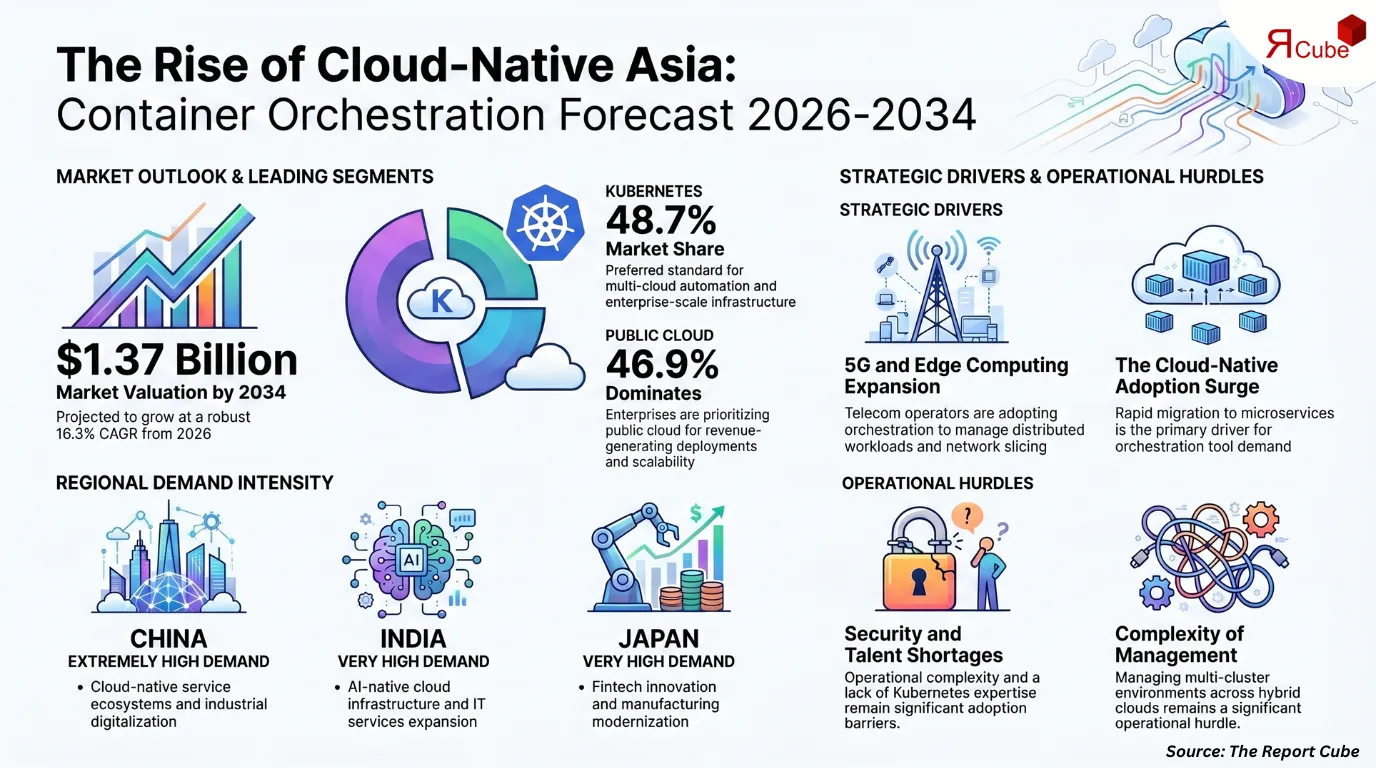
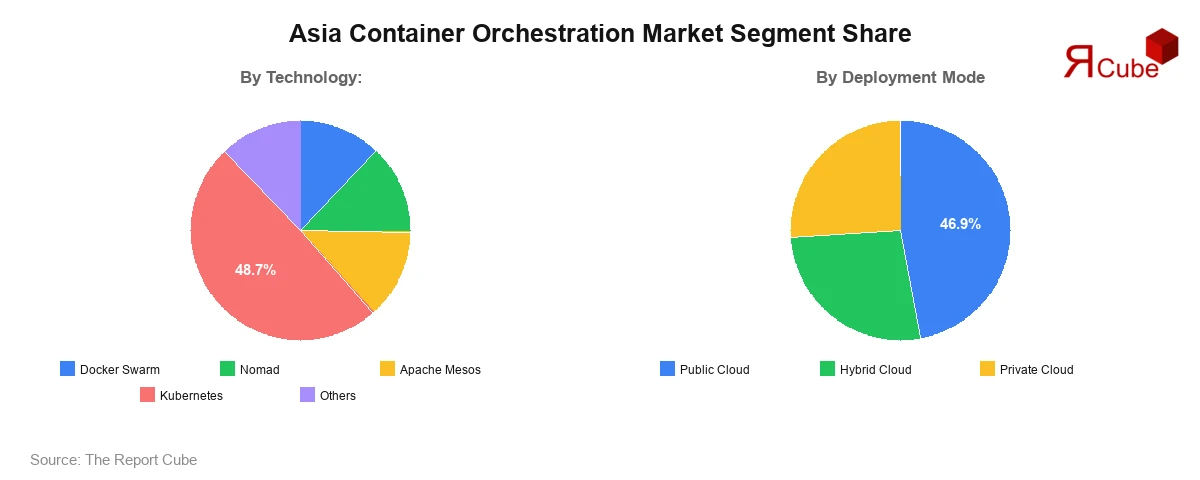
Kubernetes segment leads the market with nearly 48.7% share.
By Deployment Mode:
Public cloud segment dominates the market with around 46.9% of revenue.
Regional Outlook:
China dominates the Asia Container Orchestration market with approximately 34.2% share.
Asia Container Orchestration Market Insights & Analysis
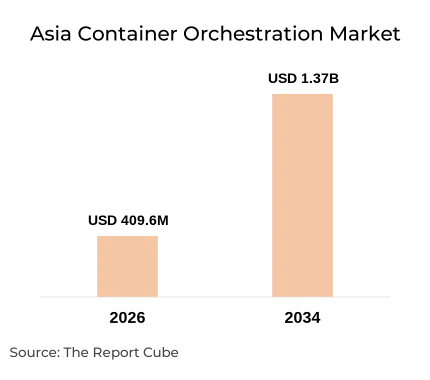
The Asia Container Orchestration Market is anticipated to register a CAGR of around 16.3% during the forecast period 2026-2034. The market size is valued at USD 409.6 million in 2026 and is projected to reach USD 1370.87 million by 2034. Rapid enterprise modernization, increasing cloud-native application development, and rising deployment of Kubernetes platforms are strengthening the Asia container orchestration market growth. Large organizations across banking, telecom, manufacturing, and retail sectors are increasingly shifting toward automated infrastructure management to improve workload scalability and operational efficiency. Growing adoption of DevOps frameworks and microservices architecture is also accelerating demand for orchestration platforms across hybrid and multi-cloud environments.
Large cloud service providers and telecom operators across China, India, Japan, and Southeast Asia continue investing in advanced data center infrastructure and managed orchestration services. Enterprises are also prioritizing operational resilience, application portability, and faster software deployment cycles to strengthen digital competitiveness. Rising adoption of DevOps practices and microservices architecture is creating long-term demand for orchestration platforms that improve resource utilization and infrastructure efficiency. Expanding implementation of edge computing and 5G-enabled applications across manufacturing, logistics, healthcare, and smart city projects is further contributing to sustained growth of the Asia container orchestration industry.
Asia Container Orchestration Market Impact Analysis
| Factor | Type | Specific Impact on Market | Magnitude | Business Implication |
|---|---|---|---|---|
| Cloud Native Adoption Surge | Market | Rapid shift toward microservices drives container usage growth | High | Expands demand for orchestration tools across enterprises |
| Digital Transformation Programs | Market | Government and enterprise projects increase platform deployments | High | Supports multi industry uptake of orchestration solutions |
| Skills and Talent Shortage | Consumer | Lack of Kubernetes expertise slows complex implementation work | Medium | Boosts need for managed services and training partnerships |
| Vendor Ecosystem Concentration | Competitive | Few global providers dominate platforms and service offerings | Medium | Raises entry barriers but enables strategic alliances growth |
| Regulatory and Data Localisation Rules | Regulatory | Compliance needs shape deployment models across key economies | Medium | Encourages hybrid and regional data center based clusters |
| Edge and 5G Network Expansion | Technological | New latency sensitive uses require distributed orchestration | High | Creates demand for edge ready container management stacks |
| Macro Economic and IT Budget Cycles | Environmental | Spending slowdowns can delay large scale modernization projects | Medium | Needs flexible pricing and value proof to sustain adoption |
Asia Container Orchestration Market Dynamics
Key Driver: Accelerating Enterprise Migration Toward Cloud-Native Infrastructure
Rapid enterprise migration toward cloud-native environments is a major factor supporting Asia container orchestration market growth. Organizations are increasingly adopting containerized applications to improve operational flexibility, reduce infrastructure dependency, and accelerate software deployment processes. Container orchestration platforms simplify workload scheduling, automated scaling, service discovery, and infrastructure management across distributed cloud ecosystems. Financial institutions, e-commerce companies, and telecom providers are actively investing in orchestration-ready infrastructure to support high-traffic digital platforms and real-time customer services.
Demand for automated infrastructure management is also rising due to the growing complexity of enterprise applications across Asia. Enterprises operating in hybrid and multi-cloud environments require orchestration solutions that provide centralized monitoring, policy enforcement, and seamless application portability. Expansion of AI-driven workloads, SaaS adoption, and cloud-hosted enterprise platforms is further strengthening the need for scalable orchestration technologies. Countries including India, China, and South Korea are witnessing higher adoption of Kubernetes environments as enterprises prioritize infrastructure modernization and cloud scalability.
Book your FREE 30-minute expert consultation today
Contact UsIndustry Trends: Expansion of Edge-Native Platforms and Kubernetes Ecosystems
Kubernetes continues to dominate the regional orchestration landscape as enterprises standardize container management environments across public and hybrid cloud infrastructure. Cloud providers are expanding managed Kubernetes offerings to simplify deployment, monitoring, and lifecycle management for enterprise customers. Businesses are increasingly integrating observability tools, automated security frameworks, and service mesh technologies into orchestration environments to improve application reliability and operational transparency. This trend is strengthening adoption across industries requiring high-performance cloud-native infrastructure.
Telecommunications and manufacturing sectors are also accelerating deployment of edge-native computing systems supported by orchestration platforms. Growing rollout of 5G standalone infrastructure, industrial IoT networks, and low-latency applications requires scalable container management frameworks capable of supporting distributed workloads. Enterprises across Asia are increasingly adopting automation-driven orchestration environments to support real-time analytics, predictive maintenance systems, and AI-enabled operational platforms. This transition is expected to reshape enterprise infrastructure strategies throughout the forecast period.
Major Challenge: Infrastructure Security and Operational Complexity
Managing large-scale containerized environments across multiple cloud platforms continues to create operational challenges for enterprises. Container orchestration systems often require advanced configuration management, workload visibility, runtime protection, and policy governance capabilities. Organizations handling sensitive enterprise and customer data face increasing concerns regarding cybersecurity threats, workload isolation, and infrastructure vulnerabilities. Misconfigured Kubernetes clusters and insecure APIs remain key operational risks across rapidly expanding cloud-native environments.
Limited availability of experienced Kubernetes professionals and DevOps specialists across several Asian economies is also affecting deployment efficiency among mid-sized enterprises. Many organizations face difficulties integrating orchestration platforms with legacy systems and maintaining consistent performance across distributed infrastructure. Compliance requirements associated with regional data governance frameworks further increase operational complexity for enterprises operating across multiple jurisdictions. These factors may slow adoption rates among businesses with limited technical resources and infrastructure modernization budgets.
Opportunity: Rising Investments in 5G, AI Infrastructure, and Edge Computing
Strong investment activity in 5G infrastructure and AI-enabled enterprise ecosystems is creating substantial growth opportunities for the Asia container orchestration market. Telecom operators across the region are deploying cloud-native network functions and virtualized infrastructure that depend on orchestration platforms for automation and resource optimization. Container orchestration technologies support dynamic workload allocation, network scalability, and low-latency service delivery, making them essential for modern telecom architecture and edge computing environments.
Growing adoption of AI-powered enterprise applications is also increasing demand for scalable orchestration frameworks capable of supporting data-intensive workloads. Industries including healthcare, manufacturing, transportation, and financial services are deploying machine learning systems, predictive analytics tools, and intelligent automation platforms requiring high-performance infrastructure management. Government-backed digital economy initiatives across Asia are encouraging enterprise cloud adoption and modernization of public-sector infrastructure. These developments are expected to strengthen demand for orchestration platforms supporting secure, scalable, and automated cloud-native operations.
Asia Container Orchestration Market Segment-wise Analysis
By Technology:
- Docker Swarm
- Nomad
- Apache Mesos
- Kubernetes
- Others
Kubernetes accounts for nearly 48.7% share of the Asia container orchestration market due to its strong compatibility with multi-cloud infrastructure and enterprise-scale automation requirements. Large enterprises increasingly prefer Kubernetes because it enables automated deployment, workload balancing, infrastructure scalability, and efficient resource management across distributed application environments. Technology providers and cloud vendors throughout Asia continue expanding Kubernetes-as-a-service offerings to support enterprise migration toward cloud-native operations.
The technology is witnessing strong adoption across telecom, financial services, retail, and manufacturing sectors where organizations require high availability, application portability, and rapid deployment capabilities. Enterprises are integrating Kubernetes with AI monitoring tools, cybersecurity frameworks, and infrastructure automation systems to improve operational performance and reduce manual intervention. Expansion of containerized applications and microservices architecture across digital enterprises is expected to maintain Kubernetes leadership throughout the forecast period.
By Vertical:
- Retail & E-commerce
- BFSI
- Healthcare
- Manufacturing
- Government & Public Sector
- Media & Entertainment
- Transportation & Logistics
- Energy & Utilities
- IT & Telecommunications
- Others
The IT & Telecommunications segment holds the largest share of the Asia container orchestration market due to rapid deployment of cloud-native networking infrastructure and digital connectivity services. Telecom operators are increasingly adopting orchestration platforms to manage virtualized network functions, automate infrastructure operations, and support scalable 5G service environments. Expansion of edge computing infrastructure and distributed telecom applications is further increasing demand for automated workload management solutions.
Cloud service providers and digital platform operators are also investing heavily in orchestration technologies to improve application reliability, optimize resource utilization, and strengthen service delivery capabilities. Rising deployment of AI-driven telecom services, streaming platforms, and enterprise communication applications across Asia is creating long-term demand for scalable orchestration frameworks. Continuous growth in mobile connectivity and enterprise digital transformation initiatives is expected to reinforce segment expansion over the coming years.
Regional Projection of Asia Container Orchestration Industry
- China
- Japan
- South Korea
- India
- Indonesia
- Thailand
- Vietnam
- Malaysia
China maintains the leading position in the Asia container orchestration market with approximately 34.2% revenue share due to large-scale investment in cloud infrastructure, AI platforms, and industrial digitalization initiatives. Domestic technology providers including Alibaba Cloud, Huawei Cloud, and Tencent Cloud are expanding cloud-native service ecosystems to support enterprise demand for scalable application management and infrastructure automation. Rapid adoption of digital commerce platforms, enterprise AI solutions, and smart manufacturing systems is significantly increasing deployment of orchestration-ready cloud environments across the country.
The country is also witnessing strong growth in hyperscale data center development and edge computing infrastructure supporting industrial IoT and real-time analytics applications. Government-backed digital economy programs and enterprise modernization initiatives continue encouraging adoption of advanced cloud-native technologies across financial services, transportation, healthcare, and telecommunications sectors. Growing demand for secure and high-performance infrastructure management solutions is expected to strengthen China's leadership position throughout the forecast timeline.
Need insights for a specific region within this market?
Request Regional DataAsia Container Orchestration Market Countries Analysis
The Asia container orchestration market varies significantly across countries due to diverse cloud maturity levels, digital transformation pace, and technology infrastructure development.
| Country | Demand Level | Key Sectors | System Dominance | Core Demand Logic | Growth Nature |
|---|---|---|---|---|---|
| China | Extremely High | Cloud services, banking, tech | Kubernetes & Docker | Major cloud player influencing regional trends | Digital transformation led |
| Japan | Very High | Fintech, manufacturing, DevOps | Kubernetes & microservices | Cloud market growing to $33.53B by 2026 | 22.60% CAGR expansion |
| South Korea | High | Semiconductors, AI, telecom | Container & cloud-native | Digital transformation at 16.90% CAGR | Technology-driven growth |
| India | Very High | AI, IT services, enterprises | Kubernetes & GPU compute | AI-native cloud infrastructure adoption | Fastest regional growth |
| Indonesia | High | Digital economy, e-commerce | Cloud orchestration tools | Data center market at 30.04% CAGR to 2030 | Hyperscaler expansion |
| Thailand | Medium | Trade logistics, regional hub | Container platforms | Infrastructure projects driving tech needs | Steady modernization |
| Vietnam | Medium to High | Manufacturing, export services | Cloud-native deployment | Supply chain diversification beneficiary | Migration-driven demand |
| Malaysia | Medium | IT, telecommunications, MNCs | Multi-cloud orchestration | Regional MNC headquarters driving adoption | Enterprise-led growth |
Government Initiatives & Policies
- India Digital India Cloud Expansion Program 2025: The Government of India accelerated enterprise cloud adoption through Digital India infrastructure modernization programs supporting AI-ready cloud ecosystems, secure data infrastructure, and enterprise digital transformation initiatives.
- China New Infrastructure Development Initiative 2025: China expanded investment in cloud computing, AI infrastructure, edge computing, and industrial internet platforms to strengthen digital economy growth and support enterprise cloud-native technology deployment.
Asia Container Orchestration Industry Recent Developments
- August 2025: Bharti Airtel launched an AI-enabled cloud services platform through Xtelify to support enterprises and telecom operators with scalable cloud-native infrastructure solutions. The platform includes AI-powered software automation, cloud migration capabilities, and orchestration-ready infrastructure designed to strengthen enterprise cloud adoption across India.
- June 2025: Ericsson signed a multi-year managed services agreement with Bharti Airtel covering pan-India 4G, 5G Standalone, and network slicing operations. The partnership focuses on cloud-native telecom infrastructure management and network automation, increasing demand for scalable container orchestration technologies across telecom environments.
Why Choose This Report?
- Provides a comprehensive overview of the overall market analysis, encompassing key trends, consumer behavior analysis, and risk assessment to support strategic decision-making.
- Provides accurate, up-to-date insights into market size, segmentation, and emerging opportunities, helping to minimize risk & capitalizing on growth.
- Gives deep understanding of target audience preferences, investment habits, and communication channels for enhanced product development & marketing effectiveness.
- Delivers competitive analysis & benchmarking, uncovering the strengths & weaknesses of market competitors to guide strategies.
- Consolidate comprehensive market intelligence, reducing reasoning & streamlining research efforts.
- Facilitates customized market segmentation & risk mitigation strategies, fine-tuned to the business objectives.
- Aids in identifying both market challenges & untapped opportunities within the industry to drive long-term business growth.
- Provides valuable information based on actual customer data & search trends.
Table of Contents
- Introduction
- Objective of the Study
- Product and Category Definition
- Market Segmentation
- Study Variables
- Research Methodology
- Secondary Data Points
- Breakdown of Secondary Sources
- Primary Data Points
- Breakdown of Primary Interviews
- Secondary Data Points
- Executive Summary
- Market Dynamics
- Emerging Opportunities
- Adoption Trends
- Demand Drivers
- Disruption Analysis (Challenges)
- Industry Analysis & Strategic Insights
- Supply/Value Chain Analysis
- Pricing Analysis
- Go-To-Market (GTM) Strategy
- BCG Matrix
- Recent Trends and Developments
- Import and Export Analysis
- Regulatory and Policy Landscape
- Region-wise policies
- Government Initiatives
- Asia Container Orchestration Market Overview and Forecast Analysis (2021-2034)
- Market Size, By Value, By Growth Rate (CAGR/USD Million)
- Market Share, By Component
- Platform
- Services
- Consulting Services
- Integration & Deployment
- Support & Maintenance
- Managed Services
- Market Share, By Deployment Mode
- Hybrid Cloud
- Public Cloud
- Private Cloud
- Market Share, By Organization Size
- Small & Medium Enterprises (SMEs)
- Large Enterprises
- Market Share, By Technology
- Docker Swarm
- Nomad
- Apache Mesos
- Kubernetes
- Others
- Market Share, By Application
- Application Lifecycle Management
- Infrastructure Management
- Networking & Security
- Resource Management
- Monitoring & Logging
- Storage Orchestration
- Market Share, By Vertical
- Retail & E-commerce
- BFSI
- Healthcare
- Manufacturing
- Government & Public Sector
- Media & Entertainment
- Transportation & Logistics
- Energy & Utilities
- IT & Telecommunications
- Others
- Market Share, By Country
- China
- Japan
- South Korea
- India
- Indonesia
- Thailand
- Vietnam
- Malaysia
- Market Share, By Company
- Revenue Shares & Analysis
- Competitive Landscape
- China Container Orchestration Market Overview and Forecast Analysis (2021-2034)
- Market Size, By Value, By Growth Rate (CAGR/USD Million)
- Market Share, By Component
- Market Share, By Deployment Mode
- Market Share, By Organization Size
- Market Share, By Technology
- Market Share, By Application
- Market Share, By Vertical
- Japan Container Orchestration Market Overview and Forecast Analysis (2021-2034)
- Market Size, By Value, By Growth Rate (CAGR/USD Million)
- Market Share, By Component
- Market Share, By Deployment Mode
- Market Share, By Organization Size
- Market Share, By Technology
- Market Share, By Application
- Market Share, By Vertical
- South Korea Container Orchestration Market Overview and Forecast Analysis (2021-2034)
- Market Size, By Value, By Growth Rate (CAGR/USD Million)
- Market Share, By Component
- Market Share, By Deployment Mode
- Market Share, By Organization Size
- Market Share, By Technology
- Market Share, By Application
- Market Share, By Vertical
- India Container Orchestration Market Overview and Forecast Analysis (2021-2034)
- Market Size, By Value, By Growth Rate (CAGR/USD Million)
- Market Share, By Component
- Market Share, By Deployment Mode
- Market Share, By Organization Size
- Market Share, By Technology
- Market Share, By Application
- Market Share, By Vertical
- Indonesia Container Orchestration Market Overview and Forecast Analysis (2021-2034)
- Market Size, By Value, By Growth Rate (CAGR/USD Million)
- Market Share, By Component
- Market Share, By Deployment Mode
- Market Share, By Organization Size
- Market Share, By Technology
- Market Share, By Application
- Market Share, By Vertical
- Thailand Container Orchestration Market Overview and Forecast Analysis (2021-2034)
- Market Size, By Value, By Growth Rate (CAGR/USD Million)
- Market Share, By Component
- Market Share, By Deployment Mode
- Market Share, By Organization Size
- Market Share, By Technology
- Market Share, By Application
- Market Share, By Vertical
- Vietnam Container Orchestration Market Overview and Forecast Analysis (2021-2034)
- Market Size, By Value, By Growth Rate (CAGR/USD Million)
- Market Share, By Component
- Market Share, By Deployment Mode
- Market Share, By Organization Size
- Market Share, By Technology
- Market Share, By Application
- Market Share, By Vertical
- Malaysia Container Orchestration Market Overview and Forecast Analysis (2021-2034)
- Market Size, By Value, By Growth Rate (CAGR/USD Million)
- Market Share, By Component
- Market Share, By Deployment Mode
- Market Share, By Organization Size
- Market Share, By Technology
- Market Share, By Application
- Market Share, By Vertical
- Competitive Analysis, 2026
- Market Share of Key Players
- Competitive Mapping for Each Segment and Companies Operating by Country
- China Container Orchestration Companies Share & Competitive Analysis, 2026
- Japan Container Orchestration Companies Share & Competitive Analysis, 2026
- South Korea Container Orchestration Companies Share & Competitive Analysis, 2026
- India Container Orchestration Companies Share & Competitive Analysis, 2026
- Indonesia Container Orchestration Companies Share & Competitive Analysis, 2026
- Thailand Container Orchestration Companies Share & Competitive Analysis, 2026
- Vietnam Container Orchestration Companies Share & Competitive Analysis, 2026
- Malaysia Container Orchestration Companies Share & Competitive Analysis, 2026
- Company Profile (Partial List)
- Docker Inc
- Company Overview
- Product Portfolio
- Strategic Alliances/Partnerships
- Recent Developments
- IBM
- Company Overview
- Product Portfolio
- Strategic Alliances/Partnerships
- Recent Developments
- Alibaba Cloud
- Company Overview
- Product Portfolio
- Strategic Alliances/Partnerships
- Recent Developments
- VMware
- Company Overview
- Product Portfolio
- Strategic Alliances/Partnerships
- Recent Developments
- Google Cloud
- Company Overview
- Product Portfolio
- Strategic Alliances/Partnerships
- Recent Developments
- Huawei Cloud Computing Technologies Co., Ltd.
- Company Overview
- Product Portfolio
- Strategic Alliances/Partnerships
- Recent Developments
- Tencent Cloud
- Company Overview
- Product Portfolio
- Strategic Alliances/Partnerships
- Recent Developments
- Microsoft
- Company Overview
- Product Portfolio
- Strategic Alliances/Partnerships
- Recent Developments
- Amazon Web Services, Inc.
- Company Overview
- Product Portfolio
- Strategic Alliances/Partnerships
- Recent Developments
- Red Hat
- Company Overview
- Product Portfolio
- Strategic Alliances/Partnerships
- Recent Developments
- Others (Partial List)
- Docker Inc
- Contact Us and Disclaimer
Top Key Players & Market Share Outlook
- Docker Inc
- IBM
- Alibaba Cloud
- VMware
- Google Cloud
- Huawei Cloud Computing Technologies Co., Ltd.
- Tencent Cloud
- Microsoft
- Amazon Web Services, Inc.
- Red Hat
- Others
Frequently Asked Questions






