




Build Your Custom Market Intelligence Report
Customize Your ReportJapan Convenience Foods Market Insights & Analysis
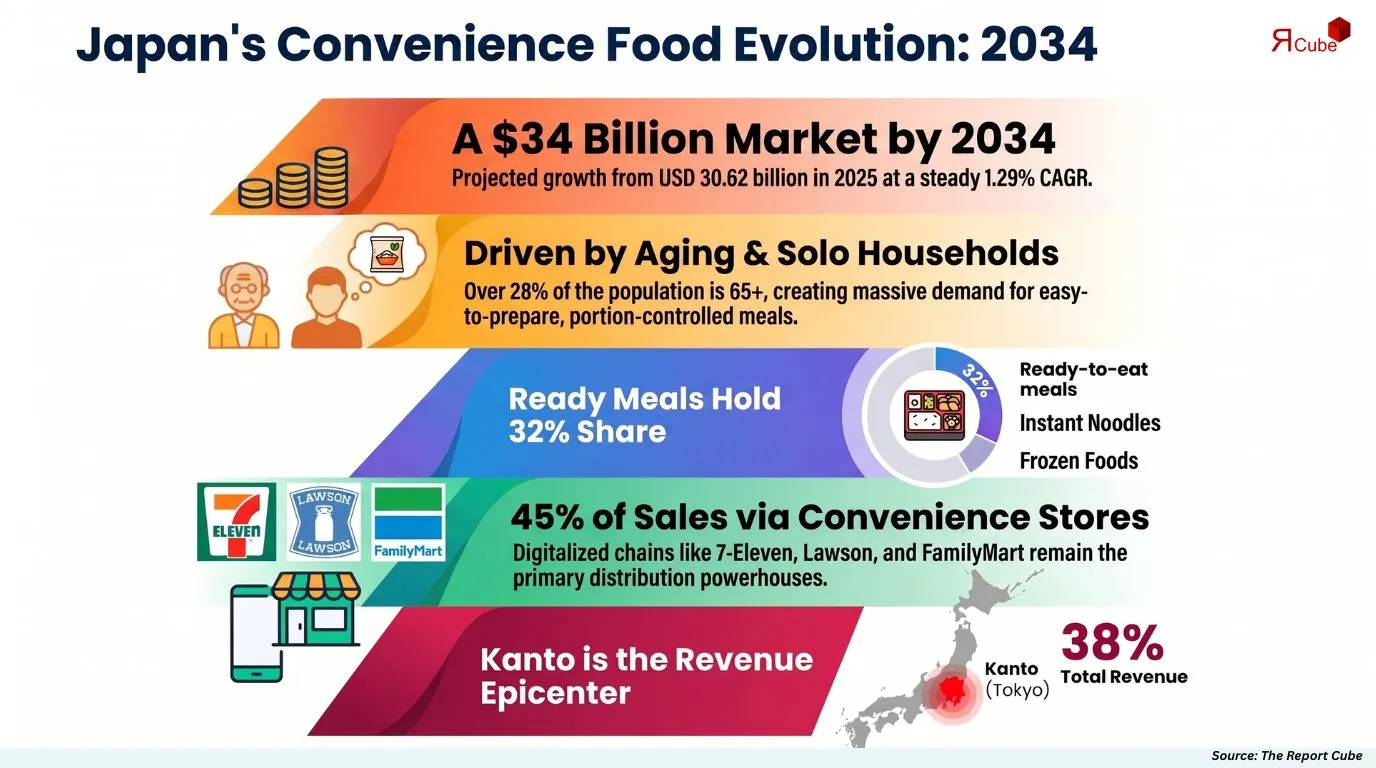
The Japan Convenience Foods Market is anticipated to register a CAGR of 1.29% during 2026-2034. The market size was valued at USD 30.62 billion in 2025 and is projected to reach USD 34.36 billion by 2034. Japan’s convenience foods industry remains mature yet resilient, supported by deeply ingrained consumption habits, a fast-paced lifestyle, and one of the world’s most advanced retail ecosystems.
The sustained demand for convenience foods in Japan is strongly linked to demographic shifts, including a rising elderly population and a high proportion of single-person households. These consumer groups increasingly rely on ready meals, instant noodles, chilled snacks, and frozen foods that offer portion control, ease of preparation, and consistent quality. This behavioral shift seamlessly connects with Japan’s strong convenience store culture, where accessibility and product variety drive frequent purchases.
Furthermore, innovation in packaging, nutrition-focused formulations, and premium product positioning continues to support steady value growth. Leading manufacturers and retailers are aligning convenience foods with health-conscious trends, reduced sodium content, and locally inspired flavors. As a result, the Japan Convenience Foods Market is expected to experience stable, incremental growth throughout the forecast period.
Japan Convenience Foods Market Recent Developments
- 2025: Nissin Foods launched low-sodium instant noodle variants targeting elderly and health-conscious consumers.
- 2025: Seven & i Holdings expanded premium chilled meal assortments across 7-Eleven Japan outlets.
Government Initiatives & Policies
- Smart Food Chain Initiative: Supports digitalization and efficiency across Japan’s food supply chain.
- Healthy Life Expectancy Extension Policy: Promotes nutritionally balanced packaged foods.
Japan Convenience Foods Market Dynamics
Key Driver: Busy Lifestyles and Aging Demographics Sustaining Demand
The primary driver of the Japan Convenience Foods Market is the combination of busy urban lifestyles and a rapidly aging population. Over 28% of Japan’s population is aged 65 or older, creating sustained demand for easy-to-prepare, portion-controlled meals. At the same time, long working hours and extended commuting times among the working population continue to limit home cooking. These two demographic forces are interconnected, reinforcing demand for ready meals, frozen foods, and chilled snacks that balance convenience with nutritional reliability. As a result, manufacturers consistently invest in product formats that cater to both time-constrained workers and elderly consumers seeking simplicity.
Book your FREE 30-minute expert consultation today
Contact UsIndustry Trends: Premiumization and Health-Oriented Product Innovation
An important trend shaping the Japan Convenience Foods Market is the gradual premiumization of everyday convenience products. Consumers increasingly favor higher-quality ingredients, regional flavors, and functional benefits such as reduced salt or added protein. This trend directly builds on the key driver of aging demographics, as health considerations influence purchasing decisions. Consequently, brands are reformulating classic convenience foods while maintaining familiarity. Packaging innovations, such as single-serve microwaveable trays, further connect premium positioning with everyday practicality, reinforcing long-term consumer loyalty.
Major Challenge: Market Saturation and Intense Brand Competition
Opportunity: Expansion of Personalized and Functional Convenience Foods
Amid these challenges, opportunities emerge in personalized and functional convenience foods. Products designed for specific dietary needs, such as high-protein meals or low-calorie options, align with both health trends and demographic realities. This opportunity directly complements existing industry trends, enabling companies to differentiate without disrupting established consumption habits. As data-driven retailing and consumer insights improve, targeted product development is expected to unlock new growth pockets within the Japan Convenience Foods Market.
Japan Convenience Foods Market Segment-wise Analysis
By Product:
- Ready Meals
- Instant Noodles
- Frozen Foods
- Canned Foods
Ready meals represent the leading product segment in the Japan Convenience Foods Market, accounting for approximately 32% of total market share. Their dominance is closely linked to urban lifestyles and single-person households seeking balanced meals without cooking effort. Instant noodles and frozen foods follow, benefiting from long shelf life and affordability. The strong performance of ready meals connects directly with the broader market driver of convenience, reinforcing their leadership position across retail channels.
By Distribution Channel:
- Supermarkets and Hypermarkets
- Convenience Stores
- Online Retail
- Specialty Stores
Convenience stores dominate distribution, contributing nearly 45% of Japan Convenience Foods Market sales. Their widespread presence, extended operating hours, and frequent product refresh cycles create a seamless connection between consumer demand and product availability. This channel’s dominance supports rapid product testing and innovation, strengthening overall market resilience.
Regional Projection of Japan Convenience Foods Industry
- Hokkaido
- Kanto
- Kinki
- Kyushu-Okinawa
The Kanto region leads the Japan Convenience Foods Market, accounting for approximately 38% of total revenue. This leadership is driven by high population density, urbanization, and a strong concentration of convenience stores in Tokyo and surrounding prefectures. The region’s fast-paced lifestyle directly aligns with convenience food consumption, reinforcing its dominant position. Moreover, Kanto often serves as a testing ground for new product launches, influencing national adoption trends and supporting long-term market stability.
Need insights for a specific region within this market?
Request Regional DataWhy Choose This Report?
- Provides a comprehensive overview of the overall market analysis, encompassing key trends, consumer behavior analysis, and risk assessment to support strategic decision-making.
- Provides accurate, up-to-date insights into market size, segmentation, and emerging opportunities, helping to minimize risk & capitalizing on growth.
- Gives deep understanding of target audience preferences, investment habits, and communication channels for enhanced product development & marketing effectiveness.
- Delivers competitive analysis & benchmarking, uncovering the strengths & weaknesses of market competitors to guide strategies.
- Consolidate comprehensive market intelligence, reducing reasoning & streamlining research efforts.
- Facilitates customized market segmentation & risk mitigation strategies, fine-tuned to the business objectives.
- Aids in identifying both market challenges & untapped opportunities within the industry to drive long-term business growth.
- Provides valuable information based on actual customer data & search trends.
Table of Contents
- Introduction
- Objective of the Study
- Product and Category Definition
- Market Segmentation
- Study Variables
- Research Methodology
- Secondary Data Points
- Breakdown of Secondary Sources
- Primary Data Points
- Breakdown of Primary Interviews
- Secondary Data Points
- Executive Summary
- Market Dynamics
- Drivers
- Challenges
- Opportunity Assessment
- Recent Trends and Developments
- Regulatory and Policy Landscape
- Japan Convenience Foods Market Overview (2021-2034)
- Market Size, By Value (USD Billion)
- Market Share, By Product
- Ready Meals
- Instant Noodles
- Frozen Foods
- Canned Foods
- Chilled Snacks
- Bakery Snacks
- Raw Foods
- Others
- Market Share, By Storage
- Frozen
- Chilled
- Shelf-stable
- Refrigerated
- Market Share, By Consumer
- Households
- Single-person Households
- On-the-go Consumers
- Elderly Consumers
- Other Consumer Groups
- Market Share, By Distribution Channel
- Supermarkets and Hypermarkets
- Convenience Stores
- Specialty Stores
- Online Retail
- Other Channels
- Market Share, By Region
- Hokkaido
- Tohoku
- Kanto
- Chubu
- Kinki
- Chugoku
- Shikoku
- Kyushu-Okinawa
- Market Share, By Company
- Revenue Shares and Analysis
- Competitive Landscape
- Hokkaido Convenience Foods Market
- Market Size, By Value (USD Billion)
- Market Share, By Product
- Market Share, By Storage
- Market Share, By Consumer
- Market Share, By Distribution Channel
- Tohoku Convenience Foods Market
- Market Size, By Value (USD Billion)
- Market Share, By Product
- Market Share, By Storage
- Market Share, By Consumer
- Market Share, By Distribution Channel
- Kanto Convenience Foods Market
- Market Size, By Value (USD Billion)
- Market Share, By Product
- Market Share, By Storage
- Market Share, By Consumer
- Market Share, By Distribution Channel
- Chubu Convenience Foods Market
- Market Size, By Value (USD Billion)
- Market Share, By Product
- Market Share, By Storage
- Market Share, By Consumer
- Market Share, By Distribution Channel
- Kinki Convenience Foods Market
- Market Size, By Value (USD Billion)
- Market Share, By Product
- Market Share, By Storage
- Market Share, By Consumer
- Market Share, By Distribution Channel
- Chugoku Convenience Foods Market
- Market Size, By Value (USD Billion)
- Market Share, By Product
- Market Share, By Storage
- Market Share, By Consumer
- Market Share, By Distribution Channel
- Shikoku Convenience Foods Market
- Market Size, By Value (USD Billion)
- Market Share, By Product
- Market Share, By Storage
- Market Share, By Consumer
- Market Share, By Distribution Channel
- Kyushu-Okinawa Convenience Foods Market
- Market Size, By Value (USD Billion)
- Market Share, By Product
- Market Share, By Storage
- Market Share, By Consumer
- Market Share, By Distribution Channel
- Competitive Outlook and Company Profiles
- Ajinomoto Co., Inc.
- Company Overview
- Product Portfolio
- Strategic Alliances/Partnerships
- Recent Developments
- Nissin Foods Holdings Co., Ltd.
- Company Overview
- Product Portfolio
- Strategic Alliances/Partnerships
- Recent Developments
- Maruchan, Inc. (Toyo Suisan Kaisha, Ltd.)
- Company Overview
- Product Portfolio
- Strategic Alliances/Partnerships
- Recent Developments
- Nichirei Corporation
- Company Overview
- Product Portfolio
- Strategic Alliances/Partnerships
- Recent Developments
- TableMark Co., Ltd. (JT Group)
- Company Overview
- Product Portfolio
- Strategic Alliances/Partnerships
- Recent Developments
- Yoshinoya Holdings Co., Ltd.
- Company Overview
- Product Portfolio
- Strategic Alliances/Partnerships
- Recent Developments
- Seven & i Holdings Co., Ltd. (7-Eleven Japan)
- Company Overview
- Product Portfolio
- Strategic Alliances/Partnerships
- Recent Developments
- Lawson, Inc.
- Company Overview
- Product Portfolio
- Strategic Alliances/Partnerships
- Recent Developments
- FamilyMart Co., Ltd.
- Company Overview
- Product Portfolio
- Strategic Alliances/Partnerships
- Recent Developments
- Meiji Co., Ltd.
- Company Overview
- Product Portfolio
- Strategic Alliances/Partnerships
- Recent Developments
- Others
- Ajinomoto Co., Inc.
- Contact Us and Disclaimer
Top Key Players & Market Share Outlook
- Ajinomoto Co., Inc.
- Nissin Foods Holdings Co., Ltd.
- Maruchan, Inc. (Toyo Suisan Kaisha, Ltd.)
- Nichirei Corporation
- TableMark Co., Ltd. (JT Group)
- Yoshinoya Holdings Co., Ltd.
- Seven & i Holdings Co., Ltd. (7-Eleven Japan)
- Lawson, Inc.
- FamilyMart Co., Ltd.
- Meiji Co., Ltd.
- Others
Frequently Asked Questions