



Build Your Custom Market Intelligence Report
Customize Your ReportEurope Crane Market Insights & Analysis
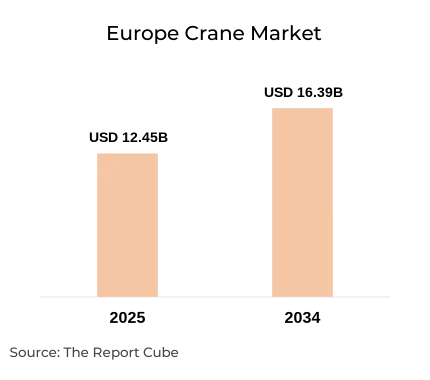
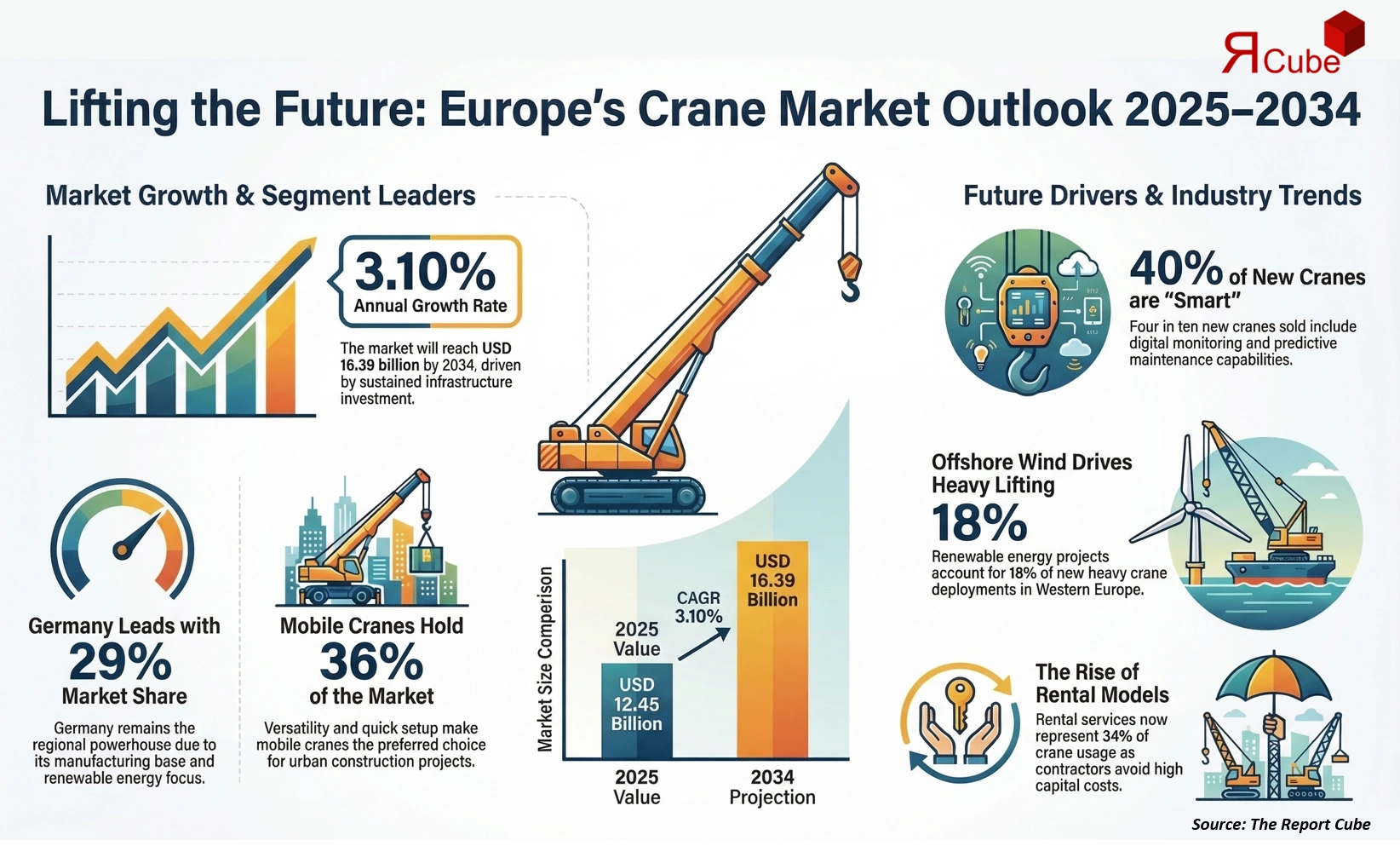
The Europe Crane Market is anticipated to register a CAGR of 3.10% during 2026-2034. The market size was valued at USD 12.45 billion in 2025 and is projected to reach USD 16.39 billion by 2034. The market is progressing steadily, supported by sustained investments in infrastructure modernization, renewable energy projects, and large-scale urban redevelopment across major European economies. Cranes play a critical role in construction, industrial handling, port operations, and energy installations, making them indispensable across multiple end-use industries.
Economic recovery initiatives and public infrastructure funding across Germany, France, the United Kingdom, and Southern Europe continue to drive crane demand. The market also benefits from increasing adoption of technologically advanced cranes offering improved load capacity, automation, and safety features. Fleet replacement cycles, especially among rental and leasing operators, further support consistent equipment demand.
In addition, Europe’s push toward sustainability is influencing crane design and procurement decisions. Electric and hybrid cranes, along with energy-efficient hydraulic systems, are gaining traction as contractors aim to reduce emissions and comply with stricter environmental regulations. These combined factors ensure a stable growth outlook for the Europe Crane Market through 2034.
Europe Crane Market Recent Developments
- 2025: Liebherr Group introduced an energy-efficient crawler crane series designed for renewable energy and infrastructure projects.
- 2025: Konecranes Plc expanded its smart crane portfolio with advanced remote monitoring and predictive maintenance systems.
Government Initiatives & Policies
- EU Trans-European Transport Network (TEN-T): Supports large-scale transport and logistics infrastructure development across Europe.
- European Green Deal: Promotes sustainable construction equipment and low-emission industrial machinery.
Europe Crane Market Dynamics
Key Driver: Expansion of Infrastructure and Renewable Energy Projects
Large-scale infrastructure expansion across Europe remains the primary driver of the crane market. Governments are investing heavily in railways, bridges, ports, and urban redevelopment projects to enhance connectivity and economic resilience. Simultaneously, Europe’s rapid expansion of wind energy, particularly offshore wind farms, has significantly increased demand for high-capacity crawler and tower cranes. Offshore wind installations alone account for nearly 18% of new heavy crane deployments in Western Europe. These projects require specialized lifting equipment capable of handling heavy nacelles and turbine components, reinforcing long-term demand for technologically advanced cranes.
Book your FREE 30-minute expert consultation today
Contact UsIndustry Trends: Technological Advancements and Smart Crane Adoption
The integration of digital technologies is transforming crane operations across Europe. Smart cranes equipped with sensors, automation, and real-time diagnostics are improving productivity while reducing downtime and maintenance costs. Features such as load optimization, remote operation, and predictive maintenance are increasingly standard among new crane models. Approximately 40% of new cranes sold in Europe in 2025 included some form of digital monitoring capability. This trend aligns with contractors’ focus on safety, efficiency, and operational transparency, further accelerating adoption across construction and industrial sectors.
Major Challenge: High Capital Costs and Skilled Labor Shortages
High upfront investment costs remain a key challenge for the Europe Crane Market, particularly for small and mid-sized contractors. Advanced cranes with automation and sustainability features command premium pricing, limiting affordability. Additionally, the region faces a shortage of skilled crane operators and maintenance technicians. Aging workforce demographics and limited training programs have increased labor costs and operational risks. These factors collectively restrain rapid market expansion despite strong underlying demand.
Opportunity: Growth of Crane Rental and Leasing Services
The expansion of crane rental and leasing services presents a significant opportunity across Europe. Contractors increasingly prefer rental models to reduce capital expenditure and gain access to advanced equipment without long-term ownership risks. Rental services now account for nearly 34% of crane usage in Western Europe. This shift supports steady fleet upgrades by rental companies and opens recurring revenue streams for manufacturers through service contracts, maintenance, and aftermarket support.
Europe Crane Market Segment-wise Analysis
By Product Type:
- Mobile Cranes
- Tower Cranes
- Crawler Cranes
- Overhead Cranes
Mobile cranes lead the Europe Crane Market by product type, holding approximately 36% market share in 2025. Their versatility, mobility, and suitability for diverse construction and industrial applications drive widespread adoption. Mobile cranes are particularly favored in urban construction projects where flexibility and quick setup are critical. Tower cranes follow closely, supported by high-rise residential and commercial developments across major European cities.
By Application:
- Construction
- Infrastructure
- Mining
- Industrial
The construction segment dominates application-based demand, accounting for nearly 44% of total market revenue. Continuous residential, commercial, and mixed-use developments across Europe sustain strong crane utilization rates. Infrastructure projects, including transport corridors and energy facilities, further reinforce demand, while industrial applications benefit from automation and factory expansion initiatives.
Regional Projection of Europe Crane Industry
- Germany
- United Kingdom
- France
- Italy
- Spain
Germany leads the Europe Crane Market, contributing approximately 29% of regional revenue in 2025. The country’s strong manufacturing base, extensive infrastructure projects, and leadership in renewable energy installations drive consistent crane demand. Germany’s focus on industrial automation and logistics modernization further supports steady equipment replacement and upgrades, maintaining its dominant market position.
Need insights for a specific region within this market?
Request Regional DataWhy Choose This Report?
- Provides a comprehensive overview of the overall market analysis, encompassing key trends, consumer behavior analysis, and risk assessment to support strategic decision-making.
- Provides accurate, up-to-date insights into market size, segmentation, and emerging opportunities, helping to minimize risk & capitalizing on growth.
- Gives deep understanding of target audience preferences, investment habits, and communication channels for enhanced product development & marketing effectiveness.
- Delivers competitive analysis & benchmarking, uncovering the strengths & weaknesses of market competitors to guide strategies.
- Consolidate comprehensive market intelligence, reducing reasoning & streamlining research efforts.
- Facilitates customized market segmentation & risk mitigation strategies, fine-tuned to the business objectives.
- Aids in identifying both market challenges & untapped opportunities within the industry to drive long-term business growth.
- Provides valuable information based on actual customer data & search trends.
Table of Contents
- Introduction
- Objective of the Study
- Product and Category Definition
- Market Segmentation
- Study Variables
- Research Methodology
- Secondary Data Points
- Breakdown of Secondary Sources
- Primary Data Points
- Breakdown of Primary Interviews
- Secondary Data Points
- Executive Summary
- Market Dynamics
- Drivers
- Challenges
- Opportunity Assessment
- Recent Trends and Developments
- Regulatory and Policy Landscape
- Europe Crane Market Overview (2020-2034)
- Market Size, By Value (USD Billion)
- Market Share, By Product Type
- Mobile Cranes
- Tower Cranes
- Crawler Cranes
- Overhead Cranes
- Marine Cranes
- Market Share, By Application
- Construction
- Infrastructure
- Mining
- Industrial
- Oil & Gas
- Market Share, By End User
- Contractors
- Rental Firms
- Ports & Terminals
- Market Share, By Operation
- Hydraulic Cranes
- Electric Cranes
- Hybrid Cranes
- Market Share, By Country
- Germany
- United Kingdom
- France
- Italy
- Spain
- Market Share, By Company
- Competition Characteristics
- Revenue Shares & Analysis
- Germany Crane Market
- Market Size, By Value (USD Billion)
- Market Share, By Product Type
- Market Share, By Application
- Market Share, By End User
- Market Share, By Operation
- United Kingdom Crane Market
- Market Size, By Value (USD Billion)
- Market Share, By Product Type
- Market Share, By Application
- Market Share, By End User
- Market Share, By Operation
- France Crane Market
- Market Size, By Value (USD Billion)
- Market Share, By Product Type
- Market Share, By Application
- Market Share, By End User
- Market Share, By Operation
- Italy Crane Market
- Market Size, By Value (USD Billion)
- Market Share, By Product Type
- Market Share, By Application
- Market Share, By End User
- Market Share, By Operation
- Spain Crane Market
- Market Size, By Value (USD Billion)
- Market Share, By Product Type
- Market Share, By Application
- Market Share, By End User
- Market Share, By Operation
- Competitive Outlook and Company Profiles
- Liebherr Group
- Company Overview
- Product Portfolio
- Strategic Alliances/Partnerships
- Recent Developments
- Konecranes Plc
- Company Overview
- Product Portfolio
- Strategic Alliances/Partnerships
- Recent Developments
- Tadano Ltd
- Company Overview
- Product Portfolio
- Strategic Alliances/Partnerships
- Recent Developments
- Terex Corporation
- Company Overview
- Product Portfolio
- Strategic Alliances/Partnerships
- Recent Developments
- Manitowoc Company
- Company Overview
- Product Portfolio
- Strategic Alliances/Partnerships
- Recent Developments
- Palfinger AG
- Company Overview
- Product Portfolio
- Strategic Alliances/Partnerships
- Recent Developments
- Fassi Gru S.p.A.
- Company Overview
- Product Portfolio
- Strategic Alliances/Partnerships
- Recent Developments
- Kobelco Cranes
- Company Overview
- Product Portfolio
- Strategic Alliances/Partnerships
- Recent Developments
- Cargotec Oyj
- Company Overview
- Product Portfolio
- Strategic Alliances/Partnerships
- Recent Developments
- Sany Group
- Company Overview
- Product Portfolio
- Strategic Alliances/Partnerships
- Recent Developments
- Others
- Liebherr Group
- Contact Us and Disclaimer
Top Key Players & Market Share Outlook
- Liebherr Group
- Konecranes Plc
- Tadano Ltd
- Terex Corporation
- Manitowoc Company
- Palfinger AG
- Fassi Gru S.p.A.
- Kobelco Cranes
- Cargotec Oyj
- Sany Group
- Others
Frequently Asked Questions






