



Build Your Custom Market Intelligence Report
Customize Your ReportPhilippines Crane Market Insights & Analysis
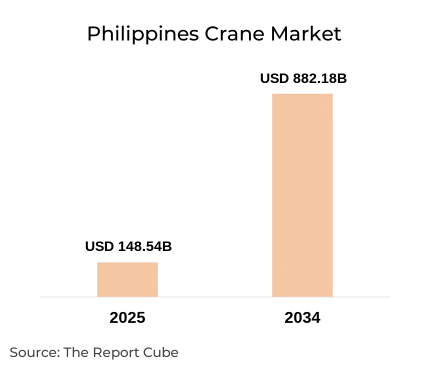
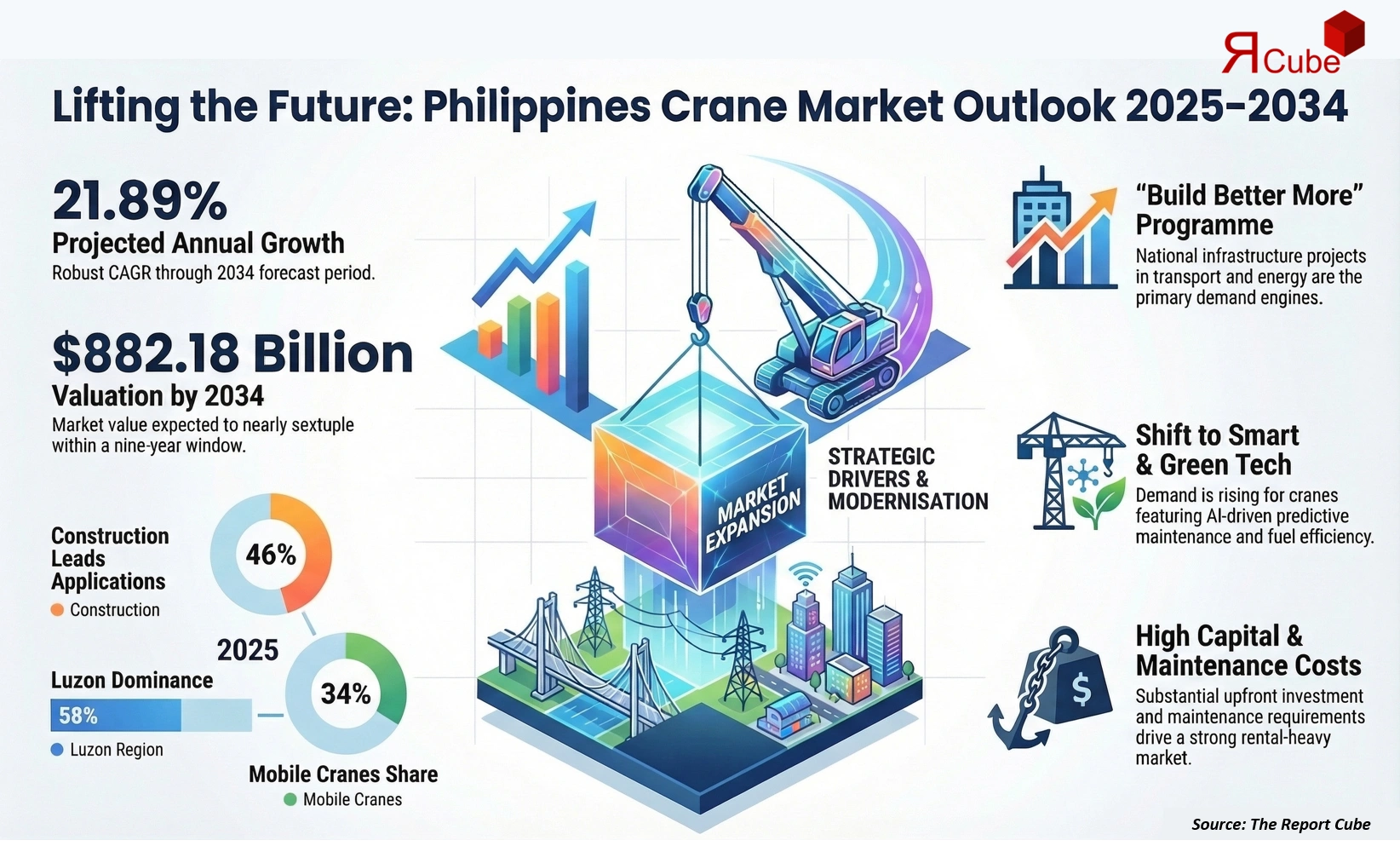
The Philippines Crane Market is anticipated to register a CAGR of 21.89% during 2026-2034. The market size was valued at USD 148.54 billion in 2025 and is projected to reach USD 882.18 billion by 2034. This exceptional growth outlook is strongly supported by accelerated infrastructure development, rapid urbanization, and sustained public-private investments across transportation, energy, and industrial construction projects nationwide. Cranes have become indispensable assets in large-scale construction and logistics operations, enabling faster project execution and improved safety standards.
The Philippine government’s aggressive infrastructure agenda, including highways, airports, ports, and mass transit systems, is driving robust demand for advanced lifting solutions. Tower cranes and mobile cranes are increasingly deployed in urban construction, while port expansions and shipbuilding activities are stimulating demand for marine and overhead cranes. Additionally, foreign direct investment inflows into manufacturing and industrial zones are reinforcing long-term equipment demand, positioning cranes as critical enablers of national economic development.
Moreover, the market is benefiting from technological advancements such as automation, telematics, and load-monitoring systems, which enhance crane efficiency and reduce downtime. As construction complexity increases, end users are prioritizing high-capacity, reliable, and energy-efficient cranes. Together, these factors underpin a strong growth trajectory for the Philippines Crane Market through 2034.
Philippines Crane Market Recent Developments
- 2025: Liebherr expanded its high-capacity tower crane portfolio to support major urban infrastructure projects in Metro Manila.
- 2025: SANY Group introduced next-generation mobile cranes with enhanced fuel efficiency for Philippine construction contractors.
Government Initiatives & Policies
- Build Better More Infrastructure Program: National initiative accelerating transport, energy, and urban infrastructure development.
- Philippine Ports Authority Modernization Plan: Program focused on port expansion and cargo-handling efficiency upgrades.
Philippines Crane Market Dynamics
Key Driver: Large-Scale Infrastructure and Construction Boom
The primary driver of the Philippines Crane Market is the unprecedented scale of infrastructure and construction activity across the country. Government-backed transport corridors, airport upgrades, rail networks, and flood control projects are creating sustained demand for heavy lifting equipment. Construction spending has been growing at double-digit rates, with cranes playing a critical role in high-rise buildings, bridges, and industrial facilities. Mobile and tower cranes are particularly vital in urban centers, where space constraints and vertical construction require advanced lifting capabilities. This sustained infrastructure momentum is expected to remain the backbone of crane demand through the forecast period.
Book your FREE 30-minute expert consultation today
Contact UsIndustry Trends: Shift Toward High-Capacity and Smart Cranes
An important trend shaping the market is the increasing preference for high-capacity and technologically advanced cranes. Contractors are investing in cranes equipped with telematics, real-time monitoring, and automated safety features to improve productivity and reduce operational risks. Smart cranes enable predictive maintenance, minimizing downtime and lowering lifecycle costs. Additionally, demand for energy-efficient and hybrid cranes is rising as companies seek to reduce fuel expenses and meet environmental standards. These trends are gradually transforming the Philippine crane landscape toward more sophisticated and value-driven equipment solutions.
Major Challenge: High Capital Investment and Maintenance Costs
Despite strong demand, high acquisition and maintenance costs remain a significant challenge for the Philippines Crane Market. Advanced cranes require substantial upfront capital, making it difficult for small and mid-sized contractors to invest. Maintenance, spare parts, and skilled operator requirements further increase total ownership costs. As a result, many firms rely on rental services rather than outright purchases, limiting direct equipment sales. Currency fluctuations and import dependencies also add cost volatility, creating financial pressure for equipment buyers and distributors.
Opportunity: Expansion of Ports, Logistics, and Industrial Zones
The rapid expansion of ports, logistics hubs, and industrial zones presents a major growth opportunity for crane manufacturers and suppliers. The Philippines’ strategic location in Southeast Asia is driving investments in port modernization and cargo-handling infrastructure, boosting demand for overhead and marine cranes. Industrial parks and special economic zones are also expanding, requiring cranes for plant construction, material handling, and equipment installation. These developments provide long-term demand visibility and open opportunities for specialized crane solutions tailored to logistics and industrial applications.
Philippines Crane Market Segment-wise Analysis
By Product Type:
- Mobile Cranes
- Tower Cranes
- Overhead Cranes
- Marine Cranes
Mobile cranes lead the Philippines Crane Market by product type, accounting for nearly 34% of total market share in 2025. Their versatility, ease of transportation, and suitability for diverse construction environments make them highly preferred across infrastructure and industrial projects. Tower cranes follow closely, driven by high-rise residential and commercial developments in urban centers. Overhead and marine cranes are gaining momentum due to port modernization and manufacturing growth, contributing to balanced demand across crane categories.
By Application:
- Construction
- Mining
- Oil and Gas
- Ports and Terminals
The construction segment dominates the market, holding approximately 46% share in 2025. Continuous investments in public infrastructure and private real estate projects are driving crane deployment across construction sites. Ports and terminals represent a fast-growing application segment, supported by trade expansion and logistics infrastructure upgrades. Mining and industrial applications maintain steady demand, particularly for heavy-duty cranes used in material handling and equipment installation.
Regional Projection of Philippines Crane Industry
- Luzon
- Visayas
- Mindanao
Luzon leads the Philippines Crane Market, contributing nearly 58% of total revenue in 2025. The region benefits from concentrated infrastructure spending, major urban developments, and port expansion projects, particularly in and around Metro Manila. Luzon’s dominance is reinforced by its role as the country’s economic and industrial hub. While Luzon remains the primary market, Visayas and Mindanao are emerging as high-growth regions, supported by regional infrastructure programs and increasing industrial investments.
Need insights for a specific region within this market?
Request Regional DataWhy Choose This Report?
- Provides a comprehensive overview of the overall market analysis, encompassing key trends, consumer behavior analysis, and risk assessment to support strategic decision-making.
- Provides accurate, up-to-date insights into market size, segmentation, and emerging opportunities, helping to minimize risk & capitalizing on growth.
- Gives deep understanding of target audience preferences, investment habits, and communication channels for enhanced product development & marketing effectiveness.
- Delivers competitive analysis & benchmarking, uncovering the strengths & weaknesses of market competitors to guide strategies.
- Consolidate comprehensive market intelligence, reducing reasoning & streamlining research efforts.
- Facilitates customized market segmentation & risk mitigation strategies, fine-tuned to the business objectives.
- Aids in identifying both market challenges & untapped opportunities within the industry to drive long-term business growth.
- Provides valuable information based on actual customer data & search trends.
Table of Contents
- Introduction
- Objective of the Study
- Product and Category Definition
- Market Segmentation
- Study Variables
- Research Methodology
- Secondary Data Points
- Breakdown of Secondary Sources
- Primary Data Points
- Breakdown of Primary Interviews
- Secondary Data Points
- Executive Summary
- Market Dynamics
- Drivers
- Challenges
- Opportunity Assessment
- Recent Trends and Developments
- Regulatory and Policy Landscape
- Philippines Crane Market Overview (2020-2034)
- Market Size, By Value (USD Billion)
- Market Share, By Product Type
- Mobile Cranes
- Tower Cranes
- Overhead Cranes
- Marine Cranes
- Other Cranes
- Market Share, By Application
- Construction
- Mining
- Oil and Gas
- Ports and Terminals
- Industrial
- Market Share, By Lifting Capacity
- Upto 50 Tons
- 50-150 Tons
- 150-300 Tons
- Above 300 Tons
- Market Share, By End User
- Contractors
- Rental Fleets
- Industrial Plants
- Port Operators
- Market Share, By Region
- Luzon
- Visayas
- Mindanao
- Market Share, By Company
- Competition Characteristics
- Revenue Shares & Analysis
- Luzon Crane Market
- Market Size, By Value (USD Billion)
- Market Share, By Product Type
- Market Share, By Application
- Market Share, By Lifting Capacity
- Market Share, By End User
- Visayas Crane Market
- Market Size, By Value (USD Billion)
- Market Share, By Product Type
- Market Share, By Application
- Market Share, By Lifting Capacity
- Market Share, By End User
- Mindanao Crane Market
- Market Size, By Value (USD Billion)
- Market Share, By Product Type
- Market Share, By Application
- Market Share, By Lifting Capacity
- Market Share, By End User
- Competitive Outlook and Company Profiles
- Konecranes
- Company Overview
- Product Portfolio
- Strategic Alliances/Partnerships
- Recent Developments
- Liebherr
- Company Overview
- Product Portfolio
- Strategic Alliances/Partnerships
- Recent Developments
- Manitowoc
- Company Overview
- Product Portfolio
- Strategic Alliances/Partnerships
- Recent Developments
- SANY Group
- Company Overview
- Product Portfolio
- Strategic Alliances/Partnerships
- Recent Developments
- XCMG
- Company Overview
- Product Portfolio
- Strategic Alliances/Partnerships
- Recent Developments
- Zoomlion
- Company Overview
- Product Portfolio
- Strategic Alliances/Partnerships
- Recent Developments
- Cargotec
- Company Overview
- Product Portfolio
- Strategic Alliances/Partnerships
- Recent Developments
- ZPMC
- Company Overview
- Product Portfolio
- Strategic Alliances/Partnerships
- Recent Developments
- Terex Corporation
- Company Overview
- Product Portfolio
- Strategic Alliances/Partnerships
- Recent Developments
- Hyundai Heavy Industries
- Company Overview
- Product Portfolio
- Strategic Alliances/Partnerships
- Recent Developments
- Others
- Konecranes
- Contact Us and Disclaimer
Top Key Players & Market Share Outlook
- Konecranes
- Liebherr
- Manitowoc
- SANY Group
- XCMG
- Zoomlion
- Cargotec
- ZPMC
- Terex Corporation
- Hyundai Heavy Industries
- Others
Frequently Asked Questions






