



Build Your Custom Market Intelligence Report
Customize Your ReportUnited States Crop Protection Chemicals Market Key Takeaways
- United States crop protection chemicals market valued at USD 11.38 billion in 2026, reflecting sustained agricultural demand.
- Industry projected to reach USD 16.31 billion by 2034 at a 4.60% CAGR.
- Market expanding at a consistent 4.60% CAGR throughout the 2026–2034 forecast period.
- Cereals and grains lead the crop type segment driven by large-scale commodity farming operations.
- Foliar spray dominates the mode of application segment across major U.S. farming regions.
- Soil treatment is the fastest-growing application mode as precision agriculture investments accelerate.
- Bayer, Syngenta, BASF, and Corteva lead crop protection chemical supply across the United States.
- Biological crop protection integration and resistance management are reshaping agrochemical procurement strategies nationwide.
United States Crop Protection Chemicals Market Overview
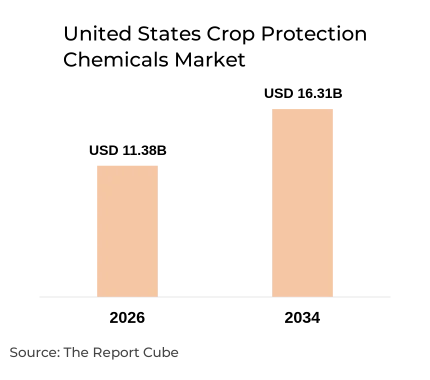
The United States Crop Protection Chemicals Market is anticipated to register a 4.60% CAGR during 2026–2034. The market size was valued at USD 11.38 billion in 2026 and is projected to reach USD 16.31 billion by 2034. A United States crop protection chemicals market analysis reveals that large-scale commodity crop production, expanding oilseed cultivation, and intensifying pest resistance pressures collectively sustain demand for herbicides, fungicides, and insecticides. Federal programs under the USDA Farm Service Agency and EPA-regulated product approval channels continue shaping the competitive landscape for leading suppliers including Bayer, BASF, and Corteva Agriscience.
Rising demand for food security solutions, growing awareness of integrated pest management practices, and advancing biological formulation capabilities are further supporting market expansion. Syngenta AG, FMC Corporation, and ADAMA have strengthened their U.S. distribution and formulation networks, enabling farmers across the Midwest, South, and Western growing regions to access a broader spectrum of targeted crop protection solutions. Sustainability commitments and evolving resistance management guidelines are prompting growers to diversify chemical and biological input procurement.
United States Crop Protection Chemicals Market Size & Forecast
|
Metric |
Details |
|---|---|
|
Market Size (2026) |
USD 11.38 Billion |
|
Market Size (2034) |
USD 16.31 Billion |
|
CAGR (2026–2034) |
4.60% |
|
Base Year |
2026 |
|
Historical Years |
2021–2025 |
|
Forecast Years |
2026–2034 |
The United States Crop Protection Chemicals Market size was valued at USD 11.38 billion in 2026 and is projected to reach USD 16.31 billion by 2034, growing at a 4.60% CAGR. This trajectory is underpinned by accelerating cereal and grain cultivation across Midwest farmland, increasing oilseed acreage, and the intensifying adoption of precision application technologies that improve active ingredient efficacy across diverse American cropping systems.
United States Crop Protection Chemicals Market Dynamics
The United States Crop Protection Chemicals Market is shaped by an interplay of agricultural productivity imperatives, regulatory frameworks, and advancing agrochemical innovation. Growing crop yield pressures, expanding farmland under cultivation, and the persistent threat of invasive pest species and fungal outbreaks are reinforcing demand for herbicides, fungicides, insecticides, and biopesticide solutions across major U.S. growing regions.
|
Factor |
Type |
Specific Impact on Market |
Magnitude |
|---|---|---|---|
|
Large-scale commodity crop cultivation |
Driver |
Sustains high-volume herbicide and fungicide procurement across Midwest cereal and grain farmland |
High |
|
Expanding precision agriculture adoption |
Driver |
Increases demand for targeted foliar and soil treatment formulations with optimized efficacy profiles |
High |
|
Stringent EPA registration and re-evaluation |
Challenge |
Delays active ingredient approvals and raises compliance costs for manufacturers and distributors |
Medium |
|
Biological and biostimulant integration |
Opportunity |
Creates new formulation revenue streams by combining synthetic and biological crop protection inputs |
High |
|
Pesticide resistance development in key crops |
Trend |
Accelerates demand for novel modes of action, tank-mix solutions, and resistance management programs |
Medium |
- Growth Drivers - Expanding cultivation of corn, soybeans, and wheat across Midwestern states sustains consistent herbicide and fungicide procurement. Companies including Bayer and Corteva supply large-volume glyphosate, SDHI fungicides, and pyrethroid insecticide formulations serving commodity grain producers. United States crop protection chemicals market growth is reinforced by increasing farmer investment in yield-protection inputs.
- Market Opportunities - The biologicals and biopesticide sector presents a significant expansion opportunity, projected to grow as growers seek resistance-breaking alternatives and export-compliant input programs. BASF and UPL Limited are actively scaling biological product lines that complement synthetic chemistries, positioning integrated programs as premium agronomic solutions across U.S. specialty and commodity crop segments.
- Industry Challenges - Herbicide-resistant weed biotypes - particularly Palmer amaranth and waterhemp - have spread extensively across Southern and Midwestern crop fields, reducing efficacy of established herbicide modes of action. The emergence of multi-site resistance creates operational complexity for agronomists and elevates per-acre input costs for growers dependent on chemical weed management programs.
United States Crop Protection Chemicals Market Trends
- Emerging Trends - United States Crop Protection Chemicals Market trends indicate accelerating adoption of biologicals and microbial-based fungicides as growers seek sustainable alternatives. Integrated pest management frameworks combining synthetic and biological inputs are gaining adoption across fruits, vegetables, and premium specialty crop segments nationwide.
- Technology Trends - Variable-rate application technology, drone-based foliar spray platforms, and AI-powered pest scouting tools are transforming precision application practices. Digital farming platforms from Bayer's Climate Corporation and Corteva's Granular Farm Management software are enabling data-driven crop protection scheduling and input optimization across large U.S. farming operations.
- Consumer / Buyer Trends - Large agribusiness buyers and cooperative purchasing networks increasingly require suppliers to provide integrated resistance management programs alongside chemistry supply agreements. Retailers and food processors sourcing from U.S. farms are applying MRL compliance requirements and sustainability sourcing criteria that directly influence grower input selection priorities.
- Regulatory Trends - EPA's Integrated Risk Information System re-evaluations and the ongoing review of organophosphate and neonicotinoid registrations continue reshaping the approved chemistry landscape. State-level Maximum Residue Limit alignment with EU export standards is increasing compliance pressure on crop protection product selection for fruit and vegetable producers targeting export markets.

Need Specific Data, Let’s Customize the Report for You
Request CustomizationUnited States Crop Protection Chemicals Market Segment Analysis
The United States Crop Protection Chemicals Market serves diverse agricultural production systems across crop type and application mode segments, each characterized by distinct procurement volumes, active ingredient requirements, and supplier engagement patterns. Understanding United States crop protection chemicals market share distribution across these segments enables manufacturers and distributors to prioritize formulation strategies and channel investments effectively.
By Crop Type
|
Crop Type |
Estimated Share (2026) |
Key Characteristics |
|---|---|---|
|
Cereals & Grains |
38% |
Largest segment; high herbicide and fungicide volumes for corn, wheat, and soybean cultivation |
|
Fruits & Vegetables |
27% |
Premium-value crops with high per-acre input spending and strict MRL compliance requirements |
|
Oilseed & Pulses |
22% |
Growing segment driven by soybean and canola acreage expansion across Midwest and Northern Plains |
|
Others |
13% |
Includes turf, ornamental, and industrial crop applications with specialty chemistry demand |
Cereals and grains dominate the crop type segment with an estimated 38% share in 2026, driven by the extensive corn and soybean belt spanning Illinois, Iowa, Indiana, and Nebraska. Bayer CropScience and Corteva Agriscience supply leading herbicide and fungicide portfolios, including glyphosate, dicamba, and propiconazole formulations, to large-scale grain producers. Fruits and vegetables represent the second-largest segment, where Syngenta and FMC Corporation deliver targeted insecticide and fungicide programs aligned with retailer residue compliance and export certification standards.
By Mode of Application
|
Mode of Application |
Estimated Share (2026) |
Key Characteristics |
|---|---|---|
|
Foliar Spray |
46% |
Dominant mode; in-season herbicide, fungicide, and insecticide applications across all crop types |
|
Soil Treatment |
28% |
Growing; pre-plant herbicide and nematicide applications expanding with precision agriculture adoption |
|
Seed Treatment |
19% |
Established; fungicide and insecticide seed coatings standard across cereal and oilseed planting programs |
|
Others |
7% |
Includes chemigation, fumigation, and post-harvest treatment applications |
Foliar spray maintains dominant positioning at approximately 46% share in 2026, serving as the primary delivery mechanism for in-season herbicide, fungicide, and insecticide programs across U.S. commodity and specialty crops. BASF SE, ADAMA, and Nufarm supply a wide range of foliar formulations, including azoxystrobin fungicides and pyrethroid insecticides, optimized for ground-rig and aerial application. Soil treatment is the fastest-growing mode as UPL Limited and Sumitomo Chemical expand soil-applied herbicide and biological soil health programs targeting pre-emergent weed control and nematode management.
United States Crop Protection Chemicals Market Regional Analysis
|
Region |
Estimated Market Share |
Key Growth Factors |
Consumer Trends |
|---|---|---|---|
|
Midwest |
42% |
Largest corn, soybean, and wheat cultivation zone; high herbicide and fungicide procurement volumes |
Precision application adoption, resistance management programs, cooperative purchasing networks |
|
South |
26% |
Cotton, rice, and soybean production; active insecticide and herbicide market with warm-season pest pressure |
Multiple-mode herbicide tank mixes, increasing biological input adoption |
|
West |
19% |
Intensive fruits, vegetables, and nut crop cultivation with high per-acre specialty input spending |
MRL compliance-driven purchasing, drip chemigation and precision foliar programs |
|
Northeast |
13% |
Smaller cultivated acreage but growing specialty vegetable, organic-transition, and greenhouse segment activity |
Biological and reduced-risk chemistry adoption, sustainable input certification demand |
- Midwest - Accounting for approximately 42% of total U.S. market demand, the Midwest represents the nation's largest crop protection procurement region. Extensive corn and soybean cultivation across Illinois, Iowa, Indiana, Ohio, and Nebraska drives sustained demand for high-volume herbicides - particularly glyphosate and synthetic auxin chemistries - alongside SDHI and strobilurin fungicides from Bayer and Corteva.
- South - Southern states including Texas, Arkansas, Mississippi, and Georgia contribute approximately 26% of national crop protection spending, supported by active cotton, rice, soybean, and peanut production systems. Warm-climate insect pressure from bollworm, stink bug, and thrips populations sustains strong insecticide procurement from FMC Corporation and Syngenta across the region.
- West - The Western region captures an estimated 19% of market demand, driven by California's dominance in high-value fruit, vegetable, nut, and grape production. Strict state-level regulatory controls, premium retail buyer residue standards, and export compliance demands elevate per-acre specialty input spending across growers procuring from Nufarm and ADAMA formulation portfolios.
- Northeast - Contributing approximately 13% of national demand, the Northeast features smaller cultivated acreage but expanding specialty vegetable, berry, and greenhouse production systems. Growing interest in sustainable and reduced-risk chemistry - including biological fungicides and microbial insecticides - is driving increased procurement engagement with UPL Limited and Sumitomo Chemical biological product lines.
United States Crop Protection Chemicals Market Share & Competitive Landscape
The United States Crop Protection Chemicals Market competitive landscape is concentrated among global agrochemical leaders competing across product innovation, formulation breadth, resistance management capabilities, and integrated digital agronomy service platforms. Key players differentiate through proprietary active ingredient pipelines, biological product integration, and strategic distribution network partnerships with U.S. agricultural cooperatives and independent retailers.
|
Company |
Competitive Strength |
Primary Segment Served |
|---|---|---|
|
Bayer |
Broad herbicide, fungicide, insecticide portfolio; digital farming integration |
Cereals & grains, oilseeds, foliar spray |
|
Syngenta |
Strong fungicide and insecticide pipeline; seed treatment leadership |
Fruits & vegetables, cereals, seed treatment |
|
BASF |
Innovative fungicide chemistry; biological product expansion |
Cereals & grains, oilseeds, foliar spray |
|
Corteva |
Proprietary herbicide and insecticide modes of action; integrated crop systems |
Cereals & grains, soil treatment |
|
FMC Corporation |
Specialty insecticide and herbicide portfolio; premium market positioning |
Fruits & vegetables, South region |
|
Nufarm |
Generic and off-patent formulations; broad crop and regional coverage |
All segments; West and Midwest |
|
ADAMA |
Cost-competitive generic portfolio; strong cooperative and distributor partnerships |
Foliar spray, mid-market segments |
|
UPL Limited |
Biologicals integration; global supply chain scale |
Soil treatment, specialty and organic |
|
Sumitomo Chemical |
Niche insecticide and herbicide actives; biological program development |
Fruits & vegetables, Northeast |
Key Companies in the United States Crop Protection Chemicals Market
Bayer AG
Bayer AG, headquartered in Leverkusen, Germany, operates one of the world's largest crop science divisions following its 2018 acquisition of Monsanto. In 2025, Bayer expanded its Crop Science U.S. biologicals portfolio through the commercial scale-up of microbial soil treatment products targeting corn and soybean markets. Its Climate Corporation digital agronomy platform and integrated herbicide-tolerant seed systems reinforce its leading competitive position across U.S. cereal and grain production segments.
Syngenta AG
Syngenta AG, headquartered in Basel, Switzerland, is a global leader in fungicide, insecticide, and seed treatment chemistry with a particularly strong presence across U.S. fruit, vegetable, and cereal markets. In 2024, Syngenta launched new SDHI fungicide formulations targeting cereal disease management in the Midwest. Its Cropwise digital farming platform and extensive U.S. distribution network through Helena Agri-Enterprises and other key partners reinforce its competitive standing in the United States Crop Protection Chemicals Market.
United States Crop Protection Chemicals Market Recent Developments
|
Year |
Company |
Development |
|---|---|---|
|
2025 |
Bayer |
Scaled commercial launch of biologicals-integrated soil treatment program for U.S. corn and soybean segments |
|
2025 |
Corteva Agriscience |
Expanded U.S. herbicide portfolio with new Xtend crop system herbicide registrations targeting resistant weed species |
United States Crop Protection Chemicals Market Future Outlook
The United States Crop Protection Chemicals Market forecast projects expansion from USD 11.38 billion in 2026 to USD 16.31 billion by 2034 at a 4.60% CAGR. Cereal and grain producer procurement will remain the largest demand driver as Midwest cultivation intensity continues expanding. Bayer, Corteva, and Syngenta are expected to deepen market penetration through integrated digital agronomy and resistance management program delivery across commodity and specialty crop segments through 2034.
Technological advancement in crop protection application - including AI-powered scouting platforms, variable-rate foliar spray systems, and microencapsulated formulation technologies - will progressively improve active ingredient efficacy and reduce per-acre application volumes. Sustainable sourcing standards, regenerative agriculture program requirements from major food brands, and evolving EPA re-registration outcomes will collectively reshape the approved chemistry portfolio available to U.S. farmers, accelerating biological and integrated pest management solution adoption through the forecast period.
United States Crop Protection Chemicals Market Report Coverage
The United States Crop Protection Chemicals Market Report provides comprehensive coverage of market sizing, segment performance, regional distribution, competitive profiling, and forward-looking forecasts through 2034.
|
Report Attribute |
Details |
|---|---|
|
Market Name |
United States Crop Protection Chemicals Market |
|
Market Size (2026) |
USD 11.38 Billion |
|
Market Size (2034) |
USD 16.31 Billion |
|
Forecast Period |
2026–2034 |
|
CAGR |
4.60% |
|
Base Year |
2026 |
|
Historical Years |
2021–2025 |
|
Forecast Years |
2026–2034 |
|
Segments Covered |
By Type, By Crop Type, By Mode of Application |
|
Regions Covered |
Midwest, South, West, Northeast |
|
Key Companies |
Bayer, Syngenta, BASF, Corteva, FMC Corporation, Nufarm, ADAMA, UPL Limited, Sumitomo Chemical, Others |
|
Report Format |
PDF, Excel, PPT |
|
Customization |
Available as per client requirements |
Why Choose This United States Crop Protection Chemicals Market Report?
- Comprehensive coverage of the full U.S. crop protection chemical landscape across crop type and application mode segments.
- Accurate market sizing from USD 11.38 billion in 2026 through the 2034 forecast endpoint.
- Detailed segmentation by crop type and mode of application with share percentage estimates.
- Regional insights covering Midwest, South, West, and Northeast demand areas with share breakdowns.
- Competitive profiling of nine leading global agrochemical suppliers operating in the U.S. market.
- Analysis of biologicals integration and precision application trends reshaping agrochemical procurement strategy.
- Forecast data supporting strategic investment, product launch planning, and distribution partnership decisions.
- Research aligned with USDA agricultural production programs and EPA regulatory evolution through 2034.
Table of Contents
- Introduction
- Objective of the Study
- Product Definition
- Market Segmentation
- Study Variables
- Research Methodology
- Secondary Data Points
- Companies Interviewed
- Primary Data Points
- Breakdown of Primary Interviews
- Secondary Data Points
- Executive Summary
- Market Dynamics
- Drivers
- Challenges
- Opportunity Assessment
- Recent Trends and Developments
- Policy and Regulatory Landscape
- United States Crop Protection Chemicals Market Overview and Forecast Analysis (2021-2034)
- Market Size, By Value, By Growth Rate (CAGR/USD Billions)
- Demand – Supply Trends
- Market Share, By Type
- Fungicides
- Insecticides
- Herbicides
- Others
- Market Share, By Crop Type
- Cereal & Grains
- Fruits & Vegetables
- Oilseed & Pulses
- Others
- Market Share, By Mode of Application
- Soil Treatment
- Seed Treatment
- Foliar Spray
- Others
- Market Share, By Region
- Northeast
- Midwest
- South
- West
- Market Share, By Competitors
- Competition Characteristics
- Revenue Shares
- Fungicides United States Crop Protection Chemicals Market Overview, 2021-2034F
- By Value (USD Million)
- By Crop Type – Market Size & Forecast 2021-2034, USD Million
- Cereal & Grains
- Fruits & Vegetables
- Oilseed & Pulses
- Others
- Insecticides United States Crop Protection Chemicals Market Overview, 2021-2034F
- By Value (USD Million)
- By Crop Type – Market Size & Forecast 2021-2034, USD Million
- Cereal & Grains
- Fruits & Vegetables
- Oilseed & Pulses
- Others
- Herbicides United States Crop Protection Chemicals Market Overview, 2021-2034F
- By Value (USD Million)
- By Crop Type – Market Size & Forecast 2021-2034, USD Million
- Cereal & Grains
- Fruits & Vegetables
- Oilseed & Pulses
- Others
- Others United States Crop Protection Chemicals Market Overview, 2021-2034F
- By Value (USD Million)
- By Crop Type – Market Size & Forecast 2021-2034, USD Million
- Cereal & Grains
- Fruits & Vegetables
- Oilseed & Pulses
- Others
- Competitive Outlook (Company Profile - Partial List)
- Bayer
- Company Overview
- Business Segments
- Strategic Alliances/Partnerships
- Recent Developments
- Syngenta
- Company Overview
- Business Segments
- Strategic Alliances/Partnerships
- Recent Developments
- BASF
- Company Overview
- Business Segments
- Strategic Alliances/Partnerships
- Recent Developments
- Corteva
- Company Overview
- Business Segments
- Strategic Alliances/Partnerships
- Recent Developments
- FMC Corporation
- Company Overview
- Business Segments
- Strategic Alliances/Partnerships
- Recent Developments
- Nufarm
- Company Overview
- Business Segments
- Strategic Alliances/Partnerships
- Recent Developments
- ADAMA
- Company Overview
- Business Segments
- Strategic Alliances/Partnerships
- Recent Developments
- UPL Limited
- Company Overview
- Business Segments
- Strategic Alliances/Partnerships
- Recent Developments
- Sumitomo Chemical
- Company Overview
- Business Segments
- Strategic Alliances/Partnerships
- Recent Developments
- Others
- Bayer
- Contact Us & Disclaimer
Top Key Players & Market Share Outlook
- Bayer
- Syngenta
- BASF
- Corteva
- FMC Corporation
- Nufarm
- ADAMA
- UPL Limited
- Sumitomo Chemical
- Others
Frequently Asked Questions






