



Build Your Custom Market Intelligence Report
Customize Your ReportIndia Dating Apps Market Insights & Analysis
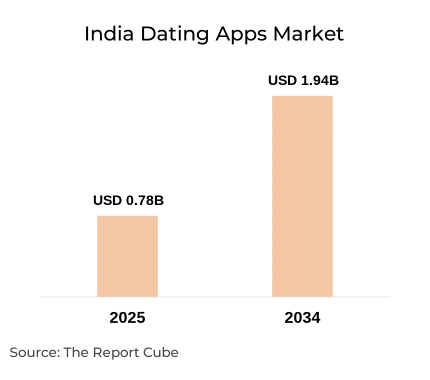
The India Dating Apps Market is anticipated to register a 11% CAGR during 2026-2034. The market size was valued at USD 0.78 Billion in 2025 and is projected to reach USD 1.94 Billion by 2034. This expansion is supported by changing social attitudes toward digital relationships, rising smartphone penetration, and a rapidly growing millennial and Gen Z population comfortable with app-based interactions. India has over 750 million smartphone users in 2025, with nearly 68% of users aged between 18 and 35, forming the core audience for dating platforms. Urban migration, delayed marriages, and increasing financial independence among young professionals are reshaping relationship discovery patterns.
Dating apps are also benefiting from regional language interfaces, enhanced safety features, and culturally adapted matchmaking algorithms. Monetization strategies are becoming more sophisticated, moving beyond simple subscriptions to feature-based microtransactions and ad-supported engagement models. As digital intimacy gains broader acceptance across tier-1 and tier-2 cities, the India dating apps market is transitioning from niche adoption to mainstream digital lifestyle usage, supporting sustained revenue growth through the forecast period.
India Dating Apps Market Recent Developments
- 2025: Bumble India introduced advanced profile verification and interest-based matching tools to improve user safety and engagement.
- 2025: Tinder India expanded regional language support and launched premium discovery features targeting tier-2 city users.
Government Initiatives & Policies
- Digital India Programme: Promotes internet accessibility, digital literacy, and smartphone adoption, indirectly supporting app-based platforms.
- Information Technology Rules, 2021: Strengthen user data protection, content moderation, and platform accountability across digital services.
India Dating Apps Market Dynamics
Key Driver: Shifting social norms and smartphone-led digital lifestyles
One of the strongest drivers of the India dating apps market is the rapid evolution of social norms combined with deep smartphone penetration. Younger demographics increasingly prefer digital platforms to meet potential partners due to convenience, broader choice, and privacy. Surveys indicate that over 42% of urban Indian singles have used at least one dating app, compared to less than 20% five years ago. The normalization of online dating is also supported by rising female participation, aided by safety tools such as profile verification, block/report functions, and women-first interaction models. Increased time spent on mobile applications, averaging nearly 5 hours per day among Indian users, further strengthens engagement levels. These behavioral shifts are converting dating apps from experimental tools into recurring-use platforms, directly accelerating user base expansion and monetization opportunities.
Industry Trends: Regional customization, safety innovation, and feature monetization
The India dating apps industry is witnessing a clear trend toward localization and feature-led monetization. Platforms are introducing regional language interfaces, culturally relevant prompts, and interest-based communities to improve relevance beyond metro users. Safety innovation is another major trend, with apps deploying AI-backed moderation, selfie verification, and location masking features, which have reduced fake profiles by an estimated 30% on leading platforms. Monetization strategies are also evolving, with premium tiers offering boosts, advanced filters, and visibility enhancements. À la carte purchases now account for nearly 25% of in-app revenues, reflecting user willingness to pay for personalized experiences rather than long-term subscriptions. These trends collectively improve user retention and average revenue per user.
Major Challenge: User trust, privacy concerns, and social stigma
Despite strong growth potential, the market faces challenges related to user trust, data privacy, and lingering social stigma in certain regions. Concerns around data misuse, harassment, and identity fraud remain barriers, particularly among first-time users and women. Industry data suggests that nearly 35% of app uninstallations are linked to negative trust or safety experiences. Additionally, conservative social attitudes in smaller cities slow adoption rates compared to metro regions. Regulatory compliance requirements related to data storage and content moderation also increase operational complexity for platform operators. Addressing these challenges requires continuous investment in safety infrastructure, transparent policies, and community education.
Opportunity: Tier-2 city expansion and diversified revenue streams
Significant opportunities exist in expanding into tier-2 and emerging urban centers, where digital adoption is rising faster than metros. Smartphone penetration in tier-2 cities crossed 58% in 2025, creating a large untapped user base. Platforms that tailor pricing, language, and cultural preferences can achieve rapid traction. Additionally, diversified revenue models such as ad-supported free tiers, event-based monetization, and brand partnerships offer new income streams beyond subscriptions. Collaborations with lifestyle brands and experiential dating formats can further enhance engagement. These opportunities position dating apps as scalable digital ecosystems rather than single-purpose platforms.
India Dating Apps Market Segment-wise Analysis
By Revenue Model:
- Freemium Model
- Subscription Model
- Ads Supported
- À La Carte
The freemium model dominates the India dating apps market, accounting for approximately 46% of total revenues. Free access lowers entry barriers and supports rapid user acquisition, while premium upgrades monetize engaged users. Subscription models follow closely, particularly among urban professionals seeking advanced filters and unlimited interactions. Ads-supported models are gaining momentum, contributing nearly 18% of revenues as brands target young, mobile-first audiences. À la carte purchases are the fastest-growing segment, driven by demand for boosts, super-likes, and profile highlights. This diversified revenue structure allows platforms to balance scale with profitability.
By Platform:
- Android Devices
- iOS Devices
- Others
Android devices lead platform-based segmentation with an estimated 72% market share, reflecting Android’s dominance in India’s smartphone ecosystem. Affordable data plans and wide handset availability support mass adoption. iOS users, while smaller in number, contribute disproportionately higher revenue due to stronger premium subscription uptake. Other platforms, including web-based access, remain marginal but serve niche user segments. Platform optimization, app performance, and payment integration continue to influence user retention and monetization efficiency.
Regional Projection of India Dating Apps Industry
- North India
- West India
- South India
- East India
- Central India
North India leads the dating apps market with an estimated 34% revenue share, driven by high urban density, strong digital adoption, and a large young population in cities such as Delhi NCR and Chandigarh. West India follows closely, supported by Mumbai and Pune’s tech-savvy user base. South India demonstrates the fastest growth rate due to high internet literacy and app engagement levels. East and Central India remain emerging regions but show improving adoption as regional language support expands. Regional strategies focused on cultural alignment and safety awareness are critical for sustained growth.
Why Choose This Report?
- Provides a comprehensive overview of the overall market analysis, encompassing key trends, consumer behavior analysis, and risk assessment to support strategic decision-making.
- Provides accurate, up-to-date insights into market size, segmentation, and emerging opportunities, helping to minimize risk & capitalizing on growth.
- Gives deep understanding of target audience preferences, investment habits, and communication channels for enhanced product development & marketing effectiveness.
- Delivers competitive analysis & benchmarking, uncovering the strengths & weaknesses of market competitors to guide strategies.
- Consolidate comprehensive market intelligence, reducing reasoning & streamlining research efforts.
- Facilitates customized market segmentation & risk mitigation strategies, fine-tuned to the business objectives.
- Aids in identifying both market challenges & untapped opportunities within the industry to drive long-term business growth.
- Provides valuable information based on actual customer data & search trends.
Table of Contents
- Introduction
- Objective of the Study
- Product and Category Definition
- Market Segmentation
- Study Variables
- Research Methodology
- Secondary Data Points
- Breakdown of Secondary Sources
- Primary Data Points
- Breakdown of Primary Interviews
- Secondary Data Points
- Executive Summary
- Market Dynamics
- Drivers
- Challenges
- Opportunity Assessment
- Recent Trends and Developments
- Regulatory and Policy Landscape
- India Dating Apps Market Overview (2021-2034)
- Market Size, By Value (USD Million)
- Market Share, By Revenue Model
- Freemium Model
- Subscription Model
- Ads Supported
- À La Carte
- Market Share, By Platform
- Android Devices
- iOS Devices
- Others
- Market Share, By Relationship Goal
- Casual Dating
- Serious Dating
- Friendship Social
- Community Niche
- Market Share, By User Demographics
- Gen Z
- Millennial
- Gen X
- Other Age Groups
- Market Share, By Gender Mix
- Male Heavy
- Balanced Mix
- Women Focused
- LGBTQ+ Focused
- Market Share, By Region Tier
- North India
- West India
- South India
- East India
- Central India
- Market Share, By Company
- Revenue Shares & Analysis
- Competition Characteristics
- Regional Analysis by Zone
- North India Dating Apps
- Market Size, By Value (USD Million)
- User Penetration Trends
- Preferred Revenue Model
- West India Dating Apps
- Market Size, By Value (USD Million)
- User Penetration Trends
- Preferred Revenue Model
- South India Dating Apps
- Market Size, By Value (USD Million)
- User Penetration Trends
- Preferred Revenue Model
- East India Dating Apps
- Market Size, By Value (USD Million)
- User Penetration Trends
- Preferred Revenue Model
- Central India Dating Apps
- Market Size, By Value (USD Million)
- User Penetration Trends
- Preferred Revenue Model
- North India Dating Apps
- User Behavior and Demographics
- Adoption by Age Group
- Adoption by Gender
- Usage by City Tier
- Engagement and Monetization
- Competitive Outlook and Company Profiles
- Tinder India
- Company Overview
- Product Positioning
- Monetization Strategy
- Recent Developments
- Bumble India
- Company Overview
- Product Positioning
- Monetization Strategy
- Recent Developments
- Hinge India
- Company Overview
- Product Positioning
- Monetization Strategy
- Recent Developments
- Aisle App
- Company Overview
- Product Positioning
- Monetization Strategy
- Recent Developments
- TrulyMadly
- Company Overview
- Product Positioning
- Monetization Strategy
- Recent Developments
- QuackQuack
- Company Overview
- Product Positioning
- Monetization Strategy
- Recent Developments
- Happn India
- Company Overview
- Product Positioning
- Monetization Strategy
- Recent Developments
- OkCupid India
- Company Overview
- Product Positioning
- Monetization Strategy
- Recent Developments
- Grindr India
- Company Overview
- Product Positioning
- Monetization Strategy
- Recent Developments
- Coffee Meets Bagel
- Company Overview
- Product Positioning
- Monetization Strategy
- Recent Developments
- Others
- Tinder India
- Contact Us and Disclaimer
Top Key Players & Market Share Outlook
- Tinder India
- Bumble India
- Hinge India
- Aisle App
- TrulyMadly
- QuackQuack
- Happn India
- OkCupid India
- Grindr India
- Coffee Meets Bagel
- Others
Frequently Asked Questions






