



Build Your Custom Market Intelligence Report
Customize Your ReportJapan Digital Health Market Statistics and Insights
Market Insight
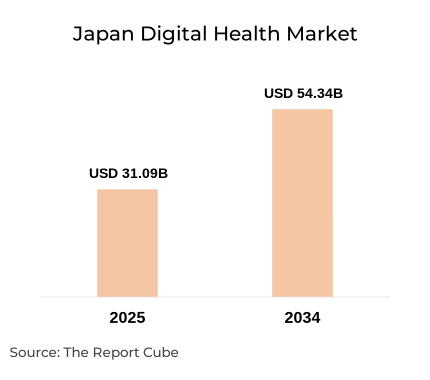
- Japan Digital Health Market was valued at USD 31.09 billion in 2025.
- Japan Digital Health Market is projected to reach USD 54.34 billion by 2034.
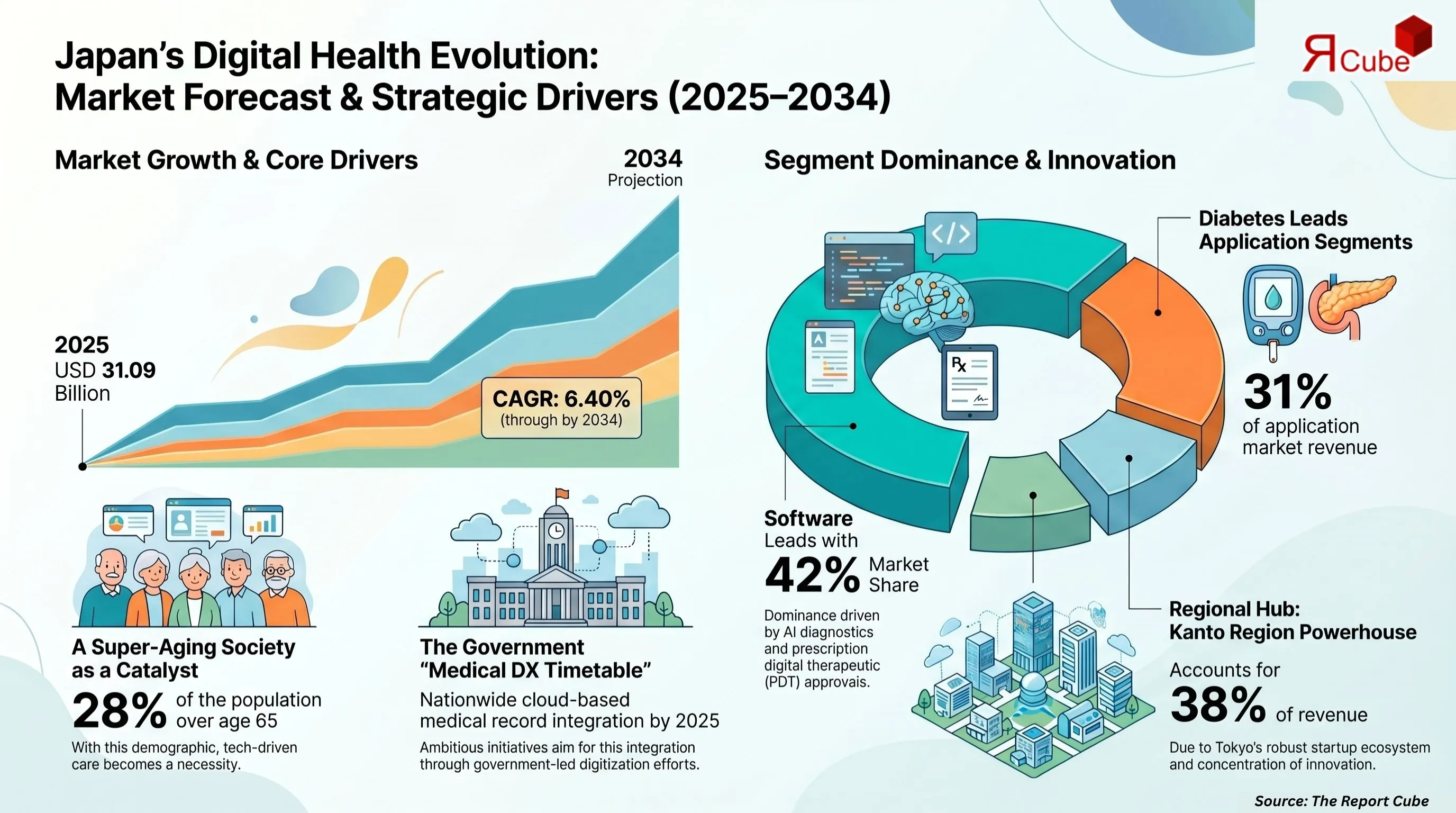
- The market is forecast to grow at a CAGR of 6.40% from 2026 to 2034.
By Component
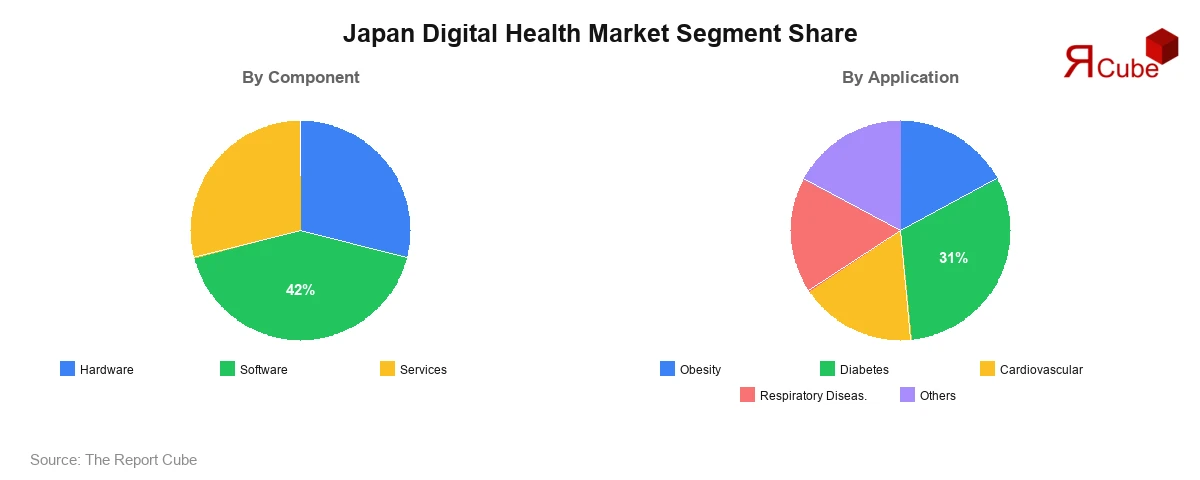
- Software segment leads the Japan Digital Health Market with approximately 42% share.
Competitive Landscape
- More than 10 companies are actively engaged in producing Japan Digital Health Market solutions.
- Top 5 companies acquired around 38% of the market share.
- Takeda Pharmaceutical Company Limited, OMRON Corporation, CureApp, Shionogi & Co., Ltd., HealthNode, and others.
By Application
- Diabetes segment dominates the Japan Digital Health Market with approximately 31% share.
Japan Digital Health Market Insights & Analysis
The Japan Digital Health Market is anticipated to register a 6.40% CAGR during 2026–2034. The market size was valued at USD 31.09 billion in 2025 and is projected to reach USD 54.34 billion by 2034. Japan's digital health sector is undergoing a decisive transformation, underpinned by the country's rapidly aging demographics, escalating prevalence of chronic diseases, and ambitious government-led digitization initiatives. With approximately 28% of Japan's population aged 65 and older as of 2025, the demand for scalable, technology-driven healthcare delivery is immense.
The Japanese government's "Medical DX Timetable", released in 2023, outlines accelerated implementation of nationwide electronic medical records, interoperable cloud-based platforms, and digital prescription systems, with full-scale operation targeted for fiscal year 2025. In February 2025, Shionogi & Co., Ltd. received marketing approval for a digital therapeutic application for pediatric ADHD patients, while CureApp simultaneously obtained approval for an alcohol addiction treatment app, marking continued momentum in Japan's regulated digital therapeutics pipeline. The country is rapidly positioning itself as a global leader in Software as a Medical Device (SaMD) adoption, driving sustained demand across hardware, software, and services segments.
Japan Digital Health Market Dynamics
Key Market Driver: Aging Population Fueling Digital Therapeutics Demand
Japan's demographic structure is a defining catalyst for the digital health market. With over 35 million citizens aged 65 and above, the highest proportion among G7 nations, the strain on conventional healthcare infrastructure is unprecedented. Digital health platforms are emerging as the primary mechanism to manage this burden efficiently. OMRON Corporation's wearable remote monitoring devices and Allm Inc.'s clinical communication platforms are directly addressing care coordination challenges for elderly patients.
Government data indicates that chronic disease management expenditures exceeded JPY 44.2 trillion in fiscal 2021, a figure projected to rise sharply by 2030. Digital therapeutics and remote patient monitoring tools are reducing hospital readmissions by enabling continuous at-home health tracking, directly cutting downstream medical costs and reinforcing market adoption across all segments.
Major Industry Challenge: Healthcare System Interoperability Remains Persistently Fragmented
Despite Japan's formidable technological capabilities, interoperability between existing healthcare IT systems remains a significant structural impediment. Many hospital networks continue to operate on siloed, proprietary electronic medical record platforms with limited cross-institutional data exchange capabilities. Standardized data formats for clinical documentation have yet to achieve universal adoption, preventing seamless integration of emerging digital health applications with legacy hospital management systems.
The Ministry of Health, Labour and Welfare's Nationwide Medical Information Platform, designed to unify patient records across care settings, is still in phased rollout, with full integration of all six priority data categories including diagnoses, allergies, and drug contraindications scheduled incrementally through 2026. Until comprehensive interoperability is achieved, deployment of enterprise-scale digital health solutions remains constrained by system fragmentation at the institutional level.
Emerging Trend Shaping Outlook: Digital Therapeutics Gaining Regulatory Traction Nationwide
Japan is pioneering a globally distinctive regulatory pathway for prescription digital therapeutics (PDTs), creating a structured framework under the Pharmaceuticals and Medical Devices Act (PMDA) that treats software applications as approvable medical interventions. CureApp's nicotine dependence app became the world's first regulatory-approved hypertension digital therapeutic in Japan, followed by approvals for insomnia, ADHD, and alcohol addiction applications by 2025.
This regulatory clarity is attracting significant investment from pharmaceutical companies such as Takeda and Shionogi into app-based treatment development pipelines. By 2034, prescription digital therapeutics are projected to constitute a growing sub-segment within the broader software component, particularly in metabolic disease, psychiatry, and cardiovascular management, reflecting a fundamental shift from device-centric digital health toward software-led clinical intervention models.
Need Specific Data, Let’s Customize the Report for You
Request CustomizationJapan Digital Health Market Segment-wise Analysis
Japan's digital health market encompasses a broad ecosystem of technologies, applications, and therapeutic use cases. Growth is distributed across hardware-driven remote monitoring, software-based therapeutics and analytics platforms, and services including telemedicine and clinical integration. Meanwhile, chronic disease management applications, particularly for diabetes, cardiovascular conditions, and respiratory illness, are commanding increasing investment as Japan's disease burden intensifies. The following segment-level analysis identifies the key revenue drivers shaping this market through 2034.
By Component
- Hardware
- Software
- Services
The software segment commands the leading position within Japan's digital health market by component, capturing approximately 42% of total market revenue in 2026. This dominance is underpinned by accelerating adoption of electronic health records (EHR), AI-enabled diagnostic decision support tools, and prescription digital therapeutic applications receiving formal PMDA approval. Platforms developed by HealthNode for clinical data integration and by CureApp for condition-specific digital therapeutics have collectively strengthened the commercial viability of the software sub-segment.
The hardware segment holds approximately 35% market share, driven by strong demand for OMRON's remote blood pressure monitors, wearable cardiac trackers, and continuous glucose monitoring (CGM) devices essential for diabetes management. Japan's well-established electronics manufacturing base further supports hardware competitiveness globally. The services segment, accounting for the remaining 23%, is growing steadily through expansion of telemedicine consultation platforms, remote patient monitoring services, and managed health analytics offerings. Allm Inc.'s hospital communication infrastructure and Dai-ichi Life Holdings' health management programs are key contributors to recurring services revenue, with B2B insurance-integrated wellness platforms representing an emerging growth avenue within this sub-segment.
By Application
- Obesity
- Diabetes
- Cardiovascular
- Respiratory Diseases
- Others
The diabetes application segment leads the Japan Digital Health Market by application, holding approximately 31% revenue share in 2026. With over 10 million diagnosed diabetes patients in Japan and an estimated additional 10 million in a pre-diabetic state, continuous glucose monitoring, digital dietary management applications, and insulin adherence platforms are in acute demand. Welldoc's BlueStar collaboration with Astellas Pharma and CureApp's expanding therapeutic portfolio directly address this population. Cardiovascular applications represent the second-largest segment at approximately 26%, supported by OMRON's industry-leading remote blood pressure monitoring devices, widely distributed across Japan's retail pharmacy network, alongside AI-assisted ECG interpretation tools gaining traction in hospital networks.
Respiratory disease applications account for roughly 16% of market share, with sleep apnea monitoring platforms and AI-supported spirometry applications contributing to this segment's growth. Japan's high urban pollution indices and increasing COPD prevalence among elderly citizens are sustaining demand for continuous respiratory health monitoring solutions. Obesity management applications are gaining momentum as metabolic syndrome awareness increases, while the "others" category encompasses neurology, oncology, and mental health platforms, each representing incremental but high-growth digital health niches.
Regional Projection of Japan Digital Health Market
The Japan Digital Health Market is a single-country assessment segmented by domestic administrative regions:
- Kanto Region
- Kinki (Kansai) Region
- Central/Chubu Region
- Kyushu-Okinawa Region
The Kanto Region, encompassing Tokyo, Kanagawa, Saitama, and Chiba, dominates the Japan Digital Health Market with approximately 38% revenue share, driven by the concentration of digital health startups, major hospital networks, pharmaceutical company headquarters, and venture capital investment ecosystems. Tokyo serves as the primary hub for regulatory interactions with the PMDA, accelerating the clinical approval pipeline for digital therapeutics. The Kinki region, encompassing Osaka and Kyoto, is the second-largest contributor, supported by established pharmaceutical manufacturing and university hospital digital transformation programs.
Japan Digital Health Market: Recent Development (2025)
- OMRON Corporation reported a 12% revenue increase in its healthcare division, driven by wearable remote monitoring device exports across Asia-Pacific markets.
- CureApp secured regulatory approval for an alcohol addiction digital therapeutic in February 2025, expanding its pipeline with a projected net margin improvement of 8%.
- Shionogi & Co., Ltd. received PMDA marketing approval for a pediatric ADHD digital therapeutic app, reinforcing its digital health portfolio expansion strategy.
- Allm Inc. expanded its clinical communication platform deployment to over 400 hospitals across Japan, deepening enterprise healthcare IT penetration nationally.
Japan Digital Health Market Future Outlook (2034)
The Japan Digital Health Market is projected to reach USD 54.34 billion by 2034, expanding at a 6.40% CAGR through the forecast period. Growth will be anchored by the maturation of Japan's prescription digital therapeutic regulatory framework, enabling broader adoption of software-led clinical interventions for chronic diseases including diabetes, cardiovascular conditions, and respiratory disorders. AI-driven drug discovery platforms, advanced wearable biosensors, and cloud-based interoperable health data exchanges are expected to reshape clinical workflows significantly. The nationwide rollout of Japan's Medical Information Platform will create a unified data infrastructure supporting precision medicine initiatives. As digital health literacy improves among elderly populations and reimbursement policies evolve to accommodate digital therapeutics, the market will transition from early adoption to mainstream integration across Japan's healthcare system.
Why Choose This Report?
- Provides a comprehensive overview of the overall market analysis, encompassing key trends, consumer behavior analysis, and risk assessment to support strategic decision-making.
- Provides accurate, up-to-date insights into market size, segmentation, and emerging opportunities, helping to minimize risk & capitalizing on growth.
- Gives deep understanding of target audience preferences, investment habits, and communication channels for enhanced product development & marketing effectiveness.
- Delivers competitive analysis & benchmarking, uncovering the strengths & weaknesses of market competitors to guide strategies.
- Consolidate comprehensive market intelligence, reducing reasoning & streamlining research efforts.
- Facilitates customized market segmentation & risk mitigation strategies, fine-tuned to the business objectives.
- Aids in identifying both market challenges & untapped opportunities within the industry to drive long-term business growth.
- Provides valuable information based on actual customer data & search trends.
Table of Contents
- Introduction
- Objective of the study
- Product Definition
- Market Segmentation
- Study Variables
- Research Methodology
- Secondary Data Points
- Companies Interviewed
- Primary Data Points
- Breakdown of Primary Interviews
- Secondary Data Points
- Executive Summary
- Market Dynamics
- Drivers
- Challenges
- Opportunity Assessment
- Recent Trends and Developments
- Policy and Regulatory Landscape
- Japan Digital Health Market Overview and Forecast Analysis (2021-2034)
- Market Size, By Value, By growth rate (CAGR/USD Billions)
- Demand - Supply Trends
- Market Share, By Component
- Hardware
- Software
- Services
- Market Share, By Application
- Obesity
- Diabetes
- Cardiovascular
- Respiratory Diseases
- Others
- Market Share, By Type
- Telehealth
- Medical Wearables
- EMR/EHR Systems
- Medical Apps
- Healthcare Analytics
- Others
- Market Share, By Region
- Kanto Region
- Kinki (Kansai) Region
- Central/Chubu Region
- Kyushu-Okinawa Region
- Market Share, By Competitors
- Competition Characteristics
- Revenue Shares
- Japan Hardware Digital Health Market Overview, 2021-2034F
- By Value (USD Million)
- By Application- Market Size & Forecast 2021-2034, USD Million
- By Type- Market Size & Forecast 2021-2034, USD Million
- Japan Software Digital Health Market Overview, 2021-2034F
- By Value (USD Million)
- By Application- Market Size & Forecast 2021-2034, USD Million
- By Type- Market Size & Forecast 2021-2034, USD Million
- Japan Services Digital Health Market Overview, 2021-2034F
- By Value (USD Million)
- By Application- Market Size & Forecast 2021-2034, USD Million
- By Type- Market Size & Forecast 2021-2034, USD Million
- Competitive Outlook (Company Profile - Partial List)
- Takeda Pharmaceutical Company Limited
- Company Overview
- Business Segments
- Strategic Alliances/Partnerships
- Recent Developments
- OMRON Corporation
- Company Overview
- Business Segments
- Strategic Alliances/Partnerships
- Recent Developments
- CureApp
- Company Overview
- Business Segments
- Strategic Alliances/Partnerships
- Recent Developments
- Shionogi & Co., Ltd.
- Company Overview
- Business Segments
- Strategic Alliances/Partnerships
- Recent Developments
- HealthNode
- Company Overview
- Business Segments
- Strategic Alliances/Partnerships
- Recent Developments
- Whill
- Company Overview
- Business Segments
- Strategic Alliances/Partnerships
- Recent Developments
- Allm Inc.
- Company Overview
- Business Segments
- Strategic Alliances/Partnerships
- Recent Developments
- Dai-ichi Life Holdings, Inc.
- Company Overview
- Business Segments
- Strategic Alliances/Partnerships
- Recent Developments
- Xiaomi
- Company Overview
- Business Segments
- Strategic Alliances/Partnerships
- Recent Developments
- Others
- Takeda Pharmaceutical Company Limited
- Contact Us & Disclaimer
Top Key Players & Market Share Outlook
- Takeda Pharmaceutical Company Limited
- OMRON Corporation
- CureApp
- Shionogi & Co., Ltd.
- HealthNode
- Whill
- Allm Inc.
- Dai-ichi Life Holdings, Inc.
- Xiaomi
- Others
Frequently Asked Questions






