



Build Your Custom Market Intelligence Report
Customize Your ReportGlobal Digital Inks Market Key Highlights
By Ink Type:
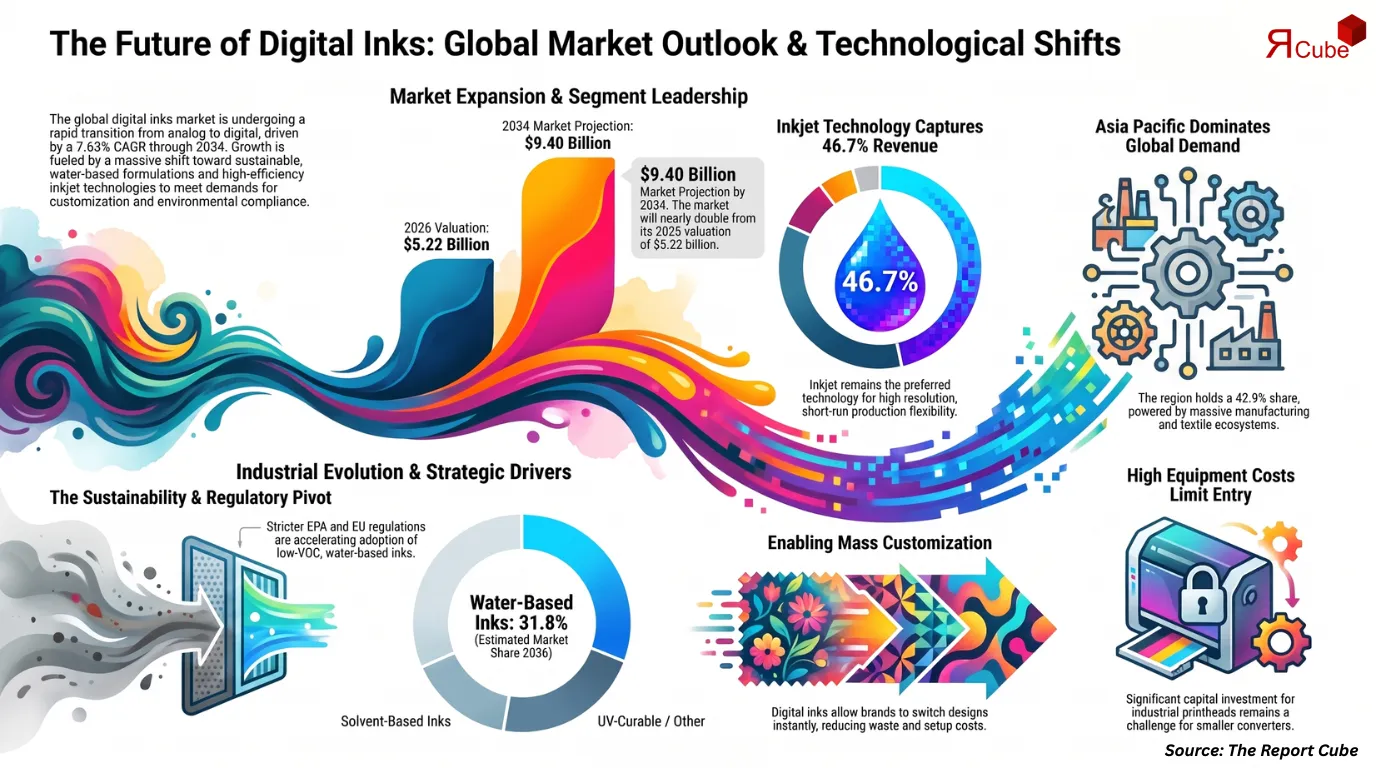
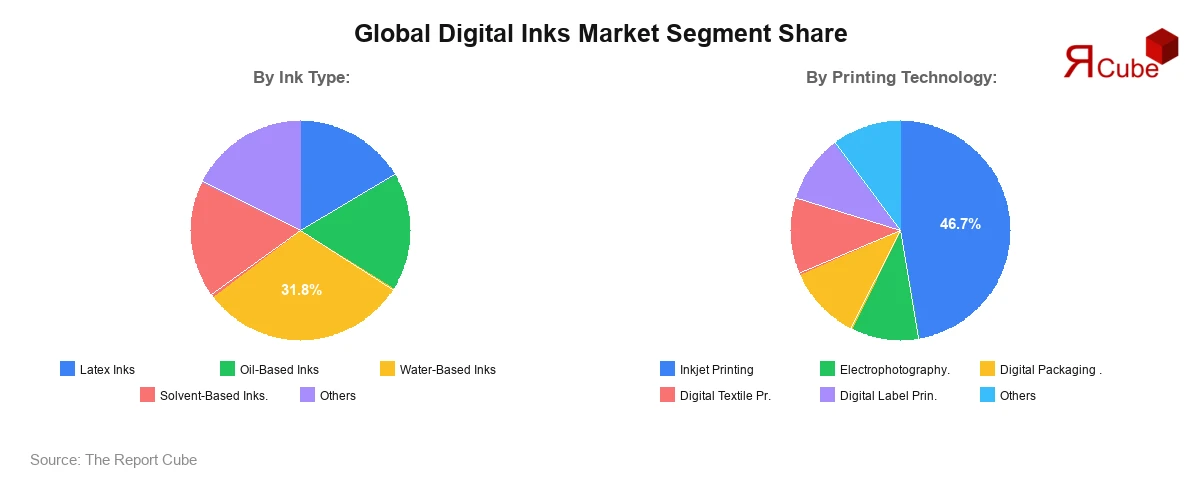
Water-Based Inks segment leads the market with approximately 31.8% share.
By Printing Technology:
Inkjet Printing dominates the market with nearly 46.7% of total revenue.
Regional Outlook:
Asia Pacific dominates the Global Digital Inks Market with an estimated 42.9% market share.
Global Digital Inks Market Insights & Analysis
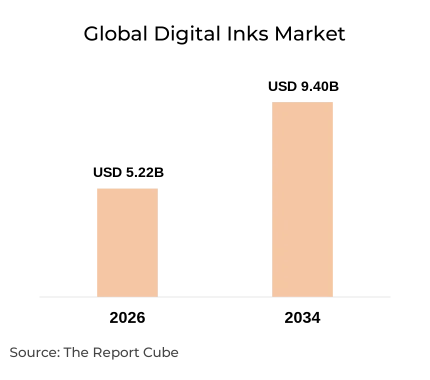
The Global Digital Inks Market is anticipated to register a CAGR of around 7.63% during the forecast period of 2026-2034. The market size is valued at USD 5.22 billion in 2026 and is projected to reach USD 9.40 billion by 2034. Digital inks have become an essential component of modern printing as manufacturers seek greater production flexibility, faster turnaround times, and improved print consistency. Industries such as packaging, textiles, consumer electronics, pharmaceuticals, and commercial graphics are steadily replacing conventional printing processes with digital technologies capable of handling shorter production runs and variable data printing. The transition is supported by continuous improvements in pigment technology, resin chemistry, printhead performance, and curing systems that enhance color accuracy, substrate compatibility, and operational efficiency. As product customization becomes a competitive strategy across global industries, digital printing continues to gain preference for delivering high-quality output while reducing production waste and setup costs.
Business investments made during 2025 and 2026 demonstrate the industry's commitment to technological innovation and sustainability. Leading manufacturers have expanded their portfolios with water-based, UV-curable, LED UV-curable, and low-VOC digital inks that comply with evolving environmental regulations without compromising print performance. Product launches from companies including Kornit Digital, Agfa-Gevaert, FUJIFILM, and Sun Chemical reflect increasing demand for advanced ink formulations capable of supporting industrial graphics, wide-format printing, textile production, and corrugated packaging. Packaging converters are also investing in digital printing equipment to improve inventory management, accelerate product launches, and deliver personalized packaging solutions. At the same time, stricter environmental policies across North America and Europe are encouraging the adoption of sustainable ink technologies, while manufacturing expansion across Asia Pacific continues to strengthen production capacity and long-term market growth.
Global Digital Inks Market Impact Analysis
| Factor | Type | Specific Impact on Market | Magnitude | Business Implication |
|---|---|---|---|---|
| Adoption of Digital Printing | Market | Shifts volume from analog to digital across print segments | High | Supports rapid growth in ink demand for digital presses globally |
| Packaging and Labels Demand | Market | Brands require short run, high quality packaging and labels | High | Drives higher value inks tailored for flexible packaging users |
| Customization and Personalization Trend | Consumer | End users favor variable data and customized print solutions | High | Enables premium pricing for inks enabling short customized runs |
| Technological Advances in Inkjet | Technological | Improved heads and formulations widen substrates and uses | Medium-High | Requires ongoing R&D to maintain compatibility and performance |
| Environmental and Regulatory Pressure | Regulatory | Policies favor low VOC, water based and eco friendly inks | High | Accelerates shift of portfolios toward sustainable ink lines |
| High Initial Equipment and Ink Cost | Market | Capital intensity slows adoption among smaller converters | Medium | Encourages leasing models and tiered ink pricing strategies |
| Competition from Traditional Printing | Competitive | Conventional methods still capture large volume share | Medium | Requires clear value proof versus analog on cost and flexibility |
Global Digital Inks Market Dynamics
Key Driver: Expansion of Sustainable Packaging and Customized Printing Applications
Packaging manufacturers are steadily increasing the use of digital printing technologies as global brands prioritize product differentiation, shorter production cycles, and sustainable manufacturing practices. Digital inks enable high-resolution printing without the lengthy setup associated with traditional printing methods, allowing businesses to respond quickly to changing product designs and seasonal marketing campaigns. Food and beverage companies, pharmaceutical manufacturers, and personal care brands increasingly rely on digital printing to produce variable data labels, multilingual packaging, traceability codes, and customized promotional graphics while maintaining consistent print quality throughout production.
Environmental compliance has become another important factor supporting market growth. Regulatory agencies across several developed economies continue promoting reduced solvent emissions and improved workplace safety, encouraging the transition toward water-based, UV-curable, LED UV-curable, and bio-based digital inks. Ink manufacturers are responding with advanced formulations that provide stronger adhesion, faster curing, excellent color density, and compatibility across paper, plastics, textiles, glass, and metal substrates. These technological improvements are strengthening the commercial value of digital inks across multiple industrial sectors.
Industry Trends: Advanced Ink Chemistry and Industrial Inkjet Adoption Reshape Printing Operations
Printing technology continues to evolve as manufacturers seek higher productivity without compromising print quality or sustainability objectives. Recent product developments have focused on improving pigment stability, resin performance, and curing efficiency to deliver faster production speeds and greater substrate compatibility. UV-curable and LED UV-curable inks have gained considerable commercial acceptance because they reduce drying time, improve abrasion resistance, and enable printing on challenging materials used in industrial manufacturing, retail displays, packaging, and decorative applications.
Digital textile printing has also emerged as a major investment area throughout 2025 and 2026. Apparel brands are shifting toward on-demand manufacturing models that reduce excess inventory while allowing greater design flexibility. New textile ink technologies introduced by leading manufacturers support vibrant color reproduction, improved wash durability, and compatibility with cotton, polyester, and blended fabrics. Similar advancements are being introduced across wide-format graphics, industrial labeling, and corrugated packaging, expanding the commercial application of digital inks beyond conventional commercial printing.
Book your FREE 30-minute expert consultation today
Contact UsMajor Challenge: Capital-Intensive Printing Infrastructure and Complex Material Compatibility
Although digital printing offers substantial operational advantages, implementation costs remain a significant consideration for many printing businesses. Modern industrial inkjet systems require investments in high-performance printheads, precision curing equipment, workflow automation software, and specialized maintenance programs. Small and medium-sized printing companies often face longer investment recovery periods, particularly when transitioning from conventional offset or flexographic printing technologies.
Material compatibility continues to present technical challenges for ink developers. Each substrate requires carefully balanced formulations capable of delivering strong adhesion, accurate color reproduction, rapid curing, and long-term durability under different environmental conditions. Packaging films, metals, ceramics, textiles, glass, and engineered plastics each demand distinct performance characteristics. Manufacturers therefore continue allocating substantial research and development resources toward expanding substrate compatibility while maintaining regulatory compliance, production efficiency, and consistent print performance.
Opportunity: Industrial Manufacturing, Smart Packaging, and Sustainable Ink Innovation
Industrial digital printing is creating new revenue opportunities as manufacturers integrate decorative graphics, functional markings, product identification, and traceability features directly into production processes. Automotive components, consumer electronics, medical devices, construction materials, and industrial equipment increasingly require durable digital printing solutions capable of maintaining performance under demanding operating environments. These applications continue driving demand for advanced digital inks with superior chemical resistance, weather stability, and mechanical durability.
Future market expansion will also benefit from rapid adoption of smart packaging technologies. Brand owners are incorporating QR codes, authentication features, serialization, and interactive packaging elements to strengthen consumer engagement and improve supply chain visibility. Digital printing provides the flexibility needed to produce these features efficiently without interrupting manufacturing workflows. Continued investment in bio-based raw materials, recyclable packaging systems, and low-emission ink formulations is expected to create attractive long-term growth opportunities for digital ink manufacturers across global markets through 2034.
Global Digital Inks Market Segment-wise Analysis
By Ink Type:
- Latex Inks
- Oil-Based Inks
- Water-Based Inks
- Solvent-Based Inks
- Others
Water-Based Inks accounted for an estimated 31.8% of the Global Digital Inks Market in 2026, making them the largest ink type segment. Their market leadership is supported by increasing adoption across food packaging, labels, commercial graphics, and corrugated printing, where low emissions and regulatory compliance are essential. These inks contain significantly lower levels of volatile organic compounds than solvent-based alternatives, helping printing companies meet environmental standards while maintaining high-quality color reproduction and print consistency. Continuous improvements in pigment dispersion, drying performance, and substrate adhesion have further expanded their use across paper, paperboard, and selected plastic film applications.
Investment in sustainable printing technologies continues to strengthen the outlook for water-based inks. Brand owners and packaging converters are adopting environmentally responsible production practices to achieve corporate sustainability targets and comply with evolving regulations in North America and Europe. Manufacturers are also introducing advanced resin systems that improve water resistance, durability, and print speed without compromising environmental performance. The rapid expansion of e-commerce packaging, digital labeling, and customized retail packaging is expected to sustain healthy demand for water-based digital inks throughout the forecast period.
By Printing Technology:
- Inkjet Printing
- Electrophotography Printing
- Digital Packaging Printing
- Digital Textile Printing
- Digital Label Printing
- Others
Inkjet Printing represented nearly 46.7% of the Global Digital Inks Market in 2026 and remains the preferred digital printing technology across multiple industries. Its ability to produce high-resolution images with minimal setup time makes it suitable for short production runs, personalized packaging, textile printing, industrial graphics, and variable data printing. Unlike conventional printing methods, inkjet systems allow manufacturers to change artwork instantly, reduce material waste, and improve operational efficiency. Ongoing improvements in printhead technology and precision droplet control continue to enhance print quality while increasing production speeds.
Industrial adoption of inkjet printing continues to accelerate as manufacturers seek flexible production capabilities and lower operating costs. Packaging companies are investing in high-speed inkjet systems to support product customization and faster product launches, while textile producers are expanding digital printing capacity to meet growing demand for on-demand apparel manufacturing. The introduction of UV-curable, LED UV-curable, and water-based ink technologies has further broadened inkjet applications across plastics, textiles, metal, glass, ceramics, and corrugated packaging, reinforcing the segment's long-term growth potential.
Regional Projection of Global Digital Inks Industry
- North America
- Europe
- Asia Pacific
- Middle East and Africa
- South America
Asia Pacific held approximately 42.9% of the Global Digital Inks Market in 2026, making it the largest regional market. The region benefits from a well-established manufacturing ecosystem, strong packaging production capacity, and expanding digital textile printing industries across China, India, Japan, South Korea, and Southeast Asia. Rapid industrialization, increasing urbanization, and rising consumer spending continue to stimulate demand for packaged food, consumer electronics, personal care products, and apparel, all of which require high-quality digital printing solutions. Strong domestic manufacturing capabilities also enable regional producers to supply digital inks to both local and international markets.
Continued investment in advanced printing equipment and sustainable manufacturing technologies is expected to support regional market expansion through 2034. Governments across Asia Pacific are promoting environmentally responsible industrial production, encouraging greater adoption of water-based, low-VOC, and UV-curable inks. In addition, the rapid growth of e-commerce, smart packaging, pharmaceutical labeling, and customized textile production is generating sustained demand for advanced digital printing solutions. Ongoing capacity expansion by leading global ink manufacturers and printing equipment suppliers further strengthens Asia Pacific's position as the primary growth engine for the Digital Inks Market.
Need insights for a specific region within this market?
Request Regional DataGlobal Digital Inks Market Regional Analysis
The global digital inks market in 2026 shows strong regional contrasts in technology adoption, application mix, and growth drivers.
| Region | Demand Level | Key Areas | System Dominance | Core Demand Logic | Growth Nature |
|---|---|---|---|---|---|
| North America | Very High | U.S., Canada | Inkjet & UV-curable inks | E‑commerce packaging and signage | Tech‑driven, sustainability‑led |
| Europe | High | Germany, U.K., France | Low‑migration & eco inks | Strict packaging and safety rules | Regulation‑driven upgrades |
| Asia Pacific | Extremely High | China, Japan, India | Textile & packaging inks | Manufacturing scale and exports | Fastest‑growing regional hub |
| Middle East & Africa | Medium | UAE, Saudi Arabia, South Africa | Wide‑format & packaging inks | Retail branding and infrastructure | Emerging, project‑linked growth |
| South America | Medium | Brazil, Mexico, Argentina | Solvent & water‑based inks | FMCG labels and local printing | Gradual, consumption‑led |
Government Initiatives & Policies
- European Union Ecodesign for Sustainable Products Regulation (ESPR) Implementation: During 2025-2026, the European Union continued implementing ESPR requirements that encourage sustainable manufacturing, circular product design, improved recyclability, and lower-emission materials. These measures are accelerating the adoption of low-VOC, water-based, UV-curable, and bio-based digital inks across packaging and textile printing industries.
- U.S. Environmental Protection Agency National VOC Emission Standards: In 2025-2026, the U.S. EPA continued strengthening initiatives to reduce volatile organic compound emissions from industrial coating and printing operations. The regulations encourage manufacturers and printing companies to transition toward environmentally friendly digital ink technologies with lower solvent content and improved workplace safety.
Global Digital Inks Industry Recent Developments
- 2026: Kornit Digital Ltd. launched the Atlas MATRIX platform powered by Karbon Shield technology, enhancing digital textile printing performance for cotton, polyester, and blended fabrics. The solution improves production efficiency, print durability, and supports sustainable on-demand apparel manufacturing while reducing water consumption and inventory waste.
- 2026: Mutoh America, Inc. introduced the HydrAton 1642 wide-format printer utilizing FUJIFILM Corporation's AQUAFUZE ink technology. The new system delivers low-VOC, low-odor, and hazard-free printing while providing high image quality for signage, graphics, and commercial printing applications.
- 2026: Agfa-Gevaert Group showcased its Jeti Tauro H3300 UHS at FESPA 2026, highlighting high-speed UV inkjet printing capabilities for industrial graphics, display applications, retail signage, and wide-format commercial printing. The launch further strengthens the company's position in industrial digital printing solutions.
- 2025: Sun Chemical Corporation, a member of the DIC Corporation Group, introduced Streamline Toccata aqueous inks designed for poster printing and corrugated display applications. The product supports growing industry demand for water-based digital inks while improving sustainability, print quality, and production efficiency for graphics and packaging applications.
Why Choose This Report?
- Provides a comprehensive overview of the overall market analysis, encompassing key trends, consumer behavior analysis, and risk assessment to support strategic decision-making.
- Provides accurate, up-to-date insights into market size, segmentation, and emerging opportunities, helping to minimize risk while capitalizing on growth opportunities.
- Gives deep understanding of target audience preferences, investment habits, and communication channels for enhanced product development and marketing effectiveness.
- Delivers competitive analysis and benchmarking, uncovering the strengths and weaknesses of market competitors to guide business strategies.
- Consolidates comprehensive market intelligence, reducing research time and streamlining strategic planning.
- Facilitates customized market segmentation and risk mitigation strategies tailored to specific business objectives.
- Helps identify both market challenges and untapped growth opportunities across the Global Digital Inks Market.
- Provides valuable information based on actual customer demand patterns, technology trends, sustainability initiatives, and evolving industry developments.
Table of Contents
- Introduction
- Objective of the Study
- Product and Category Definition
- Market Segmentation
- Study Variables
- Research Methodology
- Secondary Data Points
- Breakdown of Secondary Sources
- Primary Data Points
- Breakdown of Primary Interviews
- Secondary Data Points
- Executive Summary
- Market Dynamics
- Emerging Opportunities
- Adoption Trends
- Demand Drivers
- Disruption Analysis (Challenges)
- Industry Analysis and Strategic Insights
- Supply and Value Chain Analysis
- Pricing Analysis
- Go-To-Market Strategy
- BCG Matrix
- Recent Trends and Developments
- Import and Export Analysis
- Regulatory and Policy Landscape
- Region-wise Policies
- Government Initiatives
- Global Digital Inks Market Overview and Forecast Analysis (2021-2034)
- Market Size, By Value, By Growth Rate (CAGR/US$ Billion)
- Market Share, By Ink Type
- Latex Inks
- Oil-Based Inks
- Water-Based Inks
- Solvent-Based Inks
- Others
- Market Share, By Curing Type
- Electron Beam-Curable Inks
- Oxidative Drying Inks
- UV-Curable Inks
- LED UV-Curable Inks
- Conventional Drying Inks
- Others
- Market Share, By VOC Level
- High VOC Inks
- Low VOC Inks
- Zero VOC Inks
- Market Share, By Bio-Based Content
- Non-Bio-Based Inks
- Bio-Based Inks
- Market Share, By Printing Technology
- Digital Packaging Printing
- Digital Textile Printing
- Electrophotography Printing
- Digital Label Printing
- Inkjet Printing
- Others
- Market Share, By Resin Type
- Polyester
- Nitrocellulose
- Polyamide
- Epoxy
- Polyurethane
- Acrylic
- Others
- Market Share, By Application and Use Case
- Industrial Printing
- Decorative Printing
- Textile Printing
- Security Printing
- Labels and Tags
- Commercial Printing
- Publications
- Packaging
- Others
- Market Share, By Substrate
- Wood
- Glass and Ceramics
- Metal
- Plastics and Films
- Textile
- Paper and Paperboard
- Others
- Market Share, By End-Use Industry
- Automotive
- Electronics
- Consumer Goods
- Industrial Goods
- Textiles and Apparel
- Personal Care and Cosmetics
- Pharmaceuticals
- Publishing and Commercial Printing
- Food and Beverages
- Others
- Market Share, By Region
- North America
- Europe
- Asia Pacific
- Middle East and Africa
- South America
- Market Share, By Company
- Revenue Shares and Analysis
- Competitive Landscape
- North America Digital Inks Market Overview and Forecast Analysis (2021-2034)
- Market Size, By Value, By Growth Rate (CAGR/US$ Billion/Million)
- Market Share, By Ink Type
- Market Share, By Curing Type
- Market Share, By VOC Level
- Market Share, By Bio-Based Content
- Market Share, By Printing Technology
- Market Share, By Resin Type
- Market Share, By Application and Use Case
- Market Share, By Substrate
- Market Share, By End-Use Industry
- Market Share, By Country
- United States
- Canada
- Mexico
- Rest of North America
- Europe Digital Inks Market Overview and Forecast Analysis (2021-2034)
- Market Size, By Value, By Growth Rate (CAGR/US$ Billion/Million)
- Market Share, By Ink Type
- Market Share, By Curing Type
- Market Share, By VOC Level
- Market Share, By Bio-Based Content
- Market Share, By Printing Technology
- Market Share, By Resin Type
- Market Share, By Application and Use Case
- Market Share, By Substrate
- Market Share, By End-Use Industry
- Market Share, By Country
- Germany
- United Kingdom
- France
- Italy
- Spain
- Netherlands
- Russia
- Poland
- Belgium
- Sweden
- Rest of Europe
- Asia Pacific Digital Inks Market Overview and Forecast Analysis (2021-2034)
- Market Size, By Value, By Growth Rate (CAGR/US$ Billion/Million)
- Market Share, By Ink Type
- Market Share, By Curing Type
- Market Share, By VOC Level
- Market Share, By Bio-Based Content
- Market Share, By Printing Technology
- Market Share, By Resin Type
- Market Share, By Application and Use Case
- Market Share, By Substrate
- Market Share, By End-Use Industry
- Market Share, By Country
- China
- India
- Japan
- South Korea
- Australia
- Indonesia
- Thailand
- Malaysia
- Vietnam
- Philippines
- Singapore
- New Zealand
- Rest of Asia Pacific
- Middle East and Africa Digital Inks Market Overview and Forecast Analysis (2021-2034)
- Market Size, By Value, By Growth Rate (CAGR/US$ Billion/Million)
- Market Share, By Ink Type
- Market Share, By Curing Type
- Market Share, By VOC Level
- Market Share, By Bio-Based Content
- Market Share, By Printing Technology
- Market Share, By Resin Type
- Market Share, By Application and Use Case
- Market Share, By Substrate
- Market Share, By End-Use Industry
- Market Share, By Country
- Saudi Arabia
- United Arab Emirates
- South Africa
- Egypt
- Nigeria
- Morocco
- Turkey
- Rest of Middle East and Africa
- South America Digital Inks Market Overview and Forecast Analysis (2021-2034)
- Market Size, By Value, By Growth Rate (CAGR/US$ Billion/Million)
- Market Share, By Ink Type
- Market Share, By Curing Type
- Market Share, By VOC Level
- Market Share, By Bio-Based Content
- Market Share, By Printing Technology
- Market Share, By Resin Type
- Market Share, By Application and Use Case
- Market Share, By Substrate
- Market Share, By End-Use Industry
- Market Share, By Country
- Brazil
- Argentina
- Chile
- Colombia
- Peru
- Rest of South America
- Competitive Analysis, 2026
- Market Share of Key Players
- Competitive Mapping for Each Segment and Companies Operating Regionally
- North America Digital Inks Companies Share and Competitive Analysis, 2026
- Europe Digital Inks Companies Share and Competitive Analysis, 2026
- Asia Pacific Digital Inks Companies Share and Competitive Analysis, 2026
- Middle East and Africa Digital Inks Companies Share and Competitive Analysis, 2026
- South America Digital Inks Companies Share and Competitive Analysis, 2026
- Company Profile (Partial List)
- Flint Group
- Company Overview
- Product Portfolio
- Strategic Alliances and Partnerships
- Recent Developments
- Kornit Digital Ltd.
- Company Overview
- Product Portfolio
- Strategic Alliances and Partnerships
- Recent Developments
- Agfa-Gevaert Group
- Company Overview
- Product Portfolio
- Strategic Alliances and Partnerships
- Recent Developments
- DIC Corporation
- Company Overview
- Product Portfolio
- Strategic Alliances and Partnerships
- Recent Developments
- Archroma
- Company Overview
- Product Portfolio
- Strategic Alliances and Partnerships
- Recent Developments
- HP Inc.
- Company Overview
- Product Portfolio
- Strategic Alliances and Partnerships
- Recent Developments
- Nazdar Company
- Company Overview
- Product Portfolio
- Strategic Alliances and Partnerships
- Recent Developments
- FUJIFILM Corporation
- Company Overview
- Product Portfolio
- Strategic Alliances and Partnerships
- Recent Developments
- Marabu GmbH and Co. KG
- Company Overview
- Product Portfolio
- Strategic Alliances and Partnerships
- Recent Developments
- DuPont
- Company Overview
- Product Portfolio
- Strategic Alliances and Partnerships
- Recent Developments
- Siegwerk Druckfarben AG and Co. KGaA
- Company Overview
- Product Portfolio
- Strategic Alliances and Partnerships
- Recent Developments
- Seiko Epson Corporation
- Company Overview
- Product Portfolio
- Strategic Alliances and Partnerships
- Recent Developments
- Electronics For Imaging, Inc.
- Company Overview
- Product Portfolio
- Strategic Alliances and Partnerships
- Recent Developments
- artience Co., Ltd.
- Company Overview
- Product Portfolio
- Strategic Alliances and Partnerships
- Recent Developments
- SAKATA INX CORPORATION
- Company Overview
- Product Portfolio
- Strategic Alliances and Partnerships
- Recent Developments
- Others (Partial List)
- Flint Group
- Contact Us and Disclaimer
Top Key Players & Market Share Outlook
- Flint Group
- Kornit Digital Ltd.
- Agfa-Gevaert Group
- DIC Corporation
- Archroma
- HP Inc.
- Nazdar Company
- FUJIFILM Corporation
- Marabu GmbH & Co. KG
- DuPont
- Siegwerk Druckfarben AG & Co. KGaA
- Seiko Epson Corporation
- Electronics For Imaging, Inc.
- artience Co., Ltd.
- SAKATA INX CORPORATION
- Others
Frequently Asked Questions






