




Build Your Custom Market Intelligence Report
Customize Your ReportUnited States Dropshipping Market Insights & Analysis
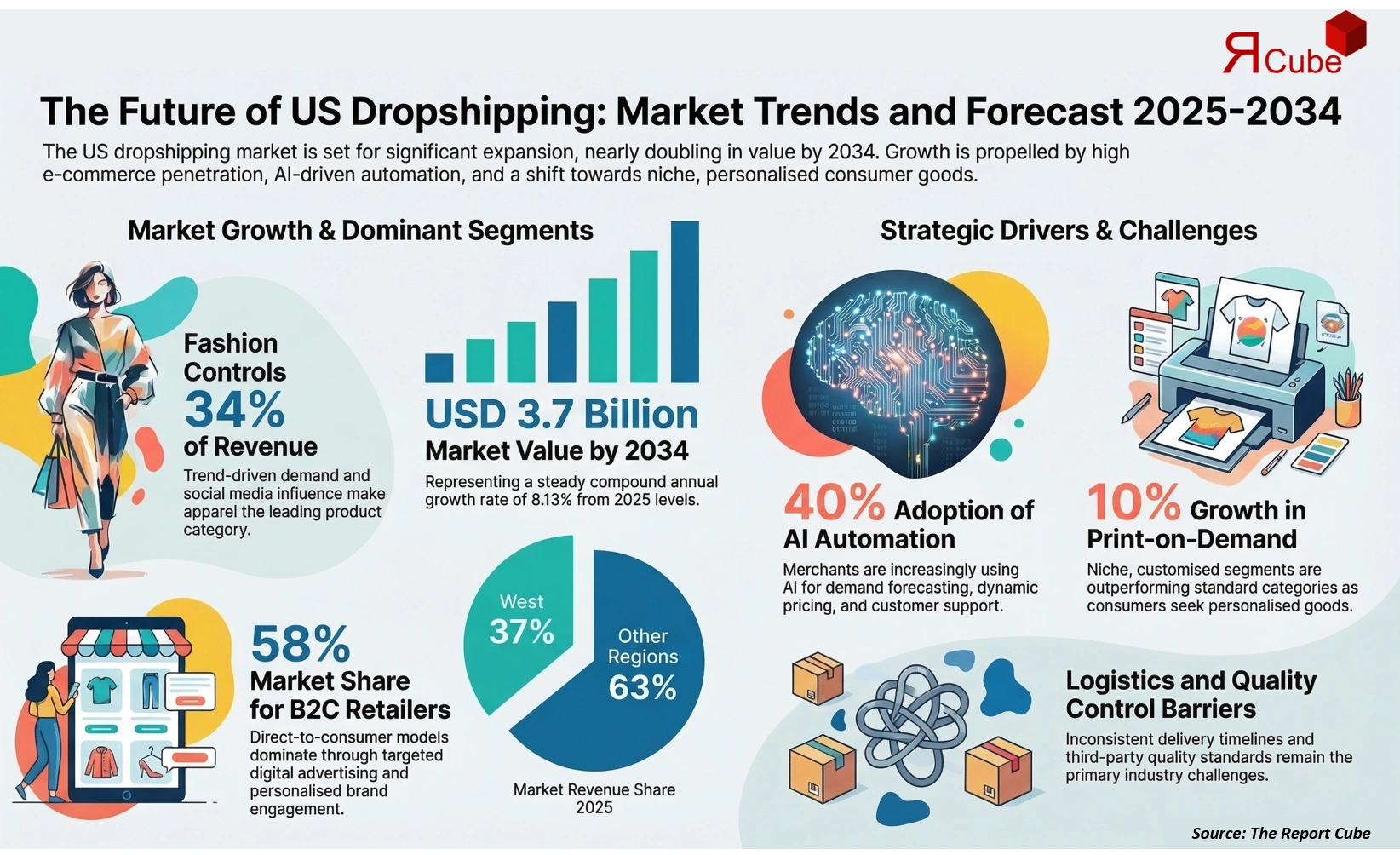
The United States Dropshipping Market is anticipated to register a CAGR of 8.13% during 2026-2034. The market size was valued at USD 1.83 billion in 2025 and is projected to reach USD 3.7 billion by 2034. The market continues to expand as e-commerce penetration deepens across the country, supported by increasing consumer preference for online shopping, fast product discovery, and flexible fulfillment models. Dropshipping enables sellers to operate with minimal upfront investment, which has significantly lowered entry barriers for small businesses and digital entrepreneurs.
This growth is further reinforced by advancements in digital storefront platforms, payment gateways, and logistics integrations. U.S. consumers increasingly demand wider product variety, competitive pricing, and faster delivery timelines, encouraging retailers to adopt dropshipping as a scalable solution. The ability to test products quickly, adapt to consumer trends, and eliminate inventory risks makes the model particularly attractive in a dynamic retail environment.
Moreover, social commerce, influencer marketing, and data-driven advertising are strengthening dropshipping performance across niche categories. Platforms that seamlessly connect suppliers, sellers, and customers are improving transparency and service reliability. As a result, the U.S. Dropshipping Market is positioned for sustained growth through 2034, driven by innovation, operational efficiency, and evolving consumer expectations.
United States Dropshipping Market Recent Developments
- 2025: Shopify Inc. enhanced AI-powered product recommendation tools to support U.S.-based dropshipping merchants.
- 2025: Printful expanded its U.S. fulfillment network to reduce delivery times for customized dropshipped products.
Government Initiatives & Policies
- U.S. Small Business Digital Support Programs: Federal initiatives promoting digital commerce adoption among small businesses.
- Federal E-Commerce and Consumer Protection Framework: Strengthens transparency, data protection, and online trade compliance.
United States Dropshipping Market Dynamics
Key Driver: Rapid Expansion of E-Commerce and Digital Entrepreneurship
The primary driver of the U.S. Dropshipping Market is the rapid expansion of e-commerce combined with rising digital entrepreneurship. Over 80% of U.S. consumers made online purchases in 2025, creating a strong demand base for flexible retail models. Dropshipping enables entrepreneurs to launch online stores without managing inventory or warehousing, reducing capital risk and operational complexity. This model is particularly attractive to small businesses, influencers, and social-media-driven sellers who rely on agile product sourcing. Additionally, improved integration between online storefronts, suppliers, and logistics providers has enhanced order accuracy and customer satisfaction, further fueling market growth.
Book your FREE 30-minute expert consultation today
Contact UsIndustry Trends: Integration of Automation, AI, and Omnichannel Selling
A key trend shaping the market is the increasing integration of automation and artificial intelligence across dropshipping operations. AI-driven tools are being used for product selection, demand forecasting, dynamic pricing, and customer support. Nearly 40% of U.S. dropshippers adopted automation tools in 2025 to streamline operations and reduce manual errors. Omnichannel selling is also gaining momentum, with sellers leveraging marketplaces, social media platforms, and branded websites simultaneously. This trend enhances customer reach while diversifying revenue streams, making dropshipping more resilient to platform-specific risks.
Major Challenge: Quality Control and Delivery Time Variability
Despite strong growth, quality control and inconsistent delivery timelines remain significant challenges for the U.S. Dropshipping Market. Since sellers rely heavily on third-party suppliers, maintaining consistent product standards can be difficult. Customer dissatisfaction arising from delayed shipping or mismatched product descriptions impacts brand trust and repeat purchases. Furthermore, rising consumer expectations for fast delivery, influenced by major e-commerce players, place pressure on dropshippers to optimize supplier selection and logistics coordination. Addressing these issues requires stronger supplier vetting and regional fulfillment strategies.
Opportunity: Growth of Niche and Customized Product Segments
The increasing demand for niche and customized products presents a major opportunity for dropshipping businesses in the United States. Consumers are showing strong interest in personalized fashion, home décor, hobby products, and eco-friendly goods. Print-on-demand and made-to-order dropshipping models are growing at over 10% annually, outperforming standard product categories. Sellers that focus on brand storytelling, customization, and community engagement can command higher margins and customer loyalty. Strategic use of data analytics and targeted marketing further enhances profitability within niche segments.
United States Dropshipping Market Segment-wise Analysis
By Product Category:
- Fashion
- Electronics & Media
- Furniture & Appliances
- Food & Personal Care
Fashion leads the U.S. Dropshipping Market by product category, accounting for approximately 34% of total revenue in 2025. The segment benefits from high purchase frequency, trend-driven demand, and strong social media influence. Apparel, accessories, and print-on-demand fashion items are particularly popular among younger consumers. Electronics & media follow as a fast-growing category, supported by continuous product innovation and consumer interest in smart devices. Furniture and personal care segments are also expanding as suppliers improve packaging and fulfillment reliability.
By Business Model:
- B2C Retailers
- B2B Wholesale
- C2C Marketplaces
B2C retailers dominate the U.S. Dropshipping Market, holding nearly 58% market share in 2025. Direct-to-consumer models allow sellers to control branding, pricing, and customer experience more effectively. B2C dropshipping benefits from targeted digital advertising and personalized engagement strategies. B2B wholesale dropshipping is gaining traction among small retailers seeking inventory-light sourcing solutions, while C2C marketplaces support micro-entrepreneurs and niche sellers, contributing to overall market diversity.
Regional Projection of United States Dropshipping Industry
- Northeast
- Midwest
- South
- West
The West region leads the U.S. Dropshipping Market, contributing approximately 37% of total market revenue in 2025. The region benefits from a strong technology ecosystem, high e-commerce adoption, and the presence of major digital commerce platforms. States such as California and Washington host a large concentration of online entrepreneurs and fulfillment infrastructure. The South is emerging as a high-growth region due to expanding logistics networks and a growing base of small online sellers, supporting nationwide market expansion.
Need insights for a specific region within this market?
Request Regional DataWhy Choose This Report?
- Provides a comprehensive overview of the overall market analysis, encompassing key trends, consumer behavior analysis, and risk assessment to support strategic decision-making.
- Provides accurate, up-to-date insights into market size, segmentation, and emerging opportunities, helping to minimize risk & capitalizing on growth.
- Gives deep understanding of target audience preferences, investment habits, and communication channels for enhanced product development & marketing effectiveness.
- Delivers competitive analysis & benchmarking, uncovering the strengths & weaknesses of market competitors to guide strategies.
- Consolidate comprehensive market intelligence, reducing reasoning & streamlining research efforts.
- Facilitates customized market segmentation & risk mitigation strategies, fine-tuned to the business objectives.
- Aids in identifying both market challenges & untapped opportunities within the industry to drive long-term business growth.
- Provides valuable information based on actual customer data & search trends.
Table of Contents
- Introduction
- Objective of the Study
- Product and Category Definition
- Market Segmentation
- Study Variables
- Research Methodology
- Secondary Data Points
- Breakdown of Secondary Sources
- Primary Data Points
- Breakdown of Primary Interviews
- Secondary Data Points
- Executive Summary
- Market Dynamics
- Drivers
- Challenges
- Opportunity Assessment
- Recent Trends and Developments
- Regulatory and Policy Landscape
- US Dropshipping Market Overview (2020-2034)
- Market Size, By Value (USD Billion)
- Market Share, By Product Category
- Fashion
- Electronics & Media
- Furniture & Appliances
- Food & Personal Care
- Toys, Hobby & DIY
- Market Share, By Business Model
- B2C Retailers
- B2B Wholesale
- C2C Marketplaces
- Market Share, By Channel Type
- Online Marketplaces
- Branded Stores
- Social Commerce
- Market Share, By Destination
- Domestic Shipping
- Cross-border Shipping
- Market Share, By Region
- Northeast
- Midwest
- South
- West
- Market Share, By Company
- Competition Characteristics
- Revenue Shares & Analysis
- Northeast US Dropshipping Market
- Market Size, By Value (USD Billion)
- Market Share, By Product Category
- Market Share, By Business Model
- Market Share, By Channel Type
- Market Share, By Destination
- Market Share, By State
- New York
- Massachusetts
- New Jersey
- Rest of Northeast
- Midwest US Dropshipping Market
- Market Size, By Value (USD Billion)
- Market Share, By Product Category
- Market Share, By Business Model
- Market Share, By Channel Type
- Market Share, By Destination
- Market Share, By State
- Illinois
- Ohio
- Michigan
- Rest of Midwest
- South US Dropshipping Market
- Market Size, By Value (USD Billion)
- Market Share, By Product Category
- Market Share, By Business Model
- Market Share, By Channel Type
- Market Share, By Destination
- Market Share, By State
- Texas
- Florida
- Georgia
- Rest of South
- West US Dropshipping Market
- Market Size, By Value (USD Billion)
- Market Share, By Product Category
- Market Share, By Business Model
- Market Share, By Channel Type
- Market Share, By Destination
- Market Share, By State
- California
- Washington
- Colorado
- Rest of West
- Competitive Outlook and Company Profiles
- Shopify Inc.
- Company Overview
- Service Portfolio
- Strategic Alliances/Partnerships
- Recent Developments
- AliDropship
- Company Overview
- Service Portfolio
- Strategic Alliances/Partnerships
- Recent Developments
- WooCommerce
- Company Overview
- Service Portfolio
- Strategic Alliances/Partnerships
- Recent Developments
- Spocket
- Company Overview
- Service Portfolio
- Strategic Alliances/Partnerships
- Recent Developments
- Printful
- Company Overview
- Service Portfolio
- Strategic Alliances/Partnerships
- Recent Developments
- Oberlo
- Company Overview
- Service Portfolio
- Strategic Alliances/Partnerships
- Recent Developments
- SaleHoo Group
- Company Overview
- Service Portfolio
- Strategic Alliances/Partnerships
- Recent Developments
- Doba Inc.
- Company Overview
- Service Portfolio
- Strategic Alliances/Partnerships
- Recent Developments
- Inventory Source
- Company Overview
- Service Portfolio
- Strategic Alliances/Partnerships
- Recent Developments
- Modalyst
- Company Overview
- Service Portfolio
- Strategic Alliances/Partnerships
- Recent Developments
- Others
- Shopify Inc.
- Contact Us and Disclaimer
Top Key Players & Market Share Outlook
- Shopify Inc.
- AliDropship
- WooCommerce
- Spocket
- Printful
- Oberlo
- SaleHoo Group
- Doba Inc.
- Inventory Source
- Modalyst
- Others
Frequently Asked Questions






