




Build Your Custom Market Intelligence Report
Customize Your ReportLatin America E-Commerce Logistics Market Insights & Analysis
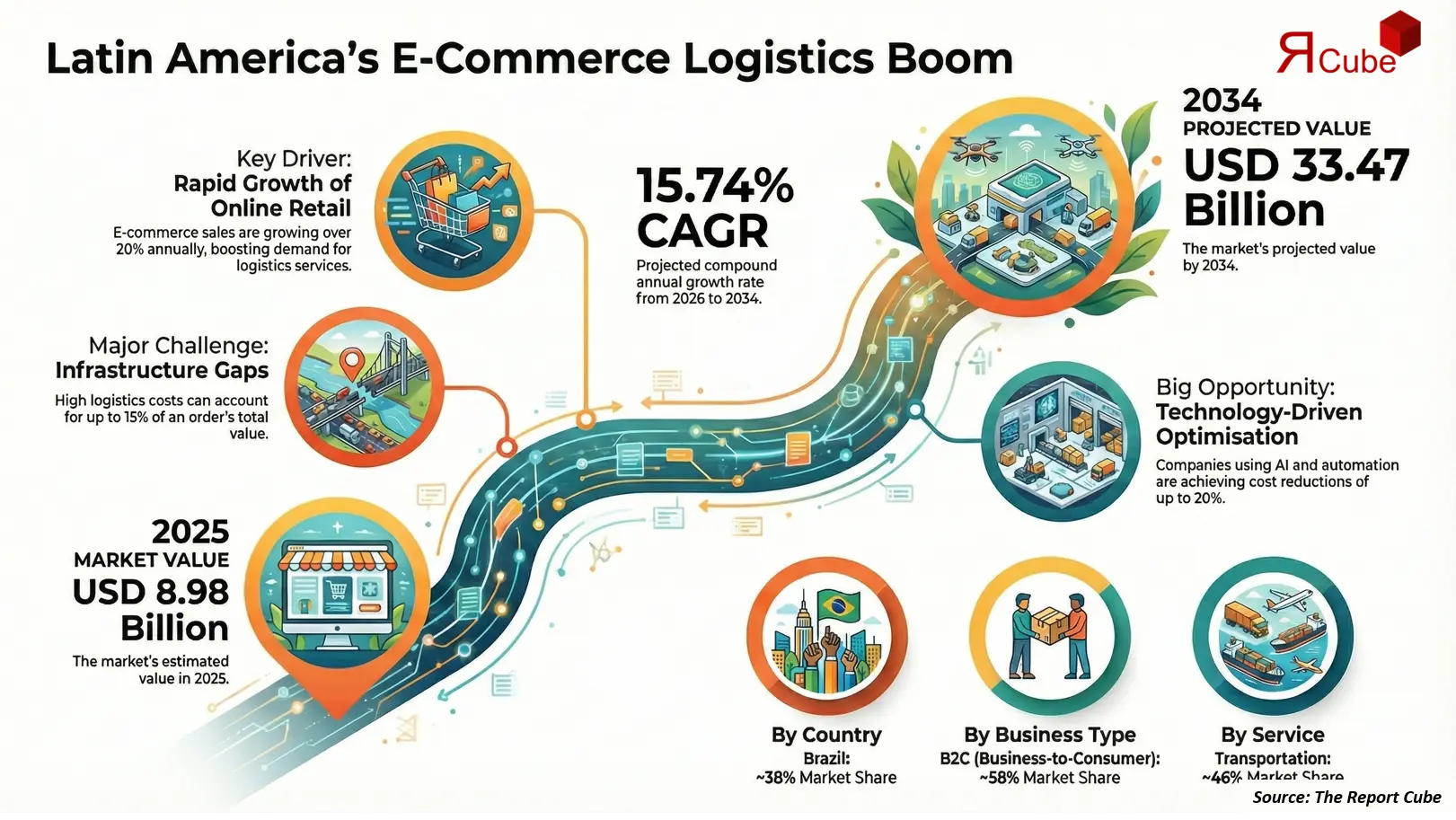
The Latin America E-Commerce Logistics Market is anticipated to register a CAGR of 15.74% during 2026-2034. The market size was valued at USD 8.98 billion in 2025 and is projected to reach USD 33.47 billion by 2034. The market is undergoing rapid structural transformation, fueled by accelerated e-commerce penetration, rising smartphone adoption, and expanding digital payment ecosystems across major Latin American economies. As online retail becomes mainstream, logistics has emerged as a critical enabler, directly influencing delivery speed, cost efficiency, and customer satisfaction.
The region’s logistics landscape is evolving from fragmented, manual systems toward integrated, technology-driven networks. Major economies such as Brazil and Mexico are witnessing heavy investments in fulfillment centers, last-mile delivery optimization, and cross-border logistics capabilities. This shift is supported by both global logistics leaders and regional e-commerce platforms that are building proprietary delivery networks to reduce dependency on third-party providers.
Furthermore, changing consumer expectations for same-day and next-day delivery are pushing logistics providers to innovate rapidly. The integration of data analytics, route optimization, and automated warehousing is improving delivery reliability across urban and semi-urban areas. Collectively, these developments position the Latin America E-Commerce Logistics Market as one of the fastest-growing logistics segments globally through 2034.
Latin America E-Commerce Logistics Market Recent Developments
- 2025: DHL Express expanded its regional e-fulfillment hubs in Brazil to support cross-border e-commerce deliveries.
- 2025: Mercado Envios strengthened last-mile delivery coverage in Mexico through new urban micro-fulfillment centers.
Government Initiatives & Policies
- Brazil National Logistics Plan: Infrastructure investment program improving road, port, and digital logistics connectivity.
- Mexico Digital Economy Strategy: Supports e-commerce growth through logistics modernization and digital trade facilitation.
Latin America E-Commerce Logistics Market Dynamics
Key Driver: Rapid Growth of Online Retail Penetration
The most significant driver of the Latin America E-Commerce Logistics Market is the rapid growth of online retail adoption across the region. E-commerce sales in Latin America are growing at over 20% annually, driven by increased internet access and a young, digitally engaged population. As online order volumes surge, retailers are increasingly outsourcing logistics to specialized providers capable of managing high-volume, time-sensitive deliveries. This has elevated demand for transportation, warehousing, and last-mile delivery services, making logistics a strategic priority for e-commerce platforms seeking competitive differentiation.
Book your FREE 30-minute expert consultation today
Contact UsIndustry Trends: Expansion of Last-Mile and Urban Fulfillment Networks
A key trend shaping the market is the expansion of last-mile delivery and urban fulfillment infrastructure. Logistics providers are investing in city-based micro-warehouses to shorten delivery times and reduce costs. Same-day delivery adoption has increased by nearly 30% year-over-year in major metropolitan areas such as São Paulo and Mexico City. Additionally, partnerships with local couriers and crowd-sourced delivery models are gaining traction, enabling scalable and flexible delivery solutions tailored to dense urban environments.
Major Challenge: Infrastructure Gaps and High Logistics Costs
Despite strong growth, infrastructure limitations remain a major challenge for the market. Inadequate road connectivity, port congestion, and limited warehousing capacity in secondary cities increase delivery times and costs. Logistics expenses in Latin America can account for up to 15% of total e-commerce order value, compared to under 10% in developed markets. These inefficiencies particularly affect cross-border e-commerce and rural deliveries, limiting service consistency and profitability for logistics providers.
Opportunity: Technology-Driven Logistics Optimization
The adoption of advanced logistics technologies presents a substantial opportunity for market expansion. Automation, artificial intelligence, and real-time tracking are improving inventory visibility and delivery accuracy. Companies leveraging predictive analytics for demand forecasting and route optimization are achieving cost reductions of up to 20%. As digital infrastructure improves, technology-enabled logistics solutions will play a critical role in enhancing service reliability and unlocking underserved markets across Latin America.
Latin America E-Commerce Logistics Market Segment-wise Analysis
By Service:
- Transportation
- Warehousing
- Inventory Management
- Value-Added Services
Transportation dominates the service segment, accounting for approximately 46% of market revenue in 2025. High order volumes and geographically dispersed consumers drive strong demand for road and air freight services. Transportation remains critical for both domestic and cross-border e-commerce, while warehousing is growing steadily due to rising fulfillment center investments. Value-added services such as packaging and reverse logistics are emerging as differentiation factors among leading providers.
By Business Type:
- B2C
- B2B
- C2C
The B2C segment leads the market with nearly 58% share, reflecting the dominance of online retail transactions. Growth is supported by increasing consumer trust in digital platforms and improved delivery reliability. B2B logistics is also expanding as small and medium enterprises adopt e-commerce channels. C2C logistics, driven by marketplace platforms, is gaining momentum through peer-to-peer selling and second-hand goods trading.
Regional Projection of Latin America E-Commerce Logistics Industry
- Brazil
- Mexico
- Argentina
- Rest of Latin America
Brazil leads the Latin America E-Commerce Logistics Market, contributing approximately 38% of total regional revenue in 2025. The country benefits from a large consumer base, advanced e-commerce ecosystems, and significant logistics infrastructure investments. Mexico follows closely, supported by strong cross-border trade with the United States. Argentina and other Latin American countries are witnessing steady growth as digital commerce adoption accelerates and logistics networks expand beyond major urban centers.
Need insights for a specific region within this market?
Request Regional DataWhy Choose This Report?
- Provides a comprehensive overview of the overall market analysis, encompassing key trends, consumer behavior analysis, and risk assessment to support strategic decision-making.
- Provides accurate, up-to-date insights into market size, segmentation, and emerging opportunities, helping to minimize risk & capitalizing on growth.
- Gives deep understanding of target audience preferences, investment habits, and communication channels for enhanced product development & marketing effectiveness.
- Delivers competitive analysis & benchmarking, uncovering the strengths & weaknesses of market competitors to guide strategies.
- Consolidate comprehensive market intelligence, reducing reasoning & streamlining research efforts.
- Facilitates customized market segmentation & risk mitigation strategies, fine-tuned to the business objectives.
- Aids in identifying both market challenges & untapped opportunities within the industry to drive long-term business growth.
- Provides valuable information based on actual customer data & search trends.
Table of Contents
- Introduction
- Objective of the Study
- Product and Category Definition
- Market Segmentation
- Study Variables
- Research Methodology
- Secondary Data Points
- Breakdown of Secondary Sources
- Primary Data Points
- Breakdown of Primary Interviews
- Secondary Data Points
- Executive Summary
- Market Dynamics
- Drivers
- Challenges
- Opportunity Assessment
- Recent Trends and Developments
- Regulatory and Policy Landscape
- Latin America E-Commerce Logistics Market Overview (2020-2034)
- Market Size, By Value (USD Billion)
- Market Share, By Service
- Transportation
- Warehousing
- Inventory Management
- Value-Added Services
- Market Share, By Business Type
- B2C
- B2B
- C2C
- Market Share, By Destination
- Domestic
- International
- Market Share, By Product
- Fashion & Apparel
- Consumer Electronics
- Beauty & Personal Care
- Home & Appliances
- Other Products
- Market Share, By Country
- Brazil
- Mexico
- Argentina
- Colombia
- Chile
- Peru
- Rest of Latin America
- Market Share, By Company
- Competitive Landscape
- Competition Characteristics
- Revenue Shares & Analysis
- Brazil E-Commerce Logistics Market
- Market Size, By Value (USD Billion)
- Market Share, By Service
- Market Share, By Business Type
- Market Share, By Destination
- Market Share, By Product
- Mexico E-Commerce Logistics Market
- Market Size, By Value (USD Billion)
- Market Share, By Service
- Market Share, By Business Type
- Market Share, By Destination
- Market Share, By Product
- Argentina E-Commerce Logistics Market
- Market Size, By Value (USD Billion)
- Market Share, By Service
- Market Share, By Business Type
- Market Share, By Destination
- Market Share, By Product
- Colombia E-Commerce Logistics Market
- Market Size, By Value (USD Billion)
- Market Share, By Service
- Market Share, By Business Type
- Market Share, By Destination
- Market Share, By Product
- Chile E-Commerce Logistics Market
- Market Size, By Value (USD Billion)
- Market Share, By Service
- Market Share, By Business Type
- Market Share, By Destination
- Market Share, By Product
- Peru E-Commerce Logistics Market
- Market Size, By Value (USD Billion)
- Market Share, By Service
- Market Share, By Business Type
- Market Share, By Destination
- Market Share, By Product
- Competitive Outlook and Company Profiles
- DHL Express
- Company Overview
- Service Portfolio
- Strategic Alliances/Partnerships
- Recent Developments
- FedEx Corporation
- Company Overview
- Service Portfolio
- Strategic Alliances/Partnerships
- Recent Developments
- UPS
- Company Overview
- Service Portfolio
- Strategic Alliances/Partnerships
- Recent Developments
- DB Schenker
- Company Overview
- Service Portfolio
- Strategic Alliances/Partnerships
- Recent Developments
- Kuehne + Nagel
- Company Overview
- Service Portfolio
- Strategic Alliances/Partnerships
- Recent Developments
- GEFCO Corporation
- Company Overview
- Service Portfolio
- Strategic Alliances/Partnerships
- Recent Developments
- Bolloré Logistics
- Company Overview
- Service Portfolio
- Strategic Alliances/Partnerships
- Recent Developments
- Mercado Libre (Mercado Envios)
- Company Overview
- Service Portfolio
- Strategic Alliances/Partnerships
- Recent Developments
- Rappi
- Company Overview
- Service Portfolio
- Strategic Alliances/Partnerships
- Recent Developments
- Amazon Logistics
- Company Overview
- Service Portfolio
- Strategic Alliances/Partnerships
- Recent Developments
- Others
- DHL Express
- Contact Us and Disclaimer
Top Key Players & Market Share Outlook
- DHL Express
- FedEx Corporation
- UPS
- DB Schenker
- Kuehne + Nagel
- GEFCO Corporation
- Bolloré Logistics
- Mercado Libre (Mercado Envios)
- Rappi
- Amazon Logistics
- Others
Frequently Asked Questions






