



Build Your Custom Market Intelligence Report
Customize Your ReportVietnam E-Waste Management Market Key Highlights
By Process:
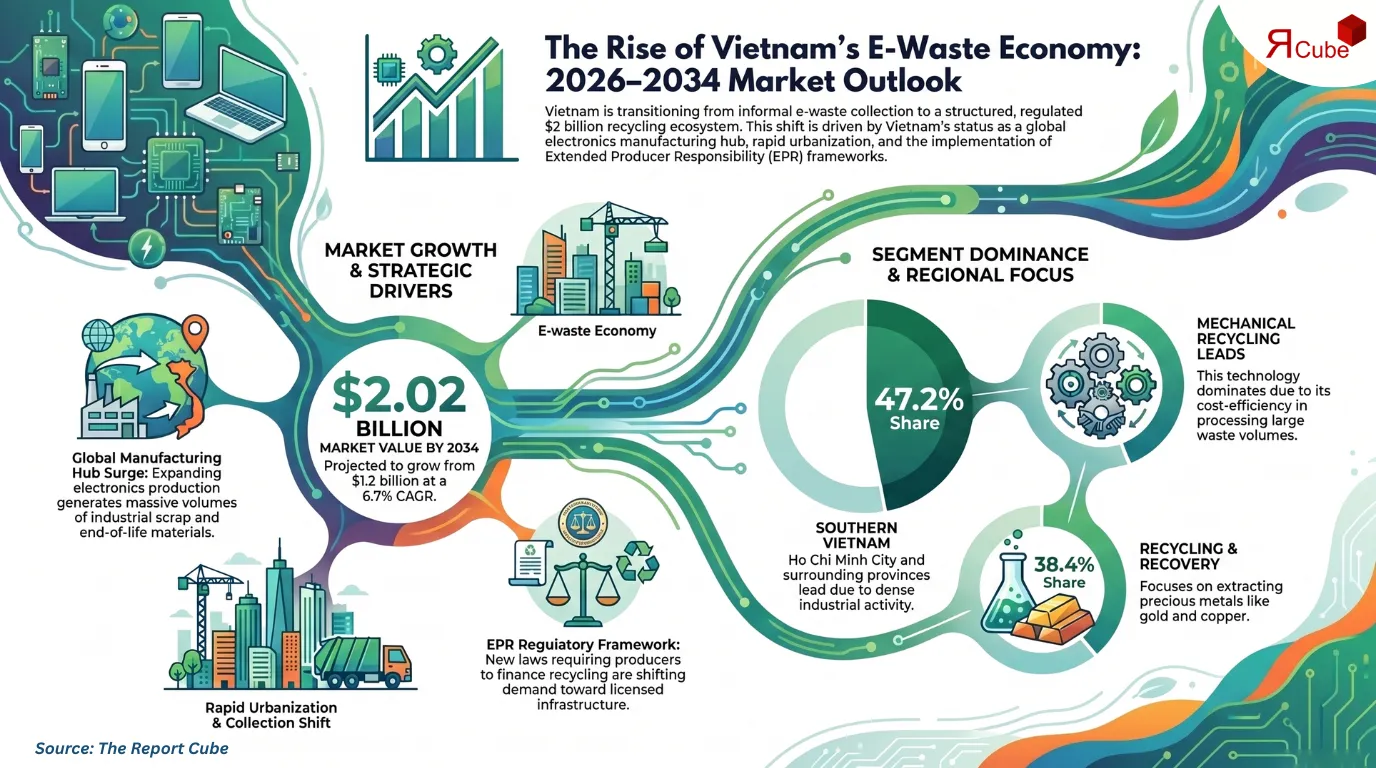
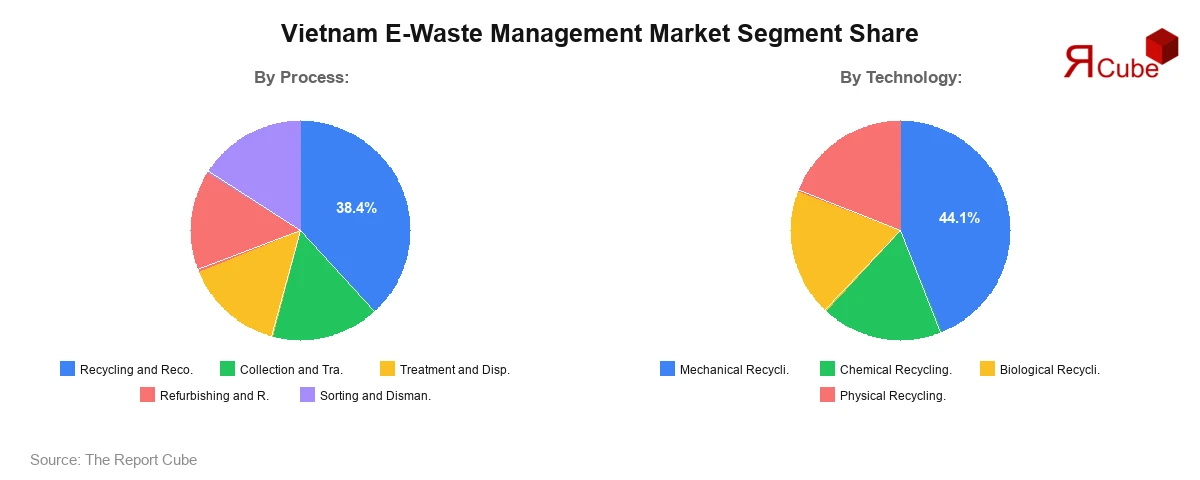
Recycling and Recovery segment leads the market with nearly 38.4% share.
By Technology:
Mechanical Recycling segment dominates the market with around 44.1% of total revenue.
Regional Outlook:
Southern Vietnam dominates the Vietnam E-Waste Management Market with approximately 47.2% share.
Vietnam E-Waste Management Market Insights & Analysis
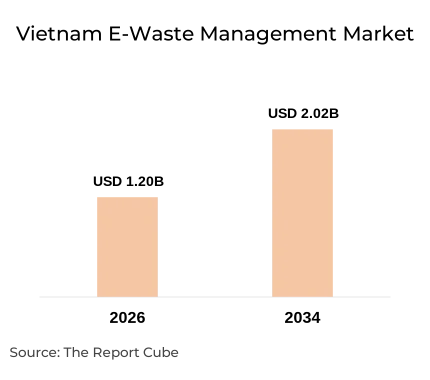
The Vietnam E-Waste Management Market is anticipated to register a CAGR of around 6.7% during the forecast period 2026-2034. The market size is valued at USD 1.2 billion in 2026 and is projected to reach USD 2.02 billion by 2034. Vietnam’s position as a major electronics manufacturing destination in Southeast Asia continues to generate significant volumes of discarded electronic components, damaged production materials, obsolete consumer devices, and retired industrial equipment. Growing urbanization and rising ownership of smartphones, household appliances, laptops, and connected devices are accelerating the generation of electronic waste across both residential and commercial sectors. Large industrial zones in Ho Chi Minh City, Bac Ninh, and Hai Phong are also contributing to the growing need for organized recycling, dismantling, and disposal infrastructure.
The Electronic Waste Management Sector in Vietnam is evolving from informal collection practices toward more structured recycling ecosystems supported by environmental regulations and producer accountability frameworks. Enterprises operating in finance, telecommunications, healthcare, and manufacturing are increasingly adopting certified IT asset disposal services to meet cybersecurity and environmental compliance requirements. Investment in modern recycling plants, automated sorting technologies, and reverse logistics networks is gradually improving recovery efficiency for metals and reusable materials. Growing collaboration between electronics manufacturers, recyclers, and logistics providers is also strengthening collection systems in urban regions, helping the market build long-term operational stability and environmental credibility.
Vietnam E-Waste Management Market Impact Analysis
| Factor | Type | Specific Impact on Market | Magnitude | Business Implication |
|---|---|---|---|---|
| Rapid Urbanization and Digitalization | Market | Higher device ownership accelerates discarded electronics volume nationwide | High | Expands collection opportunities for formal e-waste service providers |
| Government Sustainability and EPR Policies | Regulatory | New rules promote formal recycling, producer responsibility, and reporting | High | Creates compliance driven demand for licensed recycling infrastructure |
| Dominance of Informal Collection Sector | Competitive | Informal actors capture valuable flows with low cost manual operations | High | Limits feedstock for formal firms and pressures margins and pricing |
| Growing Environmental and Health Concerns | Environmental | Improper handling raises pollution and public health risk awareness | Medium | Supports stricter enforcement and demand for safer treatment options |
| Technological Gaps in Formal Recycling | Technological | Outdated equipment constrains recovery efficiency and plant capacity | Medium | Opens scope for technology upgrades and foreign partnership models |
| Foreign Investment and PPP Participation | Market | Capital inflows enable modern facilities and regional collection hubs | Medium | Enhances scale, network coverage, and integrated service offerings |
| Data and Enforcement Constraints in EPR | Regulatory | Weak databases and monitoring slow full rollout of new schemes | Medium | Creates phased compliance timelines and uncertainty for investors |
Vietnam E-Waste Management Market Dynamics
Key Driver: Rapid Expansion of Electronics Manufacturing and Device Replacement Cycles
Vietnam has emerged as a strategic manufacturing hub for consumer electronics, semiconductors, and electrical equipment, supported by strong foreign direct investment and competitive industrial infrastructure. Major global brands continue expanding production operations in the country, increasing the volume of manufacturing scrap and end-of-life electronic materials entering the waste stream. At the same time, faster replacement cycles for smartphones, tablets, televisions, and office equipment are creating consistent growth in discarded electronics from households and enterprises. Industry participants are witnessing higher demand for collection, dismantling, and material recovery services across industrial and urban areas.
Commercial organizations are also replacing outdated IT infrastructure more frequently to improve operational efficiency and digital security standards. This trend is creating a stable demand environment for secure destruction, refurbishment, and certified recycling services. Rising environmental awareness among enterprises and stronger regulatory oversight regarding hazardous waste handling are encouraging businesses to transition from unregulated disposal methods toward professional e-waste management providers. These structural changes continue to strengthen the long-term outlook for the Vietnam electronic waste recycling industry.
Industry Trends: Shift Toward Formal Recycling Infrastructure and Circular Economy Practices
The Electronic Waste Management Sector in Vietnam is witnessing gradual formalization as authorities and private operators strengthen organized recycling and collection systems. Electronics manufacturers, retailers, and waste management companies are increasingly participating in take-back programs designed to improve recovery rates for discarded electronic devices. Several urban municipalities are also promoting environmentally responsible disposal campaigns to reduce unsafe handling of hazardous electronic components. These initiatives are helping formal recyclers secure more consistent access to recyclable waste streams.
Technology integration within recycling facilities is becoming an important trend across the market. Automated dismantling equipment, magnetic separation systems, and advanced sorting technologies are improving recovery efficiency while reducing labor-intensive processing. Demand for refurbishment and reuse services is also increasing, particularly for laptops, servers, and commercial electronics that can be restored for secondary markets. Companies operating in the Vietnam E-Waste Management Market are further expanding logistics partnerships to strengthen collection coverage in industrial parks and metropolitan regions where electronic waste generation continues to rise rapidly.
Book your FREE 30-minute expert consultation today
Contact UsMajor Challenge: Informal Processing Activities Continue to Impact Organized Recycling Growth
A considerable share of electronic waste generated in Vietnam still flows through informal recycling networks that operate with limited environmental safeguards and weak waste traceability systems. Informal collectors and dismantlers often use low-cost extraction methods that involve unsafe handling of hazardous materials such as lead, mercury, and chemical solvents. These practices create environmental risks while limiting the supply of recyclable materials reaching certified treatment and recovery facilities. Organized operators therefore face challenges in securing sufficient feedstock volumes for large-scale recycling operations.
Consumer awareness regarding proper electronic disposal methods also varies significantly between urban and rural areas. Many households continue storing obsolete electronics or selling them to informal scrap buyers due to convenience and immediate financial returns. Collection infrastructure outside major industrial regions remains underdeveloped, making logistics operations more expensive for organized recyclers. In addition, advanced recycling facilities require substantial capital investment in processing equipment, compliance systems, and worker safety standards, which can limit expansion opportunities for smaller market participants.
Opportunity: Expansion of IT Asset Disposal and High-Value Material Recovery Services
The increasing volume of retired enterprise IT equipment is creating strong business opportunities for companies specializing in secure IT asset disposal and certified electronic recycling services. Financial institutions, government agencies, telecom operators, and multinational corporations are placing greater emphasis on data security and environmentally compliant disposal practices. This is driving demand for professional service providers capable of handling secure collection, industrial-grade destruction, refurbishment, and downstream recycling operations within a regulated framework.
Material recovery also presents significant long-term commercial potential for the Vietnam E-Waste Management Market. Electronic waste contains valuable metals including copper, aluminum, silver, gold, and lithium that can be recovered and reintroduced into manufacturing supply chains. As commodity prices fluctuate and resource efficiency becomes more important, recycling operators are investing in technologies that improve extraction rates and processing quality. Growing interest in battery recycling and secondary raw material sourcing is expected to create additional investment opportunities across Vietnam’s developing circular economy ecosystem.
Vietnam E-Waste Management Market Segment-wise Analysis
By Process:
- Recycling and Recovery
- Collection and Transportation
- Treatment and Disposal
- Refurbishing and Reuse
- Sorting and Dismantling
Recycling and Recovery remains the leading process segment within the Vietnam E-Waste Management Market, accounting for nearly 38.4% of overall revenue share in 2026. The segment benefits from rising demand for valuable metal extraction and increased focus on resource efficiency across manufacturing industries. Discarded consumer electronics, industrial equipment, and communication devices contain recoverable quantities of copper, aluminum, gold, and rare earth materials, making recycling activities commercially attractive for organized operators. Recycling companies are gradually adopting automated shredding, separation, and sorting technologies to improve processing speed and recovery rates while reducing environmental exposure risks.
Industrial manufacturers operating in Vietnam are also strengthening sustainability commitments by integrating recycled raw materials into production cycles. This shift is increasing the importance of formal recycling infrastructure capable of supplying high-quality secondary materials. Demand for environmentally compliant treatment systems is expected to remain strong as producer responsibility regulations and waste recovery requirements continue to expand throughout the forecast period.
By Technology:
- Mechanical Recycling
- Chemical Recycling
- Biological Recycling
- Physical Recycling
Mechanical Recycling dominates the Electronic Waste Management Sector in Vietnam with approximately 44.1% market share due to its operational efficiency and suitability for processing large electronic waste volumes. The technology is commonly used for dismantling, crushing, shredding, and separating metals and plastics from discarded electronic products. Mechanical recycling systems offer lower operational costs compared to advanced chemical processing methods, making them widely preferred among regional recyclers and waste management operators.
The growing concentration of electronics manufacturing facilities in Southern and Northern Vietnam is supporting additional investment in automated processing equipment and industrial recycling systems. Mechanical recycling is particularly effective for handling printed circuit boards, cables, household appliances, and industrial electronic components. Operators are also integrating advanced sorting technologies and magnetic separation systems to improve recovery precision and reduce contamination levels. Continuous infrastructure upgrades are expected to strengthen segment growth as organized recycling capacity expands across Vietnam.
Regional Projection of Vietnam E-Waste Management Industry
- Northern Vietnam
- Central Vietnam
- Southern Vietnam
- Others
Southern Vietnam holds the dominant position in the Vietnam E-Waste Management Market with nearly 47.2% revenue share, supported by its dense industrial base, high urban population, and strong concentration of electronics manufacturing activities. Ho Chi Minh City and nearby provinces generate substantial volumes of electronic waste from commercial offices, industrial facilities, retail operations, and residential consumers. The region also benefits from comparatively advanced logistics infrastructure and stronger presence of organized waste management and recycling companies.
The rapid expansion of industrial parks and export-oriented electronics manufacturing operations across Southern Vietnam continues to increase demand for collection, dismantling, and recovery services. Enterprises operating in the region are increasingly adopting structured recycling partnerships to improve environmental compliance and strengthen sustainability performance. Rising investments in secure IT asset disposal, hazardous waste treatment, and material recovery technologies are further supporting regional market expansion. In addition, higher awareness regarding environmental protection among urban consumers and commercial businesses is encouraging greater participation in organized electronic waste recycling programs.
Need insights for a specific region within this market?
Request Regional DataVietnam E-Waste Management Market Regional Analysis
The Vietnam e-waste management market varies significantly across regions due to urban concentration, industrial activity, and infrastructure development.
| Region | Demand Level | Key Areas | System Dominance | Core Demand Logic | Growth Nature |
|---|---|---|---|---|---|
| Northern Vietnam | Very High | Hanoi, Haiphong, Red River Delta | Informal & formal recycling mix | Dense population & high e-device demand | EPR-driven formalization |
| Central Vietnam | Low to Medium | Da Nang, Hue, Central Coast | Manual recycling & limited facilities | Lower urbanization & waste generation rate | Infrastructure development |
| Southern Vietnam | Extremely High | Ho Chi Minh City, Mekong Delta | Informal sector-dominated (48% share) | Largest urban center & electronics hub | Fastest-growing segment |
| Others (Highlands & Remote) | Very Low | Central Highlands, Northwest | No formal recycling infrastructure | Minimal electronics penetration & rural | Limited near-term potential |
Government Initiatives & Policies
- Vietnam Extended Producer Responsibility Framework: Vietnam’s Ministry of Natural Resources and Environment expanded EPR implementation under the Law on Environmental Protection, requiring producers and importers to finance recycling activities for electronic products and waste recovery systems.
- National Strategy on Integrated Solid Waste Management 2025–2030: Vietnam continues strengthening policies focused on sustainable waste collection, recycling infrastructure, hazardous waste control, and circular economy adoption to improve management of electronic and industrial waste streams.
Vietnam E-Waste Management Industry Recent Developments
- 2025: Crown Records Management Vietnam expanded its E-Waste and IT Asset Disposal services across Vietnam by strengthening secure collection, certified destruction, and downstream recycling capabilities for enterprise clients. The expansion supports rising demand for compliant electronic waste disposal and organized recycling services from financial institutions, telecom providers, and multinational corporations.
- 2025: Ecotrade Group continued participating within Vietnam’s organized recycling ecosystem supported by increasing producer responsibility initiatives and structured take-back programs. The growing collaboration between recyclers, manufacturers, and collection operators is improving recovery rates for discarded electronic products and strengthening formal recycling channels across the country.
Why Choose This Report?
- Provides a comprehensive overview of the overall market analysis, encompassing key trends, consumer behavior analysis, and risk assessment to support strategic decision-making.
- Provides accurate, up-to-date insights into market size, segmentation, and emerging opportunities, helping to minimize risk and capitalizing on growth.
- Gives deep understanding of target audience preferences, investment habits, and communication channels for enhanced product development and marketing effectiveness.
- Delivers competitive analysis and benchmarking, uncovering the strengths and weaknesses of market competitors to guide strategies.
- Consolidates comprehensive market intelligence, reducing research efforts and streamlining business planning.
- Facilitates customized market segmentation and risk mitigation strategies, fine-tuned to business objectives.
- Aids in identifying both market challenges and untapped opportunities within the industry to drive long-term business growth.
- Provides valuable information based on actual customer demand patterns, industry developments, and search trends.
Table of Contents
- Introduction
- Objective of the Study
- Product and Category Definition
- Market Segmentation
- Study Variables
- Research Methodology
- Secondary Data Points
- Breakdown of Secondary Sources
- Primary Data Points
- Breakdown of Primary Interviews
- Secondary Data Points
- Executive Summary
- Market Dynamics
- Emerging Opportunities
- Adoption Trends
- Demand Drivers
- Disruption Analysis (Challenges)
- Industry Analysis & Strategic Insights
- Supply and Value Chain Analysis
- Pricing Analysis
- Go-To-Market Strategy
- BCG Matrix
- Recent Trends and Developments
- Regulatory and Policy Landscape
- Region-wise Policies in Vietnam
- Government Initiatives
- Vietnam E-Waste Management Market Overview and Forecast Analysis (2021-2034)
- Market Size, By Value, By Growth Rate (CAGR/USD Billion/Million)
- Market Share, By Type
- Small Household Appliances
- Consumer Electronics
- Medical Devices
- IT and Telecommunications Equipment
- Lighting Equipment
- Automatic Dispensers
- Toys
- Large Household Appliances
- Electrical and Electronic Tools
- Leisure and Sports Equipment
- Monitoring and Control Instruments
- Market Share, By Process
- Recycling and Recovery
- Collection and Transportation
- Treatment and Disposal
- Refurbishing and Reuse
- Sorting and Dismantling
- Market Share, By Technology
- Mechanical Recycling
- Chemical Recycling
- Biological Recycling
- Physical Recycling
- Market Share, By Material Type
- Glass
- Metals
- Plastics
- Others
- Market Share, By Service
- Consultancy Services
- Collection Services
- Refurbishment Services
- Recycling Services
- Disposal Services
- Market Share, By Collection Channel
- Municipal Collection
- Retail Collection
- Direct Producer Collection
- Take-back Programs
- Third-party Collection
- Market Share, By End-User
- Commercial
- Government and Public Sector
- Industrial
- Residential
- Market Share, By Region
- Northern
- Central
- Southern
- Others
- Market Share, By Company
- Revenue Shares and Analysis
- Competitive Landscape
- Northern Vietnam E-Waste Management Market Overview and Forecast Analysis (2021-2034)
- Market Size, By Value, By Growth Rate (CAGR/USD Billion/Million)
- Market Share, By Type
- Market Share, By Process
- Market Share, By Technology
- Market Share, By Material Type
- Market Share, By Service
- Market Share, By Collection Channel
- Market Share, By End-User
- Central Vietnam E-Waste Management Market Overview and Forecast Analysis (2021-2034)
- Market Size, By Value, By Growth Rate (CAGR/USD Billion/Million)
- Market Share, By Type
- Market Share, By Process
- Market Share, By Technology
- Market Share, By Material Type
- Market Share, By Service
- Market Share, By Collection Channel
- Market Share, By End-User
- Southern Vietnam E-Waste Management Market Overview and Forecast Analysis (2021-2034)
- Market Size, By Value, By Growth Rate (CAGR/USD Billion/Million)
- Market Share, By Type
- Market Share, By Process
- Market Share, By Technology
- Market Share, By Material Type
- Market Share, By Service
- Market Share, By Collection Channel
- Market Share, By End-User
- Competitive Analysis, 2026
- Market Share of Key Players
- Competitive Mapping for Each Segment and Companies Operating by Region
- Northern Vietnam E-Waste Management Companies Share and Competitive Analysis, 2026
- Central Vietnam E-Waste Management Companies Share and Competitive Analysis, 2026
- Southern Vietnam E-Waste Management Companies Share and Competitive Analysis, 2026
- Company Profile (Partial List)
- Vietnam Waste Solutions
- Company Overview
- Product and Service Portfolio
- Strategic Alliances and Partnerships
- Recent Developments
- Green Environment Production and Trade Services Co., Ltd
- Company Overview
- Product and Service Portfolio
- Strategic Alliances and Partnerships
- Recent Developments
- Dai Lam Son Co., Ltd
- Company Overview
- Product and Service Portfolio
- Strategic Alliances and Partnerships
- Recent Developments
- TES Group
- Company Overview
- Product and Service Portfolio
- Strategic Alliances and Partnerships
- Recent Developments
- SGS Société Générale de Surveillance SA
- Company Overview
- Product and Service Portfolio
- Strategic Alliances and Partnerships
- Recent Developments
- Crown Records Management Vietnam
- Company Overview
- Product and Service Portfolio
- Strategic Alliances and Partnerships
- Recent Developments
- Ecotrade Group
- Company Overview
- Product and Service Portfolio
- Strategic Alliances and Partnerships
- Recent Developments
- Others (Partial List)
- Vietnam Waste Solutions
- Contact Us and Disclaimer
Top Key Players & Market Share Outlook
- Vietnam Waste Solutions
- Green Environment Production and Trade Services Co., Ltd
- Dai Lam Son Co., Ltd
- TES Group
- SGS Société Générale de Surveillance SA
- Crown Records Management Vietnam
- Ecotrade Group
- Others
Frequently Asked Questions






