



Build Your Custom Market Intelligence Report
Customize Your ReportIndonesia E-Waste Management Market Key Highlights
By Type:
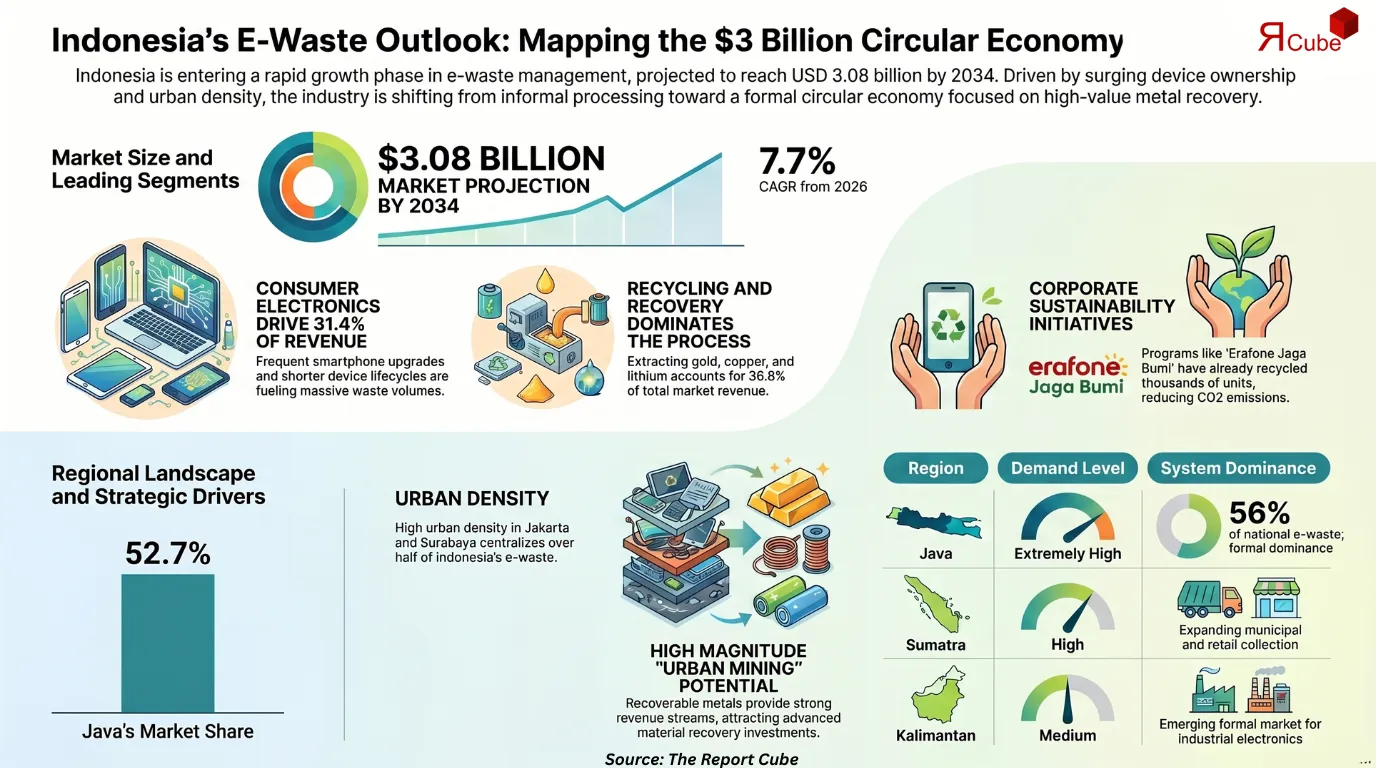
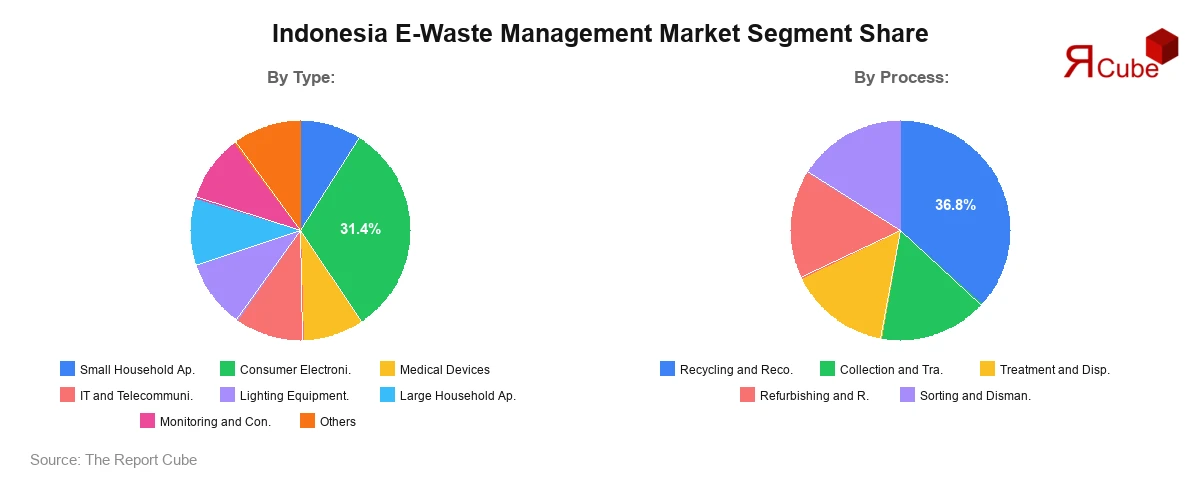
Consumer Electronics segment leads the market with nearly 31.4% share.
By Process:
Recycling and Recovery segment dominates the market with around 36.8% of revenue.
Regional Outlook:
Java region dominates the Indonesia E-Waste Management market with approximately 52.7% share.
Indonesia E-Waste Management Market Insights & Analysis
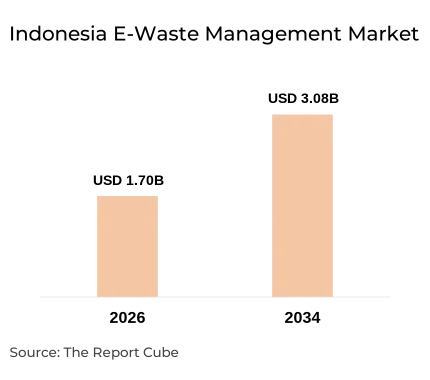
The Indonesia E-Waste Management Market is anticipated to register a CAGR of around 7.7% during the forecast period 2026-2034. The market size is valued at USD 1.7 billion in 2026 and is projected to reach USD 3.08 billion by 2034. Indonesia is experiencing a rapid increase in discarded electronic products as smartphone penetration, home appliance ownership, and digital infrastructure expansion continue across both urban and semi-urban areas. Large cities such as Jakarta, Surabaya, and Bandung are generating substantial volumes of obsolete consumer electronics, laptops, routers, and household appliances due to faster replacement cycles and higher technology adoption. This shift is placing pressure on municipalities and private recyclers to strengthen formal collection, transportation, and recycling systems.
Industry participants are actively investing in environmentally compliant recycling facilities and material recovery technologies to improve processing efficiency and reduce landfill dependency. Valuable materials such as copper, aluminum, gold, and lithium extracted from electronic waste are increasingly supporting Indonesia’s broader circular economy ambitions. Public awareness campaigns led by electronics brands, retailers, and environmental organizations are also encouraging responsible disposal practices. At the same time, collaborations between waste processors and government agencies are improving collection networks and hazardous waste handling standards. These developments are reinforcing long-term growth opportunities within the Indonesia Electronic Waste Management Industry.
Indonesia E-Waste Management Market Impact Analysis
| Factor | Type | Specific Impact on Market | Magnitude | Business Implication |
|---|---|---|---|---|
| Surging Device Ownership | Market | Rising use of electronics sharply increases national e-waste | High | Expands feedstock volumes for formal recycling operators |
| Government E-Waste Policies | Regulatory | Stricter rules push producers toward formal waste channels | High | Supports growth of licensed collection and recycling firms |
| Informal Sector Dominance | Environmental | Unregulated recycling causes pollution and health exposure | High | Creates urgency for safer formal recovery infrastructure |
| Urban Mining Value Potential | Technological | Recoverable metals add strong revenue streams to recyclers | High | Encourages investment in advanced material recovery plants |
| Low Formal Recycling Rate | Market | Most e-waste bypasses official systems and remains unmanaged | Medium | Leaves large untapped volume for new regulated facilities |
| Corporate Sustainability Targets | Competitive | Enterprises seek certified partners for compliant disposal | Medium | Boosts demand for traceable, audit ready recycling services |
| Public Awareness Campaigns | Consumer | Gradual behavior shift toward safe drop off and recycling | Medium | Improves collection efficiency for formal system operators |
Indonesia E-Waste Management Market Dynamics
Key Driver: Increasing Electronics Consumption Across Urban Households and Businesses
Indonesia’s growing digital economy is significantly contributing to the expansion of electronic waste volumes across the country. Rising demand for smartphones, tablets, smart televisions, kitchen appliances, and office electronics has created a strong replacement market, particularly in metropolitan regions. Businesses are also upgrading IT infrastructure more frequently to support cloud services, digital payment systems, and hybrid workplace operations. This ongoing transition is increasing the amount of obsolete electronic equipment entering the waste stream each year.
Environmental concerns associated with improper disposal methods are encouraging both public and private organizations to support structured e-waste management solutions. Hazardous substances contained in electronic devices, including lead, cadmium, and mercury, have raised concerns regarding soil contamination and public health risks. As a result, certified recycling providers are witnessing stronger demand from commercial enterprises, educational institutions, and municipal authorities seeking compliant disposal and recovery services.
Industry Trends: Expansion of Producer Responsibility Programs and Recycling Technologies
The Indonesia Electronic Waste Management Industry is evolving through stronger adoption of producer-led recycling initiatives and advanced material recovery systems. Electronics manufacturers and retail chains are increasingly introducing collection campaigns that encourage consumers to return unused devices for safe processing. Several companies operating in Indonesia have expanded take-back programs for mobile phones, televisions, batteries, and home appliances as part of their sustainability commitments.
Technology adoption within recycling facilities is also improving operational performance across the market. Automated dismantling systems, AI-assisted sorting equipment, and advanced metal separation technologies are helping recyclers increase recovery rates while lowering processing losses. Battery recycling capabilities are receiving additional attention due to rising electric mobility adoption in Southeast Asia. These developments are strengthening the commercial viability of organized recycling operations and supporting higher recovery of reusable raw materials from discarded electronics.
Book your FREE 30-minute expert consultation today
Contact UsMajor Challenge: Informal Waste Processing and Uneven Recycling Infrastructure
A large share of Indonesia’s electronic waste is still processed through informal channels that operate with limited environmental safeguards. Informal dismantling activities often rely on unsafe extraction techniques such as open burning and acid leaching, creating environmental hazards and health concerns for local communities. Smaller cities and rural regions continue to face infrastructure limitations, making access to formal collection systems inconsistent across the country.
Consumer awareness regarding responsible electronic disposal also remains relatively low outside major urban centers. Many households continue storing unused devices or disposing of them through general waste streams due to limited accessibility of collection facilities. Regulatory implementation and monitoring challenges further affect the efficiency of organized recycling operations. Strengthening nationwide collection coverage and improving public education will remain essential for accelerating formal market development over the next decade.
Opportunity: Rising Circular Economy Investments Supporting Sustainable Waste Recovery
Indonesia’s increasing commitment toward sustainable resource management is creating favorable opportunities for e-waste recyclers and recovery service providers. Government agencies and private investors are expanding support for circular economy projects focused on reducing landfill waste and recovering valuable industrial materials. The growing demand for secondary metals and reusable components is improving the economic potential of recycling operations across the country.
Corporate sustainability programs are also creating new growth avenues for certified electronic waste management companies. Businesses operating in manufacturing, telecommunications, banking, and retail sectors are strengthening ESG compliance by partnering with formal recyclers for secure disposal of outdated electronic assets. Demand for refurbished electronics is also increasing among educational institutions and small enterprises seeking affordable technology solutions. These factors are expected to strengthen long-term investment opportunities within the Indonesia E-Waste Management Market.
Indonesia E-Waste Management Market Segment-wise Analysis
By Type:
- Small Household Appliances
- Consumer Electronics
- Medical Devices
- IT and Telecommunications Equipment
- Lighting Equipment
- Automatic Dispensers
- Toys
- Large Household Appliances
- Electrical and Electronic Tools
- Leisure and Sports Equipment
- Monitoring and Control Instruments
Consumer Electronics accounts for the largest share of the Indonesia E-Waste Management Market, holding nearly 31.4% of total industry revenue. The segment’s dominance is supported by strong sales of smartphones, televisions, gaming devices, and home entertainment systems across urban households. Frequent product upgrades and shorter device life cycles are increasing the volume of discarded electronics entering formal and informal waste streams. Indonesia’s growing digital lifestyle and expanding internet penetration are also encouraging higher ownership of connected consumer devices.
IT and Telecommunications Equipment is witnessing notable growth due to expanding enterprise digitization and data infrastructure development. Businesses across banking, retail, healthcare, and telecommunications sectors are replacing outdated servers, networking equipment, and office electronics to improve operational efficiency. This trend is increasing demand for secure disposal, recycling, and refurbishment services capable of handling sensitive electronic assets and reusable components responsibly.
By Process:
- Recycling and Recovery
- Collection and Transportation
- Treatment and Disposal
- Refurbishing and Reuse
- Sorting and Dismantling
Recycling and Recovery remains the leading process segment within the Indonesia Electronic Waste Management Industry, contributing approximately 36.8% of total market revenue. The segment benefits from increasing recovery of high-value metals including copper, aluminum, silver, and gold from discarded electronic products. Rising global demand for recycled industrial materials is improving profitability for recycling companies investing in modern processing infrastructure. Advanced dismantling systems and improved sorting technologies are also supporting better recovery efficiency across organized facilities.
Refurbishing and Reuse is emerging as an important growth segment as businesses and consumers seek affordable alternatives to newly manufactured electronics. Refurbished smartphones, laptops, and networking devices are gaining wider acceptance among educational institutions, startups, and price-sensitive consumers. This trend is extending product life cycles while reducing electronic waste generation volumes. The increasing availability of certified refurbishment providers is expected to support further market expansion during the forecast period.
Regional Projection of Indonesia E-Waste Management Industry
- Sumatra
- Java
- Kalimantan
- Sulawesi
- Nusa Tenggara
- Maluku
- Papua
Java dominates the Indonesia E-Waste Management Market with an estimated 52.7% share due to its high population density, industrial concentration, and advanced urban infrastructure. Major metropolitan areas including Jakarta, Surabaya, and Bandung generate substantial volumes of electronic waste from residential, commercial, and industrial sources. The region also benefits from stronger logistics networks, better access to recycling facilities, and higher public awareness regarding sustainable waste management practices.
Sumatra is experiencing steady market growth driven by expanding manufacturing activity and improving environmental management initiatives. Kalimantan and Sulawesi are gradually strengthening organized collection and transportation systems as local governments focus on reducing hazardous waste pollution. Eastern regions such as Papua and Maluku continue to face infrastructure limitations but are expected to witness gradual development as electronics adoption and digital connectivity increase over the coming years.
Need insights for a specific region within this market?
Request Regional DataIndonesia E-Waste Management Market Regional Analysis
The Indonesia e-waste management market varies significantly across regions due to diverse population density, urbanization levels, and infrastructure development.
| Region | Demand Level | Key Areas | System Dominance | Core Demand Logic | Growth Nature |
|---|---|---|---|---|---|
| Java | Extremely High | Jakarta, Surabaya, Bandung | Formal recycling & collection | 56% of national e-waste from urban density | Fastest-growing segment |
| Sumatra | High | Medan, Palembang, Pekanbaru | Municipal & retail collection | Expanding urbanization & digital adoption | Infrastructure expansion |
| Kalimantan | Medium | Balikpapan, Pontianak, Banjarmasin | Informal & emerging formal | Mining & industrial electronics demand | Emerging market potential |
| Sulawesi | Medium | Makassar, Manado, Palu | Mixed formal-informal | Growing commercial & residential tech use | Gradual formalization |
| Nusa Tenggara | Low | Mataram, Kupang | Informal sector dominant | Limited digital penetration & awareness | Awareness-driven growth |
| Maluku | Very Low | Ambon, Ternate | Informal handling only | Remote location with minimal infrastructure | Long-term potential |
| Papua | Very Low | Jayapura, Sorong | Informal disposal dominant | Lowest device ownership & collection access | Undeveloped market |
Government Initiatives & Policies
- Indonesia National Circular Economy Roadmap 2025: Indonesia’s Ministry of National Development Planning expanded circular economy implementation targets in electronics waste reduction and material recovery to strengthen sustainable waste management infrastructure and recycling investment growth.
- Ministry of Environment and Forestry E-Waste Management Program 2026: The Indonesian government strengthened hazardous electronic waste handling regulations and promoted certified collection systems to improve formal recycling participation and reduce illegal dumping activities nationwide.
Indonesia E-Waste Management Industry Recent Developments
- 2025: Erafone launched its “Erafone Jaga Bumi” program to collect and recycle electronic waste across Indonesia. The initiative collected 2,255 units of old electronics while reducing nearly 161,700 kg of CO₂ emissions and saving approximately 301,261 kWh of energy through recycling activities.
- 2025: LG Electronics Indonesia introduced its nationwide “E-Waste Recycling for a Better Planet” campaign by establishing multiple electronic waste collection points in Jakarta and conducting consumer awareness programs focused on responsible disposal and sustainable recycling practices.
Why Choose This Report?
- Provides a comprehensive overview of the overall market analysis, encompassing key trends, consumer behavior analysis, and risk assessment to support strategic decision-making.
- Provides accurate, up-to-date insights into market size, segmentation, and emerging opportunities, helping to minimize risk & capitalizing on growth.
- Gives deep understanding of target audience preferences, investment habits, and communication channels for enhanced product development & marketing effectiveness.
- Delivers competitive analysis & benchmarking, uncovering the strengths & weaknesses of market competitors to guide strategies.
- Consolidate comprehensive market intelligence, reducing reasoning & streamlining research efforts.
- Facilitates customized market segmentation & risk mitigation strategies, fine-tuned to the business objectives.
- Aids in identifying both market challenges & untapped opportunities within the industry to drive long-term business growth.
- Provides valuable information based on actual customer data & search trends.
Table of Contents
- Introduction
- Objective of the Study
- Product and Category Definition
- Market Segmentation
- Study Variables
- Research Methodology
- Secondary Data Points
- Breakdown of Secondary Sources
- Primary Data Points
- Breakdown of Primary Interviews
- Secondary Data Points
- Executive Summary
- Market Dynamics
- Emerging Opportunities
- Adoption Trends
- Demand Drivers
- Disruption Analysis (Challenges)
- Industry Analysis and Strategic Insights
- Supply and Value Chain Analysis
- Pricing Analysis
- Go-to-Market Strategy
- BCG Matrix
- Recent Trends and Developments
- Import and Export Analysis
- Regulatory and Policy Landscape
- Region-wise Policies
- Government Initiatives
- Indonesia E-Waste Management Market Overview and Forecast Analysis (2021-2034)
- Market Size, By Value, By Growth Rate (CAGR/USD Billion)
- Market Share, By Type
- Small Household Appliances
- Consumer Electronics
- Medical Devices
- IT and Telecommunications Equipment
- Lighting Equipment
- Automatic Dispensers
- Toys
- Large Household Appliances
- Electrical and Electronic Tools
- Leisure and Sports Equipment
- Monitoring and Control Instruments
- Market Share, By Process
- Recycling and Recovery
- Collection and Transportation
- Treatment and Disposal
- Refurbishing and Reuse
- Sorting and Dismantling
- Market Share, By Technology
- Mechanical Recycling
- Chemical Recycling
- Biological Recycling
- Physical Recycling
- Market Share, By Material Type
- Glass
- Metals
- Plastics
- Others
- Market Share, By Service
- Consultancy Services
- Collection Services
- Refurbishment Services
- Recycling Services
- Disposal Services
- Market Share, By Collection Channel
- Municipal Collection
- Retail Collection
- Direct Producer Collection
- Take-back Programs
- Third-party Collection
- Market Share, By End-User
- Commercial
- Government and Public Sector
- Industrial
- Residential
- Market Share, By Region
- Sumatra
- Java
- Kalimantan
- Sulawesi
- Nusa Tenggara
- Maluku
- Papua
- Market Share, By Company
- Revenue Shares and Analysis
- Competitive Landscape
- Sumatra Indonesia E-Waste Management Market Overview and Forecast Analysis (2021-2034)
- Market Size, By Value, By Growth Rate (CAGR/USD Billion/Million)
- Market Share, By Type
- Market Share, By Process
- Market Share, By Technology
- Market Share, By Material Type
- Market Share, By Service
- Market Share, By Collection Channel
- Market Share, By End-User
- Java Indonesia E-Waste Management Market Overview and Forecast Analysis (2021-2034)
- Market Size, By Value, By Growth Rate (CAGR/USD Billion/Million)
- Market Share, By Type
- Market Share, By Process
- Market Share, By Technology
- Market Share, By Material Type
- Market Share, By Service
- Market Share, By Collection Channel
- Market Share, By End-User
- Kalimantan Indonesia E-Waste Management Market Overview and Forecast Analysis (2021-2034)
- Market Size, By Value, By Growth Rate (CAGR/USD Billion/Million)
- Market Share, By Type
- Market Share, By Process
- Market Share, By Technology
- Market Share, By Material Type
- Market Share, By Service
- Market Share, By Collection Channel
- Market Share, By End-User
- Sulawesi Indonesia E-Waste Management Market Overview and Forecast Analysis (2021-2034)
- Market Size, By Value, By Growth Rate (CAGR/USD Billion/Million)
- Market Share, By Type
- Market Share, By Process
- Market Share, By Technology
- Market Share, By Material Type
- Market Share, By Service
- Market Share, By Collection Channel
- Market Share, By End-User
- Nusa Tenggara Indonesia E-Waste Management Market Overview and Forecast Analysis (2021-2034)
- Market Size, By Value, By Growth Rate (CAGR/USD Billion/Million)
- Market Share, By Type
- Market Share, By Process
- Market Share, By Technology
- Market Share, By Material Type
- Market Share, By Service
- Market Share, By Collection Channel
- Market Share, By End-User
- Maluku Indonesia E-Waste Management Market Overview and Forecast Analysis (2021-2034)
- Market Size, By Value, By Growth Rate (CAGR/USD Billion/Million)
- Market Share, By Type
- Market Share, By Process
- Market Share, By Technology
- Market Share, By Material Type
- Market Share, By Service
- Market Share, By Collection Channel
- Market Share, By End-User
- Papua Indonesia E-Waste Management Market Overview and Forecast Analysis (2021-2034)
- Market Size, By Value, By Growth Rate (CAGR/USD Billion/Million)
- Market Share, By Type
- Market Share, By Process
- Market Share, By Technology
- Market Share, By Material Type
- Market Share, By Service
- Market Share, By Collection Channel
- Market Share, By End-User
- Competitive Analysis, 2026
- Market Share of Key Players
- Competitive Mapping for Each Type
- Competitive Mapping for Each Process
- Competitive Mapping for Each Technology
- Competitive Mapping for Each Material Type
- Competitive Mapping for Each Service
- Competitive Mapping for Each Collection Channel
- Competitive Mapping for Each End-User
- Sumatra E-Waste Management Companies Share & Competitive Analysis, 2026
- Java E-Waste Management Companies Share & Competitive Analysis, 2026
- Kalimantan E-Waste Management Companies Share & Competitive Analysis, 2026
- Sulawesi E-Waste Management Companies Share & Competitive Analysis, 2026
- Nusa Tenggara E-Waste Management Companies Share & Competitive Analysis, 2026
- Maluku E-Waste Management Companies Share & Competitive Analysis, 2026
- Papua E-Waste Management Companies Share & Competitive Analysis, 2026
- Company Profiles (Partial List)
- EnviroHub
- Company Overview
- Product and Service Portfolio
- Strategic Alliances and Partnerships
- Recent Developments
- Waste4Change
- Company Overview
- Product and Service Portfolio
- Strategic Alliances and Partnerships
- Recent Developments
- Veolia Environment SA
- Company Overview
- Product and Service Portfolio
- Strategic Alliances and Partnerships
- Recent Developments
- PT Mukti Mandiri Lestari
- Company Overview
- Product and Service Portfolio
- Strategic Alliances and Partnerships
- Recent Developments
- DOWA Holdings
- Company Overview
- Product and Service Portfolio
- Strategic Alliances and Partnerships
- Recent Developments
- TES-AMM
- Company Overview
- Product and Service Portfolio
- Strategic Alliances and Partnerships
- Recent Developments
- Sims Lifecycle Services
- Company Overview
- Product and Service Portfolio
- Strategic Alliances and Partnerships
- Recent Developments
- Eco Beringin
- Company Overview
- Product and Service Portfolio
- Strategic Alliances and Partnerships
- Recent Developments
- EwasteRJ
- Company Overview
- Product and Service Portfolio
- Strategic Alliances and Partnerships
- Recent Developments
- Revirec
- Company Overview
- Product and Service Portfolio
- Strategic Alliances and Partnerships
- Recent Developments
- PT Prasadha Pamunah Limbah Industri (PPLI)
- Company Overview
- Product and Service Portfolio
- Strategic Alliances and Partnerships
- Recent Developments
- Others (Partial List)
- EnviroHub
- Contact Us and Disclaimer
Top Key Players & Market Share Outlook
- EnviroHub
- Waste4Change
- Veolia Environment SA
- PT Mukti Mandiri Lestari
- DOWA Holdings
- TES-AMM
- Sims Lifecycle Services
- Eco Beringin
- EwasteRJ
- Revirec
- PT Prasadha Pamunah Limbah Industri (PPLI)
- Others
Frequently Asked Questions






