



Build Your Custom Market Intelligence Report
Customize Your ReportSaudi Arabia Electric Delivery Vans Market Key Highlights
By Type:
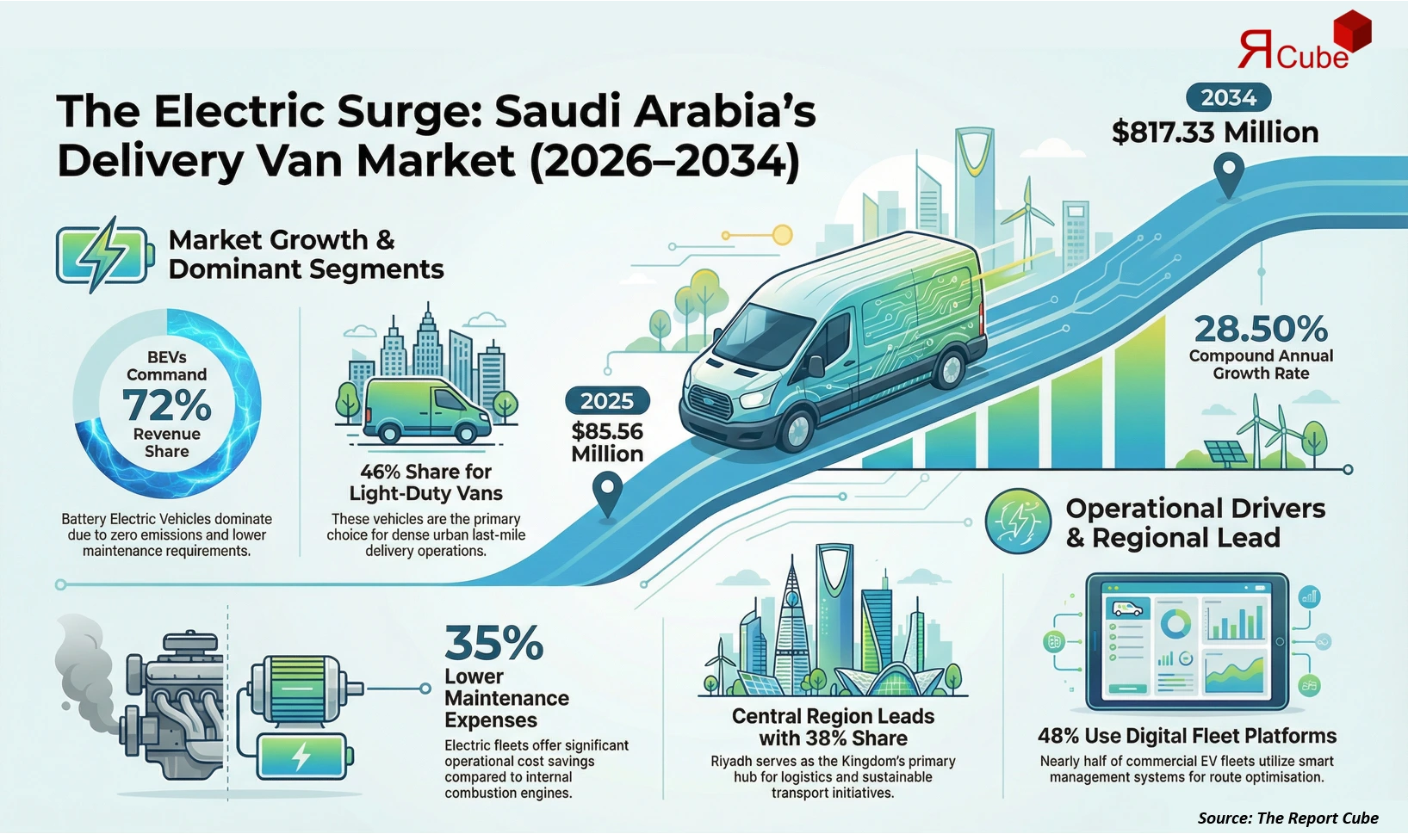
Light-Duty Electric Vans lead the market, with around 46% market share.
By Propulsion Type:
Battery Electric Vehicles (BEVs) dominate the market, accounting for nearly 72% of total revenue.
Regional Outlook:
Central Region dominates the market, with around 38% market share.
Government Initiatives & Policies
- Saudi Vision 2030 - National Transport & Logistics Strategy: The program promotes electric mobility adoption, sustainable logistics fleets, and emission reduction across commercial transportation.
- Saudi Green Initiative: Supports electrification of transport fleets, charging infrastructure expansion, and private-sector EV adoption incentives.
Saudi Arabia Electric Delivery Vans Market Insights & Analysis
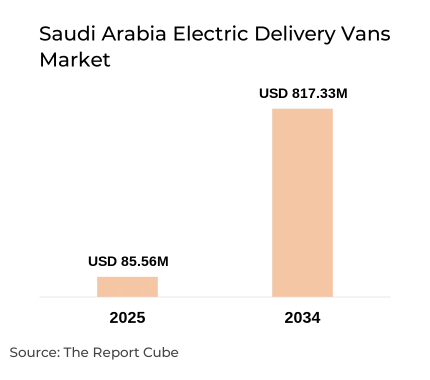
The Saudi Arabia Electric Delivery Vans Market is anticipated to register a CAGR of 28.50% during 2026-2034. The market size was valued at USD 85.56 million in 2025 and is projected to reach USD 817.33 million by 2034. This exceptional growth trajectory reflects Saudi Arabia’s rapid transformation of its logistics and transportation ecosystem under national sustainability and diversification agendas.
Electric delivery vans are increasingly becoming integral to last-mile logistics, e-commerce fulfillment, and urban delivery networks across the Kingdom. Rising fuel efficiency concerns, growing urban congestion, and corporate sustainability commitments are accelerating fleet electrification. By 2025, logistics operators in Saudi Arabia were actively piloting electric vans to reduce operating costs, with studies indicating up to 35% lower maintenance expenses compared to internal combustion engine fleets. As infrastructure readiness improves and government support strengthens, the Saudi Arabia Electric Delivery Vans Market is transitioning from early adoption to scalable commercial deployment.
Saudi Arabia Electric Delivery Vans Market Dynamics
Key Driver: Rapid Growth of E-Commerce and Last-Mile Logistics
The most significant driver propelling the Saudi Arabia Electric Delivery Vans Market is the explosive growth of e-commerce and on-demand delivery services. Online retail penetration in the Kingdom surpassed 33% of total retail transactions by 2025, intensifying demand for efficient, low-cost, and environmentally friendly delivery solutions. Electric delivery vans offer logistics operators reduced fuel dependency, predictable operating costs, and compliance with emerging urban emission regulations. Additionally, rising same-day and next-day delivery expectations require vehicles optimized for frequent stop-and-go operations, where electric drivetrains outperform traditional engines. As logistics networks expand across urban centers such as Riyadh, Jeddah, and Dammam, electric vans are becoming operationally and economically compelling, reinforcing sustained market growth.
Book your FREE 30-minute expert consultation today
Contact UsIndustry Trends: Integration of Smart Fleet Management and Charging Infrastructure
A notable trend shaping the Saudi Arabia Electric Delivery Vans Market is the integration of smart fleet management systems with EV charging infrastructure. Logistics providers are increasingly deploying telematics, route optimization software, and battery health monitoring to maximize vehicle utilization. In 2025, more than 48% of commercial EV fleets in the Kingdom utilized digital fleet platforms to optimize delivery routes and charging schedules. Simultaneously, investments in DC fast-charging hubs near logistics parks and urban warehouses are reducing range anxiety. This convergence of digitalization and electrification is improving fleet efficiency, lowering downtime, and enhancing return on investment, accelerating broader adoption across commercial delivery segments.
Major Challenge: Limited Public Charging Infrastructure Outside Urban Centers
Despite strong momentum, limited charging infrastructure outside major metropolitan areas remains a key challenge for the Saudi Arabia Electric Delivery Vans Market. While urban regions benefit from growing charging networks, intercity routes and remote delivery zones face infrastructure gaps. Fleet operators serving nationwide distribution networks must often invest in private charging depots, increasing upfront capital requirements. Additionally, grid capacity constraints in certain regions can delay large-scale fleet electrification. Although government and private stakeholders are accelerating infrastructure deployment, uneven regional availability continues to restrain full market penetration, particularly for medium- and heavy-duty electric vans.
Opportunity: Government-Led Fleet Electrification and Corporate ESG Commitments
A major opportunity for the Saudi Arabia Electric Delivery Vans Market lies in government-led fleet electrification programs and rising corporate ESG commitments. Public sector entities, postal services, and municipal authorities are increasingly prioritizing electric delivery fleets to meet sustainability targets. Private enterprises are also aligning fleet strategies with carbon-reduction goals to enhance brand value and regulatory compliance. Incentives related to import duties, financing, and charging infrastructure development further strengthen the business case for electric vans. As ESG reporting becomes more standardized, electric delivery vehicles will play a pivotal role in corporate sustainability roadmaps, unlocking long-term market expansion.
Saudi Arabia Electric Delivery Vans Market Segment-wise Analysis
By Type:
- Medium-Duty Electric Vans
- Light-Duty Electric Vans
- Heavy-Duty Electric Vans
Light-duty electric vans account for approximately 46% of the Saudi Arabia Electric Delivery Vans Market in 2025. Their dominance is driven by suitability for last-mile delivery, food delivery, and e-commerce logistics within dense urban environments. These vehicles offer optimal payload capacity, lower acquisition costs, and extended daily range sufficient for city operations. Logistics operators report up to 28% cost savings per kilometer compared to diesel counterparts, making light-duty electric vans the preferred entry point for fleet electrification across Saudi cities.
By Propulsion Type:
- Plug-in Hybrid Electric Vehicles (PHEVs)
- Battery Electric Vehicles (BEVs)
- Fuel Cell Electric Vehicles (FCEVs)
Battery Electric Vehicles (BEVs) dominate the Saudi Arabia Electric Delivery Vans Market with nearly 72% market share. BEVs benefit from simpler drivetrains, lower maintenance requirements, and compatibility with expanding charging infrastructure. Fleet operators increasingly favor BEVs due to zero tailpipe emissions and alignment with national sustainability objectives. As battery energy density improves and charging times decrease, BEVs are expected to further consolidate their leadership position during the forecast period.
Regional Projection of Saudi Arabia Electric Delivery Vans Industry
- East
- Central
- South
- West
The Central region leads the Saudi Arabia Electric Delivery Vans Market, holding around 38% market share in 2025. Riyadh’s role as the Kingdom’s primary logistics, commercial, and e-commerce hub drives concentrated demand for electric delivery fleets. The region benefits from advanced road infrastructure, higher charging station density, and strong government support for sustainable transport initiatives. As logistics clusters continue expanding in the Central region, electric delivery van adoption is expected to remain robust.
Saudi Arabia Electric Delivery Vans Market Recent Developments
- 2025: Mercedes-Benz Group expanded its electric commercial vehicle portfolio in Saudi Arabia by introducing region-specific configurations of its eSprinter, targeting logistics and parcel delivery operators seeking extended range and high payload efficiency.
- 2025: BYD Company Limited partnered with local fleet operators to pilot large-scale electric delivery van deployments, focusing on last-mile e-commerce operations across Riyadh and Jeddah with integrated charging solutions.
- 2025: Ford Motor Company announced strategic collaborations with Saudi distributors to expand availability of electric transit vans, supporting fleet electrification initiatives aligned with Vision 2030 sustainability targets.
- 2025: Hyundai Motor Company advanced its commercial EV roadmap in the Kingdom by introducing tailored financing and aftersales programs designed to lower total ownership costs for electric delivery van fleets.
Need insights for a specific region within this market?
Request Regional DataWhy Choose This Report?
- Provides a comprehensive overview of the overall market analysis, encompassing key trends, consumer behavior analysis, and risk assessment to support strategic decision-making.
- Provides accurate, up-to-date insights into market size, segmentation, and emerging opportunities, helping to minimize risk & capitalizing on growth.
- Gives deep understanding of target audience preferences, investment habits, and communication channels for enhanced product development & marketing effectiveness.
- Delivers competitive analysis & benchmarking, uncovering the strengths & weaknesses of market competitors to guide strategies.
- Consolidate comprehensive market intelligence, reducing reasoning & streamlining research efforts.
- Facilitates customized market segmentation & risk mitigation strategies, fine-tuned to the business objectives.
- Aids in identifying both market challenges & untapped opportunities within the industry to drive long-term business growth.
- Provides valuable information based on actual customer data & search trends.
Table of Contents
- Introduction
- Objective of the Study
- Product and Category Definition
- Market Segmentation
- Study Variables
- Research Methodology
- Secondary Data Points
- Breakdown of Secondary Sources
- Primary Data Points
- Breakdown of Primary Interviews
- Secondary Data Points
- Executive Summary
- Market Dynamics
- Drivers
- Challenges
- Opportunity Assessment
- Recent Trends and Developments
- Regulatory and Policy Landscape
- Saudi Arabia Electric Delivery Vans Market Overview (2021-2034)
- Market Size, By Value (USD Million)
- Market Share, By Type
- Medium-Duty Electric Vans
- Light-Duty Electric Vans
- Heavy-Duty Electric Vans
- Market Share, By Battery Capacity
- Below 30 kWh
- 30 kWh to 70 kWh
- Above 70 kWh
- Market Share, By Charging Type
- DC Fast Charging
- AC Charging
- Wireless Charging
- Market Share, By Distribution Channel
- Dealerships & Automotive Retailers
- Online Sales
- Direct Sales
- Market Share, By Propulsion Type
- Plug-in Hybrid Electric Vehicles (PHEVs)
- Battery Electric Vehicles (BEVs)
- Fuel Cell Electric Vehicles (FCEVs)
- Market Share, By End Use
- Postal & Parcel Services
- E-commerce
- Food Delivery
- Healthcare
- Others
- Market Share, By Region
- East
- Central
- South
- West
- Market Share, By Company
- Revenue Shares
- Competitive Landscape
- East Region Electric Delivery Vans Market
- Market Size, By Value (USD Million)
- Market Share, By Type
- Market Share, By Battery Capacity
- Market Share, By Charging Type
- Market Share, By Distribution Channel
- Market Share, By Propulsion Type
- Market Share, By End Use
- Central Region Electric Delivery Vans Market
- Market Size, By Value (USD Million)
- Market Share, By Type
- Market Share, By Battery Capacity
- Market Share, By Charging Type
- Market Share, By Distribution Channel
- Market Share, By Propulsion Type
- Market Share, By End Use
- South Region Electric Delivery Vans Market
- Market Size, By Value (USD Million)
- Market Share, By Type
- Market Share, By Battery Capacity
- Market Share, By Charging Type
- Market Share, By Distribution Channel
- Market Share, By Propulsion Type
- Market Share, By End Use
- West Region Electric Delivery Vans Market
- Market Size, By Value (USD Million)
- Market Share, By Type
- Market Share, By Battery Capacity
- Market Share, By Charging Type
- Market Share, By Distribution Channel
- Market Share, By Propulsion Type
- Market Share, By End Use
- Competitive Outlook and Company Profiles
- Mercedes-Benz Group
- Company Overview
- Product Portfolio
- Strategic Alliances/Partnerships
- Recent Developments
- Ford Motor Company
- Company Overview
- Product Portfolio
- Strategic Alliances/Partnerships
- Recent Developments
- General Motors Company
- Company Overview
- Product Portfolio
- Strategic Alliances/Partnerships
- Recent Developments
- BYD Company Limited
- Company Overview
- Product Portfolio
- Strategic Alliances/Partnerships
- Recent Developments
- Renault Group
- Company Overview
- Product Portfolio
- Strategic Alliances/Partnerships
- Recent Developments
- Nissan Motor Co., Ltd.
- Company Overview
- Product Portfolio
- Strategic Alliances/Partnerships
- Recent Developments
- Tata Motors Limited
- Company Overview
- Product Portfolio
- Strategic Alliances/Partnerships
- Recent Developments
- Hyundai Motor Company
- Company Overview
- Product Portfolio
- Strategic Alliances/Partnerships
- Recent Developments
- Rivian Automotive, Inc.
- Company Overview
- Product Portfolio
- Strategic Alliances/Partnerships
- Recent Developments
- Lucid Group, Inc.
- Company Overview
- Product Portfolio
- Strategic Alliances/Partnerships
- Recent Developments
- Others
- Mercedes-Benz Group
- Contact Us and Disclaimer
Top Key Players & Market Share Outlook
- Mercedes-Benz Group
- Ford Motor Company
- General Motors Company
- BYD Company Limited
- Renault Group
- Nissan Motor Co., Ltd.
- Tata Motors Limited
- Hyundai Motor Company
- Rivian Automotive, Inc.
- Lucid Group, Inc.
- Others
Frequently Asked Questions






