



Build Your Custom Market Intelligence Report
Customize Your ReportChina Energy Drink Market Insights & Analysis
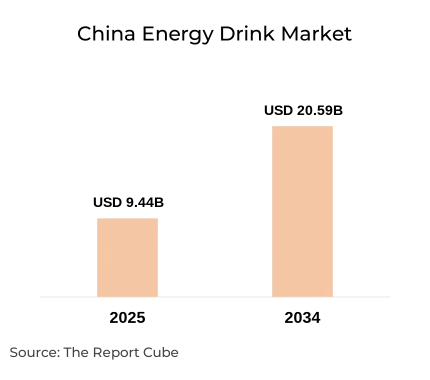
The China Energy Drink Market is projected to grow at a 9.05% CAGR during 2026-2034. The market stood at USD 9.44 billion in 2025 and is expected to reach USD 20.59 billion by 2034. Rapid urbanization, rising disposable incomes among younger cohorts, and an expanding convenience retail and e-commerce ecosystem are key demand drivers. China’s large youth and working-age population increasingly adopts on-the-go beverage formats for productivity, study, and fitness support, while the proliferation of delivery platforms and vending solutions boosts impulse purchases. International brands and strong domestic players both invest heavily in marketing, localized flavours, and channel partnerships with convenience store chains and online platforms. Product innovation sugar-free variants, functional nootropic blends, and compact energy shots is widening the consumer base beyond traditional users, helping convert occasional buyers into habitual consumers and supporting higher per-capita consumption across cities and emerging tier-2/3 markets.
In addition to shifting consumption patterns, the market benefits from better distribution and tailored product positioning: packaging formats optimized for convenience retail, targeted SKU assortments for gyms and campus stores, and seasonal flavour rotations. Manufacturers are also working on formulation diversity to reduce sugar content and add functional ingredients such as B-vitamins, taurine, plant adaptogens, and nootropic complexes to capture wellness-oriented buyers. Marketing strategies that combine celebrity endorsements, gaming and e-sports sponsorships, and social-media activations have proven effective in China’s digital-first environment. These strategies, together with expanding acceptance of sugar-free options and a growing trend for functional beverages, indicate that the market will more than double in value by 2034 driven by both volume growth and premiumization of the category.
China Energy Drink Market Recent Developments
- 2025: Local manufacturers rolled out expanded sugar-free and low-calorie energy drink lines, leveraging domestic R&D to adapt flavors for regional tastes and to meet rising health-conscious demand.
- 2025: Several brands increased partnerships with e-sports tournaments and convenience store chains, boosting in-store visibility and driving youth-focused trial and repeat purchase behavior.
Government Initiatives & Policies
- Food Safety & Labeling Standards: National and provincial regulators have emphasized accurate labeling of functional ingredients, sugar content, and recommended consumption guidelines to protect consumer health and guide industry reformulation.
- Healthy Consumption Campaigns: Public health messages and local-level guidance on sugar reduction and responsible consumption encourage manufacturers to develop low-sugar and fortified energy beverage options.
China Energy Drink Market Dynamics
Driver: Youth Demographics, E-sports & On-the-Go Lifestyles
China’s large youth and young-adult population is a core driver of energy drink growth. Urban millennials and Gen Z consumers favor immediate, portable solutions for study sessions, long commutes, night shifts, gym workouts and competitive gaming. The rapid expansion of e-sports, live-streaming, and influencer-led culture provides a high-visibility platform for brand activation; energy drink brands actively sponsor teams, events, and streamers to build strong emotional connections. Convenience retail density extensive convenience-store networks, vending machines, and fast delivery from e-commerce platforms means trial and repeat purchases are easier than ever. These behavioral and structural factors stimulate frequent buying, encourage SKU experimentation, and enable premium and functional sub-segments to scale quickly across tier-1 and tier-2 cities, while brand marketing and on-channel promotions convert occasional users into regular consumers.
Challenge: Health Concerns, Sugar Reduction Pressure & Regulatory Scrutiny
Rising health awareness, sugar-reduction initiatives, and scrutiny of stimulant use pose a notable challenge for the industry. Consumers, particularly older and more health-conscious cohorts, have concerns regarding high sugar levels and excessive caffeine intake. Regulatory guidance on labeling and recommended consumption may also constrain aggressive marketing claims. In response, manufacturers face the dual challenge of reformulating core SKUs to lower sugar while maintaining taste and efficacy, often at increased production cost. Moreover, export and cross-border e-commerce channels must navigate different regional regulations on functional claims and ingredient thresholds. Balancing consumer appeal, regulatory compliance, and production economics remains a critical hurdle for both domestic champions and international entrants operating in China.
Opportunity: Functional & Nootropic Energy Beverages, Sugar-free Premiumization
Opportunities are strong in functional energy beverages that combine cognitive support, adaptogens, vitamins, and targeted amino acids products that appeal to office workers, students, and gamers seeking performance benefits without high sugar loads. Nootropic blends, fortified vitamin formulas, and amino-acid-enriched options can command premium pricing while targeting health-aware segments. Sugar-free and low-calorie variants also open a large incremental market by converting consumers who previously avoided traditional high-sugar energy drinks. Formulation innovation, clear labeling, and evidence-backed ingredient positioning will enable brands to expand market reach while meeting public health expectations. Additionally, private-label energy beverages for convenience chains and e-commerce sellers provide margin and volume opportunities for co-manufacturers and smaller brands that can move quickly to capture niche trends.
Trend: Channel Diversification, Micro-Formats & E-commerce-Led Promotions
Channel strategy is evolving: convenience chains and online marketplaces coexist with gym and campus channels to form a broad distribution mix. Micro-formats such as energy shots and single-serve ampoules are gaining traction for consumers seeking portability and controlled dosing. E-commerce promotions, subscription packs, and flash deals help brands test new flavors and formulations rapidly, while data from online channels informs SKU rationalization. Brands that optimize omnichannel inventory, run targeted digital campaigns, and use loyalty mechanics across platforms can scale faster. This trend also encourages collaboration between manufacturers and retailers on exclusive SKUs, co-branded launches, and private-label functional ranges tailored to platform-specific consumer segments.
China Energy Drink Market Segment-wise Analysis
By Product Type:
- Traditional Energy Drinks
- Sugar-free & Low-calorie Energy Drinks
- Energy Shots
- Nootropic / Functional Energy Beverages
- Others
Traditional Energy Drinks remain the largest product-type segment with an approximate 45% share. These core SKUs often carbonated or ready-to-drink formats containing taurine, caffeine and B-vitamins continue to attract the bulk of consumers who value classic taste profiles and immediate perceived energy effects. However, growth in sugar-free, nootropic, and shot formats is steadily eroding traditional dominance as health-conscious and performance-focused buyers shift to alternatives. Traditional brands are responding by launching low-sugar variants and limited-edition flavors to maintain relevance. Despite rising competition from functional products, traditional energy drinks still account for near-half of the market due to broad recognition, lower price points, and entrenched retail placement across convenience stores and vending channels.
By Ingredient Profile:
- Caffeinated
- Non-caffeinated / Herbal-based
- Vitamins & Minerals Fortified
- Amino Acid & Taurine-based
- Others
Caffeinated formulations lead the ingredient-profile segment with roughly about 58% share, driven by traditional energy formulas that rely on caffeine as the principal stimulant for alertness and performance. While caffeinated options dominate, there is growing interest in herbal and amino-acid-based formulations that offer milder stimulation or complementary functional benefits. Market leaders often position caffeinated products across mainstream and sugar-free lines to retain a broad consumer base. As regulatory guidance and consumer education evolves, some brands will seek to balance caffeine levels with additional nootropic ingredients to both meet effectiveness expectations and moderate adverse perceptions tied to high-stimulant consumption.
Regional Projection of China Energy Drink Industry
By Region:
- East China (Shanghai, Jiangsu, Zhejiang)
- North China (Beijing, Tianjin, Hebei)
- South China (Guangdong, Shenzhen, Guangzhou)
- Central China
- West China
- Northeast China
- Others
East China leads the market with an estimated approximately 38% share, supported by dense urban populations, high disposable incomes, strong convenience retail penetration, and vibrant e-commerce activity centered in hubs such as Shanghai and Hangzhou. East China’s consumer base includes significant numbers of students, young professionals, and e-sports audiences key cohorts for energy drink consumption. Logistic efficiencies and proximity to major beverage co-manufacturers also reduce time-to-shelf for new SKUs, fostering rapid rollout of innovations. As tier-2 and tier-3 cities in other regions scale up, East China will likely remain the category growth engine due to its mature retail infrastructure and concentrated marketing ecosystems.
What Does Our China Energy Drink Market Research Study Entail?
- Provides comprehensive market sizing and forecasting from 2026–2034, showing growth from USD 9.44 billion in 2025 to USD 20.59 billion by 2034 at a 9.05% CAGR.
- Delivers detailed segmentation across Product Types and Ingredient Profiles, with market-share estimates and growth drivers for traditional, sugar-free, shot, and functional nootropic formats.
- Offers regional analysis covering East, North, South, Central, West, and Northeast China to identify high-opportunity clusters and distribution dynamics for modern retail and e-commerce.
- Presents competitive profiling of leading players including Red Bull (China), Eastroc Beverage (Dongpeng), JDB Group, Wahaha, Uni-President China, Coca-Cola China, PepsiCo China, and local functional beverage brands and private labels.
- Reviews regulatory guidance on labeling and functional claims, consumer health trends, formulation innovation opportunities, and go-to-market strategies for retailers, co-manufacturers, and brand owners.
Table of Contents
- Introduction
- Objective of the Study
- Product/Technology Definition
- Market Segmentation
- Study Variables
- Research Methodology
- Secondary Data Points
- Breakdown of Secondary Sources
- Primary Data Points
- Breakdown of Primary Interviews
- Secondary Data Points
- Executive Summary
- Market Dynamics
- Drivers
- Challenges
- Opportunity Assessment
- Recent Trends and Developments
- Policy and Regulatory Landscape
- China Energy Drink Market Overview (2020–2034)
- Market Size, By Volume (Million Liters) & Value (USD Million)
- Market Share, By Product Type
- Traditional Energy Drinks
- Sugar-free & Low-calorie Energy Drinks
- Energy Shots
- Nootropic / Functional Energy Beverages
- Others
- Market Share, By Ingredient Profile
- Caffeinated
- Non-caffeinated / Herbal-based
- Vitamins & Minerals Fortified
- Amino Acid & Taurine-based
- Others
- Market Share, By Packaging Type
- Cans
- PET Bottles
- Glass Bottles
- Tetra Packs
- Others
- Market Share, By Distribution Channel
- Supermarkets & Hypermarkets
- Convenience Stores
- Food Service & On-trade
- Online/E-commerce
- Others
- Market Share, By Consumer Group
- Students & Young Adults
- Working Professionals
- Sports & Fitness Enthusiasts
- Others
- Market Share, By Region
- East China (Shanghai, Jiangsu, Zhejiang, etc.)
- South China (Guangdong, Fujian, etc.)
- North China (Beijing, Tianjin, Hebei, etc.)
- Central & South-central China
- Southwest China
- Northwest & Northeast China
- Market Share, By Company
- Revenue Shares
- Competitive Landscape
- Segment-wise & Industry-wise Market Forecast (2026–2034)
- By Product Type
- By Ingredient Profile
- By Packaging Type
- By Distribution Channel
- By Consumer Group
- By Region
- Regions Analysis (2020–2034)
- East China Energy Drink Market
- Market Size, By Volume (Million Liters) & Value (USD Million)
- Market Share, By Product Type
- Market Share, By Ingredient Profile
- Market Share, By Distribution Channel
- South China Energy Drink Market
- Market Size, By Volume (Million Liters) & Value (USD Million)
- Market Share, By Product Type
- Market Share, By Ingredient Profile
- Market Share, By Distribution Channel
- North China Energy Drink Market
- Market Size, By Volume (Million Liters) & Value (USD Million)
- Market Share, By Product Type
- Market Share, By Ingredient Profile
- Market Share, By Distribution Channel
- Central & South-central China Energy Drink Market
- Market Size, By Volume (Million Liters) & Value (USD Million)
- Market Share, By Product Type
- Market Share, By Ingredient Profile
- Market Share, By Distribution Channel
- Southwest China Energy Drink Market
- Market Size, By Volume (Million Liters) & Value (USD Million)
- Market Share, By Product Type
- Market Share, By Ingredient Profile
- Market Share, By Distribution Channel
- Northwest & Northeast China Energy Drink Market
- Market Size, By Volume (Million Liters) & Value (USD Million)
- Market Share, By Product Type
- Market Share, By Ingredient Profile
- Market Share, By Distribution Channel
- Competitive Outlook & Company Profiles
- Red Bull (China)
- Company Overview
- Business Segments
- Strategic Alliances/Partnerships
- Recent Developments
- Eastroc Beverage (Dongpeng)
- Company Overview
- Business Segments
- Strategic Alliances/Partnerships
- Recent Developments
- JDB Group (Energy & Herbal Drinks)
- Company Overview
- Business Segments
- Strategic Alliances/Partnerships
- Recent Developments
- Wahaha Group
- Company Overview
- Business Segments
- Strategic Alliances/Partnerships
- Recent Developments
- Uni-President China
- Company Overview
- Business Segments
- Strategic Alliances/Partnerships
- Recent Developments
- Coca-Cola China (Monster, Burn, etc.)
- Company Overview
- Business Segments
- Strategic Alliances/Partnerships
- Recent Developments
- PepsiCo China (Rockstar & Related Brands)
- Company Overview
- Business Segments
- Strategic Alliances/Partnerships
- Recent Developments
- Others
- Red Bull (China)
- Contact Us / Disclaimer
Top Key Players & Market Share Outlook
- Red Bull China
- Eastroc Beverage
- JDB Group
- Wahaha Group
- Uni-President China
- Coca-Cola China
- PepsiCo China
- Others
Frequently Asked Questions






