




Build Your Custom Market Intelligence Report
Customize Your ReportChina E-Commerce Logistics Market Insights & Analysis
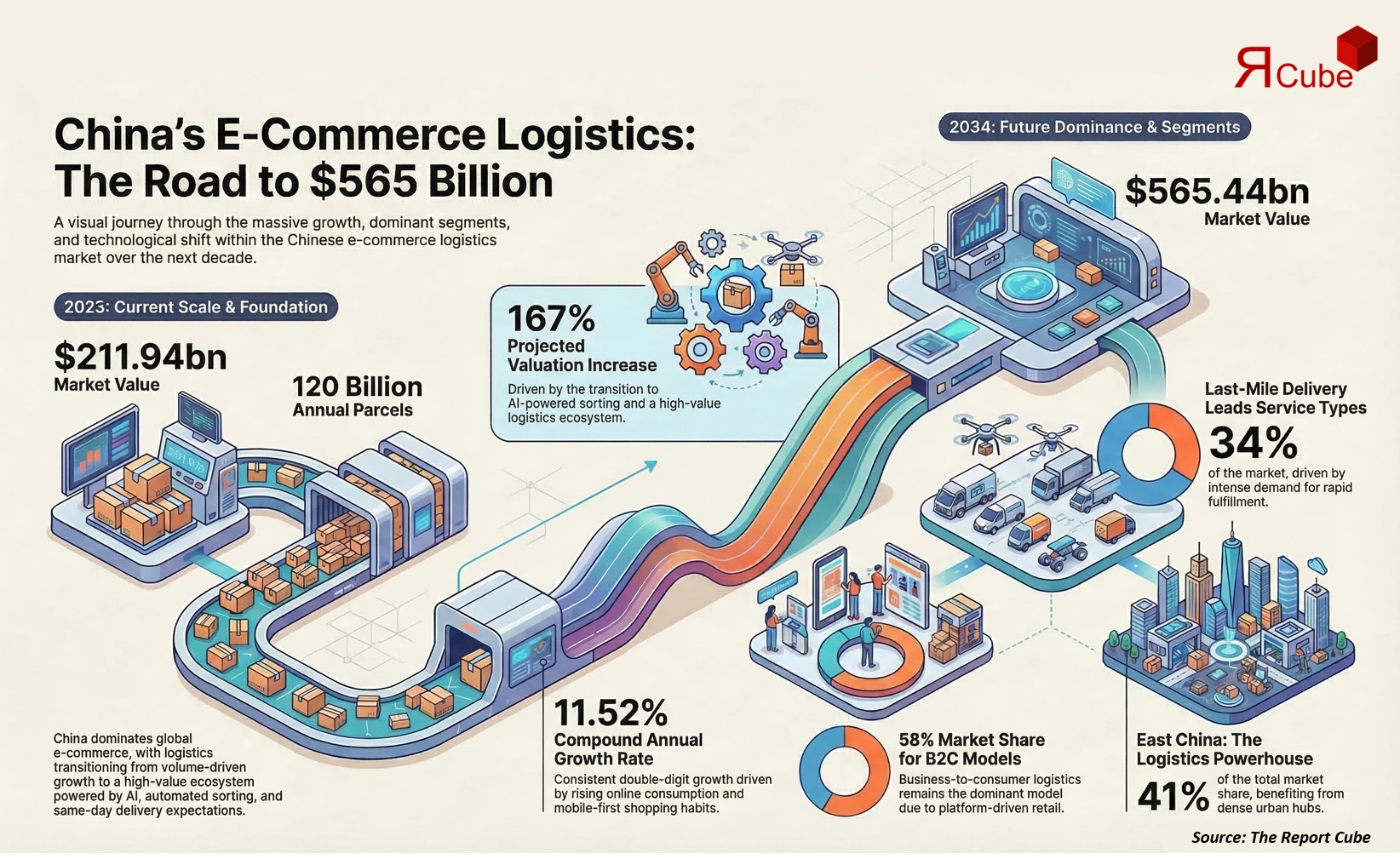
The China E-Commerce Logistics Market is anticipated to register a CAGR of 11.52% during the forecast period 2026-2034. The market size was valued at USD 211.94 billion in 2025 and is projected to reach USD 565.44 billion by 2034. This robust expansion is closely linked to China’s rapidly evolving digital commerce ecosystem, where rising online consumption, mobile-first shoppers, and platform-driven retail models continue to redefine logistics demand at scale.
The growth of the market is deeply interconnected with China’s dominance in global e-commerce transactions, accounting for over half of worldwide online retail sales. As platforms accelerate same-day and next-day delivery promises, logistics providers are investing heavily in automated sorting centers, smart warehousing, and AI-enabled route optimization. This operational shift has strengthened network density in urban clusters while also extending fulfillment capabilities into lower-tier cities and rural regions.
Moreover, cross-border e-commerce has emerged as a structural growth lever, supported by favorable trade policies and expanding bonded warehouse infrastructure. Logistics companies are increasingly integrating transportation, warehousing, and last-mile services into end-to-end solutions, improving delivery speed and cost efficiency. As a result, the China E-Commerce Logistics Market is transitioning from volume-driven growth toward value-added, technology-enabled logistics ecosystems with long-term scalability.
China E-Commerce Logistics Market Recent Developments
- 2025: :contentReference[oaicite:0]{index=0} expanded automated sorting hubs to enhance same-day delivery coverage across tier-2 cities.
- 2025: :contentReference[oaicite:1]{index=1} strengthened integrated warehousing networks to support rapid B2C fulfillment growth.
Government Initiatives & Policies
- 14th Five-Year Modern Logistics Development Plan: Promotes smart logistics infrastructure, digital supply chains, and nationwide distribution efficiency.
- Cross-Border E-Commerce Comprehensive Pilot Zones: Supports bonded warehousing, customs efficiency, and international e-commerce logistics.
China E-Commerce Logistics Market Dynamics
Key Driver: Explosive Growth of Online Retail and Instant Delivery Expectations
The primary driver of the China E-Commerce Logistics Market is the sustained surge in online retail volumes coupled with rising consumer expectations for faster deliveries. Chinese consumers increasingly demand same-day or next-day delivery, particularly in urban centers, forcing logistics providers to optimize fulfillment speed and reliability. In 2024 alone, China processed over 120 billion express parcels, highlighting the sheer scale of logistics activity. This growth directly fuels demand for advanced transportation networks, high-throughput warehouses, and intelligent last-mile solutions. As e-commerce platforms compete on delivery experience, logistics providers have become strategic partners rather than backend operators, reinforcing long-term market expansion.
Book your FREE 30-minute expert consultation today
Contact UsIndustry Trends: Automation, Digitalization, and Integrated Logistics Platforms
A defining trend in the market is the rapid adoption of automation and digital technologies across logistics operations. Companies are deploying robotic sorting systems, AI-powered demand forecasting, and digital twins to optimize warehouse utilization. Integrated logistics platforms that combine warehousing, transportation, and last-mile delivery are becoming standard, particularly for large B2C merchants. Additionally, the use of data analytics to reduce empty miles and improve delivery density is gaining traction. These trends are not only improving cost efficiency but also enhancing service reliability, enabling logistics providers to manage peak demand during major shopping festivals.
Major Challenge: Rising Operational Costs and Margin Pressure
Despite strong demand, rising operational costs pose a significant challenge to market players. Labor shortages, increasing fuel prices, and higher land costs for warehouses have compressed profit margins across the logistics value chain. Last-mile delivery, in particular, remains cost-intensive due to fragmented delivery points and labor dependency. Smaller logistics firms struggle to absorb these costs, leading to consolidation pressures within the industry. While technology investments offer long-term savings, the high upfront capital expenditure can strain short-term financial performance, especially for mid-sized operators.
Opportunity: Expansion of Cross-Border and Value-Added Logistics Services
The expansion of cross-border e-commerce presents a major growth opportunity for the China E-Commerce Logistics Market. Demand for international fulfillment, customs clearance, and bonded warehousing services is rising as Chinese merchants increasingly sell to overseas consumers. Value-added services such as reverse logistics, cold-chain delivery, and customized packaging are also gaining importance. Logistics providers that can offer integrated cross-border solutions stand to capture higher margins and diversify revenue streams, strengthening their competitive positioning over the forecast period.
China E-Commerce Logistics Market Segment-wise Analysis
By Service Type:
- Transportation
- Warehousing
- Last-Mile Delivery
- Cross-Border Logistics
- Value-Added Services
Last-Mile Delivery dominates the service type segment, accounting for approximately 34% of the total market share in 2025. This leadership is driven by high parcel volumes and consumer demand for rapid delivery. Transportation services follow closely, supported by intercity and regional freight movement. Warehousing continues to expand as e-commerce players invest in fulfillment centers closer to consumers. Cross-border logistics and value-added services, while smaller in share, are growing at faster rates due to rising international trade and premium service demand.
By Business Model:
- B2C
- C2C
- B2B
The B2C segment leads the market with nearly 58% share, reflecting the dominance of platform-driven online retail and direct-to-consumer brands. B2C logistics requires high-speed, high-frequency deliveries, driving investment in automation and last-mile networks. C2C logistics remains significant due to marketplace transactions, while B2B logistics is gaining momentum as manufacturers and wholesalers adopt digital procurement models. The interconnected growth of these models ensures diversified demand across the logistics ecosystem.
Regional Projection of China E-Commerce Logistics Industry
- East China
- North China
- South China
- Central China
- Southwest China
- Northwest China
- Northeast China
East China leads the China E-Commerce Logistics Market, contributing approximately 41% of total market share. The region benefits from dense urban populations, advanced infrastructure, and major e-commerce hubs such as Shanghai and Hangzhou. South and North China follow, supported by strong consumption levels and port connectivity. East China’s dominance is reinforced by high warehouse density and superior last-mile coverage, making it the most attractive region for logistics investments through 2034.
Need insights for a specific region within this market?
Request Regional DataWhy Choose This Report?
- Provides a comprehensive overview of the overall market analysis, encompassing key trends, consumer behavior analysis, and risk assessment to support strategic decision-making.
- Provides accurate, up-to-date insights into market size, segmentation, and emerging opportunities, helping to minimize risk & capitalizing on growth.
- Gives deep understanding of target audience preferences, investment habits, and communication channels for enhanced product development & marketing effectiveness.
- Delivers competitive analysis & benchmarking, uncovering the strengths & weaknesses of market competitors to guide strategies.
- Consolidate comprehensive market intelligence, reducing reasoning & streamlining research efforts.
- Facilitates customized market segmentation & risk mitigation strategies, fine-tuned to the business objectives.
- Aids in identifying both market challenges & untapped opportunities within the industry to drive long-term business growth.
- Provides valuable information based on actual customer data & search trends.
Table of Contents
- Introduction
- Objective of the Study
- Product and Category Definition
- Market Segmentation
- Study Variables
- Research Methodology
- Secondary Data Points
- Breakdown of Secondary Sources
- Primary Data Points
- Breakdown of Primary Interviews
- Secondary Data Points
- Executive Summary
- Market Dynamics
- Drivers
- Challenges
- Opportunity Assessment
- Recent Trends and Developments
- Regulatory and Policy Landscape
- China E‑Commerce Logistics Market Overview (2020-2034)
- Market Size, By Value (USD Billion)
- Market Share, By Service Type
- Transportation
- Warehousing
- Last‑Mile Delivery
- Cross‑Border Logistics
- Value‑Added Services
- Market Share, By Business Model
- B2C
- C2C
- B2B
- Market Share, By Shipment Type
- Domestic
- Cross‑Border
- Market Share, By End‑User
- Marketplace Sellers
- Brand Retailers
- Grocery Platforms
- Social Commerce
- Market Share, By Region
- East
- North
- South
- Central
- Southwest
- Northwest
- Northeast
- Market Share, By Company
- Revenue Shares
- Competition Characteristics
- Revenue Shares & Analysis
- East China E‑Commerce Logistics Market
- Market Size, By Value (USD Billion)
- Service Type Split
- Business Model Split
- Shipment Type Split
- End‑User Split
- Market Share, By Province/City Group
- Market Share, By Key Corridor
- North China E‑Commerce Logistics Market
- Market Size, By Value (USD Billion)
- Service Type Split
- Business Model Split
- Shipment Type Split
- End‑User Split
- Market Share, By Province/City Group
- Market Share, By Key Corridor
- South China E‑Commerce Logistics Market
- Market Size, By Value (USD Billion)
- Service Type Split
- Business Model Split
- Shipment Type Split
- End‑User Split
- Market Share, By Province/City Group
- Market Share, By Key Corridor
- Central China E‑Commerce Logistics Market
- Market Size, By Value (USD Billion)
- Service Type Split
- Business Model Split
- Shipment Type Split
- End‑User Split
- Market Share, By Province/City Group
- Market Share, By Key Corridor
- Southwest China E‑Commerce Logistics Market
- Market Size, By Value (USD Billion)
- Service Type Split
- Business Model Split
- Shipment Type Split
- End‑User Split
- Market Share, By Province/City Group
- Market Share, By Key Corridor
- Northwest China E‑Commerce Logistics Market
- Market Size, By Value (USD Billion)
- Service Type Split
- Business Model Split
- Shipment Type Split
- End‑User Split
- Market Share, By Province/City Group
- Market Share, By Key Corridor
- Northeast China E‑Commerce Logistics Market
- Market Size, By Value (USD Billion)
- Service Type Split
- Business Model Split
- Shipment Type Split
- End‑User Split
- Market Share, By Province/City Group
- Market Share, By Key Corridor
- Competitive Outlook and Company Profiles
- SF Express
- Company Overview
- Service Portfolio
- Strategic Alliances/Partnerships
- Recent Developments
- JD Logistics
- Company Overview
- Service Portfolio
- Strategic Alliances/Partnerships
- Recent Developments
- Cainiao Network
- Company Overview
- Service Portfolio
- Strategic Alliances/Partnerships
- Recent Developments
- ZTO Express
- Company Overview
- Service Portfolio
- Strategic Alliances/Partnerships
- Recent Developments
- YTO Express
- Company Overview
- Service Portfolio
- Strategic Alliances/Partnerships
- Recent Developments
- Yunda Express
- Company Overview
- Service Portfolio
- Strategic Alliances/Partnerships
- Recent Developments
- STO Express
- Company Overview
- Service Portfolio
- Strategic Alliances/Partnerships
- Recent Developments
- Best Inc.
- Company Overview
- Service Portfolio
- Strategic Alliances/Partnerships
- Recent Developments
- China Post EMS
- Company Overview
- Service Portfolio
- Strategic Alliances/Partnerships
- Recent Developments
- Deppon Logistics
- Company Overview
- Service Portfolio
- Strategic Alliances/Partnerships
- Recent Developments
- Others
- SF Express
- Contact Us and Disclaimer
Top Key Players & Market Share Outlook
- SF Express
- JD Logistics
- Cainiao Network
- ZTO Express
- YTO Express
- Yunda Express
- STO Express
- Best Inc.
- China Post EMS
- Deppon Logistics
- Others
Frequently Asked Questions






