



Build Your Custom Market Intelligence Report
Customize Your ReportIndia Ethanol Market Key Highlights
By Type:
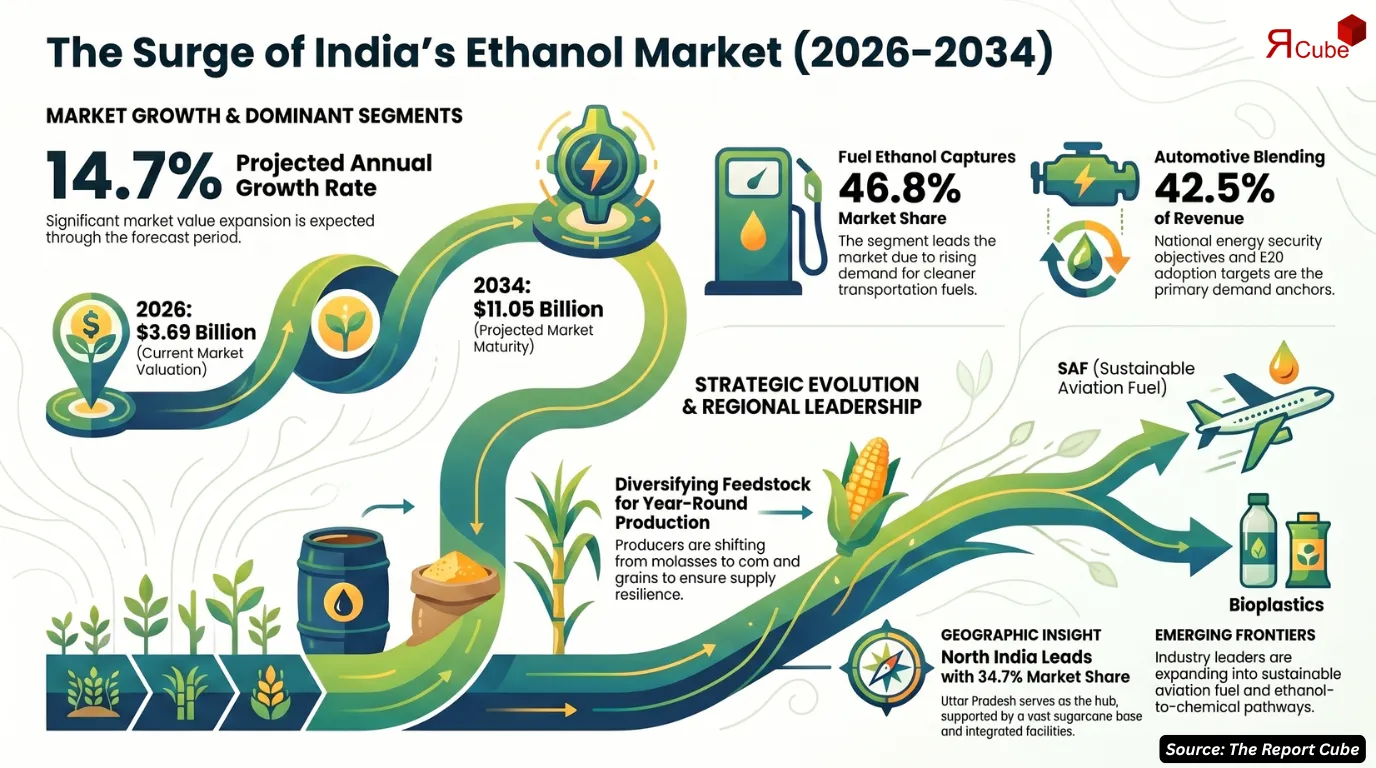
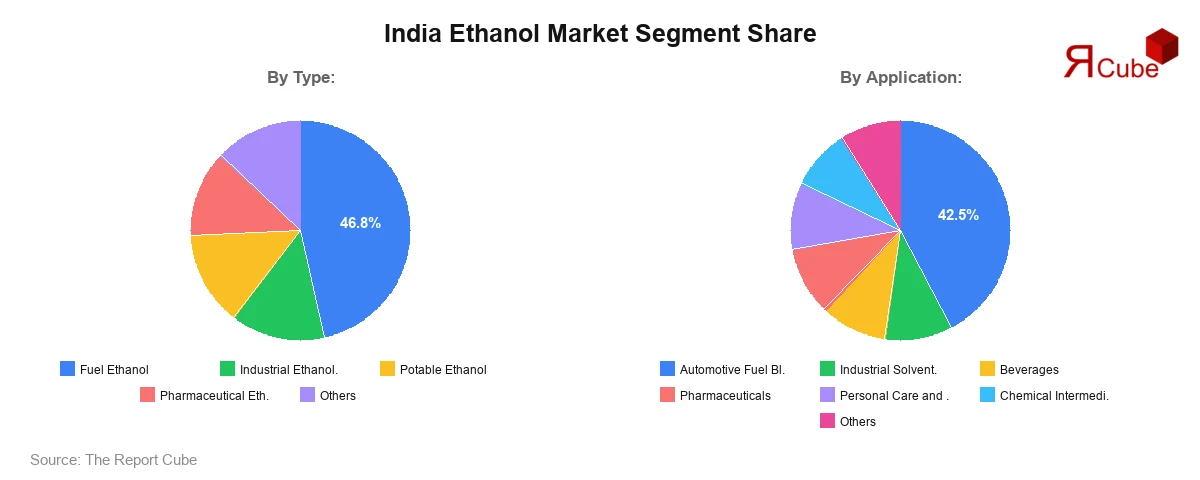
Fuel Ethanol segment leads the market with nearly 46.8% share.
By Application:
Automotive Fuel Blending segment dominates the market with around 42.5% of revenue.
Regional Outlook:
North region dominates the India Ethanol Market with approximately 34.7% share.
India Ethanol Market Insights & Analysis
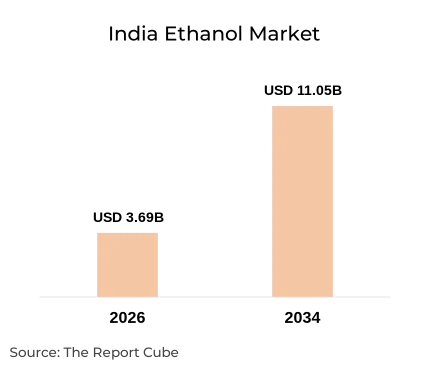
The India Ethanol Market is anticipated to register a CAGR of around 14.7% during the forecast period 2026-2034. The market size is valued at USD 3.69 billion in 2026 and is projected to reach USD 11.05 billion by 2034. Growth is strongly supported by India's transition toward cleaner transportation fuels and the government's long-term objective of reducing dependence on imported crude oil. Ethanol consumption in fuel blending has risen substantially over the past few years, supported by the successful implementation of the Ethanol Blended Petrol (EBP) Programme. According to industry estimates, ethanol supply to oil marketing companies has increased several-fold since the launch of accelerated blending initiatives, creating a stable demand environment for producers across sugar and grain value chains.
Growing investments in distillation capacity, storage infrastructure, and feedstock diversification are reshaping the India ethanol fuel market. Sugar mills and integrated bioenergy companies are increasingly investing in grain-based and dual-feedstock ethanol facilities to ensure year-round production. Capacity additions in Uttar Pradesh, Maharashtra, Karnataka, and Bihar are strengthening domestic supply while improving regional distribution efficiency. The industry is also witnessing increased interest in ethanol-to-chemicals and ethanol-to-sustainable aviation fuel pathways, creating additional revenue streams beyond automotive fuel blending. These developments are expected to strengthen market value growth, production volumes, and ethanol demand measured in billion liters throughout the forecast period.
India Ethanol Market Impact Analysis
| Factor | Type | Specific Impact on Market | Magnitude | Business Implication |
|---|---|---|---|---|
| Ethanol Blending Policy Targets | Regulatory | Mandated E20 adoption steadily raises national ethanol demand | High | Encourages capacity expansion and long term supply contracts |
| Rising Fuel and Additive Demand | Market | Fuel blending uses majority share of domestic ethanol volumes | High | Secures steady offtake for producers linked to oil marketing |
| Sugar and Grain Feedstock Availability | Environmental | Crop output swings influence feedstock cost and plant utilization | Medium | Needs diversified feedstock mix and sourcing risk controls |
| Government Price Support Mechanisms | Regulatory | Administered pricing improves project viability for distilleries | Medium | Supports investment in new plants and technology upgrades |
| Environmental and Emission Benefits | Environmental | Blending cuts tailpipe emissions versus conventional gasoline | Medium | Strengthens policy backing and public acceptance for ethanol |
| Infrastructure and Logistics Constraints | Technological | Storage and transport gaps limit regional ethanol distribution | Medium | Requires pipeline, depot and blending hub investments |
| Competition from Alternate Biofuels | Competitive | New biofuel options could cap long run ethanol share growth | Low | Necessitates innovation focus and cost efficiency improvements |
India Ethanol Market Dynamics
Key Driver: Accelerated Ethanol Blending Program Supporting Domestic Biofuel Demand
India's ethanol blending initiative has transformed the market from a largely sugar-linked industry into a nationally important energy segment. Higher blending targets have generated consistent demand for fuel-grade ethanol, creating long-term revenue visibility for producers. Oil marketing companies continue expanding ethanol procurement volumes to support cleaner fuel adoption and reduce exposure to international crude oil price fluctuations. The policy environment has encouraged significant capital deployment across distillation, storage, and logistics infrastructure, strengthening the overall ethanol ecosystem.
Production capacity has expanded rapidly across sugarcane and grain-based facilities, allowing manufacturers to diversify feedstock sources and improve supply resilience. Increased participation from private-sector investors and large sugar companies has further accelerated industry development. Strong government backing, combined with rising fuel consumption and favorable procurement policies, is expected to remain a central growth catalyst for the India ethanol market through 2034.
Industry Trends: Feedstock Diversification and Integration with Green Manufacturing
Feedstock flexibility has emerged as a defining trend across the India ethanol industry. While sugarcane molasses remains a major raw material, producers are increasingly utilizing corn, damaged food grains, and sugarcane juice to improve production continuity and reduce dependence on a single agricultural source. This shift has strengthened supply-chain resilience and supported capacity utilization throughout the year. Investments in modern distillation technologies are also helping manufacturers improve ethanol recovery rates and reduce production costs.
Industrial integration is creating additional momentum across the value chain. Several producers are linking ethanol production with bioplastics, renewable chemicals, and sustainable aviation fuel initiatives. These investments are expanding the commercial relevance of ethanol beyond transportation fuels and opening new revenue streams. Market participants are increasingly positioning ethanol as a key renewable feedstock for multiple industries, reflecting broader trends toward decarbonization and sustainable manufacturing practices across India.
Book your FREE 30-minute expert consultation today
Contact UsMajor Challenge: Feedstock Supply Variability and Cost Management
Reliable feedstock availability remains a critical concern for ethanol producers. Agricultural output is influenced by monsoon patterns, water availability, crop diseases, and regional cultivation dynamics. Variations in sugarcane and grain production can directly affect ethanol output levels and increase procurement costs. Maintaining a balanced allocation between food requirements and biofuel production also requires careful policy coordination, particularly during periods of supply tightness.
Cost pressures associated with raw material procurement, transportation, and storage continue to influence operating margins across the industry. Producers must manage fluctuating commodity prices while maintaining competitive production economics. Infrastructure gaps in certain regions can further increase logistics expenses and impact distribution efficiency. Addressing these challenges will be essential for sustaining long-term growth and ensuring stable ethanol supplies across the country.
Opportunity: Sustainable Aviation Fuel and Bio-Based Industrial Applications
Demand for low-carbon aviation fuels is creating a substantial opportunity for ethanol producers in India. Airlines, fuel suppliers, and bioenergy companies are actively evaluating ethanol-to-jet technologies as part of broader decarbonization strategies. Industry collaborations announced during 2025 and 2026 demonstrate growing confidence in ethanol-derived sustainable aviation fuel pathways. As regulatory frameworks mature, commercial-scale production could create a significant new demand channel for domestic ethanol manufacturers.
Additional opportunities are emerging across bioplastics, pharmaceuticals, personal care products, and specialty chemicals. Businesses are increasingly seeking renewable alternatives to petroleum-derived raw materials, creating favorable conditions for ethanol-based industrial solutions. Ongoing investments in research, advanced processing technologies, and downstream product development are expected to improve product diversification and enhance the market's long-term growth potential.
India Ethanol Market Segment-wise Analysis
By Type:
- Fuel Ethanol
- Industrial Ethanol
- Potable Ethanol
- Pharmaceutical Ethanol
- Other Ethanol Types
Fuel Ethanol accounted for approximately 46.8% of the India ethanol market in 2026, making it the largest product category. The segment's leadership reflects the country's expanding ethanol blending program and rising demand from the transportation sector. Fuel ethanol consumption has increased steadily as oil marketing companies procure larger volumes to meet national blending objectives. Capacity additions by sugar producers and grain-based distilleries have significantly strengthened domestic supply capabilities.
Large-scale investments in ethanol infrastructure across Uttar Pradesh, Maharashtra, Karnataka, and Bihar have further reinforced segment growth. Producers are increasingly adopting modern processing technologies to improve conversion efficiency and product quality. Continued policy support, favorable procurement pricing, and growing demand for cleaner transportation fuels are expected to sustain Fuel Ethanol's dominant position throughout the forecast period.
By Application:
- Automotive Fuel Blending
- Industrial Solvents
- Beverages
- Pharmaceuticals
- Personal Care and Cosmetics
- Chemical Intermediates
- Others
Automotive Fuel Blending represented nearly 42.5% of total market revenue in 2026 and remains the most significant application segment within the India ethanol fuel market. Rising adoption of ethanol-blended petrol has been driven by national energy security objectives and increasing environmental awareness. The segment benefits from established procurement systems, government-backed blending targets, and expanding fuel distribution infrastructure across urban and rural markets.
Strong growth in vehicle ownership and transportation fuel demand continues to support ethanol consumption within this segment. Investments in refining infrastructure and fuel logistics networks are improving blending efficiency and distribution coverage. Industry participants expect automotive fuel blending to remain the primary source of ethanol demand over the next decade, supported by sustained policy commitment and rising domestic production capacity.
Regional Projection of India Ethanol Industry
- North India
- South India
- West India
- East India
- Central India
North India captured approximately 34.7% of the India Ethanol Market in 2026, maintaining its position as the country's leading ethanol-producing region. The region benefits from extensive sugarcane cultivation, a well-established sugar industry, and significant distillation infrastructure. Uttar Pradesh remains the largest contributor due to its strong agricultural base and concentration of integrated sugar and ethanol facilities. Continuous investments in capacity expansion have strengthened production efficiency and supply capabilities across the region.
Supportive state-level policies, improving logistics infrastructure, and increasing participation from private-sector investors continue to reinforce North India's leadership. The presence of major ethanol manufacturers and access to abundant feedstock resources provide a competitive advantage compared to other regions. Rising investments in biofuel projects, sustainable manufacturing initiatives, and downstream ethanol applications are expected to support continued regional growth through 2034.
Need insights for a specific region within this market?
Request Regional DataIndia Ethanol Market Regional Analysis
The India ethanol market shows strong regional variation in feedstock, capacity, and fuel blending demand across key zones.
| Cluster | Demand Level | Key Areas | System Dominance | Core Demand Logic | Growth Nature |
|---|---|---|---|---|---|
| North India | Very High | UP, Punjab, Haryana, Delhi | Sugarcane and grain ethanol | Surplus cane, strong OMC offtake | Blend-led, capacity expansion |
| West India | Extremely High | Maharashtra, Gujarat, Goa | Large sugar mills, E20 supply | Highest cane output, port demand | Export, flex-fuel corridor growth |
| South India | High | Karnataka, Tamil Nadu, AP, TS | Mixed feedstock, grain & cane | Auto hubs, refineries, E85 pilots | Demand-led, flex-fuel scaling |
| East India | Medium | Bihar, Odisha, West Bengal | New grain-based distilleries | Policy push to cut deficit | Greenfield, catch-up growth |
| Central India | High | MP, Chhattisgarh | Molasses and grain capacity | Bridging North-South supply | Logistics-led, steady ramp-up |
Government Initiatives & Policies
- Ethanol Blended Petrol (EBP) Programme: The Government of India continues expanding ethanol blending targets to reduce crude oil imports and improve energy security. The program supports ethanol procurement, production capacity expansion, and long-term biofuel development.
- National Policy on Biofuels: The policy promotes ethanol production from multiple feedstocks including sugarcane, grains, and agricultural residues. It encourages investments in advanced biofuels and supports sustainable transportation fuel adoption across India.
India Ethanol Industry Recent Developments
- 2026: Balrampur Chini Mills Limited expanded its green manufacturing strategy through a major investment of approximately ₹2,850 crore in a polylactic acid bioplastics project in Uttar Pradesh. The company also outlined future expansion plans worth ₹2,000-4,000 crore to strengthen the bio-based manufacturing ecosystem.
- 2025: Praj Industries Ltd. partnered with the International Air Transport Association (IATA) and the Indian Sugar & Bio-energy Manufacturers Association to accelerate sustainable aviation fuel development in India. The collaboration focuses on lifecycle assessment studies and creating an India-specific certification framework aligned with international sustainability standards.
- 2025: Triveni Engineering & Industries Ltd. announced investments exceeding ₹1,000 crore to increase ethanol production capacity to 860 KLPD. The company is also advancing strategic restructuring initiatives involving business integration and portfolio optimization to support long-term growth.
Why Choose This Report?
- Provides a comprehensive overview of the overall market analysis, encompassing key trends, consumer behavior analysis, and risk assessment to support strategic decision-making.
- Provides accurate, up-to-date insights into market size, segmentation, and emerging opportunities, helping to minimize risk & capitalizing on growth.
- Gives deep understanding of target audience preferences, investment habits, and communication channels for enhanced product development & marketing effectiveness.
- Delivers competitive analysis & benchmarking, uncovering the strengths & weaknesses of market competitors to guide strategies.
- Consolidate comprehensive market intelligence, reducing reasoning & streamlining research efforts.
- Facilitates customized market segmentation & risk mitigation strategies, fine-tuned to the business objectives.
- Aids in identifying both market challenges & untapped opportunities within the industry to drive long-term business growth.
- Provides valuable information based on actual customer data & search trends.
Table of Contents
- Introduction
- Objective of the Study
- Product and Category Definition
- Market Segmentation
- Study Variables
- Research Methodology
- Secondary Data Points
- Breakdown of Secondary Sources
- Primary Data Points
- Breakdown of Primary Interviews
- Secondary Data Points
- Executive Summary
- Market Dynamics
- Emerging Opportunities
- Adoption Trends
- Demand Drivers
- Disruption Analysis (Challenges)
- Industry Analysis & Strategic Insights
- Supply/Value Chain Analysis
- Pricing Analysis
- Go-To-Market (GTM) Strategy
- BCG Matrix
- Recent Trends and Developments
- Import and Export Analysis
- Regulatory and Policy Landscape
- Region-wise policies
- Government Initiatives
- India Ethanol Market Overview and Forecast Analysis (2021-2034)
- Market Size, By Value, By Growth Rate (CAGR/USD Billion)
- Market Share, By Type
- Fuel Ethanol
- Industrial Ethanol
- Potable Ethanol
- Pharmaceutical Ethanol
- Other Ethanol Types
- Market Share, By Type Raw Material
- Sugarcane Molasses
- Sugarcane Juice
- Damaged Food Grains
- Corn
- Other Feedstocks
- Market Share, By Type Purity
- Hydrous Ethanol
- Anhydrous Ethanol
- Extra-Neutral Alcohol
- Market Share, By Type Application
- Automotive Fuel Blending
- Industrial Solvents
- Beverages
- Pharmaceuticals
- Personal Care and Cosmetics
- Chemical Intermediates
- Othes
- Market Share, By Region
- North
- South
- West
- East
- Central
- Market Share, By Company
- Revenue Shares and Analysis
- Competitive Landscape
- North India Ethanol Market Overview and Forecast Analysis (2021-2034)
- Market Size, By Value, By Growth Rate (CAGR/USD Billion/Million)
- Market Share, By Region (North)
- Market Share, By Type
- Market Share, By Type Raw Material
- Market Share, By Type Purity
- Market Share, By Type Application
- South India Ethanol Market Overview and Forecast Analysis (2021-2034)
- Market Size, By Value, By Growth Rate (CAGR/USD Billion/Million)
- Market Share, By Region (South)
- Market Share, By Type
- Market Share, By Type Raw Material
- Market Share, By Type Purity
- Market Share, By Type Application
- West India Ethanol Market Overview and Forecast Analysis (2021-2034)
- Market Size, By Value, By Growth Rate (CAGR/USD Billion/Million)
- Market Share, By Region (West)
- Market Share, By Type
- Market Share, By Type Raw Material
- Market Share, By Type Purity
- Market Share, By Type Application
- East India Ethanol Market Overview and Forecast Analysis (2021-2034)
- Market Size, By Value, By Growth Rate (CAGR/USD Billion/Million)
- Market Share, By Region (East)
- Market Share, By Type
- Market Share, By Type Raw Material
- Market Share, By Type Purity
- Market Share, By Type Application
- Central India Ethanol Market Overview and Forecast Analysis (2021-2034)
- Market Size, By Value, By Growth Rate (CAGR/USD Billion/Million)
- Market Share, By Region (Central)
- Market Share, By Type
- Market Share, By Type Raw Material
- Market Share, By Type Purity
- Market Share, By Type Application
- Competitive Analysis, 2026
- Market Share of Key Players
- Competitive Mapping for Each Segment and Companies Operating Regionally
- North India Ethanol Companies Share and Competitive Analysis, 2026
- South India Ethanol Companies Share and Competitive Analysis, 2026
- West India Ethanol Companies Share and Competitive Analysis, 2026
- East India Ethanol Companies Share and Competitive Analysis, 2026
- Central India Ethanol Companies Share and Competitive Analysis, 2026
- Company Profile (Partial List)
- Indalc Spirits Pvt. Ltd.
- Company Overview
- Product Portfolio
- Strategic Alliances/Partnerships
- Recent Developments
- Balrampur Chini Mills Limited
- Company Overview
- Product Portfolio
- Strategic Alliances/Partnerships
- Recent Developments
- Radical Bio Organics Limited
- Company Overview
- Product Portfolio
- Strategic Alliances/Partnerships
- Recent Developments
- Dalmia Bharat Sugar & Industries Ltd.
- Company Overview
- Product Portfolio
- Strategic Alliances/Partnerships
- Recent Developments
- New Phaltan Sugar Works Distillery Division Ltd.
- Company Overview
- Product Portfolio
- Strategic Alliances/Partnerships
- Recent Developments
- Triveni Engineering & Industries Ltd.
- Company Overview
- Product Portfolio
- Strategic Alliances/Partnerships
- Recent Developments
- Zenith Bio Chemical Industries Private Limited
- Company Overview
- Product Portfolio
- Strategic Alliances/Partnerships
- Recent Developments
- Pioneer Industries Private Limited
- Company Overview
- Product Portfolio
- Strategic Alliances/Partnerships
- Recent Developments
- Shree Renuka Sugars Ltd.
- Company Overview
- Product Portfolio
- Strategic Alliances/Partnerships
- Recent Developments
- Praj Industries Ltd.
- Company Overview
- Product Portfolio
- Strategic Alliances/Partnerships
- Recent Developments
- Others (Partial List)
- Indalc Spirits Pvt. Ltd.
- Contact Us and Disclaimer
Top Key Players & Market Share Outlook
- Indalc Spirits Pvt. Ltd.
- Balrampur Chini Mills Limited
- Radical Bio Organics Limited
- Dalmia Bharat Sugar & Industries Ltd.
- New Phaltan Sugar Works Distillery Division Ltd.
- Triveni Engineering & Industries Ltd.
- Zenith Bio Chemical Industries Private Limited
- Pioneer Industries Private Limited
- Shree Renuka Sugars Ltd.
- Praj Industries Ltd.
Frequently Asked Questions






