



Build Your Custom Market Intelligence Report
Customize Your ReportUAE Ethnic Wear Market Key Highlights
By Product Type:
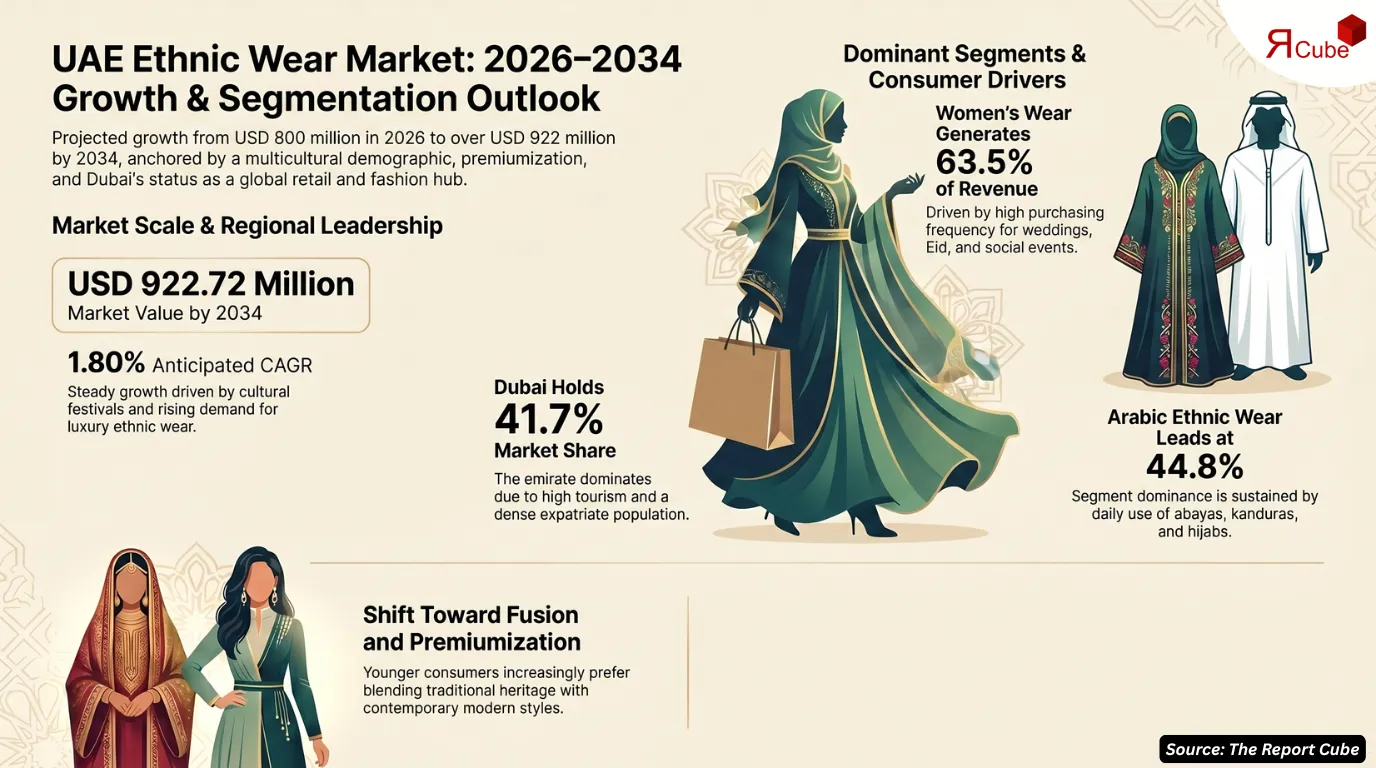
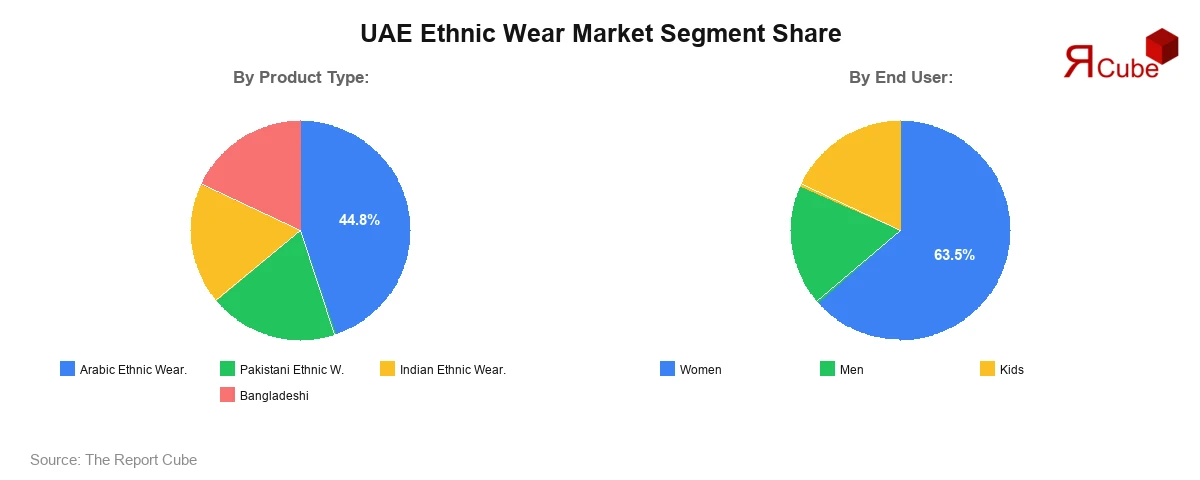
Arabic Ethnic Wear segment leads the market with nearly 44.8% share.
By End User:
Women segment dominates the market with around 63.5% of revenue.
Regional Outlook:
Dubai region dominates the UAE Ethnic Wear Market with approximately 41.7% share.
UAE Ethnic Wear Market Insights & Analysis
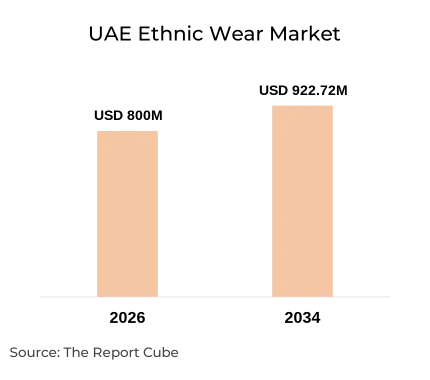
The UAE Ethnic Wear Market is anticipated to register a CAGR of around 1.80% during the forecast period 2026-2034. The market size is valued at USD 800 million in 2026 and is projected to reach USD 922.72 million by 2034. Demand for ethnic apparel in the UAE remains closely tied to the country's multicultural demographic structure, where Emirati nationals, South Asian expatriates, and international residents collectively support year-round consumption of traditional clothing. Arabic ethnic wear continues to account for a substantial share of retail sales due to everyday use of abayas, kanduras, hijabs, and jalabiyas, while Indian and Pakistani garments maintain strong demand during weddings, religious celebrations, and cultural gatherings. Retailers across Dubai and Abu Dhabi have expanded their ethnic wear assortments to cater to consumers seeking premium craftsmanship, customized tailoring, and occasion-specific fashion.
Market expansion is further supported by the UAE's position as a regional fashion, tourism, and trade center. Large-scale retail developments, luxury shopping destinations, and international fashion events continue to attract global brands and designers. The growing popularity of premium ethnic wear, fusion fashion, and designer collections has created additional revenue opportunities across organized retail channels. Recent investments by regional and international apparel companies, combined with infrastructure projects such as Bharat Mart in Dubai and the expansion plans announced by Gul Ahmed Textile Mills, are expected to strengthen sourcing capabilities and improve product availability. These developments reinforce the UAE's role as a gateway for ethnic fashion across the Middle East and wider GCC region.
UAE Ethnic Wear Market Impact Analysis
| Factor | Type | Specific Impact on Market | Magnitude | Business Implication |
|---|---|---|---|---|
| Cultural Festivals and Events | Market | Seasonal demand peaks for abayas and traditional outfits | High | Requires festive collections and agile inventory planning |
| Rising Expat and Diaspora Base | Consumer | Diverse communities sustain demand for varied ethnic styles | High | Supports multi-ethnic ranges and targeted micro assortments |
| Shift Toward Fusion and Modest Fashion | Market | Consumers prefer blends of traditional cuts with modern designs | Medium | Encourages design innovation and capsule fusion collections |
| Growth of E-commerce and Social Commerce | Technological | Online channels expand reach beyond malls and souks | High | Demands strong omnichannel, digital marketing, and logistics |
| Heritage and Craft Promotion Policies | Regulatory | Support for local artisans raises interest in crafted apparel | Medium | Enables branding around craftsmanship and premium pricing |
| Sustainability and Conscious Consumption | Environmental | Growing concern about ethical sourcing in fashion choices | Medium | Drives adoption of eco fabrics and transparent supply chains |
| Competition from Global Fashion Brands | Competitive | International labels contest wallet share in apparel spend | Medium | Needs clear ethnic positioning and differentiated experience |
UAE Ethnic Wear Market Dynamics
Key Driver: Cultural Celebrations and Premium Fashion Spending Strengthen Market Demand
Ethnic wear purchasing in the UAE is strongly influenced by cultural traditions, religious observances, and family-oriented celebrations. Events such as Eid, Ramadan, Diwali, weddings, and community festivals generate recurring demand for traditional apparel across multiple ethnic groups. Households increasingly allocate higher budgets toward occasion wear, particularly within women's fashion categories where embroidered abayas, designer sarees, lehengas, and luxury salwar suits remain highly sought after. The growing preference for exclusive designs and premium fabrics has elevated average transaction values across both physical stores and digital platforms.
The market also benefits from the UAE's affluent consumer base and strong tourism sector. Visitors frequently purchase ethnic apparel as part of cultural shopping experiences, particularly in Dubai's major retail districts. Retailers have responded by introducing limited-edition collections, bespoke tailoring services, and designer collaborations that appeal to consumers seeking individuality and craftsmanship. This shift toward premiumization continues to strengthen revenue generation across the UAE ethnic clothing sector.
Industry Trends: Fusion Fashion Gains Strong Acceptance Among Younger Consumers
Fashion preferences within the UAE are evolving as consumers increasingly seek garments that blend traditional heritage with contemporary styling. Designers are introducing collections that combine classic ethnic elements with modern cuts, lightweight fabrics, and versatile silhouettes suitable for both formal and casual settings. Indo-Western outfits, contemporary abayas, embroidered kaftans, and luxury modest-fashion collections are experiencing growing adoption among younger professionals and fashion-conscious consumers.
Dubai Fashion Week and similar industry platforms have accelerated the visibility of cross-cultural fashion concepts by bringing together regional and international designers. Luxury ethnic brands are increasingly incorporating Middle Eastern influences into South Asian apparel, while Arabic fashion labels are experimenting with global design aesthetics. This trend has expanded product diversity and encouraged retailers to develop collections that cater to multicultural tastes, creating new opportunities across premium and luxury market segments.
Book your FREE 30-minute expert consultation today
Contact UsMajor Challenge: Market Fragmentation Intensifies Competitive Pressure
The UAE ethnic wear industry operates within a highly competitive retail environment characterized by the presence of local boutiques, international fashion houses, designer labels, independent retailers, and online sellers. Consumers have access to a broad range of products across different price categories, making it difficult for brands to maintain differentiation solely through traditional product offerings. Price-sensitive buyers often compare multiple retailers before making purchases, increasing competitive pressure across mass-market segments.
Fashion businesses must also manage fluctuating sourcing costs, seasonal inventory requirements, and rapidly changing style preferences. Maintaining product freshness while controlling operational expenses remains a key challenge for retailers. Companies that fail to align collections with evolving consumer expectations may experience slower sales cycles, particularly as digital commerce expands and customers gain greater access to global fashion alternatives.
Opportunity: Trade Infrastructure and E-commerce Expansion Create New Growth Avenues
The continued development of the UAE's retail and logistics infrastructure presents significant opportunities for ethnic wear brands. The construction of Bharat Mart in Dubai is expected to improve market access for Indian apparel exporters while enhancing supply-chain efficiency for ethnic fashion retailers. Similar investments in warehousing, distribution, and sourcing capabilities are expected to strengthen product availability and reduce operational bottlenecks across the sector.
Online retail continues to reshape purchasing behavior by allowing consumers to access wider product selections and international brands from a single platform. Ethnic fashion retailers are increasingly investing in digital storefronts, virtual styling services, and omnichannel strategies to enhance customer engagement. As internet penetration, mobile commerce adoption, and cross-border retail activity continue to increase, e-commerce is expected to become an increasingly important contributor to UAE ethnic wear market growth throughout the forecast period.
UAE Ethnic Wear Market Segment-wise Analysis
By Product Type:
- Arabic Ethnic Wear
- Abayas
- Kanduras
- Kaftans and Jalabiyas
- Hijabs
- Others
- Pakistani Ethnic Wear
- Salwar Kameez
- Anarkali Suits
- Lawn Suits
- Sharara and Gharara Sets
- Dupattas
- Indian Ethnic Wear
- Sarees
- Lehenga Choli
- Kurta Sets
- Sherwanis
- Indo-Western Fusion Wear
- Bangladeshi
Arabic Ethnic Wear is projected to account for approximately 44.8% of the UAE Ethnic Wear Market in 2026, making it the largest product category. Daily cultural relevance, widespread adoption across the Emirati population, and growing demand for premium modest fashion continue to support segment leadership. Abayas remain the highest-selling category, with consumers increasingly favoring customized designs, luxury embellishments, and premium fabrics such as silk blends and high-quality crepe materials. Demand for kanduras, hijabs, kaftans, and jalabiyas also remains robust across both traditional and contemporary fashion segments.
Retailers have expanded premium collections to address rising consumer interest in designer modest wear. Boutique labels and established fashion houses are introducing seasonal collections featuring modern silhouettes while preserving cultural authenticity. Industry estimates indicate that premium and luxury Arabic ethnic apparel now contributes more than one-third of total Arabic wear revenues in major urban centers such as Dubai and Abu Dhabi. Continued innovation in design, fabric quality, and personalization is expected to support sustained growth within the segment.
By End User:
- Women
- Men
- Kids
Women account for an estimated 63.5% of total UAE ethnic wear revenue, maintaining a dominant position within the market. The segment benefits from extensive product diversity spanning abayas, sarees, lehengas, salwar suits, fusion wear, and luxury occasion apparel. Female consumers generally demonstrate higher purchasing frequency, particularly during festive seasons, weddings, and social events. Demand is further supported by increasing interest in premium fabrics, customized tailoring, and designer collections that reflect both cultural heritage and contemporary fashion preferences.
Luxury ethnic wear has emerged as a particularly strong growth area among affluent consumers in Dubai and Abu Dhabi. Fashion-conscious buyers increasingly seek unique designs that combine traditional craftsmanship with modern aesthetics. Retailers have responded through exclusive capsule collections, influencer collaborations, and enhanced digital shopping experiences. These factors continue to strengthen women's contribution to overall market revenue and reinforce the segment's leadership position.
Regional Projection of UAE Ethnic Wear Industry
- Abu Dhabi
- Dubai
- Sharjah
- Northern Emirates
Dubai is expected to hold approximately 41.7% of the UAE Ethnic Wear Market, making it the leading regional market during the forecast period. The emirate's large expatriate population, thriving tourism industry, and position as the country's primary retail destination collectively support strong demand for ethnic apparel. South Asian communities residing in Dubai contribute significantly to purchases of sarees, lehengas, salwar suits, sherwanis, and fusion-fashion garments, while demand for Arabic ethnic wear remains consistently high among local consumers.
The region benefits from an advanced retail ecosystem that includes luxury malls, fashion districts, designer boutiques, and specialized ethnic wear stores. Dubai Fashion Week and related industry events continue to attract international designers and fashion investors, strengthening the city's reputation as a regional style hub. Infrastructure projects, international trade connectivity, and strong consumer spending patterns further enhance Dubai's leadership within the UAE ethnic clothing sector and support long-term market expansion.
Need insights for a specific region within this market?
Request Regional DataUAE Ethnic Wear Market Regional Analysis
The UAE ethnic wear market varies by emirate, shaped by expat mix, tourism, and traditional Emirati dress adoption patterns.
| Cluster | Demand Level | Key Areas | System Dominance | Core Demand Logic | Growth Nature |
|---|---|---|---|---|---|
| Abu Dhabi | High | Al Wahda, Downtown, Khalidiya | Abayas, kanduras, Indo-ethnic | Local families and South Asian expats | Stable, festival-led upgrade cycles |
| Dubai | Very High | Bur Dubai, Deira, Jumeirah | Abayas, Indo-Pak bridal, fusion | Tourism, fashion hubs, dense expat base | Fastest, trend-driven premiumization |
| Sharjah | High | Rollah, Al Nahda, industrial belt | Value abayas, kurtas, modestwear | Price-aware families, daily wear demand | Volume-led, price-sensitive growth |
| Northern Emirates | Medium | Ajman, RAK, Fujairah, UAQ | Basic abayas, jalabiyas, casual sets | Smaller markets with omni-channel reach | Gradual rise via e‑commerce and malls |
Government Initiatives & Policies
- Dubai Fashion Week and Dubai Design District (d3) Support Program: Dubai authorities continue supporting fashion-sector development through Dubai Design District and Dubai Fashion Week, strengthening opportunities for regional designers, retailers, and fashion entrepreneurs while enhancing global market visibility.
- Fashion Futures Dubai Initiative (2025-2026): Supported through partnerships involving Dubai Design District, the initiative promotes sustainable fashion, innovation, investment, and international collaboration, creating long-term growth opportunities for fashion and ethnic apparel businesses.
UAE Ethnic Wear Industry Recent Developments
- 2026: Gul Ahmed Textile Mills announced plans to expand its UAE operations through enhanced warehousing, distribution capabilities, a product development center, design studio, and exhibition facility. The initiative is expected to strengthen access to premium consumers, improve product availability, and accelerate the company's regional growth strategy.
- 2025: DP World commenced construction of Bharat Mart in Dubai's Jebel Ali Free Zone. The project will provide extensive showroom, warehousing, and trade infrastructure that can improve sourcing efficiency for Indian ethnic apparel brands and strengthen the UAE's position as a regional fashion distribution hub.
- 2025: Manish Malhotra unveiled “The World Collection: Dubai” during Dubai Fashion Week, blending Indian craftsmanship with contemporary global designs and Middle Eastern influences. The launch highlighted increasing demand for luxury ethnic wear, fusion fashion, and premium occasion apparel across the UAE.
Why Choose This Report?
- Provides a comprehensive overview of the overall market analysis, encompassing key trends, consumer behavior analysis, and risk assessment to support strategic decision-making.
- Provides accurate, up-to-date insights into market size, segmentation, and emerging opportunities, helping to minimize risk & capitalizing on growth.
- Gives deep understanding of target audience preferences, investment habits, and communication channels for enhanced product development & marketing effectiveness.
- Delivers competitive analysis & benchmarking, uncovering the strengths & weaknesses of market competitors to guide strategies.
- Consolidate comprehensive market intelligence, reducing reasoning & streamlining research efforts.
- Facilitates customized market segmentation & risk mitigation strategies, fine-tuned to the business objectives.
- Aids in identifying both market challenges & untapped opportunities within the industry to drive long-term business growth.
- Provides valuable information based on actual customer data & search trends.
Table of Contents
- Introduction
- Objective of the Study
- Product and Category Definition
- Market Segmentation
- Study Variables
- Research Methodology
- Secondary Data Points
- Breakdown of Secondary Sources
- Primary Data Points
- Breakdown of Primary Interviews
- Secondary Data Points
- Executive Summary
- Market Dynamics
- Emerging Opportunities
- Adoption Trends
- Demand Drivers
- Disruption Analysis (Challenges)
- Industry Analysis and Strategic Insights
- Supply and Value Chain Analysis
- Pricing Analysis
- Go-to-Market Strategy
- BCG Matrix
- Recent Trends and Developments
- Import and Export Analysis
- Regulatory and Policy Landscape
- Region-wise Policies
- Government Initiatives
- UAE Ethnic Wear Market Overview and Forecast Analysis (2021-2034)
- Market Size, by Value, by Growth Rate (CAGR/USD Billion)
- Market Share, by Product Type
- Arabic Ethnic Wear
- Abayas
- Kanduras
- Kaftans and Jalabiyas
- Hijabs
- Others
- Pakistani Ethnic Wear
- Salwar Kameez
- Anarkali Suits
- Lawn Suits
- Sharara and Gharara Sets
- Dupattas
- Indian Ethnic Wear
- Sarees
- Lehenga Choli
- Kurta Sets
- Sherwanis
- Indo-Western Fusion Wear
- Bangladeshi
- Arabic Ethnic Wear
- Market Share, by Fabric Type
- Cotton
- Silk
- Chiffon
- Linen
- Blended and Synthetic Fabrics
- Market Share, by Price Range (USD Billion/Million)
- Up to USD 15
- USD 15-30
- USD 31-70
- USD 71-140
- Above USD 140
- Premium and Luxury
- Market Share, by End User
- Women
- Men
- Kids
- Market Share, by Market Structure
- Organized
- Unorganized
- Market Share, by Seasonality
- Eid
- Diwali
- Navratri
- Wedding Cycles
- Market Share, by Distribution Channel
- Offline Retail
- Malls
- Boutiques
- Designer Stores
- Others
- Online Retail
- E-commerce Platforms
- Brand Websites
- Offline Retail
- Market Share, by Region
- Abu Dhabi
- Dubai
- Sharjah and Northern Emirates
- Market Share, by Company
- Revenue Shares and Analysis
- Competitive Landscape
- Abu Dhabi Ethnic Wear Market Overview and Forecast Analysis (2021-2034)
- Market Size, by Value, by Growth Rate (CAGR/USD Billion/Million)
- Market Share, by Product Type
- Market Share, by Fabric Type
- Market Share, by Price Range
- Market Share, by End User
- Market Share, by Market Structure
- Market Share, by Seasonality
- Market Share, by Distribution Channel
- Dubai Ethnic Wear Market Overview and Forecast Analysis (2021-2034)
- Market Size, by Value, by Growth Rate (CAGR/USD Billion/Million)
- Market Share, by Product Type
- Market Share, by Fabric Type
- Market Share, by Price Range
- Market Share, by End User
- Market Share, by Market Structure
- Market Share, by Seasonality
- Market Share, by Distribution Channel
- Sharjah and Northern Emirates Ethnic Wear Market Overview and Forecast Analysis (2021-2034)
- Market Size, by Value, by Growth Rate (CAGR/USD Billion/Million)
- Market Share, by Product Type
- Market Share, by Fabric Type
- Market Share, by Price Range
- Market Share, by End User
- Market Share, by Market Structure
- Market Share, by Seasonality
- Market Share, by Distribution Channel
- Competitive Analysis, 2026
- Market Share of Key Players
- Competitive Mapping for Each Product Type and Companies Operating Regionally
- Abu Dhabi Ethnic Wear Companies Share and Competitive Analysis, 2026
- Dubai Ethnic Wear Companies Share and Competitive Analysis, 2026
- Sharjah and Northern Emirates Ethnic Wear Companies Share and Competitive Analysis, 2026
- Company Profile (Partial List)
- Khaadi
- Company Overview
- Product Portfolio
- Strategic Alliances and Partnerships
- Recent Developments
- Al Jaber Gallery
- Company Overview
- Product Portfolio
- Strategic Alliances and Partnerships
- Recent Developments
- Manyavar Mohey
- Company Overview
- Product Portfolio
- Strategic Alliances and Partnerships
- Recent Developments
- Bossini Ethnic Line
- Company Overview
- Product Portfolio
- Strategic Alliances and Partnerships
- Recent Developments
- Sana Safinaz
- Company Overview
- Product Portfolio
- Strategic Alliances and Partnerships
- Recent Developments
- Ritu Kumar
- Company Overview
- Product Portfolio
- Strategic Alliances and Partnerships
- Recent Developments
- Al Hamra Fashion
- Company Overview
- Product Portfolio
- Strategic Alliances and Partnerships
- Recent Developments
- W for Woman (TCNS Clothing)
- Company Overview
- Product Portfolio
- Strategic Alliances and Partnerships
- Recent Developments
- Reem Al Kanani
- Company Overview
- Product Portfolio
- Strategic Alliances and Partnerships
- Recent Developments
- Nalli Silk Sarees
- Company Overview
- Product Portfolio
- Strategic Alliances and Partnerships
- Recent Developments
- Kalyan Silks
- Company Overview
- Product Portfolio
- Strategic Alliances and Partnerships
- Recent Developments
- Gul Ahmed Textile Mills
- Company Overview
- Product Portfolio
- Strategic Alliances and Partnerships
- Recent Developments
- Meena Bazaar Multi-Brand Retailers
- Company Overview
- Product Portfolio
- Strategic Alliances and Partnerships
- Recent Developments
- Others (Partial List)
- Khaadi
- Contact Us and Disclaimer
Top Key Players & Market Share Outlook
- Khaadi (Pakistan)
- Al Jaber Gallery (UAE, Arabic Wear)
- Manyavar Mohey (India)
- Bossini Ethnic Line
- Sana Safinaz (Pakistan)
- Ritu Kumar
- Al Hamra Fashion (UAE)
- W for Woman (TCNS Clothing)
- Reem Al Kanani (UAE, Abaya Designer)
- Nalli Silk Sarees
- Kalyan Silks
- Gul Ahmed Textile Mills (Pakistan)
- Meena Bazaar Multi-Brand Retailers
Frequently Asked Questions






