



Build Your Custom Market Intelligence Report
Customize Your ReportGlobal Flow Cytometry Market Insights & Analysis
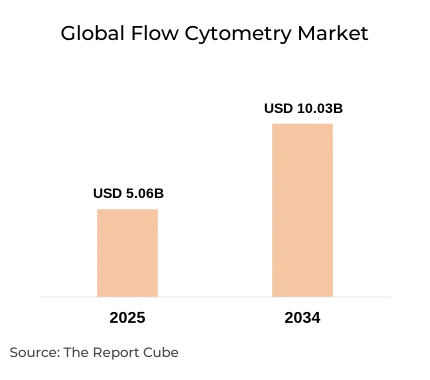
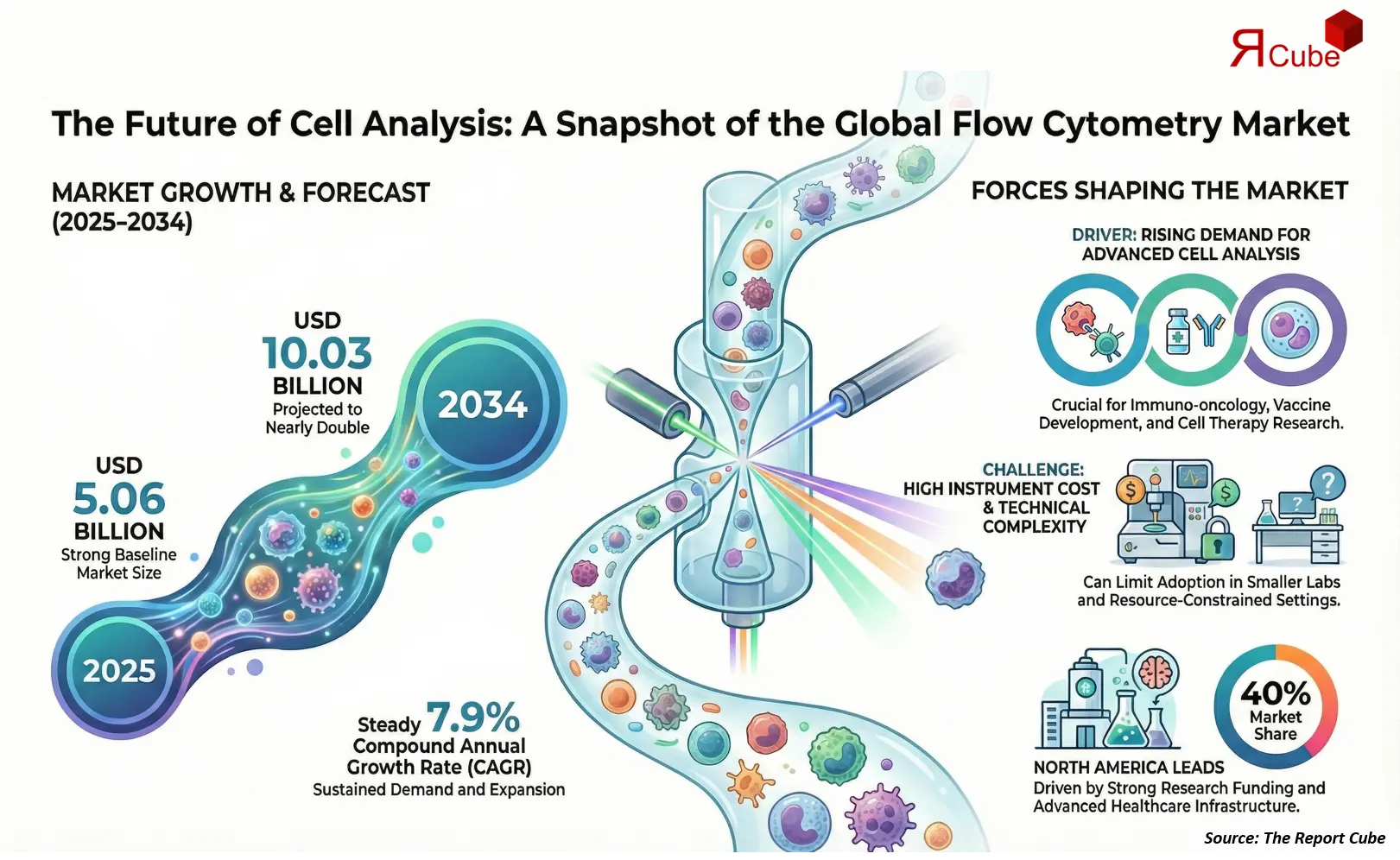
The Global Flow Cytometry Market is anticipated to register a CAGR of 7.9% during the forecast period 2026-2034. The market size was valued at USD 5.06 Billion in 2025 and is projected to reach USD 10.03 Billion by 2034. This steady growth reflects the expanding role of flow cytometry as a core analytical technology in life sciences, clinical diagnostics, immunology, oncology, and pharmaceutical research. Flow cytometry enables rapid, multiparametric analysis of individual cells, making it indispensable for understanding complex biological processes, disease mechanisms, and therapeutic responses.
The market is benefiting from rising investments in biomedical research, increasing prevalence of chronic and infectious diseases, and growing demand for advanced diagnostic and monitoring tools. Flow cytometry is widely used in applications such as immunophenotyping, cell sorting, apoptosis analysis, and biomarker discovery. The technology’s ability to deliver high-throughput, quantitative, and reproducible results supports its adoption across academic research institutes, hospitals, clinical laboratories, and biopharmaceutical companies. As precision medicine and personalized therapies gain momentum, flow cytometry continues to evolve as a critical platform for both research and clinical decision-making.
Global Flow Cytometry Market Recent Developments
- 2025: Becton Dickinson introduced advanced high-parameter flow cytometry systems to support immunology and oncology research.
- 2025: Cytek Biosciences expanded its spectral flow cytometry portfolio to enable deeper cellular profiling.
Government Initiatives & Policies
- U.S. NIH Biomedical Research Funding: Supports advanced analytical technologies including flow cytometry.
- EU Horizon Europe Program: Funds life sciences and clinical research infrastructure adoption.
Global Flow Cytometry Market Dynamics
Key Driver: Rising Demand for Advanced Cell Analysis in Research and Diagnostics
The primary driver of the global flow cytometry market is the increasing demand for advanced cell analysis tools across research and clinical diagnostics. Flow cytometry allows simultaneous measurement of multiple cellular parameters, enabling detailed characterization of immune cells, cancer cells, and stem cells. The growing focus on immuno-oncology, vaccine development, and cell and gene therapies has significantly increased the need for precise and high-throughput cellular analysis. Additionally, flow cytometry plays a vital role in clinical diagnostics for hematological malignancies, HIV monitoring, and immune disorders, reinforcing sustained market demand.
Major Challenge: High Cost and Technical Complexity
A major challenge facing the flow cytometry market is the high cost of instruments and the technical expertise required for operation and data interpretation. Advanced flow cytometers, particularly cell sorters and high-parameter systems, involve substantial capital investment and ongoing maintenance costs. Additionally, skilled personnel are required to design experiments, operate instruments, and analyze complex datasets. These factors can limit adoption in smaller laboratories and resource-constrained settings. Vendors are addressing this challenge through automation, user-friendly software, and service-based models, but cost and complexity remain key barriers.
Industry Trends: High-Parameter and Spectral Flow Cytometry
An important trend shaping the flow cytometry market is the shift toward high-parameter and spectral flow cytometry technologies. These systems enable simultaneous analysis of 30 or more cellular markers, providing deeper insights into cellular heterogeneity and immune responses. Spectral flow cytometry, in particular, improves resolution and flexibility by capturing full emission spectra rather than discrete channels. This trend is expanding the application scope of flow cytometry in systems biology, immunotherapy research, and biomarker discovery.
Opportunity Ahead: Clinical Adoption and Emerging Markets
Significant growth opportunities exist in expanding clinical applications and adoption in emerging markets. Flow cytometry is increasingly being integrated into routine clinical workflows for cancer diagnosis, transplant monitoring, and infectious disease management. In parallel, growing healthcare investment and research infrastructure development in Asia Pacific, Latin America, and parts of the Middle East are creating new demand. Portable, cost-effective systems and reagent-driven revenue models offer pathways to broaden market penetration and long-term growth.
Global Flow Cytometry Market Segment-wise Analysis
By Product:
- Instruments (Analyzers, Sorters, Accessories and Replaceable Components)
- Reagents and Consumables
- Software
- Services
Instruments represent the largest product segment, accounting for approximately 44% of total market revenue in 2025. Analyzers are widely used in research and clinical laboratories, while cell sorters support advanced applications such as cell therapy and stem cell research. Reagents and consumables form a substantial recurring revenue stream due to continuous usage in routine testing. Software and services are growing steadily as laboratories seek advanced data analysis, workflow optimization, and technical support.
By Technology:
- Cell Based Flow Cytometry
- Bead Based Flow Cytometry
Cell-based flow cytometry dominates the market, contributing nearly 72% of total revenue in 2025. This technology is essential for direct analysis of cells in immunology, oncology, and hematology applications. Bead-based flow cytometry is gaining traction for multiplex assays and biomarker detection, particularly in cytokine profiling and immunoassays. Its ability to analyze multiple analytes simultaneously supports growing adoption in translational research and clinical studies.
Regional Projection of Global Flow Cytometry Industry
- North America
- Europe
- Asia Pacific
- Middle East and Africa
- South America
North America leads the global flow cytometry market, accounting for approximately 40% of total revenue in 2025. The region benefits from strong research funding, advanced healthcare infrastructure, and early adoption of innovative technologies. Europe follows, supported by robust academic research and clinical diagnostics adoption. Asia Pacific is the fastest-growing region due to expanding biotechnology industries, increasing healthcare investment, and rising disease burden. The Middle East and Africa and South America present emerging opportunities as research and diagnostic capabilities continue to expand.
Why Choose This Report?
- Provides a comprehensive overview of the flow cytometry market and technology landscape.
- Delivers accurate, up-to-date insights into market size, segmentation, and growth opportunities.
- Offers deep understanding of research and clinical applications of flow cytometry.
- Presents competitive analysis & benchmarking of leading global manufacturers.
- Consolidates market intelligence to support strategic planning and investment decisions.
- Supports customized segmentation and regional market assessment.
- Identifies challenges and untapped opportunities in advanced cell analysis.
- Grounded in real-world research trends, clinical adoption, and technology innovation.
Table of Contents
- Introduction
- Objective of the Study
- Product and Category Definition
- Market Segmentation
- Study Variables
- Research Methodology
- Secondary Data Points
- Breakdown of Secondary Sources
- Primary Data Points
- Breakdown of Primary Interviews
- Secondary Data Points
- Executive Summary
- Market Dynamics
- Drivers
- Challenges
- Opportunity Assessment
- Recent Trends and Developments
- Regulatory and Policy Landscape
- Global Flow Cytometry Market Overview (2020-2034)
- Market Size, By Value (USD Billion)
- Market Share, By Product
- Instruments
- Analyzers
- Sorters
- Accessories and Replaceable Components
- Reagents and Consumables
- Software
- Services
- Instruments
- Market Share, By Technology
- Cell Based Flow Cytometry
- Bead Based Flow Cytometry
- Market Share, By Application
- Research Applications
- Immunology and Immune Profiling
- Cancer and Oncology Research
- Stem Cell Research
- Drug Discovery and Screening
- Others
- Clinical and Diagnostic Applications
- Hematological Malignancies
- HIV and Infectious Diseases
- Transplantation and Immunomonitoring
- Solid Tumors and Minimal Residual Disease
- Others
- Research Applications
- Market Share, By End User
- Academic and Research Institutes
- Hospitals and Clinical Laboratories
- Pharmaceutical and Biotechnology Companies
- Contract Research Organizations
- Others
- Market Share, By Region
- North America
- Europe
- Asia Pacific
- Middle East and Africa
- South America
- Market Share, By Company
- Revenue Shares
- Competitive Landscape
- North America Flow Cytometry Market
- Market Size, By Value (USD Billion)
- Market Share, By Product
- Market Share, By Technology
- Market Share, By Application
- Market Share, By End User
- Market Share, By Country
- United States
- Canada
- Mexico
- Europe Flow Cytometry Market
- Market Size, By Value (USD Billion)
- Market Share, By Product
- Market Share, By Technology
- Market Share, By Application
- Market Share, By End User
- Market Share, By Country
- Germany
- United Kingdom
- France
- Italy
- Spain
- Northern and Nordic Countries
- Rest of Europe
- Asia Pacific Flow Cytometry Market
- Market Size, By Value (USD Billion)
- Market Share, By Product
- Market Share, By Technology
- Market Share, By Application
- Market Share, By End User
- Market Share, By Country
- China
- Japan
- India
- South Korea
- Australia and New Zealand
- Rest of Asia Pacific
- Middle East and Africa Flow Cytometry Market
- Market Size, By Value (USD Billion)
- Market Share, By Product
- Market Share, By Technology
- Market Share, By Application
- Market Share, By End User
- Market Share, By Country
- Saudi Arabia
- United Arab Emirates
- South Africa
- Rest of Middle East and Africa
- South America Flow Cytometry Market
- Market Size, By Value (USD Billion)
- Market Share, By Product
- Market Share, By Technology
- Market Share, By Application
- Market Share, By End User
- Market Share, By Country
- Brazil
- Argentina
- Rest of South America
- Competitive Outlook and Company Profiles
- Becton Dickinson and Company
- Company Overview
- Flow Cytometry Product Portfolio
- Strategic Alliances and Partnerships
- Recent Developments
- Danaher Corporation Beckman Coulter
- Company Overview
- Flow Cytometry Product Portfolio
- Strategic Alliances and Partnerships
- Recent Developments
- Thermo Fisher Scientific
- Company Overview
- Flow Cytometry Product Portfolio
- Strategic Alliances and Partnerships
- Recent Developments
- Bio Rad Laboratories
- Company Overview
- Flow Cytometry Product Portfolio
- Strategic Alliances and Partnerships
- Recent Developments
- Sysmex Corporation
- Company Overview
- Flow Cytometry Product Portfolio
- Strategic Alliances and Partnerships
- Recent Developments
- Agilent Technologies
- Company Overview
- Flow Cytometry Product Portfolio
- Strategic Alliances and Partnerships
- Recent Developments
- Cytek Biosciences
- Company Overview
- Spectral Flow Cytometry Portfolio
- Strategic Alliances and Partnerships
- Recent Developments
- Sony Biotechnology
- Company Overview
- Flow Cytometry Instruments Portfolio
- Strategic Alliances and Partnerships
- Recent Developments
- Luminex Corporation
- Company Overview
- Multiplex and Flow Based Platforms Portfolio
- Strategic Alliances and Partnerships
- Recent Developments
- Miltenyi Biotec
- Company Overview
- Flow Cytometry and Cell Sorting Portfolio
- Strategic Alliances and Partnerships
- Recent Developments
- Others
- Becton Dickinson and Company
- Contact Us and Disclaimer
Top Key Players & Market Share Outlook
- Becton Dickinson and Company
- Danaher Corporation Beckman Coulter
- Thermo Fisher Scientific
- Bio Rad Laboratories
- Sysmex Corporation
- Agilent Technologies
- Cytek Biosciences
- Sony Biotechnology
- Luminex Corporation
- Miltenyi Biotec
- Others
Frequently Asked Questions






