



Build Your Custom Market Intelligence Report
Customize Your ReportU.S. Forensic Genomics Market Key Takeaways
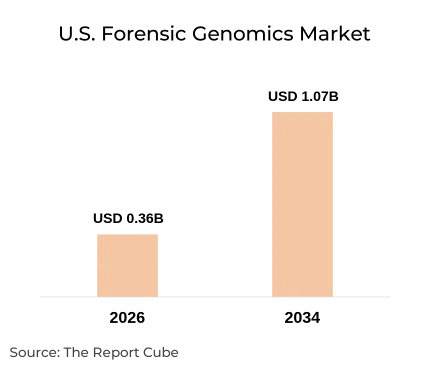
- U.S. Forensic Genomics Market was valued at USD 0.36 billion in 2026.
- Market is projected to reach USD 1.07 billion by 2034 over the forecast period.
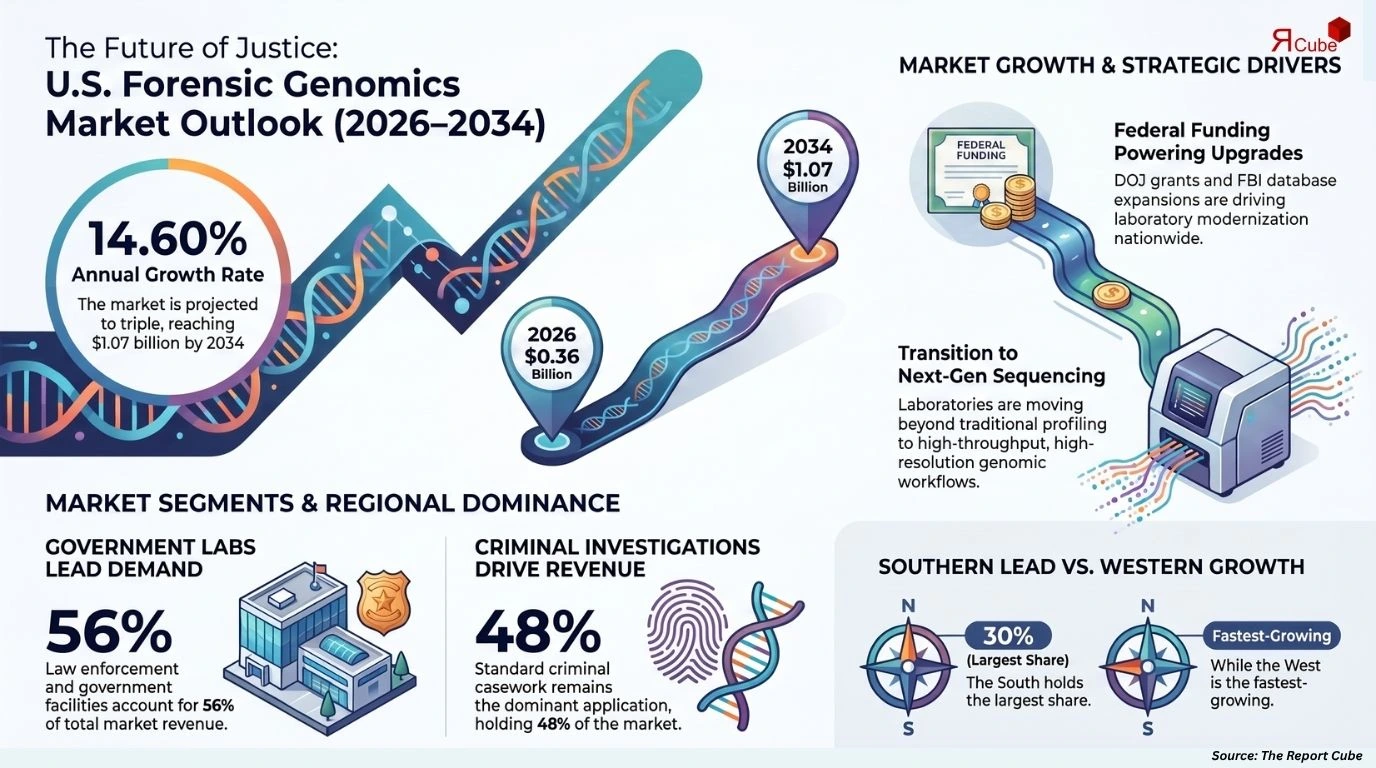
- Industry is anticipated to expand at a 14.60% CAGR during 2026–2034.
- Criminal investigation remains the dominant application driving forensic genomics adoption nationwide.
- Law enforcement and government laboratories lead end-user demand across the United States.
- The West region is emerging as the fastest-growing market for forensic genomics solutions.
- Investigative genetic genealogy is reshaping cold case resolution and victim identification workflows.
- Illumina, Thermo Fisher Scientific, Promega, QIAGEN, and Agilent Technologies lead the competitive landscape.
U.S. Forensic Genomics Market Insights & Analysis
The U.S. Forensic Genomics Market is anticipated to register a 14.60% CAGR during 2026–2034. The market size was valued at USD 0.36 billion in 2026 and is projected to reach USD 1.07 billion by 2034. Sustained growth is being driven by expanding federal DNA database initiatives, increasing adoption of next-generation sequencing platforms across forensic laboratories, and growing judicial recognition of genomic evidence. The Department of Justice has continued to allocate significant funding toward forensic science capacity enhancement, with the Paul Coverdell Forensic Science Improvement Grants program supporting laboratory modernization efforts across states.
Broader adoption of investigative genetic genealogy across law enforcement agencies has transformed the operational scope of forensic genomics beyond traditional STR profiling. Public-sector investments in CODIS database expansion, combined with state-level legislative frameworks supporting familial DNA searches, are reinforcing demand for advanced sequencing instruments and interpretive software. Private forensic laboratories are also scaling capabilities in kinship analysis and disaster victim identification, supporting a diversified revenue base that extends well beyond criminal casework into civil and humanitarian applications.
U.S. Forensic Genomics Market Dynamics
The U.S. Forensic Genomics Market is gaining momentum as law enforcement agencies, forensic service providers, and academic institutions expand their genomic analytical capabilities. Rising demand for high-throughput DNA analysis, decreasing sequencing costs, and growing legislative support for expanded DNA collection and databasing are collectively accelerating market development. Advances in portable sequencing technologies and cloud-based forensic data management are further reshaping operational workflows.
|
Factor |
Type |
Specific Impact on Market |
Magnitude |
|---|---|---|---|
|
CODIS database expansion |
Driver |
Accelerates STR profiling and DNA submission workflows |
Very High |
|
Investigative genetic genealogy adoption |
Opportunity |
Opens new revenue streams for private genomics labs |
High |
|
Next-generation sequencing integration |
Driver |
Improves resolution and throughput in forensic labs |
High |
|
Regulatory frameworks on familial DNA searches |
Challenge |
Restricts application of genealogy tools in several states |
Moderate |
|
Portable and field-deployable sequencing |
Trend |
Enables real-time DNA analysis outside laboratory settings |
High |
Key Market Driver: Federal DNA Database Modernization Initiatives
Ongoing expansion of the Combined DNA Index System and increased federal grant disbursements to state forensic labs are directly accelerating instrument procurement and reagent consumption. The FBI's National DNA Index System processed over 21 million offender profiles as of recent reporting periods, creating sustained demand for high-throughput genotyping consumables and laboratory information management systems. Grants distributed through DOJ forensic science programs incentivize upgrades to next-generation forensic sequencing infrastructure, reinforcing long-term investment cycles across both public and private laboratory networks.
Major Industry Challenge: Jurisdictional Inconsistency in Genealogy Regulations
The absence of a unified federal regulatory framework governing investigative genetic genealogy has created significant operational uncertainty for forensic service providers. While some states have enacted clear statutory guidelines permitting controlled genealogical DNA searches, others have imposed moratoriums or outright bans, fragmenting market access for vendors offering these services. Laboratories operating across state boundaries face compliance complexity that increases operational costs and limits scalable deployment of genealogy-based workflows, constraining the near-term revenue potential of what is otherwise one of the market's highest-growth application segments.
Emerging Trend Shaping Outlook: Field-Deployable Rapid DNA Analysis
Rapid DNA platforms capable of generating CODIS-compatible profiles within two hours are being adopted by booking facilities, military installations, and border security agencies. The FBI's Rapid DNA Program has certified select instruments for direct upload to the National DNA Index System, reducing reliance on centralized laboratory workflows and enabling real-time investigative decisions. Growing federal procurement of portable sequencing units and integration of these platforms into mass disaster response protocols are broadening the addressable market for forensic genomics beyond conventional laboratory environments.
Need Specific Data, Let’s Customize the Report for You
Request CustomizationU.S. Forensic Genomics Market Segment-wise Analysis
The U.S. Forensic Genomics Market spans a wide range of application verticals and end-user categories, reflecting the technology's expanding role across criminal justice, humanitarian identification, and civil proceedings. Vendors offering integrated workflows - from DNA extraction through data interpretation - are increasingly well-positioned to capture multi-segment demand across public and private sector clients.
By Application
- Criminal Investigation
- Investigative Genetic Genealogy
- Paternity & Kinship Testing
- Disaster Victim Identification
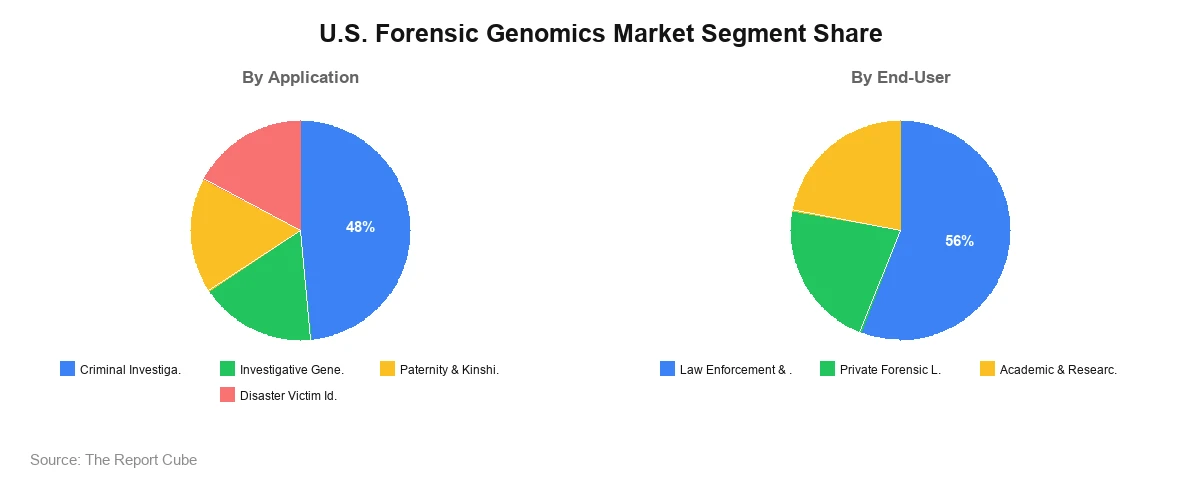
Criminal investigation accounts for an estimated 48% of total application revenue, driven by consistent law enforcement demand for STR profiling, touch DNA analysis, and database matching across federal, state, and local agencies. This segment benefits from mandatory DNA collection laws for felony offenders in all 50 states, continuous CODIS upload requirements, and growing judicial standards that incentivize high-confidence genomic evidence. Capital investments in automated DNA processing equipment within government labs further anchor this segment's revenue share.
Investigative genetic genealogy is the fastest-growing application, gaining traction following high-profile case resolutions and increasing adoption by cold case units. This technique, which combines long-read sequencing with genealogical database cross-referencing, now supports active investigative pipelines across dozens of state agencies. Paternity and kinship testing maintains steady commercial demand through family courts and immigration proceedings, while disaster victim identification capabilities across mass casualty events are expanding through INTERPOL-aligned protocols and mitochondrial DNA reference matching.
By End-User
- Law Enforcement & Government Labs
- Private Forensic Laboratories
- Academic & Research Institutes
Law enforcement and government laboratories represent the dominant end-user segment with approximately 56% of total market revenue, reflecting their role as the primary operational consumers of forensic DNA technologies. These institutions are bound by federal and state submission mandates, creating predictable, recurring demand for genotyping reagents, sequencing instruments, and database integration software. Dedicated federal budget allocations through agencies such as the FBI, DHS, and DOD sustain long-term procurement cycles independent of broader economic fluctuations.
Private forensic laboratories account for a growing share of the market as outsourced forensic services gain acceptance among jurisdictions seeking to reduce backlogs. These labs are increasingly offering forensic kinship and genealogy testing services under contract to state crime labs, enabling faster case turnaround without proportional public investment in infrastructure. Academic and research institutes, while holding a smaller revenue share, play a critical enabling role by developing validated analytical methods, reference population datasets, and novel biomarker panels that subsequently transition into operational workflows.
Regional Projection of U.S. Forensic Genomics Market
The U.S. Forensic Genomics Market exhibits meaningful regional differentiation based on state-level legislative environments, laboratory infrastructure maturity, law enforcement budgets, and the density of forensic service providers. Federal funding distribution also influences regional capacity, with certain states receiving disproportionately higher Paul Coverdell grant allocations tied to case backlog levels and laboratory accreditation status.
|
Region |
Estimated Market Share |
Key Growth Factors |
Consumer Trends |
|---|---|---|---|
|
Midwest |
22% |
Strong government lab networks, university research partnerships |
Increasing cold case reinvestigation programs |
|
West |
28% |
Tech-forward law enforcement agencies, high investigative genealogy adoption |
Rapid DNA platform integration in booking facilities |
|
South |
30% |
Largest regional law enforcement footprint, high CODIS submission volumes |
DNA collection expansion for misdemeanor offenses |
|
Northeast |
20% |
Dense private lab presence, academic genomics ecosystem |
Growing demand for outsourced forensic genomics services |
- South: The South holds the largest regional revenue share at approximately 30%, driven by its extensive law enforcement infrastructure and consistently high CODIS submission volumes across Texas, Florida, Georgia, and North Carolina. Several southern states have broadened DNA collection mandates to include misdemeanor offenders, expanding the volume of samples processed annually.
- West: The West is the fastest-growing regional market, led by California's progressive adoption of investigative genetic genealogy and early integration of Rapid DNA booking systems. Washington and Oregon have established structured genealogy search policies, attracting private forensic service providers to the region and supporting above-average technology adoption rates.
- Midwest: The Midwest benefits from a dense network of state crime laboratories and strong university-industry research partnerships, particularly across Illinois, Ohio, and Michigan. Cold case reinvestigation units in these states are increasingly deploying long-read sequencing platforms to reprocess legacy biological evidence.
- Northeast: The Northeast hosts a high concentration of private forensic laboratories and world-class academic genomics programs, particularly in Massachusetts, New York, and Pennsylvania. Outsourcing of forensic DNA analysis by municipal crime labs to accredited private providers is an accelerating trend, supporting growth among commercial market participants.
U.S. Forensic Genomics Market: Recent Development (2025)
- Illumina launched an enhanced forensic sequencing panel supporting investigative genetic genealogy workflows across certified labs.
- Thermo Fisher Scientific expanded its RapidHIT ID platform with upgraded consumables targeting U.S. law enforcement booking facilities.
- Promega Corporation entered a supply agreement with a major federal agency for forensic STR genotyping reagent kits.
- QIAGEN introduced an automated DNA extraction solution validated for low-template touch DNA forensic applications nationwide.
U.S. Forensic Genomics Market Future Outlook (2034)
The U.S. Forensic Genomics Market is projected to expand at a 14.60% CAGR, reaching approximately USD 1.07 billion by 2034. Growth will be shaped by continued federal investment in DNA database modernization, broader legislative authorization of investigative genetic genealogy, and accelerating integration of next-generation sequencing into routine casework. Advances in single-cell genomics, phenotypic prediction from DNA, and AI-assisted genealogical search algorithms will expand the evidentiary value of biological evidence and open new application pathways across civil, criminal, and humanitarian identification sectors.
Long-term market expansion will be supported by increasing adoption of cloud-based laboratory information management systems, automated evidence tracking platforms, and population reference databases that improve the statistical power of forensic DNA interpretations. As instrument costs continue declining and portable sequencing solutions mature, forensic genomics capabilities will extend beyond centralized crime labs into field environments, military applications, and international disaster response operations. Vendors offering end-to-end integrated workflows - from sample collection through courtroom-ready reporting - will be best positioned to capture the full scope of this expanding market opportunity.
U.S. Forensic Genomics Market Report Coverage
|
Report Attribute |
Details |
|---|---|
|
Market Name |
U.S. Forensic Genomics Market |
|
Market Size (2026) |
USD 0.36 Billion |
|
Market Size (2034) |
USD 1.07 Billion |
|
Forecast Period |
2026–2034 |
|
CAGR |
14.60% |
|
Base Year |
2026 |
|
Historical Years |
2021–2025 |
|
Forecast Years |
2026–2034 |
|
Segments Covered |
By Application, By End-User, By Technology¸ By Product & Service |
|
Regions Covered |
Midwest, West, South, Northeast |
|
Key Companies |
Illumina Inc., Thermo Fisher Scientific Inc., Promega Corporation, QIAGEN, Agilent Technologies, Others |
|
Report Format |
PDF, Excel, PPT |
|
Customization |
Available as per client requirements |
Why Choose This Report?
- Comprehensive analysis covering all forensic genomics application segments and end-users.
- Accurate market sizing with a reliable forecast through 2034.
- Detailed regional breakdown across all four major U.S. geographic zones.
- Insight into federal funding programs shaping laboratory procurement decisions.
- Competitive profiling of leading forensic genomics vendors and their recent developments.
- Analysis of investigative genetic genealogy regulatory landscape and market impact.
- Data-driven research aligned with current law enforcement and judicial trends.
- Strategic insights supporting investment, product development, and go-to-market planning.
Table of Contents
- Introduction
- Objective of the Study
- Product Definition
- Market Segmentation
- Study Variables
- Research Methodology
- Secondary Data Points
- Companies Interviewed
- Primary Data Points
- Breakdown of Primary Interviews
- Secondary Data Points
- Executive Summary
- Market Dynamics
- Drivers
- Challenges
- Opportunity Assessment
- Recent Trends and Developments
- Policy and Regulatory Landscape
- U.S Forensic Genomics Market Overview and Forecast Analysis (2021-2034)
- Market Size, By Value, By Growth Rate (CAGR/USD Billions)
- Demand – Supply Trends
- Market Share, By Product & Service
- Kits & Reagents
- Instruments
- Software & Analytics
- Services
- Market Share, By Technology
- Capillary Electrophoresis
- Next-Generation Sequencing
- Polymerase Chain Reaction
- Market Share, By Application
- Criminal Investigation
- Investigative Genetic Genealogy
- Paternity & Kinship Testing
- Disaster Victim Identification
- Market Share, By End-User
- Law Enforcement & Government Labs
- Private Forensic Laboratories
- Academic & Research Institutes
- Market Share, By Region
- Midwest
- West
- South
- Northeast
- Market Share, By Competitors
- Competition Characteristics
- Revenue Shares
- Kits & Reagents U.S Forensic Genomics Market Overview, 2021-2034F
- By Value (USD Million)
- By Technology – Market Size & Forecast 2021-2034, USD Million
- Capillary Electrophoresis
- Next-Generation Sequencing
- Polymerase Chain Reaction
- Instruments U.S Forensic Genomics Market Overview, 2021-2034F
- By Value (USD Million)
- By Technology – Market Size & Forecast 2021-2034, USD Million
- Capillary Electrophoresis
- Next-Generation Sequencing
- Polymerase Chain Reaction
- Software & Analytics U.S Forensic Genomics Market Overview, 2021-2034F
- By Value (USD Million)
- By Technology – Market Size & Forecast 2021-2034, USD Million
- Capillary Electrophoresis
- Next-Generation Sequencing
- Polymerase Chain Reaction
- Services U.S Forensic Genomics Market Overview, 2021-2034F
- By Value (USD Million)
- By Technology – Market Size & Forecast 2021-2034, USD Million
- Capillary Electrophoresis
- Next-Generation Sequencing
- Polymerase Chain Reaction
- Competitive Outlook (Company Profile – Partial List)
- Illumina Inc.
- Company Overview
- Business Segments
- Strategic Alliances/Partnerships
- Recent Developments
- Thermo Fisher
- Company Overview
- Business Segments
- Strategic Alliances/Partnerships
- Recent Developments
- Scientific Inc.
- Company Overview
- Business Segments
- Strategic Alliances/Partnerships
- Recent Developments
- Promega Corporation
- Company Overview
- Business Segments
- Strategic Alliances/Partnerships
- Recent Developments
- QIAGEN
- Company Overview
- Business Segments
- Strategic Alliances/Partnerships
- Recent Developments
- Agilent Technologies
- Company Overview
- Business Segments
- Strategic Alliances/Partnerships
- Recent Developments
- Others
- Illumina Inc.
- Contact Us & Disclaimer
Top Key Players & Market Share Outlook
- Illumina Inc.
- Thermo Fisher
- Scientific Inc.
- Promega Corporation
- QIAGEN
- Agilent Technologies
- Others
Frequently Asked Questions






