



Build Your Custom Market Intelligence Report
Customize Your ReportSaudi Arabia Forklift Rental Market Insights & Analysis
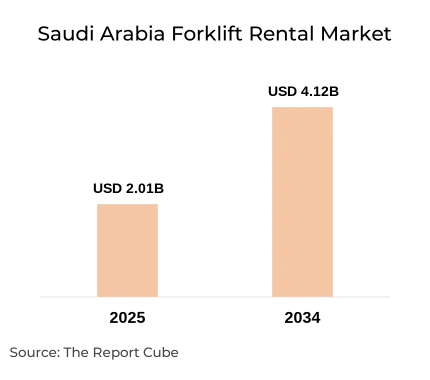
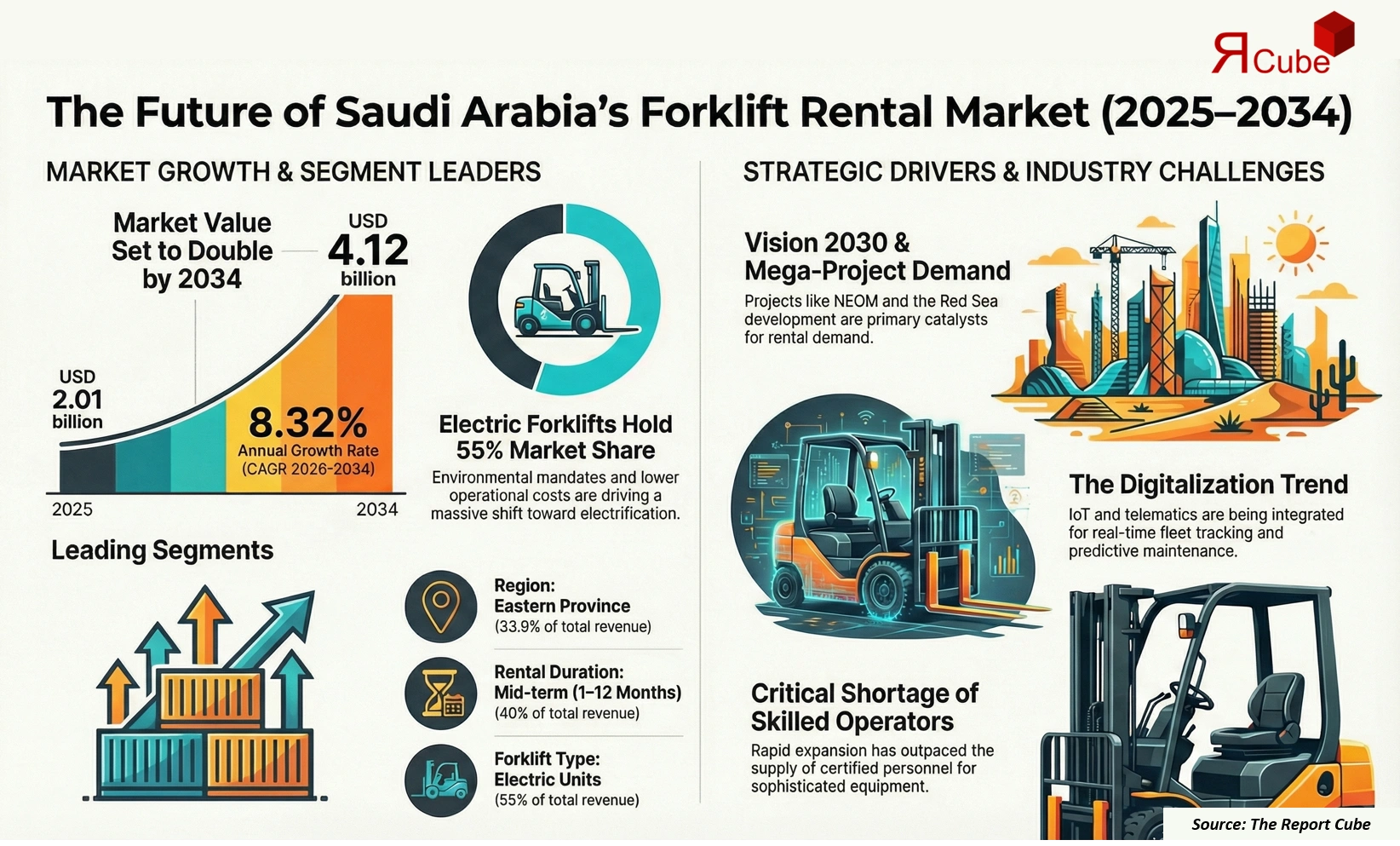
The Saudi Arabia Forklift Rental Market is anticipated to register an 8.32% CAGR during 2026–2034. The market size was valued at USD 2.01 Billion in 2025 and is projected to reach USD 4.12 Billion by 2034. This robust growth reflects the increasing preference for flexible rental solutions over capital-intensive purchases across logistics, warehousing, construction, and manufacturing sectors. The Kingdom’s ongoing investment in logistics infrastructure, smart supply chain development and mega-project rollouts under Saudi Vision 2030 are accelerating demand for material handling equipment including forklifts, which are integral to efficient operations across these industries.
Forklift Rental Market Recent Developments
- 2025: Unique Group opened a new service hub in Dammam to support offshore and industrial clients faster.
- 2025: Gulf mega-projects like NEOM & Red Sea have sharply increased demand for forklifts in rental fleets.
Government Initiatives & Policies
- Vision 2030 – National Industrial Development & Logistics Program: Designed to transform Saudi Arabia into a global logistics hub, boosting infrastructure and industrial activity that underpins forklift rental demand.
- Electric Forklift Adoption Incentives: Regulations and incentives supporting transition to electric forklifts to reduce emissions by 30% by 2030, encouraging rental fleets to include eco-friendly units.
Saudi Arabia Forklift Rental Market Dynamics
Key Driver: Expansion of Logistics and Mega-Projects
The primary driver fueling the Saudi Arabia Forklift Rental Market is the rapid expansion of logistics infrastructure and mega-project development under national transformation agendas. As the Kingdom advances its Vision 2030 objectives, initiatives such as the National Industrial Development and Logistics Program (NIDLP) are attracting major investments in supply chain, warehousing, and transportation frameworks, which directly boosts the demand for material handling equipment on a rental basis. Logistics hubs, free-trade zones, and integrated industrial zones across Riyadh, Jeddah, Dammam and other regional centers are driving the adoption of rental forklifts as companies seek cost-efficient and scalable solutions to manage rising inventory movements and operational complexities. The increasing footprint of e-commerce, coupled with infrastructure rollouts like NEOM, Red Sea Development Project, and SPARK energy park, has created sustained demand for flexible fleet options to accommodate shifting equipment needs throughout project lifecycles. Moreover, the preference for rental models is strengthened by the need to mitigate capital expenditure risks and preserve working capital, particularly among SMEs and project-based firms that benefit from the ability to scale fleets up or down with demand fluctuations. With government policies incentivizing environmentally friendly material handling and digital logistics adoption, forklift rental providers are also investing in electric and IoT-enabled units that align with sustainability and efficiency goals. These dynamics collectively underpin a long-term growth trajectory for forklift rental services across Saudi Arabia’s diversified economic landscape.
Book your FREE 30-minute expert consultation today
Contact UsIndustry Trends: Electrification and Digitalization
A significant trend shaping the Saudi Arabia Forklift Rental Market is the shift toward electrification and digitalization of material handling equipment. With regulatory encouragement for reducing carbon emissions and promoting sustainable operations, electric forklifts are gaining share within rental fleets, offering lower operational costs, reduced noise, and improved environmental performance compared to their internal combustion counterparts. Government policy frameworks aimed at reducing emissions have catalyzed uptake of battery-powered units in warehouses and logistics centers, making electric forklifts a key growth segment. Additionally, technological integration through IoT, telematics and predictive maintenance platforms is enhancing the value proposition of rental offerings by enabling real-time tracking, optimized fleet utilization, and reduced downtime — features increasingly demanded by sophisticated warehousing and logistics operators. The incorporation of such smart technologies supports enhanced safety protocols, operational efficiency, and total cost optimization, positioning rental partners as strategic service providers rather than commodity suppliers. The convergence of electrification and digital tools aligns with broader automation trends in Saudi industrial and logistics sectors, encouraging rental firms to upgrade their fleets and improve service capabilities to meet evolving customer expectations. As larger logistics and manufacturing players expand their footprint, the demand for advanced forklifts linked to warehouse management systems and automation solutions is expected to grow, reshaping the competitive landscape and elevating market standards.
Major Challenge: Skilled Operator Shortage
One of the most pressing challenges for the Saudi Arabia Forklift Rental Market is the limited availability of skilled and certified operators. As the industrial and logistics sectors expand rapidly, demand for trained personnel capable of operating sophisticated equipment has outpaced supply, creating operational bottlenecks and safety concerns. Companies often face higher training costs and extended onboarding periods due to the need for certified forklift personnel, particularly when deploying electric or automated models that require advanced technical proficiency. Despite government labor initiatives promoting Saudization and workforce development, the gap in skilled operators remains a constraint that affects rental utilization and service delivery timelines. In addition to operator shortages, regulatory compliance requirements for safety and certification add complexity to fleet deployment, as rental firms must invest in training infrastructure or partner with third-party providers to ensure compliance with occupational standards. These factors hinder market growth by increasing total operational costs and limiting the scalability of services, particularly in remote regions where training infrastructure is sparse. Addressing the skills gap through focused workforce development programs and streamlined certification pathways will be essential to sustaining long-term market growth and enhancing safety outcomes across high-demand industrial segments.
Opportunity: Growth of Short-Term and Specialized Rental Segments
There is a significant opportunity in expanding short-term and specialized rental segments tailored to project-based demands, peak seasonal activity, and niche applications. As large infrastructure, energy, and logistics projects often have fluctuating equipment needs, short-term rentals provide an attractive alternative that reduces upfront capital commitments and equipment obsolescence risks. The surge in construction, warehousing, and industrial operations across Saudi Arabia has created demand for flexible rental solutions capable of delivering tailored services — from heavy-duty forklifts for construction sites to electric units optimized for indoor logistics centers. Moreover, specialized offerings such as explosion-proof units, high-capacity lifts and remote monitoring capabilities can command premium pricing and longer engagement terms, benefiting rental service providers that invest in diverse fleet inventories. With digital booking platforms and enhanced customer service models gaining traction, rental firms have an opportunity to improve utilization rates, streamline service delivery, and enhance market penetration among SMEs and larger corporate portfolios. This trend is particularly pronounced in e-commerce, manufacturing and logistics hubs where transient demand patterns and rapid scaling requirements make ownership less feasible. Expanding the portfolio of specialized and flexible rental solutions can drive revenue diversification, strengthen competitive positioning, and foster deeper customer loyalty, unlocking new growth avenues within the broader forklift rental ecosystem. :
Saudi Arabia Forklift Rental Market Segment-wise Analysis
By Forklift Type:
- Electric Forklifts
- Internal Combustion Forklifts
- Warehouse Forklifts
- Others
The leading sub-segment in the Forklift Type category is Electric Forklifts, driven by strong environmental mandates and operational cost benefits. Electric forklifts have seen accelerated adoption as customers prioritize lower emissions, reduced noise pollution, and compatibility with indoor logistics spaces trends reinforced by government policies promoting greener industrial equipment. In recent years, electric units have captured more than half of total rental share within the Kingdom, reflecting their growing importance in modern material handling operations. These units offer efficiency advantages such as lower maintenance costs and compatibility with solar-powered logistics centers, giving rental companies an edge in securing long-term contracts with sustainability-focused clients. Currently, electric forklifts hold an estimated 55% of the market share within the Forklift Type segment, indicative of the broader shift toward electrification across Saudi logistics and warehouse environments. Their prevalence is particularly strong in Riyadh and Jeddah, where large distribution centers and e-commerce fulfillment hubs demand advanced, eco-friendly material handling solutions.
By Rental Duration:
- Short-term Rentals
- Long-term Rentals
- Mid-term Rentals
- Customized Contracts
Within the Rental Duration category, the Mid-term Rentals sub-segment currently leads due to its alignment with typical project timelines in construction and logistics operations. Mid-term contracts, often spanning 1–12 months, provide a balance between flexibility and cost predictability, making them ideal for companies participating in phased projects or seasonal warehouse expansions. This sub-segment has captured more than 40% of total rental revenue, supported by high demand from construction sites and interim warehouse setups that require predictable equipment availability without the burden of long-term ownership. Meanwhile, long-term rentals are gaining momentum as larger logistics hubs lock in multi-year agreements to stabilize operational expenditures and ensure access to modern, technologically advanced forklift fleets. The strength of mid-term rentals underscores the importance of adaptable solutions that cater to shifting project needs while delivering cost efficiencies that align with corporate procurement strategies.
Need insights for a specific region within this market?
Request Regional DataRegional Projection of Forklift Rental Industry
- Central Region
- Eastern Province
- Western Province
- Northern Region
The Eastern Province leads the Saudi Arabia Forklift Rental Market, accounting for approximately 33.9% of total rental revenue in 2024. This dominance stems from the region’s concentration of heavy industry, petrochemical hubs, and major logistics nodes that require extensive material handling support. The presence of key industrial clusters and ports enhances demand for diversified forklift fleets catering to both heavy-duty and warehouse operations. Additionally, strategic investments in logistics real estate and industrial parks in the Eastern Province anchor long-term rental contracts and specialist equipment deployments. Riyadh’s Central Region comes next due to its role as the primary economic and logistics hub with numerous distribution centers and e-commerce clusters. The Western Province is rapidly expanding fuelled by Jeddah’s seaport infrastructure and ongoing mega-project developments, while the Northern Region is emerging with new industrial corridors linked to regional rail and cross-border trade opportunities. The combined strength of these regions underscores a geographically diversified market where industrial growth, infrastructure investment, and logistics expansion remain key drivers of forklift rental demand.
Why Choose This Report?
- Provides a comprehensive overview of the overall market analysis, encompassing key trends, consumer behavior analysis, and risk assessment to support strategic decision-making.
- Provides accurate, up-to-date insights into market size, segmentation, and emerging opportunities, helping to minimize risk & capitalizing on growth.
- Gives deep understanding of target audience preferences, investment habits, and communication channels for enhanced product development & marketing effectiveness.
- Delivers competitive analysis & benchmarking, uncovering the strengths & weaknesses of market competitors to guide strategies.
- Consolidates comprehensive market intelligence, reducing reasoning & streamlining research efforts.
- Facilitates customized market segmentation & risk mitigation strategies, fine-tuned to the business objectives.
- Aids in identifying both market challenges & untapped opportunities within the industry to drive long-term business growth.
- Provides valuable information based on actual customer data & search trends.
Table of Contents
- Introduction
- Objective of the Study
- Product and Category Definition
- Market Segmentation
- Study Variables
- Research Methodology
- Secondary Data Points
- Breakdown of Secondary Sources
- Primary Data Points
- Breakdown of Primary Interviews
- Secondary Data Points
- Executive Summary
- Market Dynamics
- Drivers
- Challenges
- Opportunity Assessment
- Recent Trends and Developments
- Regulatory and Policy Landscape
- Saudi Arabia Forklift Rental Market Overview (2021-2034)
- Market Size, By Value (USD Million)
- Market Share, By Forklift Type
- Electric Forklifts
- Internal Combustion Forklifts
- Warehouse Forklifts
- Others
- Market Share, By Rental Duration
- Short-term Rentals
- Long-term Rentals
- Market Share, By Application
- Warehousing Logistics
- Construction
- Manufacturing
- Others
- Market Share, By Region
- Central Region
- Eastern Province
- Western Province
- Northern Region
- Southern Region
- Market Share, By Company
- Revenue Shares & Analysis
- Competitive Landscape
- Central Region Forklift Rental Market
- Market Size, By Value (USD Million)
- Market Share, By Forklift Type
- Market Share, By Rental Duration
- Market Share, By Application
- Eastern Province Forklift Rental Market
- Market Size, By Value (USD Million)
- Market Share, By Forklift Type
- Market Share, By Rental Duration
- Market Share, By Application
- Western Province Forklift Rental Market
- Market Size, By Value (USD Million)
- Market Share, By Forklift Type
- Market Share, By Rental Duration
- Market Share, By Application
- Northern Region Forklift Rental Market
- Market Size, By Value (USD Million)
- Market Share, By Forklift Type
- Market Share, By Rental Duration
- Market Share, By Application
- Southern Region Forklift Rental Market
- Market Size, By Value (USD Million)
- Market Share, By Forklift Type
- Market Share, By Rental Duration
- Market Share, By Application
- Competitive Outlook and Company Profiles
- Abdul Latif Jameel Machinery Trading Co Ltd
- Company Overview
- Product Portfolio
- Strategic Alliances/Partnerships
- Recent Developments
- Kanoo Machinery
- Company Overview
- Product Portfolio
- Strategic Alliances/Partnerships
- Recent Developments
- Alkhorayef Group
- Company Overview
- Product Portfolio
- Strategic Alliances/Partnerships
- Recent Developments
- Zahid Group (EJAR)
- Company Overview
- Product Portfolio
- Strategic Alliances/Partnerships
- Recent Developments
- Al-Jomaih Equipment
- Company Overview
- Product Portfolio
- Strategic Alliances/Partnerships
- Recent Developments
- Expertise Contracting Co Ltd
- Company Overview
- Product Portfolio
- Strategic Alliances/Partnerships
- Recent Developments
- Mohammed Abdullah Al Areedh Company
- Company Overview
- Product Portfolio
- Strategic Alliances/Partnerships
- Recent Developments
- KITES Equipment Rental
- Company Overview
- Product Portfolio
- Strategic Alliances/Partnerships
- Recent Developments
- Dayim Equipment Rental
- Company Overview
- Product Portfolio
- Strategic Alliances/Partnerships
- Recent Developments
- Bin Quraya Construction
- Company Overview
- Product Portfolio
- Strategic Alliances/Partnerships
- Recent Developments
- Others
- Abdul Latif Jameel Machinery Trading Co Ltd
- Contact Us and Disclaimer
Top Key Players & Market Share Outlook
- Abdul Latif Jameel Machinery Trading Co Ltd
- Kanoo Machinery
- Alkhorayef Group
- Zahid Group (EJAR)
- Al-Jomaih Equipment
- Expertise Contracting Co Ltd
- Mohammed Abdullah Al Areedh Company
- KITES Equipment Rental
- Dayim Equipment Rental
- Bin Quraya Construction
- Others
Frequently Asked Questions






