



Build Your Custom Market Intelligence Report
Customize Your ReportKey Takeaways
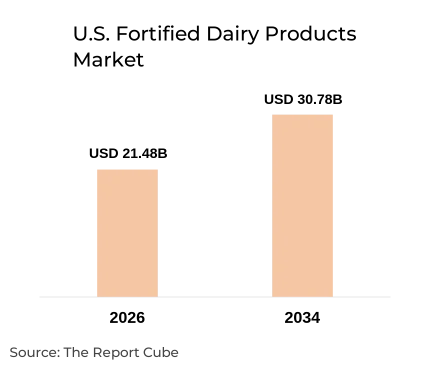
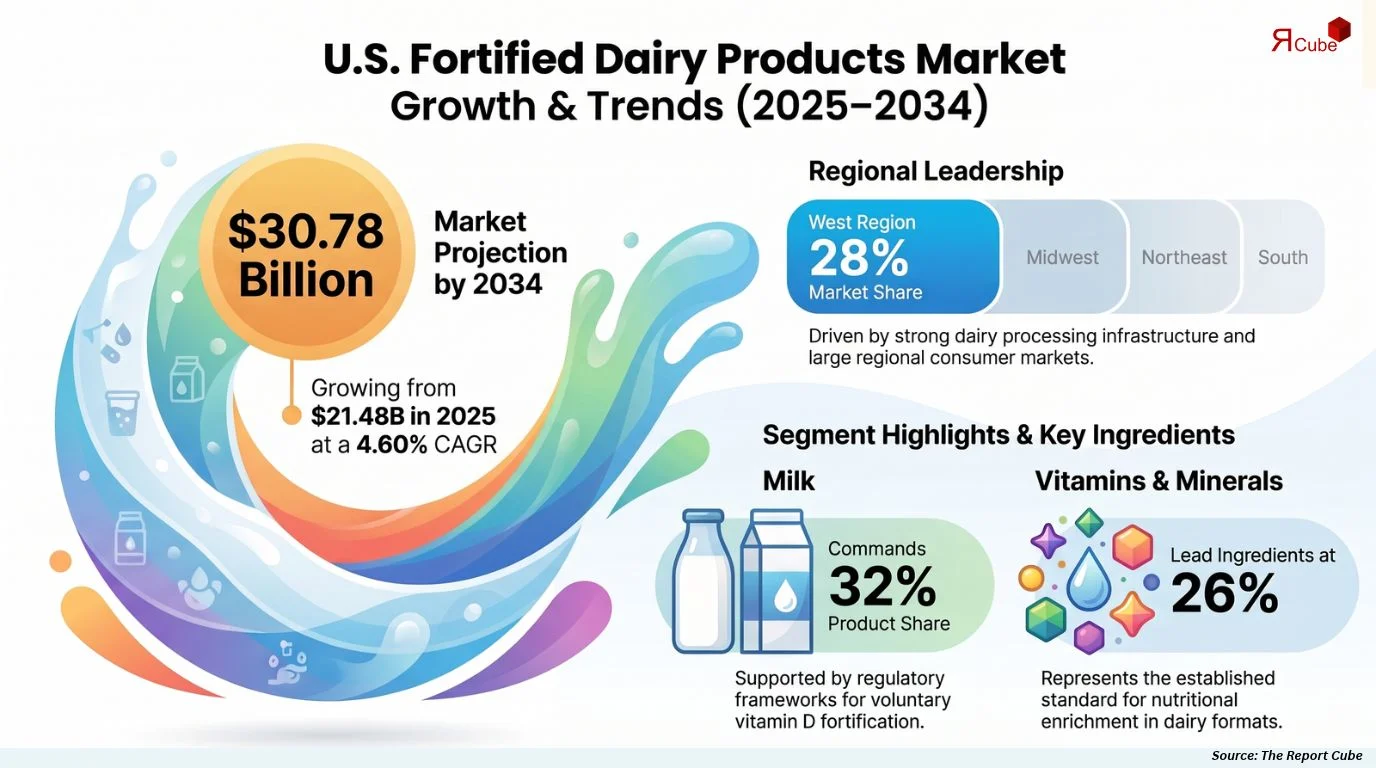
- The U.S. Fortified Dairy Products Market was valued at USD 21.48 billion in 2025 and is projected to reach USD 30.78 billion by 2034, expanding at a CAGR of 4.60% during 2026–2034.
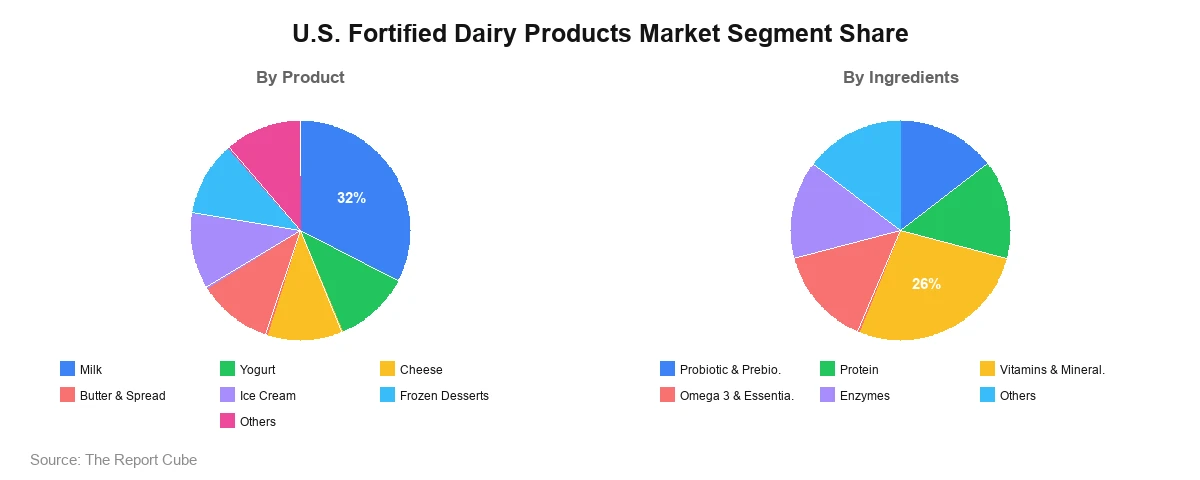
- Milk accounted for approximately 32% of the market by product in 2026, supported by its established consumption base and suitability for nutrient fortification.
- Vitamins & Minerals accounted for approximately 26% of the market by ingredients in 2026, reflecting the established use of nutrient fortification in dairy products.
- Fortified dairy products benefit from an established U.S. dairy consumption base, with USDA data showing that total U.S. domestic disappearance of dairy products increased between 2014 and 2025.
- West accounted for approximately 28% of the market by region in 2026, supported by the established U.S. dairy industry and regional dairy production infrastructure.
- Probiotic and prebiotic formulations provide opportunities for differentiated functional dairy products, particularly across yogurt and milk formats.
- The market is being influenced by changes in the U.S. dairy consumption mix, including long-term declines in fluid milk consumption alongside increased importance of cheese and other dairy categories.
- Regulatory frameworks governing vitamin fortification and yogurt standards provide an established basis for developing fortified dairy products in the U.S.
Market Overview
The U.S. Fortified Dairy Products Market includes dairy products enhanced with vitamins, minerals, proteins, probiotics, prebiotics, omega-3 fatty acids, enzymes, and other functional ingredients. Major product categories include milk, yogurt, cheese, butter and spreads, ice cream, frozen desserts, and other dairy formats. The U.S. has a large and established dairy consumption base. According to the USDA Economic Research Service, total U.S. domestic disappearance of dairy products increased from 2014 to 2025, although consumption trends differ substantially by individual dairy category. Cheese consumption has become an important force shaping the U.S. dairy industry, while fluid milk consumption has declined over the long term.
The regulatory environment also supports nutrient-fortified dairy development. The FDA permits vitamin D to be voluntarily added to milk and certain milk alternatives, while its yogurt standard allows vitamin A and D fortification subject to applicable requirements. The market is expected to expand through 2034 as manufacturers develop products positioned around nutritional value, functional ingredients, protein content, probiotics, vitamins, minerals, and other targeted nutritional attributes.
Market Dynamics
The U.S. Fortified Dairy Products Market is influenced by established dairy consumption, nutritional fortification practices, functional ingredient adoption, changing consumer preferences, regulatory requirements, and the evolving product mix across dairy categories. While the underlying dairy market provides a broad platform for fortified products, declining fluid milk consumption and the need for substantiated functional claims present challenges for manufacturers.
|
Factor |
Type |
Specific Impact on Market |
Magnitude |
|---|---|---|---|
|
Established U.S. dairy consumption base |
Driver |
Provides a large underlying consumer and product base for fortified dairy products |
High |
|
Regulatory acceptance of nutrient fortification |
Driver |
Supports development of dairy products fortified with vitamins and minerals within applicable requirements |
High |
|
Declining fluid milk consumption |
Challenge |
Limits growth opportunities for fortified products primarily dependent on conventional fluid milk |
High |
|
Scientific substantiation of probiotic claims |
Challenge |
Requires evidence-based formulation and compliant communication of functional benefits |
Medium–High |
|
Shift in the U.S. dairy consumption mix |
Trend |
Encourages manufacturers to adapt fortified products toward growing and resilient dairy categories |
High |
|
Increasing functionalization of dairy |
Trend |
Supports incorporation of probiotics, prebiotics, protein, vitamins, and minerals |
High |
|
Probiotic and prebiotic dairy |
Opportunity |
Creates opportunities for differentiated functional milk and yogurt products |
High |
|
Protein-fortified dairy |
Opportunity |
Supports development of higher-protein milk, yogurt, and other dairy formats |
High |
U.S. Fortified Dairy Products Market Drivers
Established U.S. Dairy Consumption Base
According to the USDA Economic Research Service, U.S. domestic disappearance of total dairy products increased at a compound annual growth rate of 1.24% per year on a milk-fat milk-equivalent basis between 2014 and 2025. This established dairy consumption base provides a broad platform for manufacturers to introduce fortified and functional products across multiple dairy categories.
Regulatory Acceptance of Nutrient Fortification
The U.S. regulatory framework permits the fortification of several dairy products with selected nutrients. The FDA permits vitamin D to be voluntarily added to milk, while yogurt standards allow vitamin A and D fortification subject to specified requirements. This regulatory environment supports the development of dairy products positioned around nutritional enhancement.
U.S. Fortified Dairy Products Market Challenges
Declining Fluid Milk Consumption
According to the USDA Economic Research Service, total U.S. fluid milk sales declined from approximately 55.4 billion pounds in 2009 to 43.2 billion pounds in 2024, representing a decline of approximately 22%. USDA identifies competition from alternative beverages, demographic changes, and changing consumer preferences among contributing factors. This creates a structural challenge for fortified products primarily dependent on conventional fluid milk.
Scientific Substantiation of Probiotic Claims
According to the NIH Office of Dietary Supplements, probiotics are present in fermented foods such as yogurt and can also be added to products including milk. However, not all foods labeled as containing probiotics have proven health benefits. This creates a need for evidence-based formulation and appropriate communication of functional benefits.
U.S. Fortified Dairy Products Market Trends
Shift in the U.S. Dairy Consumption Mix
According to USDA ERS, fluid milk consumption has declined over the long term, while cheese consumption has become an important force shaping the U.S. dairy industry. Yogurt and other dairy categories also contribute to the changing composition of dairy demand. This indicates that the U.S. dairy market is undergoing a structural shift rather than experiencing uniform growth across all categories.
Increasing Functionalization of Dairy
Probiotic and functional ingredients are becoming increasingly relevant to dairy product development. According to the NIH Office of Dietary Supplements, probiotics are present in yogurt and can be added to products such as milk and other foods. This supports continued development of functional dairy products while also highlighting the importance of substantiated health-related claims.
Need Specific Data, Let’s Customize the Report for You
Request CustomizationU.S. Fortified Dairy Products Market Opportunities
Probiotic and Prebiotic Dairy
The availability of probiotics in fermented foods such as yogurt and the ability to add probiotic microorganisms to products such as milk create opportunities for differentiated functional dairy products. Manufacturers can develop products around specific probiotic strains and functional positioning while complying with applicable product-labeling and evidence requirements.
Protein-Fortified Dairy
The established consumption of milk, yogurt, cheese, and other dairy products creates opportunities for higher-protein formulations targeted toward consumers seeking convenient sources of protein. USDA data confirms the importance of these categories within the broader U.S. dairy consumption landscape, providing an established platform for nutritional product innovation.
Segmentation Analysis
The U.S. Fortified Dairy Products Market is segmented by product, ingredients, and distribution channel based on the available market structure. Among the segments with supplied market-share data, Milk represents the leading product category, while Vitamins & Minerals represent the leading ingredient category. These segments benefit from established dairy consumption and nutritional fortification practices.
By Product
- Milk
- Yogurt
- Cheese
- Butter & Spread
- Ice Cream
- Frozen Desserts
- Others
Milk accounted for approximately 32% of the market in 2026. Its leading position is supported by its established role within the U.S. dairy market and its suitability for nutritional fortification. The FDA permits voluntary vitamin D addition to milk under specified conditions, supporting continued development of fortified milk products.
By Ingredients
- Probiotic & Prebiotic
- Protein
- Vitamins & Minerals
- Omega 3 & Essential Fatty Acids
- Enzymes
- Others
Vitamins & Minerals accounted for approximately 26% of the market in 2026. Their position is supported by established fortification practices and regulatory provisions covering nutrients such as vitamins A and D in dairy products. FDA requirements provide a framework for manufacturers developing fortified milk and yogurt products.
U.S. Fortified Dairy Products Regional Analysis
The U.S. Fortified Dairy Products Market is geographically distributed across the Northeast, Midwest, South, and West. Regional market development is influenced by dairy production, processing infrastructure, population distribution, retail networks, and consumer demand. The West represents the leading region based on the supplied market-share data, while the other regions provide established dairy consumption and distribution opportunities.
|
Region |
Estimated Market Share |
Key Growth Factors |
Consumer / Patient Trends |
|---|---|---|---|
|
Northeast |
— |
Large consumer markets, established retail networks, food-service activity, and dairy product distribution |
Demand for convenient, nutritional, and functional dairy products |
|
Midwest |
— |
Strong dairy production and processing infrastructure and established agricultural base |
Continued demand for conventional and value-added dairy products |
|
South |
— |
Large population base, expanding retail channels, food-service demand, and growing packaged-food consumption |
Increasing interest in convenient and nutritionally positioned dairy products |
|
West |
28% |
Established dairy production, processing infrastructure, large consumer markets, and diversified food distribution |
Growing demand for functional, protein-rich, and nutritionally enhanced dairy products |
West
The West accounted for approximately 28% of the U.S. Fortified Dairy Products Market in 2026. The region benefits from an established dairy production and processing ecosystem as well as large consumer markets. USDA data indicates that some of the highest milk-producing states are located in the western and northern areas of the United States, supporting the region's broader dairy infrastructure.
Competitive Landscape
The U.S. Fortified Dairy Products Market includes global dairy companies, diversified food manufacturers, dairy cooperatives, and international food and beverage groups. Competition is influenced by product innovation, nutritional formulation, brand recognition, distribution reach, dairy processing capabilities, and the ability to develop products aligned with changing nutritional preferences.
|
Company |
Competitive Strength |
Primary Segment Served |
|---|---|---|
|
Nestlé S. A |
Broad nutrition, food, and dairy-related product capabilities and international brand presence |
Dairy, nutrition, functional foods |
|
Danone S.A |
Strong focus on dairy, yogurt, nutrition, and functional product categories |
Yogurt, dairy, functional nutrition |
|
FrieslandCampina |
Integrated dairy supply chain and extensive international dairy portfolio |
Milk, dairy ingredients, consumer dairy |
|
LACTALIS |
Large-scale dairy processing capabilities and broad international product portfolio |
Milk, cheese, yogurt, dairy products |
|
The Kraft Heinz Company |
Strong branded food portfolio and extensive U.S. distribution |
Cheese, dairy-related food products |
|
General Mills Inc. |
Strong U.S. consumer-food distribution and yogurt capabilities |
Yogurt and dairy-related foods |
|
Dairy Farmers of America Inc. |
Large U.S. dairy cooperative and integrated milk-processing network |
Milk, dairy ingredients, dairy products |
|
Müller Group |
Strong dairy and yogurt manufacturing capabilities |
Yogurt and dairy products |
|
Yili Group |
Large international dairy producer with broad product capabilities |
Milk, yogurt, functional dairy |
|
AMUL (GCMMF) |
Large cooperative dairy network and extensive dairy product portfolio |
Milk, yogurt, dairy products |
Key Companies in the U.S. Fortified Dairy Products Market
Danone S.A
Danone has a strong position in dairy and nutrition, with an extensive portfolio across yogurt and other dairy categories. Its focus on nutrition and functional product development provides a strong platform for participating in consumer demand for fortified and nutritionally positioned dairy products.
Nestlé S. A
Nestlé operates across food, beverage, nutrition, and health-oriented product categories and has an extensive international presence. Its broad nutritional capabilities and product-development expertise provide opportunities to participate in dairy products positioned around nutritional enhancement and functional ingredients.
Future Outlook
The U.S. Fortified Dairy Products Market is expected to expand steadily through 2034, supported by the country's established dairy consumption base, regulatory acceptance of nutrient fortification, and increasing interest in functional nutritional products.
Future product development is likely to focus on categories and formulations that respond to changing consumption patterns. The long-term decline in fluid milk consumption creates pressure on conventional milk-based products, while the broader dairy market continues to provide opportunities across yogurt, cheese, and other formats.
Functional ingredients such as probiotics, prebiotics, proteins, vitamins, and minerals are expected to remain important areas of innovation. At the same time, manufacturers will need to ensure that nutritional and functional claims are appropriately substantiated and comply with applicable regulatory requirements. Overall, the U.S. Fortified Dairy Products Market is projected to increase from USD 21.48 billion in 2025 to USD 30.78 billion by 2034, representing a CAGR of 4.60% during 2026–2034.
U.S. Fortified Dairy Products Industry Report Coverage
|
Report Attribute |
Details |
|---|---|
|
Market Name |
U.S. Fortified Dairy Products Market |
|
Market Size, 2025 |
USD 21.48 billion |
|
Market Size, 2034 |
USD 30.78 billion |
|
Forecast Period |
2026–2034 |
|
CAGR |
4.60% |
|
Base Year |
2025 |
|
Forecast Years |
2026–2034 |
|
Segments Covered |
Product, Ingredients |
|
Product Segments |
Milk, Yogurt, Cheese, Butter & Spread, Ice Cream, Frozen Desserts, Others |
|
Ingredient Segments |
Probiotic & Prebiotic, Protein, Vitamins & Minerals, Omega 3 & Essential Fatty Acids, Enzymes, Others |
|
Distribution Channels |
Hypermarkets/Supermarkets, Convenience Stores, Specialty Stores, Online, Others |
|
Regions Covered |
Northeast, Midwest, South, West |
|
Leading Product |
Milk |
|
Leading Ingredient |
Vitamins & Minerals |
|
Leading Region |
West |
|
Key Companies |
Nestlé S. A, Danone S.A, FrieslandCampina, LACTALIS, The Kraft Heinz Company, General Mills Inc., Dairy Farmers of America Inc., Müller Group, Yili Group, AMUL (GCMMF) |
Why Choose This Report
- Provides a structured assessment of the U.S. Fortified Dairy Products Market from 2025 to 2034.
- Covers market segmentation by product, ingredients, distribution channel, and region.
- Highlights Milk as the leading product segment based on the supplied 2026 market share.
- Examines Vitamins & Minerals as the leading ingredient segment based on the supplied 2026 market share.
- Evaluates major drivers, challenges, trends, and opportunities affecting the market.
- Examines the role of probiotics, prebiotics, proteins, vitamins, and minerals in product development.
- Analyzes regional market dynamics across the Northeast, Midwest, South, and West.
- Covers major companies participating in the U.S. dairy and fortified dairy ecosystem.
- Incorporates relevant regulatory and consumption evidence from U.S. government and international health sources.
Table of Contents
- Introduction
- Objective of the Study
- Product Definition
- Market Segmentation
- Study Variables
- Research Methodology
- Secondary Data Points
- Companies Interviewed
- Primary Data Points
- Breakdown of Primary Interviews
- Secondary Data Points
- Executive Summary
- Market Dynamics
- Drivers
- Challenges
- Opportunity Assessment
- Recent Trends and Developments
- Policy and Regulatory Landscape
- U.S. Fortified Dairy Products Market Overview and Forecast Analysis (2021-2034)
- Market Size, By Value, By Growth Rate (CAGR/USD Billions)
- Demand – Supply Trends
- Market Share, By Product
- Milk
- Yogurt
- Cheese
- Butter & Spread
- Ice Cream
- Frozen Desserts
- Others
- Market Share, By Ingredients
- Probiotic & Prebiotic
- Protein
- Vitamins & Minerals
- Omega 3 & Essential Fatty Acids
- Enzymes
- Others
- Market Share, By Distribution Channel
- Hypermarkets/Supermarkets
- Convenience Stores
- Specialty Stores
- Online
- Others
- Market Share, By Region
- Northeast
- Midwest
- South
- West
- Market Share, By Competitors
- Competition Characteristics
- Revenue Shares
- Milk U.S. Fortified Dairy Products Market Overview, 2021-2034F
- By Value (USD Million)
- By Ingredients – Market Size & Forecast 2021-2034, USD Million
- Probiotic & Prebiotic
- Protein
- Vitamins & Minerals
- Omega 3 & Essential Fatty Acids
- Enzymes
- Others
- Yogurt U.S. Fortified Dairy Products Market Overview, 2021-2034F
- By Value (USD Million)
- By Ingredients – Market Size & Forecast 2021-2034, USD Million
- Probiotic & Prebiotic
- Protein
- Vitamins & Minerals
- Omega 3 & Essential Fatty Acids
- Enzymes
- Others
- Cheese U.S. Fortified Dairy Products Market Overview, 2021-2034F
- By Value (USD Million)
- By Ingredients – Market Size & Forecast 2021-2034, USD Million
- Probiotic & Prebiotic
- Protein
- Vitamins & Minerals
- Omega 3 & Essential Fatty Acids
- Enzymes
- Others
- Butter & Spread U.S. Fortified Dairy Products Market Overview, 2021-2034F
- By Value (USD Million)
- By Ingredients – Market Size & Forecast 2021-2034, USD Million
- Probiotic & Prebiotic
- Protein
- Vitamins & Minerals
- Omega 3 & Essential Fatty Acids
- Enzymes
- Others
- Ice Cream U.S. Fortified Dairy Products Market Overview, 2021-2034F
- By Value (USD Million)
- By Ingredients – Market Size & Forecast 2021-2034, USD Million
- Probiotic & Prebiotic
- Protein
- Vitamins & Minerals
- Omega 3 & Essential Fatty Acids
- Enzymes
- Others
- Frozen Desserts U.S. Fortified Dairy Products Market Overview, 2021-2034F
- By Value (USD Million)
- By Ingredients – Market Size & Forecast 2021-2034, USD Million
- Probiotic & Prebiotic
- Protein
- Vitamins & Minerals
- Omega 3 & Essential Fatty Acids
- Enzymes
- Others
- Others U.S. Fortified Dairy Products Market Overview, 2021-2034F
- By Value (USD Million)
- By Ingredients – Market Size & Forecast 2021-2034, USD Million
- Probiotic & Prebiotic
- Protein
- Vitamins & Minerals
- Omega 3 & Essential Fatty Acids
- Enzymes
- Others
- Competitive Outlook (Company Profile - Partial List)
- Nestlé S. A
- Company Overview
- Business Segments
- Strategic Alliances/Partnerships
- Recent Developments
- Danone S.A
- Company Overview
- Business Segments
- Strategic Alliances/Partnerships
- Recent Developments
- FrieslandCampina
- Company Overview
- Business Segments
- Strategic Alliances/Partnerships
- Recent Developments
- LACTALIS
- Company Overview
- Business Segments
- Strategic Alliances/Partnerships
- Recent Developments
- The Kraft Heinz Company
- Company Overview
- Business Segments
- Strategic Alliances/Partnerships
- Recent Developments
- General Mills Inc.
- Company Overview
- Business Segments
- Strategic Alliances/Partnerships
- Recent Developments
- Dairy Farmers of America Inc.
- Company Overview
- Business Segments
- Strategic Alliances/Partnerships
- Recent Developments
- Müller Group
- Company Overview
- Business Segments
- Strategic Alliances/Partnerships
- Recent Developments
- Yili Group
- Company Overview
- Business Segments
- Strategic Alliances/Partnerships
- Recent Developments
- AMUL (GCMMF)
- Company Overview
- Business Segments
- Strategic Alliances/Partnerships
- Recent Developments
- Nestlé S. A
- Contact Us & Disclaimer
Top Key Players & Market Share Outlook
- Nestlé S. A
- Danone S.A
- FrieslandCampina
- LACTALIS
- The Kraft Heinz Company
- General Mills Inc.
- Dairy Farmers of America Inc.
- Müller Group
- Yili Group
- AMUL (GCMMF)
Frequently Asked Questions






