



Build Your Custom Market Intelligence Report
Customize Your ReportOman Fruits and Vegetables Market Key Highlights
By Type:
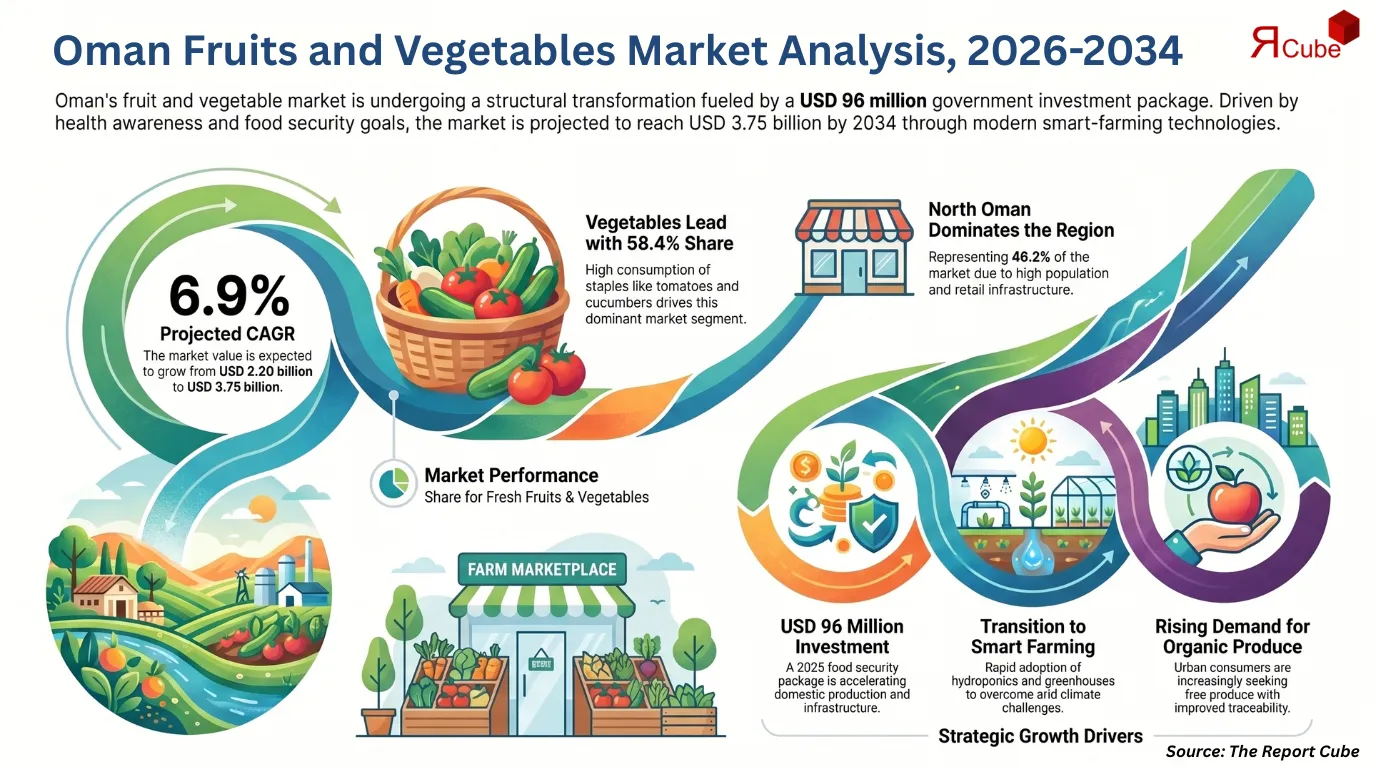
Vegetables segment leads the market with nearly 58.4% share.
By Product:
Fresh Fruits & Vegetables segment dominates the market with around 64.7% of total revenue.
Regional Outlook:
North Oman region dominates the Oman Fruits and Vegetables Market with approximately 46.2% share.
Oman Fruits and Vegetables Market Insights & Analysis
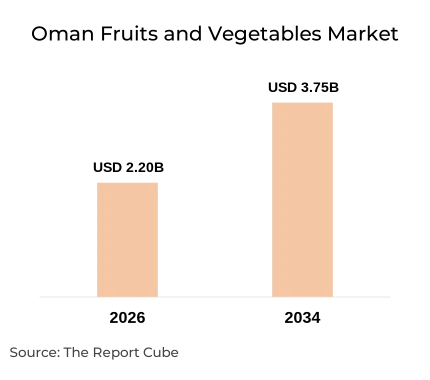
The Oman Fruits and Vegetables Market is anticipated to register a CAGR of around 6.9% during the forecast period 2026-2034. The market size is valued at USD 2.20 billion in 2026 and is projected to reach USD 3.75 billion by 2034. Rising consumer awareness regarding healthy eating habits, increasing tourism activity, and expanding organized retail networks are supporting the demand for fresh produce across Oman. The market is also benefiting from government-backed food security initiatives that encourage domestic agricultural production and reduce reliance on imported fruits and vegetables.
Oman’s agricultural sector is undergoing structural modernization through greenhouse farming, hydroponic cultivation, and advanced irrigation technologies designed for arid climatic conditions. The government-backed USD 96 million food security investment package announced in 2025 is accelerating infrastructure development, post-harvest storage efficiency, and integrated agri-logistics. Large retailers and agricultural operators are also increasing partnerships with domestic farms to improve local sourcing capabilities and reduce dependence on imported produce. Rising adoption of digital inventory systems and cold chain optimization is expected to improve operational efficiency while supporting long-term stability within the Oman fruits and vegetables industry.
Oman Fruits and Vegetables Market Impact Analysis
| Factor | Type | Specific Impact on Market | Magnitude | Business Implication |
|---|---|---|---|---|
| Rising Health and Nutrition Focus | Consumer | Consumers shift from staples to fresh produce rich in nutrients | High | Supports premium positioning for fresh and organic product lines |
| Government Support to Domestic Farming | Regulatory | Policies promote sustainable farming and capacity expansion locally | High | Encourages investment in modern farms and value chain upgrades |
| Growing Demand for Organic Produce | Market | Organic fruits and vegetables gain traction among urban buyers | Medium | Creates niche segments with higher margins and brand loyalty |
| Dependence on Imports for Supply | Environmental | Import reliance exposes prices to logistics and trade disruptions | Medium | Requires diversified sourcing and better inventory risk control |
| Perishability and Cold Chain Gaps | Technological | Insufficient storage and handling raise post harvest loss levels | High | Drives need for cold chain, packing and route optimization tools |
| Environmental and Climate Variability | Environmental | Heat, pests and weather shocks disrupt yields and supply plans | Medium | Necessitates resilient varieties and protected cultivation methods |
| Changing Consumption Patterns of Expats | Market | Expat population increases demand for diverse global produce | Medium | Supports wider assortment and segmentation in modern retail |
Oman Fruits and Vegetables Market Dynamics
Key Driver: Expansion of Domestic Food Security and Local Agricultural Production
Oman’s growing focus on strengthening national food security is creating strong momentum for the fruits and vegetables market. Government agencies are prioritizing agricultural diversification programs, greenhouse projects, and water-efficient farming systems to improve domestic production capacity. Investments in protected cultivation are helping farmers produce vegetables year-round while minimizing exposure to extreme weather conditions. This approach supports stable supply availability for supermarkets, hospitality businesses, and wholesale distributors operating across the country.
Demand for locally cultivated produce is also increasing as retailers and consumers seek fresher products with shorter transportation cycles. Domestic farms are expanding production of tomatoes, cucumbers, leafy greens, peppers, and dates to reduce import dependency. Financial support programs, agricultural innovation initiatives, and improved logistics infrastructure are encouraging private sector participation within the agricultural ecosystem. These developments are contributing to stronger supply chain resilience and supporting long-term market growth.
Book your FREE 30-minute expert consultation today
Contact UsIndustry Trends: Growing Adoption of Smart Farming and Controlled Agriculture
Modern farming technologies are becoming increasingly important across Oman’s agricultural landscape due to water scarcity and climate-related production challenges. Agricultural operators are investing in hydroponics, vertical farming, automated irrigation systems, and climate-controlled greenhouses to improve yield efficiency and optimize resource utilization. These systems are helping producers maintain crop quality while reducing water consumption compared to traditional farming methods.
Retailers and food distributors are also strengthening partnerships with technology-driven farms to secure consistent supplies of premium fresh vegetables and fruits. Controlled agriculture projects are gaining attention for their ability to support year-round cultivation and improve shelf-life stability. At the same time, producers are implementing advanced packaging and refrigerated transportation systems to reduce post-harvest losses. This shift toward technology-enabled agriculture is gradually transforming Oman into a more sustainable and productivity-focused fresh produce market.
Major Challenge: Climatic Pressures and High Agricultural Operating Costs
Extreme temperatures, limited freshwater resources, and restricted arable land continue to create operational challenges for Oman’s fruits and vegetables industry. Farmers often face higher production costs related to irrigation systems, cooling technologies, and greenhouse maintenance. Cultivating crops in desert climatic conditions requires continuous investment in water management and environmental control infrastructure, which can limit profitability for smaller agricultural businesses.
Import dependency remains another major concern, particularly for seasonal fruits and products with limited local cultivation capacity. International freight fluctuations, supply chain disruptions, and rising transportation expenses can directly influence market pricing and product availability. Retailers and distributors must also manage cold storage expenses to maintain freshness standards. Addressing these structural challenges will require continued investment in sustainable farming technologies, logistics modernization, and water conservation initiatives.
Opportunity: Rising Demand for Organic Produce and Modern Retail Distribution
Health-conscious consumers across Oman are increasingly seeking organic fruits and vegetables cultivated without synthetic chemicals or intensive pesticide usage. This shift is encouraging producers and retailers to expand certified organic product offerings within supermarkets, specialty stores, and premium grocery outlets. Demand is particularly strong among urban households looking for higher-quality produce with improved nutritional value and traceability.
Online grocery retailing is also creating new growth opportunities for fresh produce suppliers and retailers. Digital platforms are improving accessibility to imported fruits, organic vegetables, and curated fresh food packages through convenient home delivery services. Retail operators are investing in refrigerated delivery systems and warehouse automation to maintain product freshness during transportation. Expansion of e-commerce grocery channels is expected to strengthen consumer access to premium produce categories while supporting broader market penetration across Oman.
Oman Fruits and Vegetables Market Segment-wise Analysis
By Type:
- Vegetables
- Fruits
The vegetables segment accounts for the largest share of the Oman fruits and vegetables market, contributing approximately 58.4% of total market revenue in 2026. Strong consumption of tomatoes, onions, potatoes, cucumbers, and leafy vegetables across households and commercial kitchens continues to support segment growth. Domestic greenhouse farming projects have significantly improved year-round availability of vegetables while helping stabilize local supply. Hotels, restaurants, and institutional foodservice operators are also increasing procurement volumes due to rising tourism and urban expansion.
Government support for controlled agriculture and irrigation modernization is further strengthening vegetable cultivation capabilities across Oman. Producers are focusing on improving crop quality, reducing spoilage, and increasing operational efficiency through precision farming methods. Retail chains are simultaneously prioritizing locally sourced vegetables to meet growing demand for fresh produce with shorter supply cycles. These factors continue to position vegetables as the leading segment within the market.

By Product:
- Fresh Fruits & Vegetables
- Frozen Fruits & Vegetables
- Dried Fruits & Vegetables
Fresh Fruits & Vegetables dominate the Oman market with nearly 64.7% revenue share due to increasing consumer preference for natural and minimally processed food products. Fresh produce remains essential across residential consumption, hospitality businesses, and catering operations because of its nutritional benefits and daily demand patterns. Supermarkets and hypermarkets continue expanding premium fresh produce sections to improve product variety and freshness standards.
Demand for imported berries, citrus fruits, avocados, and exotic fruit categories is also rising among middle-income and high-income consumers. Retailers are strengthening refrigerated storage infrastructure and cold chain distribution systems to reduce spoilage during transportation and storage. At the same time, locally cultivated vegetables are gaining wider acceptance as consumers increasingly value freshness and domestic sourcing. The segment is expected to maintain strong growth as retail modernization and urban food consumption continue expanding across Oman.
Regional Projection of Oman Fruits and Vegetables Industry
- North Oman
- South Oman
- Central Oman
North Oman holds the dominant share of the Oman fruits and vegetables market with nearly 46.2% market contribution, supported by stronger retail infrastructure, higher population concentration, and rising food consumption levels. Muscat and surrounding urban areas represent major demand centers for fresh vegetables, imported fruits, and premium organic produce. The region also benefits from well-developed logistics connectivity, allowing efficient distribution of imported and locally cultivated products.
Retail modernization, hospitality sector growth, and increasing disposable income levels continue to support regional demand expansion. Supermarkets, hypermarkets, and online grocery operators are strengthening cold chain capabilities to improve product freshness and reduce waste during transportation. Agricultural modernization initiatives in northern farming zones are also contributing to higher local production volumes for vegetables and greenhouse-grown crops. These factors collectively position North Oman as the leading regional market for fruits and vegetables during the forecast period.
Need insights for a specific region within this market?
Request Regional DataOman Fruits and Vegetables Industry Regional Analysis
The Oman fruits and vegetables industry varies significantly across regions due to diverse climatic conditions, agricultural infrastructure, and water availability.
| Region | Demand Level | Key Areas | Crop Dominance | Core Production Logic | Growth Nature |
|---|---|---|---|---|---|
| North (Al Batinah) | Extremely High | Saham, Sohar, Rustaq | Greenhouse vegetables (tomatoes, cucumbers) | 60% of national production; 100% cucumber self-sufficiency | Smart agri-cities expansion |
| South (Dhofar) | Very High | Salalah, Al Najd | Tropical fruits (coconut, banana, papaya) | Unique monsoon climate; 170,000+ coconut trees | High-value export-driven |
| Central (Interior/Dakhiliyah) | High | Nizwa, Jabal Akhdar | Dates, premium fruits (grapes, pomegranates) | Oasis agriculture; 48,000 tonnes dates annually | Value-added processing |
| East (Al Sharqiya North & South) | Medium-High | Ibra, Sur, Masirah | Dates (14% national share), mixed crops | 250,000 tonnes total production; date specialization | Steady expansion |
| West (Al Buraimi, Al Dhahira) | Medium | Buraimi, Ibri | Wheat, vegetables, lemons | Border trade & mixed farming; RO 280K projects | Modern tech adoption |
Government Initiatives & Policies
- Food Security Lab Investment Program 2025: Oman launched a USD 96 million investment package supporting agriculture, fisheries, irrigation systems, and food supply chain infrastructure to improve self-sufficiency in fruits and vegetables.
- National Strategy for Sustainable Agriculture Development 2040: The government expanded smart farming and greenhouse support initiatives in 2026 to improve water efficiency, local crop production, and agricultural technology adoption.
Oman Fruits and Vegetables Industry Recent Developments
- October 2025: Oman Government announced a USD 96 million food security investment package under the Food Security Lab framework focused on agricultural productivity, fisheries, irrigation modernization, and integrated supply chain development. The initiative is expected to strengthen domestic fruits and vegetables production, reduce import dependency, and accelerate adoption of advanced farming technologies across Oman.
- 2025: Lulu Group expanded its fresh produce sourcing partnerships with local farms in Oman to improve the supply of domestically cultivated vegetables and organic products across its retail stores. The strategy supports local agriculture while improving product freshness and reducing logistics costs.
Why Choose This Report?
- Provides a comprehensive overview of the overall market analysis, encompassing key trends, consumer behavior analysis, and risk assessment to support strategic decision-making.
- Provides accurate, up-to-date insights into market size, segmentation, and emerging opportunities, helping to minimize risk & capitalizing on growth.
- Gives deep understanding of target audience preferences, investment habits, and communication channels for enhanced product development & marketing effectiveness.
- Delivers competitive analysis & benchmarking, uncovering the strengths & weaknesses of market competitors to guide strategies.
- Consolidate comprehensive market intelligence, reducing reasoning & streamlining research efforts.
- Facilitates customized market segmentation & risk mitigation strategies, fine-tuned to the business objectives.
- Aids in identifying both market challenges & untapped opportunities within the industry to drive long-term business growth.
- Provides valuable information based on actual customer data & search trends.
Table of Contents
- Introduction
- Objective of the Study
- Product and Category Definition
- Market Segmentation
- Study Variables
- Research Methodology
- Secondary Data Points
- Breakdown of Secondary Sources
- Primary Data Points
- Breakdown of Primary Interviews
- Secondary Data Points
- Executive Summary
- Market Dynamics
- Emerging Opportunities
- Adoption Trends
- Demand Drivers
- Disruption Analysis (Challenges)
- Industry Analysis & Strategic Insights
- Supply/Value Chain Analysis
- Pricing Analysis
- Go-To-Market (GTM) Strategy
- BCG Matrix
- Recent Trends and Developments
- Import and Export Analysis
- Regulatory and Policy Landscape
- Region-wise Policies
- Government Initiatives
- Oman Fruits and Vegetables Market Overview and Forecast Analysis (2021-2034)
- Market Size, By Value, By Growth Rate (CAGR/USD Billion)
- Market Share, By Type
- Vegetables
- Fruits
- Market Share, By Product
- Fresh Fruits & Vegetables
- Frozen Fruits & Vegetables
- Dried Fruits & Vegetables
- Market Share, By Source
- Conventional
- Organic
- Market Share, By Sales Channel
- Supermarkets and Hypermarkets
- Grocery Stores
- Specialty Stores
- Online Retailer
- Others
- Market Share, By Region
- North
- South
- Central
- Market Share, By Company
- Revenue Shares & Analysis
- Competitive Landscape
- North Oman Fruits and Vegetables Market Overview and Forecast Analysis (2021-2034)
- Market Size, By Value, By Growth Rate (CAGR/USD Billion/Million)
- Market Share, By Type
- Market Share, By Product
- Market Share, By Source
- Market Share, By Sales Channel
- South Oman Fruits and Vegetables Market Overview and Forecast Analysis (2021-2034)
- Market Size, By Value, By Growth Rate (CAGR/USD Billion/Million)
- Market Share, By Type
- Market Share, By Product
- Market Share, By Source
- Market Share, By Sales Channel
- Central Oman Fruits and Vegetables Market Overview and Forecast Analysis (2021-2034)
- Market Size, By Value, By Growth Rate (CAGR/USD Billion/Million)
- Market Share, By Type
- Market Share, By Product
- Market Share, By Source
- Market Share, By Sales Channel
- Competitive Analysis, 2026
- Market Share of Key Players
- Competitive Mapping for Each Segment and Companies Operating Regionally
- North Oman Fruits and Vegetables Companies Share & Competitive Analysis, 2026
- South Oman Fruits and Vegetables Companies Share & Competitive Analysis, 2026
- Central Oman Fruits and Vegetables Companies Share & Competitive Analysis, 2026
- Company Profile (Partial List)
- Khazaen Fruits and Vegetables Central Market
- Company Overview
- Product Portfolio
- Strategic Alliances/Partnerships
- Recent Developments
- HyperMax
- Company Overview
- Product Portfolio
- Strategic Alliances/Partnerships
- Recent Developments
- Oman Agriculture Development Company
- Company Overview
- Product Portfolio
- Strategic Alliances/Partnerships
- Recent Developments
- Khimji Ramdas
- Company Overview
- Product Portfolio
- Strategic Alliances/Partnerships
- Recent Developments
- Gulf Mushroom Products
- Company Overview
- Product Portfolio
- Strategic Alliances/Partnerships
- Recent Developments
- Nakheel Oman Development Company
- Company Overview
- Product Portfolio
- Strategic Alliances/Partnerships
- Recent Developments
- Suhol Al Fayha
- Company Overview
- Product Portfolio
- Strategic Alliances/Partnerships
- Recent Developments
- Al Fair Trading Company LLC
- Company Overview
- Product Portfolio
- Strategic Alliances/Partnerships
- Recent Developments
- Lulu Group
- Company Overview
- Product Portfolio
- Strategic Alliances/Partnerships
- Recent Developments
- Nitaj - Oman Food Investment Holding
- Company Overview
- Product Portfolio
- Strategic Alliances/Partnerships
- Recent Developments
- Others (Partial List)
- Khazaen Fruits and Vegetables Central Market
- Contact Us and Disclaimer
Top Key Players & Market Share Outlook
- Khazaen Fruits and Vegetables Central Market
- HyperMax
- Oman Agriculture Development Company
- Khimji Ramdas
- Gulf Mushroom Products
- Nakheel Oman Development Company
- Suhol Al Fayha
- Al Fair Trading Company LLC
- Lulu Group
- Nitaj - Oman Food Investment Holding
- Others
Frequently Asked Questions






