


Build Your Custom Market Intelligence Report
Customize Your ReportKey Highlights
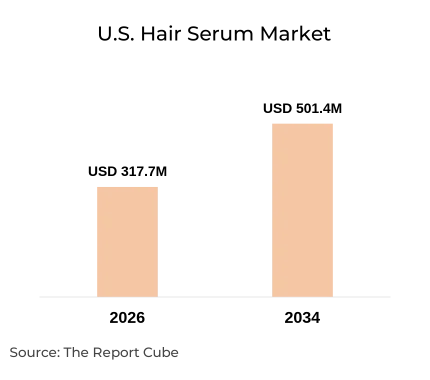
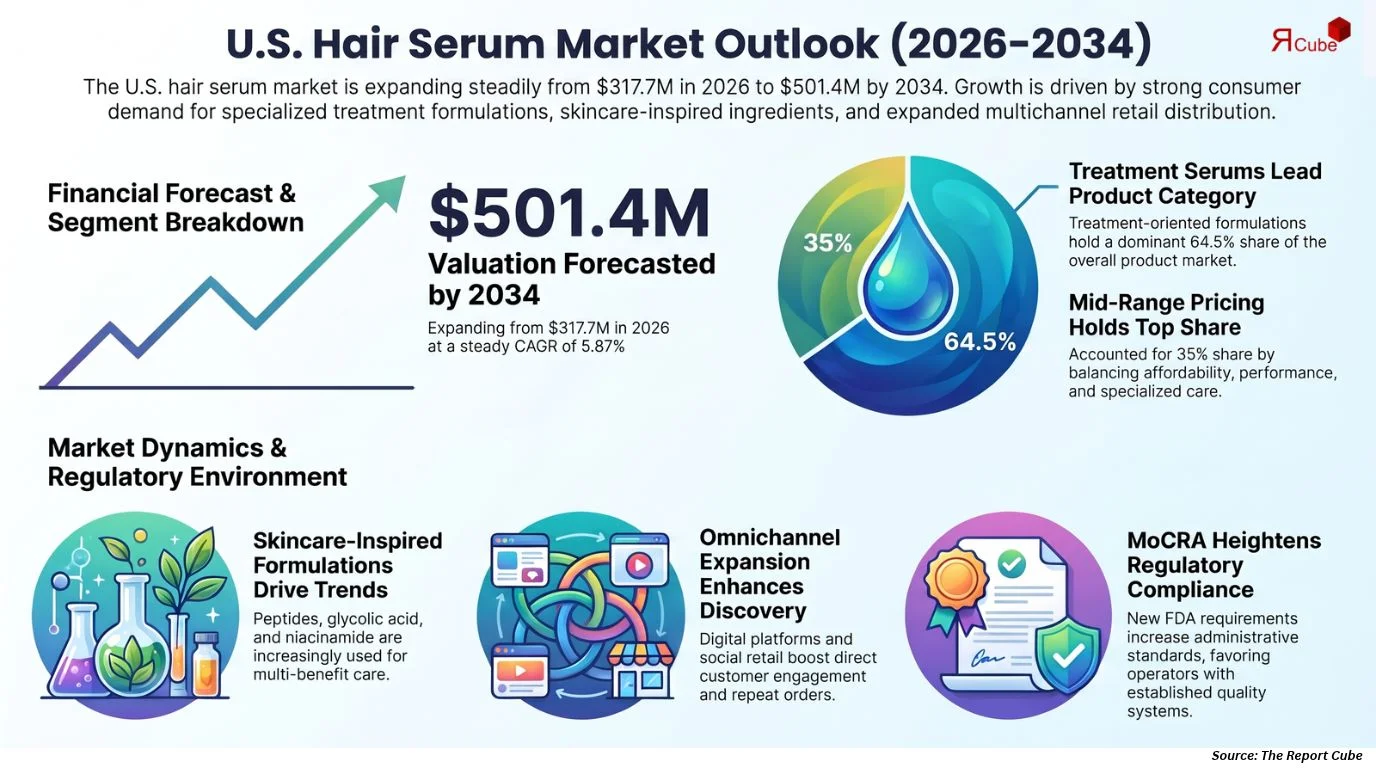
- The U.S. Hair Serum Market was valued at USD 317.7 million in 2026.
- Market size is forecast to reach USD 501.4 million by 2034.
- The market is expected to expand at a CAGR of 5.87% during 2026–2034.
- By product, Hair Treatment Serum leads with an estimated 64.5% share in 2025.
- Regional shares were not supplied, and no leading region is identified.
- Demand for treatment-oriented formulations addressing hair fall, dryness, frizz and heat damage is the major growth driver.
- Multinational beauty companies and specialist brands compete on formulation innovation, with 2026 launches from L’Oréal Paris, Schwarzkopf and e.l.f. Beauty.
Market Outlook
Hair serums are leave-in formulations that improve smoothness, manageability, shine and protection against styling and environmental damage. The U.S. Hair Serum Market sits within the wider beauty and personal-care industry, serving consumers who want targeted solutions for frizz, dryness, thinning and heat damage rather than relying only on shampoos and conditioners.
The market covers hair treatment serums and hair styling serums sold through supermarkets, hypermarkets, pharmacies, specialty beauty retailers, salons and online platforms. Consumers increasingly use serums to address specific concerns, and women account for most revenue. Online retail has become an important purchase route because of product comparison, reviews and recurring orders.
The U.S. Hair Serum Market is estimated at USD 317.7 million in 2026 and is projected to reach USD 501.4 million by 2034, a CAGR of 5.87%. Growth factors include multifunctional products and premium positioning. Competition from established manufacturers and specialist brands is encouraging ingredient-led innovation, while product substitution and price sensitivity may moderate expansion.
Government Regulations
Cosmetics in the United States are regulated by the U.S. Food and Drug Administration (FDA), and hair serums fall under that framework. The Modernization of Cosmetics Regulation Act of 2022 (MoCRA) introduced requirements for applicable facility registration, product listing, safety substantiation and record keeping. Responsible persons must report serious adverse events to the FDA within 15 business days, and products must meet applicable labeling and manufacturing requirements. Product claims must be substantiated, and claims that establish a drug intended use, such as hair growth or dandruff treatment, may trigger additional drug regulatory requirements. FDA registration or listing does not mean the FDA has approved an individual cosmetic product. These obligations raise administrative and compliance costs, particularly for smaller companies entering the U.S. market, and favor operators with documented safety and quality systems.
U.S. Hair Serum Market Dynamics
Demand is shaped by consumer awareness of hair health, specialized formulations and multichannel retail access. Manufacturers focus on targeted benefits and ingredient innovation, while competitive pressure, substitute products and regulatory compliance influence how fast the U.S. Hair Serum Market grows.
|
Factor |
Type |
Specific Impact on Market |
Magnitude |
|---|---|---|---|
|
Demand for specialized hair treatment products |
Driver |
Supports use of targeted leave-in serums for hair fall, dryness and damage |
High |
|
Premium and multifunctional hair care |
Driver |
Encourages ingredient-led and multi-benefit serum launches |
Medium–High |
|
Digital and omnichannel distribution |
Opportunity |
Improves product discovery, education and direct customer relationships |
Medium |
|
Hair-type-specific formulations |
Opportunity |
Allows differentiation for curly, coily, dry and chemically treated hair |
Medium |
|
Competition and product substitution |
Challenge |
Oils, leave-in conditioners and masks overlap with serum benefits |
Medium–High |
|
Skincare-inspired hair care |
Trend |
Peptides, glycolic acid and niacinamide shape new formulations |
Medium |
Growth Drivers: Rising Demand for Specialized Hair Treatment Products
Consumers are becoming more aware of hair fall, thinning, dryness, frizz and heat damage. Many now add targeted leave-in serums to routines built around cleansing and conditioning products. This supports demand for repair, nourishment and scalp-focused formulations, and encourages manufacturers to develop products with clearly stated benefits. Treatment-oriented serums hold the largest product position in the market, which shows the commercial weight of this need.
Market Opportunities: Expansion of Digital and Omnichannel Distribution
E-commerce and social media let manufacturers improve product discovery, explain ingredients and build direct customer relationships. Brands can use influencer partnerships, educational content, online demonstrations and personalized recommendations to support repeat purchases. An omnichannel approach that combines online retail with supermarkets, pharmacies and salons allows companies to reach different consumer groups. Smaller specialist brands can use digital channels to gain visibility without extensive physical retail networks.
Industry Challenges: Competition, Substitution and Compliance Costs
Established beauty manufacturers, professional brands and emerging specialty businesses all compete in the market. Hair oils, leave-in conditioners, masks and styling creams offer overlapping benefits, which makes differentiation difficult and can raise customer acquisition costs. Manufacturers must communicate clear performance benefits to protect loyalty and pricing. MoCRA also adds compliance responsibilities, which weigh more heavily on smaller companies entering the U.S. market.
Need Specific Data, Let’s Customize the Report for You
Request CustomizationMarket Trends: Skincare-Inspired and Multifunctional Formulations
Hair-care products increasingly use skincare-style ingredients such as peptides, glycolic acid, niacinamide and botanical extracts to target hair appearance and scalp concerns. Manufacturers are also launching serums that combine heat protection, frizz control, shine, hydration and damage repair. Consumers get convenience from a single product, and brands can support premium positioning through ingredient-led claims. L’Oréal Paris Elvive’s Glycolic + Gloss collection illustrates this ingredient-focused direction.
U.S. Hair Serum Market Segment Analysis
The U.S. Hair Serum Market is segmented by product, price tier, end user and distribution channel. Leading-segment shares below are supplied 2025 estimates, and no other segment shares are displayed.
By Product
- Hair Treatment Serum
- Hair Fall Control
- Hair Growth
- Dandruff Control
- Scalp Repair
- Others
- Hair Styling Serum
- Frizz Control
- Smoothing & Straightening
- Heat Protection
- Others
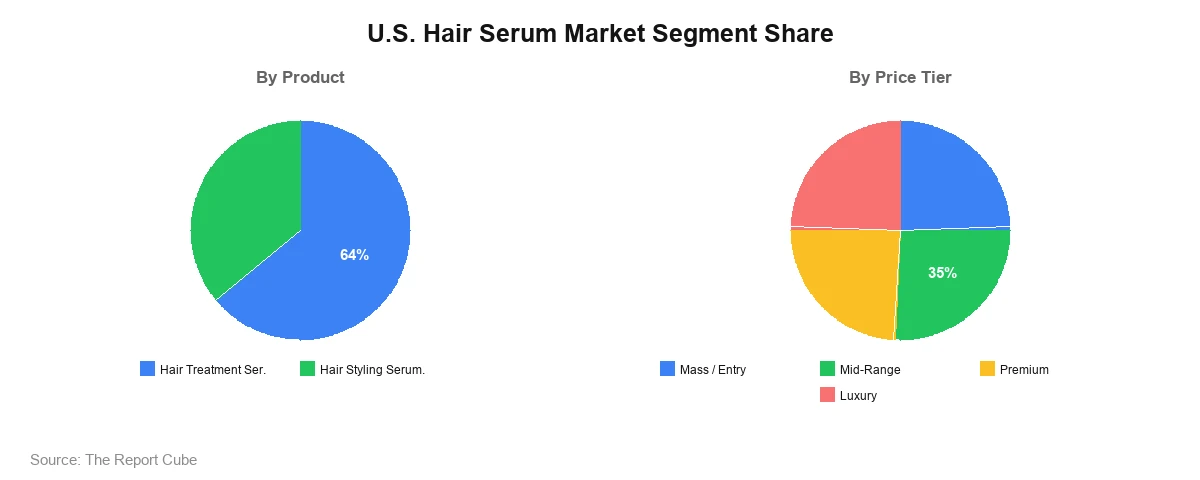
Hair Treatment Serum leads the product category with an estimated 64% share in 2025. Its position rests on demand for hair repair, nourishment, strengthening, hair fall control and scalp-related solutions, and on rising awareness of thinning. Hair Styling Serum is the second analyzed segment. It serves frizz control, smoothing, straightening, heat protection and shine, and multifunctional styling products are expected to strengthen its commercial relevance. Together these two segments make up the entire product category and reflect the split between corrective care and everyday styling.
By Price Tier
- Mass / Entry
- Mid-Range
- Premium
- Luxury
Mid-Range leads the price-tier category with an estimated 35% share in 2025. It balances affordability, formulation quality and performance, and manufacturers are offering treatment-oriented products at accessible price points for consumers who want specialized care without luxury pricing. Luxury is the second analyzed segment, supported by demand for specialized ingredients, professional-inspired formulations and differentiated performance, and it is expected to be a faster-growing tier. Mass / Entry and Premium tiers complete the price ladder, serving value-focused and aspirational buyers. No ranking beyond the leading tier is claimed.
U.S. Hair Serum Market Regional Analysis
The U.S. Hair Serum Market is analyzed across the four U.S. Census Bureau regions. California, New York, Texas and Florida are major beauty retail markets, but regional and state-level revenue shares were not supplied and no authoritative estimate is available, so none are shown.
|
Region |
Key Growth Factors |
Industry Trends |
|---|---|---|
|
West |
Large beauty retail base, including California |
Online and specialty retail adoption |
|
Northeast |
Dense metropolitan population, including New York |
Prestige and salon-led purchasing |
|
South |
Large retail networks, including Texas and Florida |
Mass-market and omnichannel distribution |
|
Midwest |
Supermarket, pharmacy and online access |
Value-focused and replenishment purchasing |
Competitive Landscape
The U.S. Hair Serum Market includes multinational beauty manufacturers, professional hair-care companies, prestige brands and specialist treatment businesses. Competition centers on formulation innovation, product performance, brand recognition, pricing and distribution reach. The table below summarizes supplied companies by capability and does not represent a ranking or market share.
|
Company |
Competitive Strength |
Primary Segment Served |
|---|---|---|
|
L’Oréal S.A. |
Brand portfolio and innovation |
Mass and premium treatment and styling |
|
Procter & Gamble Company |
Distribution and brand recognition |
Mass-market hair care |
|
Unilever PLC |
Retail reach and accessibility |
Mass-market hair care |
|
Henkel AG & Co. KGaA |
Repair and styling technology |
Professional and consumer hair care |
|
Olaplex Holdings, Inc. |
Bond-building positioning |
Premium hair treatment |
|
Moroccanoil, Inc. |
Argan-oil-based formulations |
Premium nourishment |
|
The Estée Lauder Companies Inc. |
Premium brand portfolio |
Prestige beauty and professional hair care |
|
Kao Corporation |
Formulation and manufacturing capability |
Beauty and personal care |
|
John Paul Mitchell Systems |
Salon distribution |
Professional hair care |
|
Briogeo Hair Care |
Ingredient-focused positioning |
Specialized treatment hair care |
L’Oréal S.A.: L’Oréal participates in the market through brands including L’Oréal Paris, Garnier, Kérastase and Redken. Its portfolio spans hair treatment, smoothing, nourishing and styling products across mass-market and premium categories. Its competitive position rests on a broad brand range, ingredient-led innovation and wide retail presence. Recent Elvive launches in the U.S. show continued investment in serum-based products. Company disclosures should be checked before publication.
Olaplex Holdings, Inc.: Olaplex is positioned in premium hair treatment, with an emphasis on bond-building formulations for damaged hair. Its products target consumers seeking repair and strengthening, and it competes through specialized science-led positioning rather than broad price-led distribution. Its focused portfolio contrasts with diversified multinationals and illustrates how specialist brands compete in treatment-oriented segments. Company details should be verified against official disclosures.
Recent Developments and Updates
- June 2026: e.l.f. Beauty entered the U.S. hair-care market with its e.l.f. Hair range, offering accessible hair-care products through digital and retail channels. The launch signals growing competition at accessible price points. (Verify against the company announcement.)
- May 2026: L’Oréal Paris Elvive introduced its Collagen Peptide + Lifter collection in the United States, including serum products positioned around volume enhancement. The launch reflects ingredient-led innovation in treatment-oriented hair care. (Verify against the company announcement.)
- March 2026: Schwarzkopf launched its KERATIME Care & Styling range through Walmart, including repair and color-protection serums. The range extends treatment-oriented products into large-format retail. (Verify against the company announcement.)
U.S. Hair Serum Market Future Outlook
The U.S. Hair Serum Market is expected to keep growing through 2034, supported by interest in specialized hair care, treatment-oriented products and premium formulations. Hair treatment serum is expected to remain the largest product category, while styling serums may gain share as multifunctional products spread. Luxury offerings may benefit from specialized ingredients, and mid-range products should stay commercially important. Digital retail is likely to remain central to product discovery and repeat purchases.
Competition is expected to intensify as multinational companies, prestige brands and new entrants such as e.l.f. Beauty expand serum ranges, which may raise marketing and customer acquisition costs. MoCRA compliance, product substitution and consumer price sensitivity are the main risks. Companies that combine clear benefits, credible claims substantiation, suitable pricing and omnichannel distribution are likely to strengthen their positions.
U.S. Hair Serum Market Report Coverage
This section summarizes the supplied valuation, forecast assumptions, segmentation, regional framework and competitive coverage of the U.S. Hair Serum Market.
|
Parameter |
Details |
|---|---|
|
Market Name |
U.S. Hair Serum Market |
|
Market Size (Base Year) |
USD 317.7 million (2026) |
|
Market Size (Forecast Year) |
USD 501.4 million (2034) |
|
CAGR |
5.87% |
|
Base Year |
2026 |
|
Historical Period |
2021–2025 |
|
Forecast Period |
2026–2034 |
|
Geographic Scope |
United States |
|
Segmentation |
By Product; By Price Tier; By End User; By Distribution Channel |
|
Regions Covered |
West, Northeast, South, Midwest |
|
Key Companies |
L’Oréal S.A.; Procter & Gamble Company; Unilever PLC; Henkel AG & Co. KGaA; Olaplex Holdings, Inc.; Moroccanoil, Inc.; The Estée Lauder Companies Inc.; Kao Corporation; John Paul Mitchell Systems; Briogeo Hair Care |
|
Customization |
Available as per requirement |
Why Choose This U.S. Hair Serum Market Report?
- Presents the supplied 2026 valuation, 2034 forecast and 5.87% CAGR with stated assumptions.
- Segments the market by product, price tier, end user and distribution channel.
- Reviews drivers, opportunities, challenges and trends shaping the market.
- Provides regional context across four U.S. regions, with unsupplied shares identified.
- Profiles ten participants by capability and primary segment served.
- Highlights skincare-inspired, multifunctional and digital retail opportunities.
- Summarizes FDA and MoCRA requirements relevant to product, compliance and investment decisions.
Table of Contents
- Introduction
- Objective of the Study
- Product Definition
- Market Segmentation
- Study Variables
- Research Methodology
- Secondary Data Points
- Companies Interviewed
- Primary Data Points
- Breakdown of Primary Interviews
- Secondary Data Points
- Executive Summary
- Market Dynamics
- Drivers
- Challenges
- Opportunity Assessment
- Recent Trends and Developments
- Policy and Regulatory Landscape
- U.S. Hair Serum Market Overview and Forecast Analysis (2021-2034)
- Market Size, By Value, By Growth Rate (CAGR/USD Millions)
- Demand – Supply Trends
- Market Share, By Product Type
- Hair Treatment Serum
- Hair Fall Control
- Hair Growth
- Dandruff Control
- Scalp Repair
- Others
- Hair Styling Serum
- Frizz Control
- Smoothing & Straightening
- Heat Protection
- Others
- Hair Treatment Serum
- Market Share, By Price Tier
- Mass / Entry-Level
- Mid-Range
- Premium
- Luxury
- Market Share, By End User
- Men
- Women
- Market Share, By Distribution Channel
- Supermarkets & Hypermarkets
- Pharmacy & Drug Stores
- Online Retail
- Others
- Market Share, By Region
- West
- Northeast
- South
- Midwest
- Market Share, By Competitors
- Competition Characteristics
- Revenue Shares
- Hair Treatment Serum U.S. Hair Serum Market Overview, 2021-2034F
- By Value (USD Million)
- By Price Tier – Market Size & Forecast 2021-2034, USD Million
- Mass / Entry-Level
- Mid-Range
- Premium
- Luxury
- Hair Styling Serum U.S. Hair Serum Market Overview, 2021-2034F
- By Value (USD Million)
- By Price Tier – Market Size & Forecast 2021-2034, USD Million
- Mass / Entry-Level
- Mid-Range
- Premium
- Luxury
- Competitive Outlook (Company Profile – Partial List)
- L’Oréal S.A.
- Company Overview
- Business Segments
- Strategic Alliances/Partnerships
- Recent Developments
- Procter & Gamble Company
- Company Overview
- Business Segments
- Strategic Alliances/Partnerships
- Recent Developments
- Unilever PLC
- Company Overview
- Business Segments
- Strategic Alliances/Partnerships
- Recent Developments
- Henkel AG & Co. KGaA
- Company Overview
- Business Segments
- Strategic Alliances/Partnerships
- Recent Developments
- Kao Corporation
- Company Overview
- Business Segments
- Strategic Alliances/Partnerships
- Recent Developments
- Moroccanoil Inc.
- Company Overview
- Business Segments
- Strategic Alliances/Partnerships
- Recent Developments
- Olaplex Holdings Inc.
- Company Overview
- Business Segments
- Strategic Alliances/Partnerships
- Recent Developments
- The Estée Lauder Companies Inc.
- Company Overview
- Business Segments
- Strategic Alliances/Partnerships
- Recent Developments
- John Paul Mitchell Systems
- Company Overview
- Business Segments
- Strategic Alliances/Partnerships
- Recent Developments
- Briogeo Hair Care
- Company Overview
- Business Segments
- Strategic Alliances/Partnerships
- Recent Developments
- L’Oréal S.A.
- Contact Us & Disclaimer
Top Key Players & Market Share Outlook
- hair-serum-market-us
Frequently Asked Questions