



Build Your Custom Market Intelligence Report
Customize Your ReportUAE Halal Cosmetics Market Key Takeaways
- A comprehensive UAE Halal Cosmetics Market Analysis reveals the market was valued at USD 2.21 billion in 2026, reflecting robust consumer demand.
- Industry projected to reach USD 6.25 billion by 2034, registering a 13.87% CAGR across the forecast period.
- Market expanding at 13.87% CAGR through 2034, outpacing the broader MENA cosmetics average significantly.
- Skin care leads the application segment, driven by consumer preference for ethical and certified formulations.
- Specialty stores dominate distribution as consumers seek curated halal-certified beauty retail experiences.
- Online stores are the fastest-growing distribution channel, accelerated by e-commerce adoption and influencer-driven beauty commerce.
- Estee Lauder, L'Oréal, Wardah Cosmetics, and INIKA lead halal cosmetics supply across UAE retail and professional channels.
- Premiumization of halal beauty and expansion of certified ingredient sourcing are reshaping the competitive landscape.
UAE Halal Cosmetics Market Overview
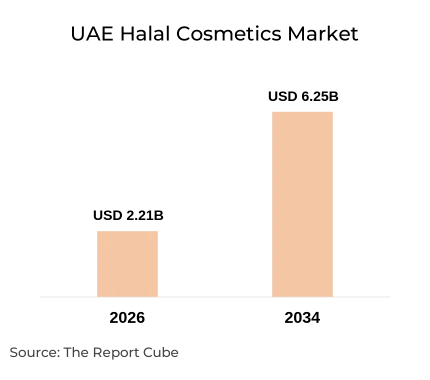
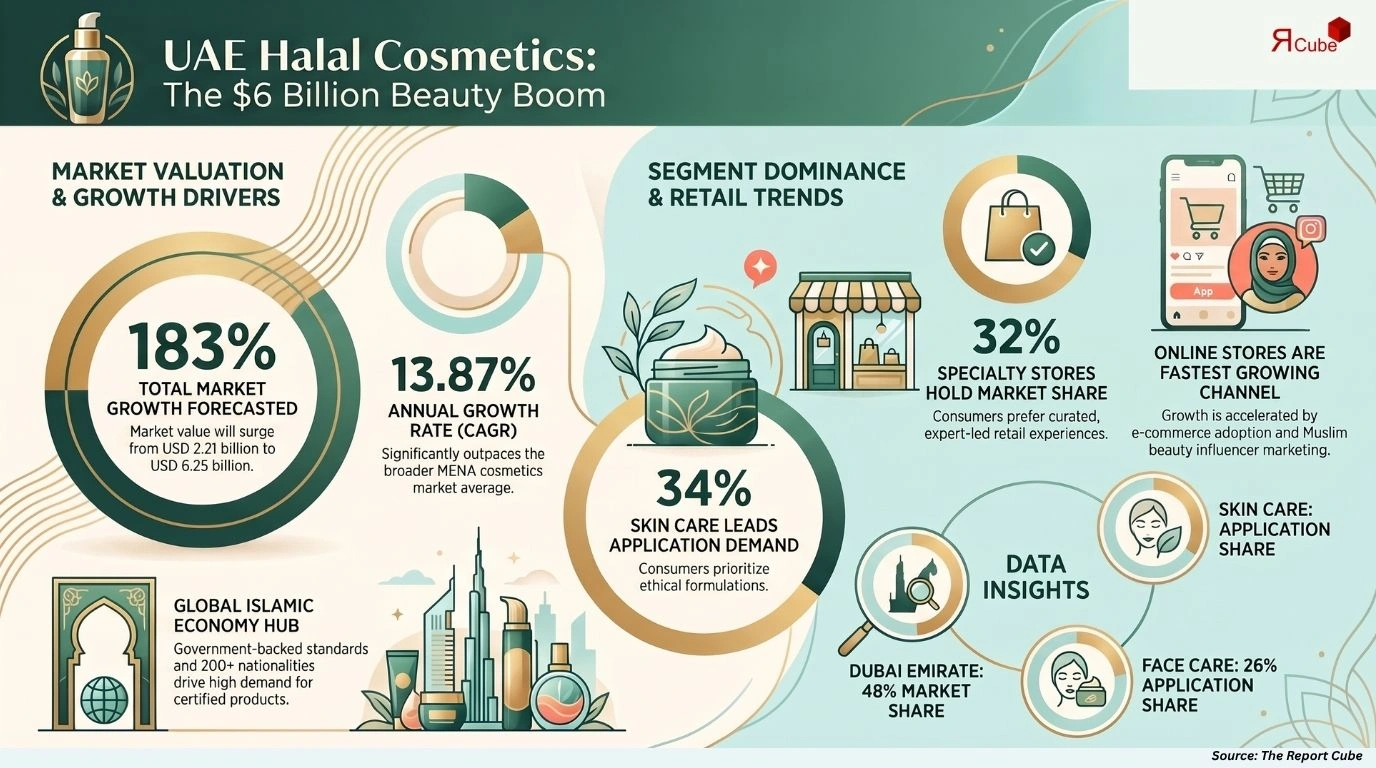
The UAE Halal Cosmetics Market is anticipated to register a 13.87% CAGR during 2026–2034. The market was valued at USD 2.21 billion in 2026 and is projected to reach USD 6.25 billion by 2034. The UAE's position as a global Islamic economy hub, combined with its multicultural consumer base of over 200 nationalities, creates a structurally favorable environment for halal-certified personal care and beauty product adoption. Government-backed initiatives under the UAE National Agenda and Dubai's Islamic Economy Development Centre actively promote halal industry standards across manufacturing, certification, and export operations. International brands including Estee Lauder Companies and L'Oréal S.A. have expanded their halal-certified product portfolios to capture growing demand across UAE's premium retail and e-commerce channels.
Consumer awareness of ingredient transparency, cruelty-free certification, and Shariah-compliant formulations continues to accelerate across the UAE's digitally engaged millennial and Gen Z demographics. Specialty retailers, luxury department stores, and curated online marketplaces are emerging as primary distribution points for halal beauty brands targeting affluent UAE residents and international visitors. INIKA Organic and AMARA COSMETICS have strengthened their UAE market presence through targeted certification campaigns and influencer-led digital commerce strategies. SAMPURE MINERALS and Clara International Beauty Group are intensifying distribution partnerships with UAE specialty beauty retailers to expand shelf presence and improve brand visibility among premium halal cosmetics consumers seeking certified, ethically produced formulations.
UAE Halal Cosmetics Market Size & Forecast
|
Metric |
Details |
|---|---|
|
Market Size (2026) |
USD 2.21 Billion |
|
Market Size (2034) |
USD 6.25 Billion |
|
CAGR (2026–2034) |
13.87% |
|
Base Year |
2026 |
|
Historical Years |
2021–2025 |
|
Forecast Years |
2026–2034 |
This UAE Halal Cosmetics Market Size study values the industry at USD 2.21 billion in 2026, with projections reaching USD 6.25 billion by 2034 at a 13.87% CAGR. Growth substantially outpaces the broader GCC beauty market average, driven by rising halal certification standards, expanding e-commerce penetration, and the UAE's strategic positioning as the Islamic economy's premier retail and tourism destination.
UAE Halal Cosmetics Market Dynamics
The UAE Halal Cosmetics Market is expanding at an accelerated pace as consumer demand for ethically formulated, Shariah-compliant personal care products intensifies across demographic segments. Rising disposable incomes, high smartphone penetration, and the UAE government's active halal economy infrastructure investments are collectively reinforcing the commercial foundations supporting the sector's strong forecast growth trajectory.
|
Factor |
Type |
Specific Impact on Market |
Magnitude |
|---|---|---|---|
|
Growing halal-conscious consumer base |
Driver |
Expands certified product demand across skin, face, and hair care categories |
High |
|
UAE Islamic Economy hub positioning |
Driver |
Strengthens certification infrastructure and attracts global halal beauty brands |
High |
|
Limited certified raw material availability |
Restraint |
Increases production costs and extends halal formulation development timelines |
Medium |
|
E-commerce and influencer-led beauty commerce |
Opportunity |
Opens scalable distribution channels for niche and international halal brands |
High |
|
Evolving global halal certification standards |
Challenge |
Creates compliance complexity for multi-market brands seeking unified certification |
Medium |
|
Premiumization of ethical beauty |
Trend |
Shifts consumer spending toward higher-value certified natural and organic halal products |
High |
- Growth Drivers - Islamic Economy Infrastructure and Consumer Demand: The UAE Halal Cosmetics Market Growth is primarily driven by the UAE's globally recognized Islamic economy ecosystem, which provides robust certification bodies including Emirates Authority for Standardization and Metrology (ESMA) and ESMA-accredited halal certifiers. Dubai's ambition to become the global capital of Islamic economy directly supports infrastructure development for halal beauty manufacturing, testing, and export. Brands such as Wardah Cosmetics and S&J International Enterprises leverage this framework to streamline market entry and certification processes, reinforcing supply-side capacity for certified beauty products.
- Market Opportunities - Digital Commerce and Influencer-Driven Beauty Retail: E-commerce platforms including Noon, Amazon.ae, and brand-direct digital storefronts are enabling halal beauty brands to reach UAE consumers without traditional retail infrastructure investment. Social commerce through Instagram, TikTok, and YouTube - driven by UAE-based Muslim beauty influencers - is generating measurable conversion for brands including INIKA and AMARA COSMETICS, creating cost-effective customer acquisition pathways for niche certified beauty brands.
- Industry Challenges - Fragmented Certification Standards: The global halal cosmetics industry lacks a single unified certification standard, with certifying bodies including ESMA UAE, JAKIM Malaysia, MUI Indonesia, and HFA UK maintaining differing ingredient and process criteria. Multi-market brands operating across GCC and Southeast Asian halal consumer segments face compliance complexity and incremental certification costs when adapting formulations to satisfy divergent regional standards simultaneously
UAE Halal Cosmetics Market Trends
- Emerging Trends: Among the most significant UAE Halal Cosmetics Market Trends is the accelerating convergence of halal certification with clean beauty, vegan, and cruelty-free positioning. UAE consumers increasingly equate halal formulation with broader ethical consumption values, prompting brands including Clara International Beauty Group and SAMPURE MINERALS to pursue multi-certification strategies that simultaneously satisfy halal, vegan, and organic standards across their product portfolios.
- Technology Trends: Blockchain-based ingredient traceability platforms are entering the UAE halal cosmetics supply chain, enabling real-time verification of raw material origins and certification compliance from supplier to retail shelf. AI-powered skin tone analysis tools integrated into halal beauty retail apps are personalizing product recommendations for UAE consumers, improving conversion rates across online specialty platforms while reinforcing brand trust through transparent formulation disclosure.
- Consumer / Buyer Trends: UAE consumers - particularly millennial women and Gen Z beauty enthusiasts - are demonstrating elevated willingness to pay premium price points for verified halal-certified cosmetics with transparent ingredient sourcing credentials. Professional buyers in salon and spa channels increasingly require supplier-provided halal certification documentation, with Kao Corporation and L'Oréal's certified professional lines experiencing increased procurement inquiries from UAE's growing licensed beauty services sector.
Need Specific Data, Let’s Customize the Report for You
Request CustomizationUAE Halal Cosmetics Market Segment Analysis
Bahrain's halal cosmetics segment landscape reflects diverse application needs and distribution preferences across the UAE's multicultural consumer base, with demand driven by both everyday personal care and premium beauty categories. Segment structures reveal strong differentiation across application types and retail channel preferences, with certified brands competing across both mass-market and premium positioning tiers.
By Application
|
Application |
Estimated Share (2026) |
Key Characteristics |
|---|---|---|
|
Skin Care |
34% |
Largest segment; driven by moisturizer, serum, and sun protection demand with halal certification |
|
Face Care |
26% |
Strong premium positioning; foundation, concealer, and BB cream with certified formulations |
|
Hair Care |
22% |
Growing certified shampoo and conditioner demand across multicultural UAE demographic |
|
Beauty Care |
18% |
Nail care, fragrance, and body care; expanding premium halal gifting category adoption |
Skin care commands the largest UAE Halal Cosmetics Market Share among application segments, representing an estimated 34% in 2026. L'Oréal's halal-certified skincare lines and SAMPURE MINERALS' mineral-based certified formulations are among the most distributed products across UAE specialty and online channels. Face care, at approximately 26%, is driven by demand for halal-certified color cosmetics including foundations and highlighters, with INIKA Organic and AMARA COSMETICS leading in certified makeup formulation breadth. Hair care represents approximately 22% of application demand, supplied by Kao Corporation's certified professional hair care portfolio and Wardah Cosmetics' mass-market certified shampoo and conditioner lines across UAE hypermarkets and specialty beauty retailers.
By Distribution Channel
Specialty stores lead distribution channel segmentation with an estimated 32% share in 2026, with retailers including Faces, Sephora UAE, and dedicated halal beauty boutiques stocking curated certified portfolios from Clara International Beauty Group, INIKA, and AMARA COSMETICS. Online stores, representing approximately 28%, are the fastest-growing channel as brands leverage Amazon.ae, Noon, and brand-direct e-commerce to access UAE's digitally engaged consumer base. Hypermarkets and supermarkets, at approximately 22%, remain critical volume channels for certified mass-market brands, with Wardah Cosmetics and S&J International Enterprises maintaining strong shelf presence across Carrefour UAE, Lulu Hypermarket, and Spinneys across the Emirates.
UAE Halal Cosmetics Market Regional Analysis
|
Region |
Estimated Market Share |
Key Growth Factors |
Consumer Trends |
|---|---|---|---|
|
Dubai Emirate |
48% |
Global tourism hub, luxury retail density, premium e-commerce penetration |
High premium halal beauty adoption; influencer-driven digital commerce |
|
Abu Dhabi Emirate |
27% |
Government investment in Islamic economy, affluent resident population |
Certified skincare and face care demand; premium specialty retail |
|
Sharjah Emirate |
14% |
Conservative consumer base with strong halal brand loyalty |
Mass-market certified personal care; high brand trust sensitivity |
|
Northern Emirates |
11% |
Growing residential communities, expanding modern retail infrastructure |
Affordable halal personal care; hypermarket-led distribution |
UAE Halal Cosmetics Market Share & Competitive Landscape
The UAE Halal Cosmetics Market's competitive landscape is shaped by a mix of global prestige beauty conglomerates with certified sub-lines and purpose-built halal beauty brands competing on certification authenticity, ingredient transparency, and digital brand engagement. Key competitive differentiators include ESMA UAE certification breadth, halal ingredient sourcing traceability, influencer partnership strategies, and multi-channel distribution reach across specialty, online, and mass retail environments.
|
Company |
Competitive Strength |
Primary Segment Served |
|---|---|---|
|
Estee Lauder |
Prestige brand equity; certified skincare portfolio |
Skin care; specialty and department store |
|
L'Oréal |
Scale, R&D capability, broad certified professional and consumer line |
Skin care, hair care; multi-channel |
|
S&J International Enterprises |
Specialty halal distribution expertise; SEA origin certification |
All segments; specialty and online |
|
Kao Corporation |
Certified professional hair care; strong salon channel partnerships |
Hair care; professional and specialty |
|
Clara International Beauty Group |
Halal-first brand positioning; pan-Asian distribution |
Face care, skin care; specialty retail |
|
INIKA |
COSMOS-certified organic halal; premium color cosmetics |
Face care, beauty care; specialty and online |
|
AMARA COSMETICS |
Dedicated halal luxury positioning; gifting and color cosmetics |
Face care, beauty care; specialty stores |
|
WARDAH COSMETICS |
High-volume certified mass-market; strong hypermarket distribution |
All segments; hypermarket and online |
|
SAMPURE MINERALS |
Mineral-based certified formulations; clean beauty positioning |
Skin care, face care; online and specialty |
Key Companies in the UAE Halal Cosmetics Market
Estee Lauder Companies Inc.
Estee Lauder Companies Inc., headquartered in New York, USA, is a global prestige beauty conglomerate operating more than 25 brands across 150 countries. In 2025, Estee Lauder expanded its halal-certified skincare product availability across UAE specialty retailers and department store channels, responding to growing institutional demand from Muslim-majority consumer segments. The company's investment in certified formulation R&D and supply chain transparency positions it competitively within UAE's premium halal skincare and personal care retail environment.
L'Oréal S.A.
L'Oréal S.A., headquartered in Clichy, France, is the world's largest beauty company by revenue, operating across consumer, professional, and luxury divisions globally. In 2025, L'Oréal reinforced its UAE halal cosmetics presence by extending certified product certification across additional SKUs within its mass-market and professional hair care portfolios. Its vertically integrated supply chain, dedicated halal R&D laboratory investments, and strong omnichannel UAE distribution network - spanning Carrefour, Sephora, and Amazon.ae - provide structural competitive advantages across all application segments.
UAE Halal Cosmetics Market Recent Developments
|
Year |
Company |
Development |
|---|---|---|
|
2025 |
Estee Lauder |
Expanded halal-certified skincare SKU availability across UAE specialty retail and department store channels |
|
2025 |
L'Oréal S.A. |
Extended halal certification across professional hair care portfolio lines for UAE salon channel distribution |
|
2025 |
WARDAH COSMETICS |
Strengthened UAE e-commerce presence through Noon and Amazon.ae partnership for certified beauty product distribution |
|
2025 |
INIKA Organic |
Launched expanded halal and COSMOS-certified color cosmetics range targeting UAE premium specialty beauty retailers |
UAE Halal Cosmetics Market Future Outlook
The UAE Halal Cosmetics Market Forecast projects a CAGR of 13.87% through 2034, with the market reaching USD 6.25 billion as premium certified beauty adoption accelerates across the UAE's growing and diversifying consumer base. Estee Lauder, L'Oréal, and INIKA Organic are expected to intensify certified product portfolio expansion as institutional procurement from UAE hospitality, salon, and specialty retail channels grows. Wardah Cosmetics and AMARA COSMETICS are positioned to scale distribution across both physical and digital retail environments through 2034.
Technological advancement in halal formulation science - including plant-derived emulsifier innovation, certified bioactive ingredient development, and blockchain-enabled supply chain traceability - will increasingly define competitive differentiation among UAE halal cosmetics suppliers. Alignment with ESMA UAE.S 2055-1 certification standards and growing GCC harmonization efforts will raise compliance expectations for all market participants, while simultaneously strengthening consumer confidence in certified halal beauty product authenticity and ingredient integrity through the forecast period.
UAE Halal Cosmetics Market Report Coverage
This UAE Halal Cosmetics Market Report covers the complete forecast period from 2026 through 2034, providing actionable intelligence across segmentation, regional, and competitive dimensions for strategic planning and investment decisions.
|
Report Attribute |
Details |
|---|---|
|
Market Name |
UAE Halal Cosmetics Market |
|
Market Size (2026) |
USD 2.21 Billion |
|
Market Size (2034) |
USD 6.25 Billion |
|
Forecast Period |
2026–2034 |
|
CAGR |
13.87% |
|
Base Year |
2026 |
|
Historical Years |
2021–2025 |
|
Forecast Years |
2026–2034 |
|
Segments Covered |
By Product Type, By Application, By Distribution Channel |
|
Regions Covered |
Dubai Emirate, Abu Dhabi Emirate, Sharjah Emirate, Northern Emirates |
|
Key Companies |
Estee Lauder, L'Oréal, S&J International Enterprises, Kao Corporation, Clara International Beauty Group, INIKA, AMARA COSMETICS, WARDAH COSMETICS, SAMPURE MINERALS, Others |
|
Report Format |
PDF, Excel, PPT |
|
Customization |
Available as per client requirements |
Why Choose This UAE Halal Cosmetics Market Report?
- Comprehensive coverage of the UAE's rapidly expanding halal-certified personal care and beauty industry.
- Accurate market sizing from USD 2.21 billion in 2026 through the 2034 forecast with CAGR validation.
- Detailed segmentation by application type and distribution channel with verified share percentages.
- Emirate-level regional insights covering Dubai, Abu Dhabi, Sharjah, and Northern Emirates demand dynamics.
- Competitive profiling of 9 leading global and specialized halal cosmetics brands operating in the UAE.
- Analysis of certification landscape, ESMA standard evolution, and GCC harmonization regulatory trends.
- Forecast data supporting brand strategy, retail partnership planning, and halal certification investment decisions.
- Research aligned with UAE Islamic Economy Development Centre and National Agenda halal industry objectives.
Table of Contents
- Introduction
- Objective of the Study
- Product Definition
- Market Segmentation
- Study Variables
- Research Methodology
- Secondary Data Points
- Companies Interviewed
- Primary Data Points
- Breakdown of Primary Interviews
- Secondary Data Points
- Executive Summary
- Market Dynamics
- Drivers
- Challenges
- Opportunity Assessment
- Recent Trends and Developments
- Policy and Regulatory Landscape
- UAE Halal Cosmetics Market Overview and Forecast Analysis (2021-2034)
- Market Size, By Value, By Growth Rate (CAGR/USD Billions)
- Demand – Supply Trends
- Market Share, By Product Type
- Personal Care Products
- Color Cosmetics
- Fragrances
- Market Share, By Application
- Hair Care
- Skin Care
- Face Care
- Beauty Care
- Market Share, By Distribution Channel
- Hypermarkets & Supermarket
- Online Stores
- Convenience Stores
- Specialty Stores
- Others
- Market Share, By Region
- Abu Dhabi Emirate
- Dubai Emirate
- Sharjah Emirate
- Northern Emirates
- Market Share, By Competitors
- Competition Characteristics
- Revenue Shares
- Personal Care Products UAE Halal Cosmetics Market Overview, 2021-2034F
- By Value (USD Million)
- By Application – Market Size & Forecast 2021-2034, USD Million
- Hair Care
- Skin Care
- Face Care
- Beauty Care
- Color Cosmetics UAE Halal Cosmetics Market Overview, 2021-2034F
- By Value (USD Million)
- By Application – Market Size & Forecast 2021-2034, USD Million
- Hair Care
- Skin Care
- Face Care
- Beauty Care
- Fragrances UAE Halal Cosmetics Market Overview, 2021-2034F
- By Value (USD Million)
- By Application – Market Size & Forecast 2021-2034, USD Million
- Hair Care
- Skin Care
- Face Care
- Beauty Care
- Competitive Outlook (Company Profile - Partial List)
- Estee Lauder
- Company Overview
- Business Segments
- Strategic Alliances/Partnerships
- Recent Developments
- L’Oréal
- Company Overview
- Business Segments
- Strategic Alliances/Partnerships
- Recent Developments
- S&J International Enterprises
- Company Overview
- Business Segments
- Strategic Alliances/Partnerships
- Recent Developments
- Kao Corporation
- Company Overview
- Business Segments
- Strategic Alliances/Partnerships
- Recent Developments
- Clara International Beauty Group
- Company Overview
- Business Segments
- Strategic Alliances/Partnerships
- Recent Developments
- INIKA
- Company Overview
- Business Segments
- Strategic Alliances/Partnerships
- Recent Developments
- AMARA COSMETICS
- Company Overview
- Business Segments
- Strategic Alliances/Partnerships
- Recent Developments
- WARDAH COSMETICS
- Company Overview
- Business Segments
- Strategic Alliances/Partnerships
- Recent Developments
- SAMPURE MINERALS
- Company Overview
- Business Segments
- Strategic Alliances/Partnerships
- Recent Developments
- Others
- Estee Lauder
- Contact Us & Disclaimer
Top Key Players & Market Share Outlook
- Estee Lauder
- L’Oréal
- S&J International Enterprises
- Kao Corporation
- Clara International Beauty Group
- INIKA
- AMARA COSMETICS
- WARDAH COSMETICS
- SAMPURE MINERALS
- Others
Frequently Asked Questions






