

Build Your Custom Market Intelligence Report
Customize Your ReportKey Takeaways
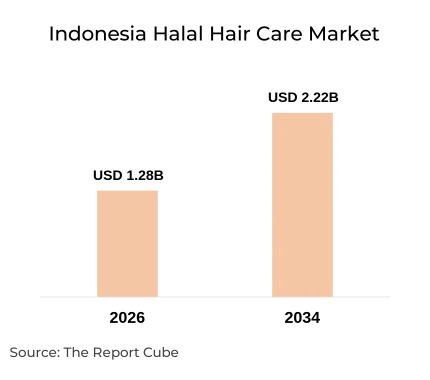
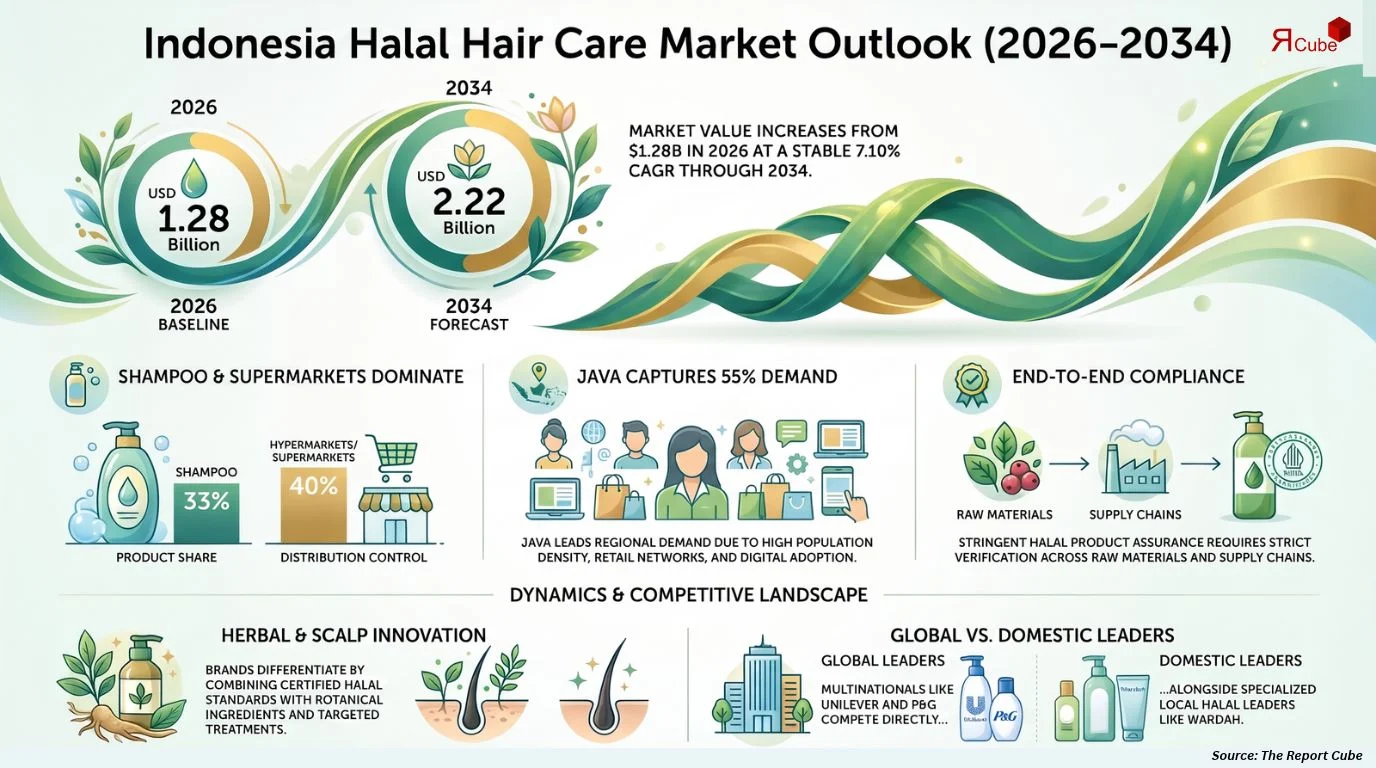
- Indonesia Halal Hair Care Market valued at USD 1.28 billion in 2026.
- Industry projected to reach USD 2.22 billion by 2034 at 7.10% CAGR.
- Shampoo leads the product segment with an estimated 33% share in 2026.
- Hypermarkets and supermarkets lead distribution channels with an estimated 40% share in 2026.
- Java dominates regional demand with an estimated 55% share in 2026.
- Unilever, L’Oréal Paris, Wardah, Sariayu Cosmetics, and Procter & Gamble lead competition.
- Halal certification and herbal ingredient positioning are shaping product development.
Market Overview
Halal hair care covers shampoos, conditioners, hair oils, hair colors, and styling products formulated with ingredients and processes that comply with halal requirements. Products are used for cleansing, conditioning, nourishment, scalp care, and styling, and manufacturers must verify raw materials, production processes, and supply-chain traceability before products can carry halal assurance.
The Indonesia Halal Hair Care Market is supported by the country’s large Muslim consumer base, rising interest in personal grooming, and growing demand for branded, quality hair-care products. Retail expansion across hypermarkets, convenience stores, and online platforms improves product access, while halal certification strengthens consumer confidence in shampoos, conditioners, hair oils, and treatment products.
This Indonesia Halal Hair Care Market Analysis shows that herbal ingredients, natural positioning, and digital product discovery are shaping consumer purchasing decisions. The market was valued at USD 1.28 billion in 2026 and is projected to reach USD 2.22 billion by 2034, growing at a CAGR of 7.10% during 2026–2034.
Indonesia Halal Hair Care Market Dynamics
Indonesian halal hair care demand is shaped by halal-conscious purchasing, personal grooming habits, ingredient sourcing, product quality, and retail-channel development. Certification requirements influence manufacturing costs, product positioning, and market entry, while branded competition, herbal formulations, and online retail affect pricing, adoption, and growth across domestic and imported hair-care products.
|
Factor |
Type |
Specific Impact on Market |
Magnitude |
|---|---|---|---|
|
Demand for halal-certified personal-care products |
Driver |
Supports purchases of products with credible halal assurance |
High (qualitative) |
|
Preference for branded, quality hair care |
Driver |
Encourages range expansion in shampoos, conditioners, and hair oils |
Medium to High (qualitative) |
|
Halal-certified herbal and treatment-focused products |
Opportunity |
Enables differentiation through targeted hair and scalp benefits |
High (qualitative) |
|
Certification and supply-chain compliance |
Challenge |
Raises verification, documentation, and traceability requirements |
High (qualitative) |
|
Halal and natural ingredient positioning |
Trend |
Shapes product development and brand differentiation |
Medium to High (qualitative) |
|
Digital product discovery and online retail |
Trend |
Expands reach for specialist and emerging brands |
Medium (qualitative) |
Indonesia Halal Hair Care Market Growth Drivers
Indonesia Halal Hair Care Market Growth is supported by demand for products with credible halal assurance among the country’s large Muslim consumer base. Indonesia’s Ministry of Trade announced an April 2026 initiative to support halal certification for beauty and personal-care businesses, underlining certification’s role in consumer confidence and industry competitiveness.
Consumers are increasingly purchasing branded, quality products for cleansing, conditioning, nourishment, and targeted hair concerns, supported by rising personal grooming. This encourages manufacturers to broaden their shampoo, conditioner, and hair oil ranges, strengthen long-term brand credibility, and compete through formulation quality, certification, and availability across modern retail and online channels.
Indonesia Halal Hair Care Market Opportunities
Indonesia Halal Hair Care Market participants can develop halal-certified herbal and treatment-focused products, including shampoos, conditioners, and hair oils designed for dandruff control, damage repair, and scalp care. These formulations combine halal assurance with differentiated performance, addressing specific consumer needs and giving manufacturers room to expand beyond basic cleansing products.
Indonesian manufacturers can use halal certification, traceability, and consistent product standards to strengthen positioning in domestic and international markets. In April 2026, the Ministry of Trade reported that beauty and personal-care exports reached USD 2.05 billion in 2025, growing 16.19%; this covers the broader sector, not halal hair care alone.
Indonesia Halal Hair Care Industry Challenges
Manufacturers in the Indonesia Halal Hair Care Market must verify ingredients, production processes, and supply-chain traceability to meet halal requirements. Government Regulation No. 42 of 2024 sets Indonesia’s halal product assurance framework, but implementation timelines have shifted, and businesses must confirm current deadlines for cosmetics and personal-care products with the relevant authorities before planning certification schedules.
Hair-care companies must manage ingredient sourcing, formulation quality, product performance, and halal compliance at the same time. Imported ingredients and complex supply chains can require additional documentation and verification, particularly for products marketed as halal-certified. Each change in supplier or formulation may require fresh verification, which can slow product launches.
Need Specific Data, Let’s Customize the Report for You
Request CustomizationIndonesia Halal Hair Care Market Trends
Indonesia Halal Hair Care Market Trends show brands differentiating products by combining halal assurance with herbal ingredients, botanical oils, and naturally positioned formulations. Consumer interest in organic, natural, and herbal hair care is an established market theme, and it is influencing shampoo, conditioner, and hair oil development across both local and international brands in Indonesia.
E-commerce and social-media content allow consumers to discover products, compare ingredients, assess brand credibility, and purchase specialist hair-care items. Online retail is a defined channel in Indonesian halal hair care, giving smaller halal brands a route beyond physical retail networks, while digital visibility is increasingly important for brands competing with established supermarket and hypermarket distribution.
Indonesia Halal Hair Care Market Segment Analysis
The Indonesia Halal Hair Care Market is segmented by product and distribution channel. Product demand reflects daily grooming routines, treatment needs, and ingredient preferences, while distribution channels determine brand visibility, price access, and consumer convenience across urban and regional markets.
By Product
- Shampoo
- Hair Color
- Conditioners
- Hair Oil
- Styling Products
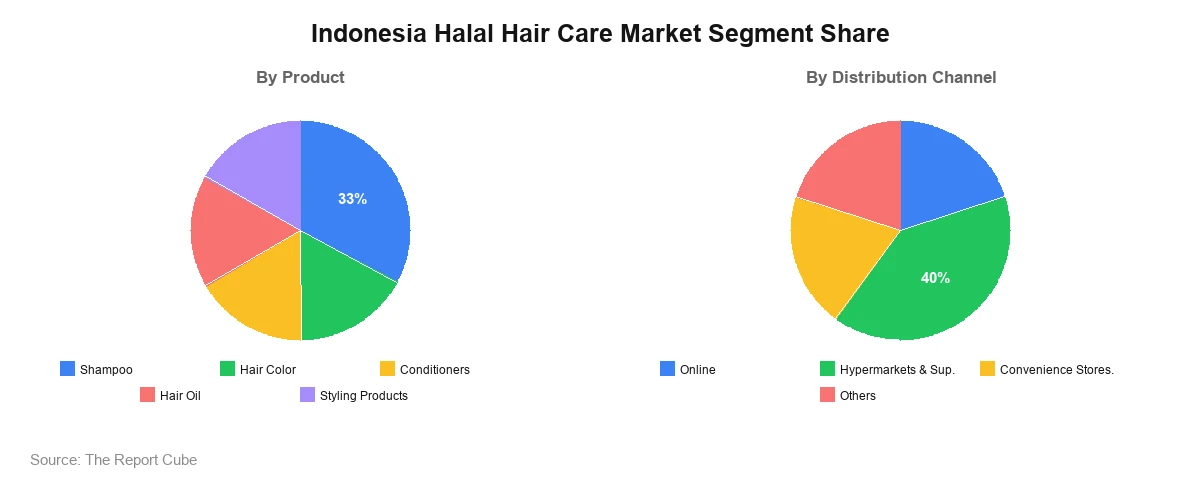
Indonesia Halal Hair Care Market Share is led by shampoo, which holds an estimated 33% in 2026, supported by routine household use, wide price availability, and the central role of cleansing in daily hair care. Global and domestic companies, including Unilever and Procter & Gamble, compete in mass-market shampoo, while Sariayu Cosmetics is associated with herbal-oriented personal care. Hair color addresses appearance and fashion preferences, although halal-compliant formulations require careful ingredient verification. Conditioners complement shampoo use and respond to demand for smoothness, nourishment, and damage care. Hair oil benefits from traditional hair-care habits and interest in botanical ingredients for scalp and hair nourishment. Styling products are supported by grooming trends and social-media exposure, with performance and certification awareness influencing choices.
By Distribution Channel
- Online
- Hypermarkets & Supermarkets
- Convenience Stores
- Others
Hypermarkets and supermarkets lead distribution with an estimated 40% share in 2026, as consumers can compare brands, access multiple price tiers, and purchase family hair-care products during routine shopping trips. Online retail offers a different route, allowing consumers to discover specialist halal products, review ingredients, and assess brand credibility through digital content. Convenience stores support quick, nearby purchases of everyday personal-care items, while other channels complement coverage and extend product availability. Distribution strategies therefore increasingly combine modern retail presence with digital visibility and clear halal assurance.
Regional Analysis
|
Region |
Estimated Market Share |
Key Growth Factors |
Industry Trends |
|---|---|---|---|
|
Java |
55% (2026) |
Population concentration, modern retail, e-commerce, manufacturing base |
Strong brand availability and digital product discovery |
|
Sumatra |
- |
Regional retail expansion and consumer access |
Growing demand for certified products |
|
Kalimantan |
- |
Distribution reach and urban demand |
Rising modern retail and online access |
|
Sulawesi |
- |
Urban retail development |
Increasing availability of branded hair care |
|
Bali & Nusa Tenggara |
- |
Retail and tourism-linked consumption |
Wider access to personal-care brands |
|
Maluku & Papua |
- |
Developing logistics and retail access |
Online channels supporting availability |
Java leads the Indonesia Halal Hair Care Market with an estimated 55% share in 2026, reflecting its concentration of population, modern retail networks, e-commerce activity, and manufacturing capacity. Dense urban markets support wider brand availability, stronger digital product discovery, and higher access to certified hair-care products than less developed distribution areas.
Sumatra, Kalimantan, Sulawesi, Bali & Nusa Tenggara, and Maluku & Papua together account for the remaining estimated 45% share. Demand in these regions depends on retail penetration, logistics, and consumer access to certified products, with online channels and modern retail expansion creating additional opportunities for manufacturers to improve regional availability.
Market Share & Competitive Landscape
The Indonesia Halal Hair Care Market includes multinational personal-care groups, Indonesian beauty companies, and halal-focused brands. Competition is shaped by halal assurance, brand recognition, product range, ingredient positioning, and distribution reach. The table below describes qualitative positioning, not numerical market share.
|
Company |
Competitive Strength |
Primary Segment Served |
|---|---|---|
|
Unilever |
Large consumer-goods portfolio and mass-market distribution |
Shampoo and conditioners |
|
L’Oréal Paris |
Global beauty brand with professional-style positioning |
Hair color and treatment products |
|
Wardah |
Established halal beauty brand in Indonesia |
Halal-positioned beauty and personal care |
|
Sariayu Cosmetics |
Indonesian beauty brand associated with herbal positioning |
Herbal-oriented hair and personal care |
|
Procter & Gamble |
Multinational hair-care presence and broad retail reach |
Shampoo and conditioners |
|
Clara International Beauty Group |
Indonesia-focused beauty and personal-care operations |
Beauty and personal care |
|
Iba Halal |
Halal-certified personal-care positioning |
Halal personal care |
|
PHB Ethical Beauty Ltd. |
Ethical and halal-oriented beauty positioning |
Halal beauty and personal care |
|
PT Paragon Technology and Innovation |
Parent company of Wardah and a multi-brand portfolio |
Beauty and personal care |
Key Companies in the Indonesia Halal Hair Care Market
Unilever: Unilever is headquartered in London, United Kingdom, and operates a broad global consumer goods portfolio, including hair-care brands. In Indonesia, it competes through its local consumer-goods operations and mass-market distribution reach. Its scale, brand portfolio, and retail presence make it a major participant in shampoo and conditioner categories.
PT Paragon Technology and Innovation: PT Paragon Technology and Innovation is an Indonesia-based halal beauty company and the parent of Wardah, a brand launched in 1995 by founder Nurhayati Subakat. Its portfolio includes Wardah, Make Over, Emina, and Kahf. In 2025, Kahf and Wardah supported Open Iftar London, extending brand visibility among international Muslim consumers.
Recent Developments
|
Year / Month |
Company |
Development |
|---|---|---|
|
2025 |
PT Paragon Technology and Innovation (Kahf, Wardah) |
Supported Open Iftar London 2025, extending the brands’ international visibility. |
|
April 2026 |
Ministry of Trade, Indonesia |
Announced support for halal certification in beauty and personal care; reported USD 2.05 billion sector exports in 2025. |
|
April 2026 |
Ministry of Industry, Indonesia |
Accelerated development of the halal industry ecosystem ahead of the mandatory certification schedule for cosmetics and consumer goods. |
|
August 2026 |
BPJPH |
Issued Regulation No. 4 of 2026 on conformity assurance for foreign halal products; later reported as revoked. |
|
October 2026 |
Government of Indonesia |
Extended mandatory halal certification deadlines for categories including cosmetics to 17 October 2028, per reports. |
Indonesia Halal Hair Care Market Future Outlook
The Indonesia Halal Hair Care Market Forecast indicates growth from USD 1.28 billion in 2026 to USD 2.22 billion by 2034, at a CAGR of 7.10%. Demand is expected to be shaped by halal-conscious purchasing, branded hair-care adoption, herbal formulations, and wider retail and online availability, although the overall pace will depend on regulatory certification timelines, ingredient access, and competitive intensity.
Manufacturers are likely to prioritize halal-certified herbal products, treatment-focused shampoos and hair oils, traceable ingredient sourcing, and digital engagement to meet changing consumer expectations across the forecast period. The revised certification timeline may give businesses additional time to prepare, but credible halal assurance is expected to remain central to consumer trust. These outcomes remain conditional on regulation, supply-chain readiness, and consumer demand.
Indonesia Halal Hair Care Market Report Coverage
This Indonesia Halal Hair Care Market Report summarizes market size, segmentation, regional distribution, competition, and forecast parameters for 2026–2034.
|
Parameter |
Details |
|---|---|
|
Market Name |
Indonesia Halal Hair Care Market |
|
Market Size 2026 |
USD 1.28 Billion |
|
Market Size 2034 |
USD 2.22 Billion |
|
Forecast Period |
2026–2034 |
|
CAGR |
7.10% |
|
Base Year |
2026 |
|
Historical Years |
2021–2025 |
|
Forecast Years |
2026–2034 |
|
Segments Covered |
By Product, By Distribution Channel, By Region |
|
Regions Covered |
Java, Sumatra, Kalimantan, Sulawesi, Bali & Nusa Tenggara, Maluku & Papua |
|
Key Companies |
Unilever, L’Oréal Paris, Wardah, Sariayu Cosmetics, Procter & Gamble, Clara International Beauty Group, Iba Halal, PHB Ethical Beauty Ltd., PT Paragon Technology and Innovation |
|
Customization |
Available as per client requirements |
Why Choose This Indonesia Halal Hair Care Market Report?
- Covers halal hair-care demand across products, distribution channels, and Indonesian regions.
- Presents 2026 market size, 2034 projections, and CAGR in one consistent framework.
- Segments the market by product and distribution channel for planning and benchmarking.
- Compares Java with other Indonesian regions to support regional assessment.
- Profiles multinational, domestic, and halal-focused companies competing in the market.
- Reviews halal certification developments, herbal positioning, and digital retail trends.
- Supports strategic planning with clearly labeled estimates and conditional forecasts.
Table of Contents
- Introduction
- Objective of the Study
- Product Definition
- Market Segmentation
- Study Variables
- Research Methodology
- Secondary Data Points
- Companies Interviewed
- Primary Data Points
- Breakdown of Primary Interviews
- Secondary Data Points
- Executive Summary
- Market Dynamics
- Drivers
- Challenges
- Opportunity Assessment
- Recent Trends and Developments
- Policy and Regulatory Landscape
- Indonesia Halal Hair Care Market Overview and Forecast Analysis (2021-2034)
- Market Size, By Value, By Growth Rate (CAGR/USD Billions)
- Demand – Supply Trends
- Market Share, By Product
- Shampoo
- Hair Color
- Conditioners
- Hair Oil
- Styling Products
- Online
- Hypermarkets & Supermarkets
- Convenience Stores
- Others
- Market Share, By Region
- Java
- Sumatra
- Kalimantan
- Sulawesi
- Bali & Nusa Tenggara
- Maluku & Papua
- Market Share, By Competitors
- Competition Characteristics
- Revenue Shares
- Shampoo Indonesia Halal Hair Care Market Overview, 2021-2034F
- By Value (USD Million)
- By Region – Market Size & Forecast 2021-2034, USD Million
- Java
- Sumatra
- Kalimantan
- Sulawesi
- Bali & Nusa Tenggara
- Maluku & Papua
- Hair Color Indonesia Halal Hair Care Market Overview, 2021-2034F
- By Value (USD Million)
- By Region – Market Size & Forecast 2021-2034, USD Million
- Java
- Sumatra
- Kalimantan
- Sulawesi
- Bali & Nusa Tenggara
- Maluku & Papua
- Conditioners Indonesia Halal Hair Care Market Overview, 2021-2034F
- By Value (USD Million)
- By Region – Market Size & Forecast 2021-2034, USD Million
- Java
- Sumatra
- Kalimantan
- Sulawesi
- Bali & Nusa Tenggara
- Maluku & Papua
- Hair Oil Indonesia Halal Hair Care Market Overview, 2021-2034F
- By Value (USD Million)
- By Region – Market Size & Forecast 2021-2034, USD Million
- Java
- Sumatra
- Kalimantan
- Sulawesi
- Bali & Nusa Tenggara
- Maluku & Papua
- Styling Products Indonesia Halal Hair Care Market Overview, 2021-2034F
- By Value (USD Million)
- By Region – Market Size & Forecast 2021-2034, USD Million
- Java
- Sumatra
- Kalimantan
- Sulawesi
- Bali & Nusa Tenggara
- Maluku & Papua
- Online Indonesia Halal Hair Care Market Overview, 2021-2034F
- By Value (USD Million)
- By Region – Market Size & Forecast 2021-2034, USD Million
- Java
- Sumatra
- Kalimantan
- Sulawesi
- Bali & Nusa Tenggara
- Maluku & Papua
- Hypermarkets & Supermarkets Indonesia Halal Hair Care Market Overview, 2021-2034F
- By Value (USD Million)
- By Region – Market Size & Forecast 2021-2034, USD Million
- Java
- Sumatra
- Kalimantan
- Sulawesi
- Bali & Nusa Tenggara
- Maluku & Papua
- Convenience Stores Indonesia Halal Hair Care Market Overview, 2021-2034F
- By Value (USD Million)
- By Region – Market Size & Forecast 2021-2034, USD Million
- Java
- Sumatra
- Kalimantan
- Sulawesi
- Bali & Nusa Tenggara
- Maluku & Papua
- Others Indonesia Halal Hair Care Market Overview, 2021-2034F
- By Value (USD Million)
- By Region – Market Size & Forecast 2021-2034, USD Million
- Java
- Sumatra
- Kalimantan
- Sulawesi
- Bali & Nusa Tenggara
- Maluku & Papua
- Competitive Outlook (Company Profile – Partial List)
- Unilever
- Company Overview
- Business Segments
- Strategic Alliances/Partnerships
- Recent Developments
- L'Oréal Paris
- Company Overview
- Business Segments
- Strategic Alliances/Partnerships
- Recent Developments
- Wardah
- Company Overview
- Business Segments
- Strategic Alliances/Partnerships
- Recent Developments
- Sariayu Cosmetics
- Company Overview
- Business Segments
- Strategic Alliances/Partnerships
- Recent Developments
- Procter & Gamble
- Company Overview
- Business Segments
- Strategic Alliances/Partnerships
- Recent Developments
- CLARA INTERNATIONAL BEAUTY GROUP
- Company Overview
- Business Segments
- Strategic Alliances/Partnerships
- Recent Developments
- Iba Halal
- Company Overview
- Business Segments
- Strategic Alliances/Partnerships
- Recent Developments
- PHB Ethical Beauty Ltd.
- Company Overview
- Business Segments
- Strategic Alliances/Partnerships
- Recent Developments
- PT Paragon Technology and Innovation
- Company Overview
- Business Segments
- Strategic Alliances/Partnerships
- Recent Developments
- Unilever
- Contact Us & Disclaimer
Top Key Players & Market Share Outlook
- Unilever
- L'Oréal Paris
- Wardah
- Sariayu Cosmetics
- Procter & Gamble
- CLARA INTERNATIONAL BEAUTY GROUP
- Iba Halal
- PHB Ethical Beauty Ltd.
- PT Paragon Technology and Innovation
Frequently Asked Questions