



Build Your Custom Market Intelligence Report
Customize Your ReportMalaysia Halal Skincare Products Market Insights & Analysis
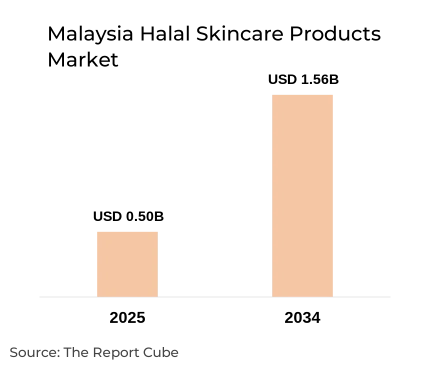
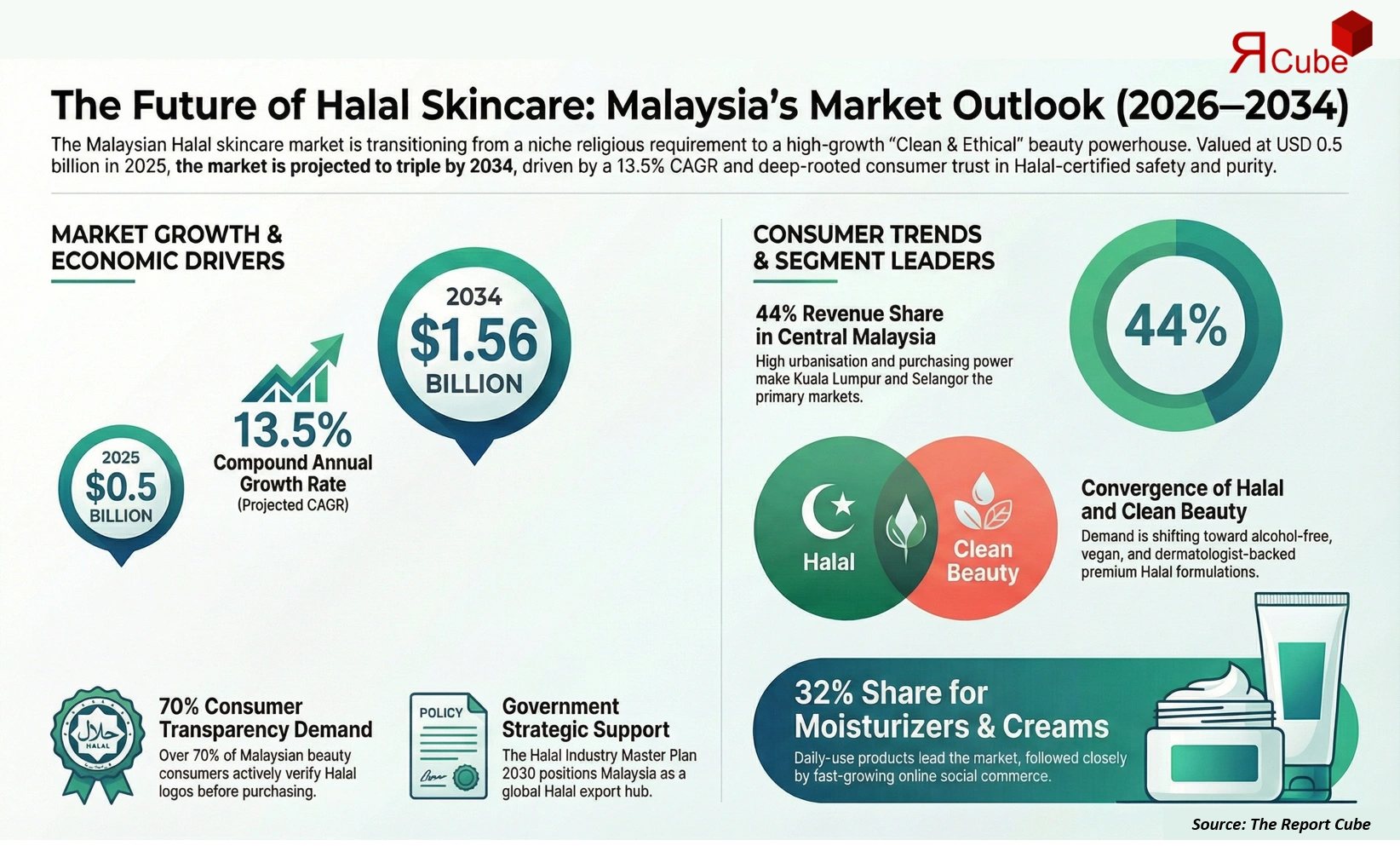
The Malaysia Halal Skincare Products Market is anticipated to register a CAGR of 13.50% during 2026-2034. The market size was valued at USD 0.5 billion in 2025 and is projected to reach USD 1.56 billion by 2034. Malaysia remains one of the most influential halal beauty hubs globally, supported by a strong Muslim consumer base, well-established halal certification frameworks, and rising awareness of ethical, clean, and Shariah-compliant personal care products.
Consumer preferences in Malaysia are shifting rapidly toward halal-certified skincare that also aligns with clean beauty, vegan, and cruelty-free principles. Over 70% of Malaysian beauty consumers actively check halal logos and ingredient transparency before purchase, highlighting trust in certified formulations. The growing influence of social commerce, beauty influencers, and dermatologist-backed halal brands further accelerates market penetration.
In addition, Malaysia’s role as a regional halal export gateway strengthens domestic innovation. Local brands are increasingly developing premium formulations using botanical and dermocosmetic actives, while multinational brands continue expanding halal-certified portfolios. These factors collectively position the Malaysia Halal Skincare Products Market for strong double-digit growth through 2034.
Malaysia Halal Skincare Products Market Recent Developments
- 2025: Safi Malaysia launched a halal-certified anti-aging serum line using botanical actives.
- 2025: Wardah expanded its Malaysia operations with clean-beauty halal skincare collections.
Government Initiatives & Policies
- Halal Industry Master Plan 2030: Strengthens Malaysia’s position as a global halal hub.
- JAKIM Halal Certification Framework: Regulates halal cosmetic and personal care standards.
Malaysia Halal Skincare Products Market Dynamics
Key Driver: Strong Halal Awareness and Ethical Beauty Preferences
The primary driver of the Malaysia Halal Skincare Products Market is heightened halal awareness combined with ethical beauty demand. Malaysian consumers increasingly associate halal skincare with safety, purity, and ethical sourcing. Halal certification assures alcohol-free, animal-derivative-free, and contamination-free formulations, which appeal beyond Muslim consumers. Rising skin sensitivity issues and demand for gentle, dermatologist-tested products further reinforce preference for halal skincare. The growth of modest fashion and Islamic lifestyle branding also supports integrated halal beauty consumption.
Industry Trends: Convergence of Halal, Clean Beauty, and Dermocosmetics
Book your FREE 30-minute expert consultation today
Contact UsA major trend shaping the market is the convergence of halal certification with clean beauty and dermocosmetic positioning. Brands are emphasizing alcohol-free, allergen-reduced, and clinically tested formulations. Functional actives such as niacinamide, hyaluronic acid, and botanical extracts are increasingly incorporated into halal-certified products. Premium halal skincare is growing at over 15% annually, driven by masstige and premium price tiers. Social commerce platforms such as TikTok Shop and Instagram play a critical role in product discovery and consumer education.
Major Challenge: Market Saturation and Brand Differentiation
Despite strong growth, market saturation poses a challenge, particularly in the mass and masstige segments. Numerous local and regional brands compete aggressively, increasing marketing costs and price sensitivity. Maintaining differentiation through innovation, clinical validation, and sustainable packaging is critical. Additionally, the cost and time required for halal certification and reformulation can limit rapid product launches, especially for smaller brands.
Opportunity: Export-Oriented Growth and Digital-First Expansion
Malaysia’s halal skincare brands are well-positioned to expand into ASEAN, Middle East, and South Asian markets. Export-oriented growth supported by JAKIM-recognized certification enhances global acceptance. Digital-first and direct-to-consumer models allow brands to scale efficiently while engaging niche consumer groups. Subscription-based skincare routines and personalized halal beauty solutions present high-growth opportunities through 2034.
Malaysia Halal Skincare Products Market Segment-wise Analysis
By Product Type:
- Cleansers & Face Wash
- Toners & Mists
- Moisturizers & Creams
- Serums & Treatments
Moisturizers and creams lead the segment, accounting for approximately 32% market share due to daily usage and suitability for sensitive skin.
By Distribution Channel:
- Hypermarkets & Supermarkets
- Pharmacies & Health & Beauty Chains
- Online & E-commerce Platforms
- Direct Selling & Social Commerce
Online and social commerce channels are the fastest-growing, contributing nearly 29% of total sales, driven by influencer marketing and live commerce.
Need insights for a specific region within this market?
Request Regional DataRegional Projection of Malaysia Halal Skincare Products Industry
- Central Malaysia
- Northern Malaysia
- Southern Malaysia
- Eastern Malaysia
- Sabah & Sarawak
Central Malaysia dominates the market with approximately 44% revenue share, supported by high urbanization, stronger purchasing power, and dense retail networks in Kuala Lumpur and Selangor. Consumers in this region show higher adoption of premium and dermatologist-tested halal skincare products.
Why Choose This Report?
- Provides a comprehensive overview of the overall market analysis, encompassing key trends, consumer behavior analysis, and risk assessment.
- Provides accurate, up-to-date insights into market size, segmentation, and emerging opportunities.
- Gives deep understanding of target audience preferences and investment habits.
- Delivers competitive analysis & benchmarking to guide strategies.
- Consolidates comprehensive market intelligence, streamlining research efforts.
- Facilitates customized market segmentation & risk mitigation strategies.
- Aids in identifying both market challenges & untapped opportunities.
- Provides valuable information based on actual customer data & search trends.
Table of Contents
- Introduction
- Objective of the Study
- Product and Category Definition
- Market Segmentation
- Study Variables
- Research Methodology
- Secondary Data Points
- Breakdown of Secondary Sources
- Primary Data Points
- Breakdown of Primary Interviews
- Secondary Data Points
- Executive Summary
- Market Dynamics
- Drivers
- Challenges
- Opportunity Assessment
- Recent Trends and Developments
- Regulatory and Policy Landscape
- Malaysia Halal Skincare Products Market Overview (2026-2034)
- Market Size, By Value (USD Million)
- Market Size, By Volume (Million Units)
- Market Share, By Product Type
- Cleansers & Face Wash
- Toners & Mists
- Moisturizers & Creams
- Serums & Treatments
- Sunscreens & Sun Care
- Masks, Peels & Exfoliators
- Body Care & Hand Care
- Market Share, By Skin Concern
- Hydration & Barrier Support
- Brightening & Pigmentation Control
- Anti-Aging & Firming
- Acne & Blemish Control
- Sensitive & Dermatitis-Prone Skin
- Market Share, By Ingredient Type
- Natural & Botanical-Based
- Organic & Eco-Certified
- Dermocosmetic & Functional Actives
- Alcohol-Free & Allergen-Reduced
- Market Share, By Certification & Claim
- Halal-Certified (JAKIM & Recognized Bodies)
- Vegan & Cruelty-Free
- Clean Beauty & Non-Toxic
- Dermatologist-Tested & Hypoallergenic
- Market Share, By Gender & Age Group
- Women (18–34)
- Women (35+)
- Men’s Skincare
- Teens & Young Skin
- Baby & Family Skincare
- Market Share, By Price Tier
- Mass
- Masstige
- Premium
- Luxury
- Market Share, By Distribution Channel
- Hypermarkets & Supermarkets
- Pharmacies & Health & Beauty Chains
- Specialty Beauty & Brand Stores
- Online & E-commerce Platforms
- Direct Selling & Social Commerce
- Market Share, By Region
- Central
- Northern
- Southern
- Eastern
- Sabah & Sarawak
- Market Share, By Company
- Revenue Shares
- Competitive Landscape
- Central Malaysia Halal Skincare Products Market
- Market Size, By Value (USD Million)
- Market Size, By Volume (Million Units)
- Market Share, By Product Type
- Market Share, By Skin Concern
- Market Share, By Ingredient Type
- Market Share, By Certification & Claim
- Market Share, By Gender & Age Group
- Market Share, By Price Tier
- Market Share, By Distribution Channel
- Northern Malaysia Halal Skincare Products Market
- Market Size, By Value (USD Million)
- Market Size, By Volume (Million Units)
- Market Share, By Product Type
- Market Share, By Skin Concern
- Market Share, By Ingredient Type
- Market Share, By Certification & Claim
- Market Share, By Gender & Age Group
- Market Share, By Price Tier
- Market Share, By Distribution Channel
- Southern Malaysia Halal Skincare Products Market
- Market Size, By Value (USD Million)
- Market Size, By Volume (Million Units)
- Market Share, By Product Type
- Market Share, By Skin Concern
- Market Share, By Ingredient Type
- Market Share, By Certification & Claim
- Market Share, By Gender & Age Group
- Market Share, By Price Tier
- Market Share, By Distribution Channel
- Eastern Malaysia Halal Skincare Products Market (Peninsular East Coast)
- Market Size, By Value (USD Million)
- Market Size, By Volume (Million Units)
- Market Share, By Product Type
- Market Share, By Skin Concern
- Market Share, By Ingredient Type
- Market Share, By Certification & Claim
- Market Share, By Gender & Age Group
- Market Share, By Price Tier
- Market Share, By Distribution Channel
- Sabah & Sarawak Halal Skincare Products Market
- Market Size, By Value (USD Million)
- Market Size, By Volume (Million Units)
- Market Share, By Product Type
- Market Share, By Skin Concern
- Market Share, By Ingredient Type
- Market Share, By Certification & Claim
- Market Share, By Gender & Age Group
- Market Share, By Price Tier
- Market Share, By Distribution Channel
- Competitive Outlook and Company Profiles
- Wardah (Malaysia Operations)
- Company Overview
- Product Portfolio
- Strategic Alliances/Partnerships
- Recent Developments
- Safi (Wipro Unza Malaysia)
- Company Overview
- Product Portfolio
- Strategic Alliances/Partnerships
- Recent Developments
- Siti Khadijah / SK Beauty (Representative Local Halal Skincare Brand)
- Company Overview
- Product Portfolio
- Strategic Alliances/Partnerships
- Recent Developments
- SimplySiti (Malaysia Presence)
- Company Overview
- Product Portfolio
- Strategic Alliances/Partnerships
- Recent Developments
- Inayah Skincare / Local Halal Indie Brand Cluster
- Company Overview
- Product Portfolio
- Strategic Alliances/Partnerships
- Recent Developments
- Hada Labo (Halal-Certified Lines in Malaysia)
- Company Overview
- Product Portfolio
- Strategic Alliances/Partnerships
- Recent Developments
- Guardian / Watsons Malaysia (Private-Label Halal Skincare)
- Company Overview
- Product Portfolio
- Strategic Alliances/Partnerships
- Recent Developments
- INOA Cosmetics or Similar Local OEM/ODM Halal Manufacturer
- Company Overview
- Product Portfolio
- Strategic Alliances/Partnerships
- Recent Developments
- International Halal Beauty Brands with Malaysia Footprint (Collective)
- Company Overview
- Product Portfolio
- Strategic Alliances/Partnerships
- Recent Developments
- Emerging Digital-First Halal Skincare Brands (Collective)
- Company Overview
- Product Portfolio
- Strategic Alliances/Partnerships
- Recent Developments
- Others
- Wardah (Malaysia Operations)
- Contact Us and Disclaimer
Top Key Players & Market Share Outlook
- Wardah (Malaysia Operations)
- Safi (Wipro Unza Malaysia)
- Siti Khadijah / SK Beauty
- SimplySiti (Malaysia Presence)
- Inayah Skincare / Local Halal Indie Brand Cluster
- Hada Labo (Halal-Certified Lines in Malaysia)
- Guardian / Watsons Malaysia (Private-Label Halal Skincare)
- INOA Cosmetics or Similar Local OEM/ODM Halal Manufacturer
- International Halal Beauty Brands with Malaysia Footprint (Collective)
- Emerging Digital-First Halal Skincare Brands (Collective)
- Others
Frequently Asked Questions






