



Build Your Custom Market Intelligence Report
Customize Your ReportSoutheast Asia Heat Transfer Fluids Market Key Highlights
By Product:
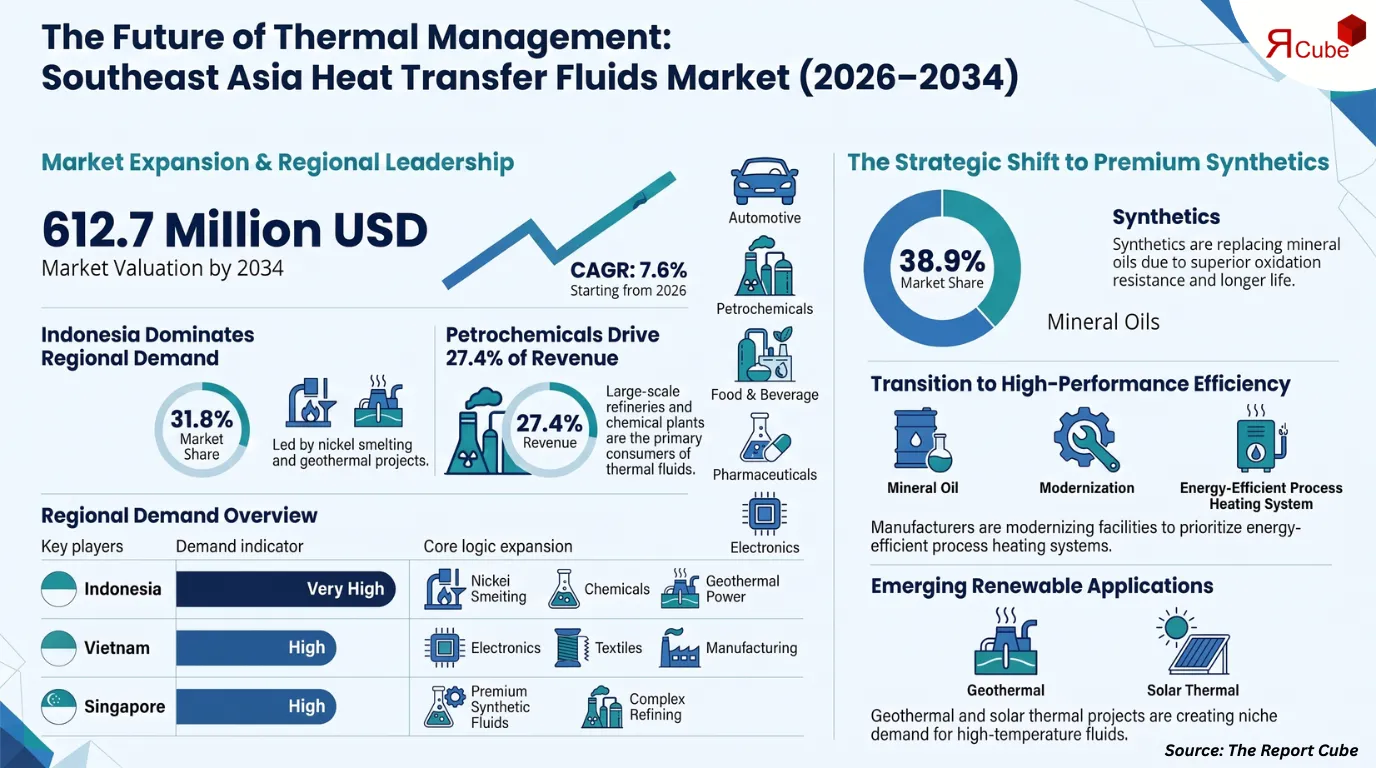
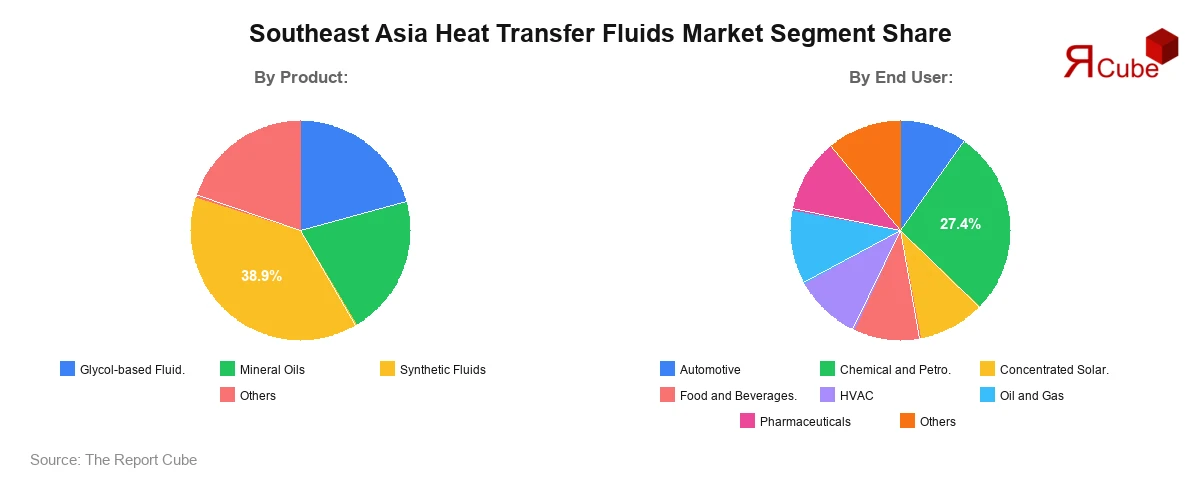
Synthetic Fluids segment leads the market with approximately 38.9% share.
By End User:
Chemical and Petrochemical segment dominates the market with nearly 27.4% of total revenue.
Regional Outlook:
Indonesia dominates the Southeast Asia Heat Transfer Fluids Market with an estimated 31.8% share.
Southeast Asia Heat Transfer Fluids Market Insights & Analysis
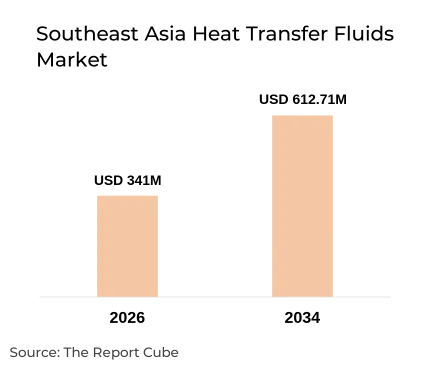
The Southeast Asia Heat Transfer Fluids Market is projected to expand at a CAGR of around 7.6% during the forecast period of 2026 to 2034. The market size is valued at USD 341 million in 2026 and is anticipated to reach approximately USD 612.71 million by 2034. Industrial expansion across Southeast Asia continues to reshape demand for high-performance Thermal Fluids as manufacturers modernize production facilities and prioritize energy-efficient process heating systems. Large investments in petrochemical complexes, food processing plants, pharmaceutical manufacturing, plastics production, and automotive component facilities are increasing the use of Heat Transfer Oils capable of maintaining stable operating temperatures under continuous production cycles. Manufacturers are gradually replacing conventional Thermal Oils with advanced Thermal Transfer Fluids that offer longer operating life, superior oxidation resistance, and lower maintenance requirements. This transition is improving plant productivity while reducing unplanned shutdowns, making premium Industrial Heat Transfer Fluids an essential component of modern industrial infrastructure throughout the region.
Government-backed industrial development programs and private sector investments continue to strengthen long-term growth prospects across Indonesia, Vietnam, Malaysia, Thailand, Singapore, and the Philippines. Indonesia remains a major investment destination for geothermal energy and downstream processing industries, while Vietnam is expanding its manufacturing base through new industrial parks and export-oriented production facilities. Singapore continues to invest in specialty chemicals and advanced process manufacturing, creating consistent demand for High Temperature Heat Transfer Fluids used in precision thermal management. At the same time, regional suppliers are expanding storage terminals, blending capabilities, and technical service networks to improve product availability and customer support. The increasing deployment of Heat Exchange Fluids in renewable energy facilities, district cooling systems, and advanced HVAC infrastructure, combined with growing adoption of customized Thermal Fluid Solutions for specialized industrial applications, is expected to support steady market expansion throughout the forecast period.
Southeast Asia Heat Transfer Fluids Market Impact Analysis
| Factor | Type | Specific Impact on Market | Magnitude | Business Implication |
|---|---|---|---|---|
| Refining and Petrochemical Expansion | Market | Integrated refineries raise demand for reliable thermal fluids in processes. | High | Supports long term volume growth in industrial heat transfer solutions. |
| Industrial Process Heating Needs | Market | More chemical, power and manufacturing plants need efficient heat control. | High | Drives wider adoption of specialized fluid based thermal systems. |
| Renewable and Solar Thermal Projects | Environmental | Geothermal and solar plants create new fluid applications for energy storage. | Medium | Opens niche segments for high temperature and stable fluid offerings. |
| Dominance of Mineral Oil Products | Competitive | Cost effective mineral oils hold major share among fluid categories. | High | Requires balancing low cost lines with premium synthetic fluid options. |
| Regulatory and Safety Compliance | Regulatory | Tighter standards push safer, longer life and monitored fluid systems. | Medium | Encourages investments in advanced monitoring and compliant chemistries. |
| Regional Industrial Leadership of Indonesia | Market | Indonesia leads usage due to smelting and processing project growth. | Medium | Positions Indonesia as a priority focus for regional sales efforts. |
| Moderately Fragmented Supplier Landscape | Competitive | Top firms hold limited share, leaving room for new regional players. | Medium | Enables differentiation via service, reliability and tailored solutions. |
Southeast Asia Heat Transfer Fluids Market Dynamics
Key Driver: Rapid Industrial Capacity Expansion Strengthens Demand for Advanced Thermal Management Solutions
Industrial investment across Southeast Asia has accelerated significantly over the past several years as manufacturers diversify production capabilities and expand downstream value-added industries. Chemical processing facilities, petroleum refineries, pharmaceutical plants, food manufacturing units, and plastics producers all require dependable Heat Transfer Liquids to maintain precise process temperatures and maximize operational efficiency. Indonesia and Vietnam continue attracting foreign direct investment into manufacturing, while Malaysia and Thailand remain important regional hubs for petrochemicals and automotive production. These developments are increasing the installation of modern thermal systems designed to operate with premium Thermal Transfer Fluids that deliver higher thermal efficiency, lower fluid degradation, and extended equipment life.
Operational reliability has become a major purchasing criterion for industrial operators seeking to reduce maintenance expenses and production interruptions. High-quality Industrial Heat Transfer Fluids help minimize carbon formation, improve heat transfer performance, and maintain viscosity under demanding operating conditions. Industrial facilities are also adopting preventive maintenance programs that include routine fluid analysis to optimize replacement cycles and improve equipment performance. As production volumes continue rising across multiple manufacturing sectors, investments in durable Heat Transfer Medium solutions are expected to remain a key contributor to sustained market growth.
Industry Trend: Specialty Synthetic Fluids Gain Preference Across High-Temperature Industrial Applications
Purchasing preferences are steadily shifting toward synthetic formulations that deliver consistent thermal performance across extended operating temperatures. Aromatic fluids, synthetic hydrocarbon fluids, ester-based fluids, and silicone fluids are increasingly replacing conventional mineral oils in applications where continuous heating, thermal stability, and long operating life are critical. Facilities operating chemical reactors, polymer production units, pharmaceutical equipment, and industrial ovens are investing in High Temperature Heat Transfer Fluids capable of maintaining performance under intensive production conditions. These products reduce oxidation rates, limit deposit formation, and contribute to lower lifecycle operating costs.
Product innovation has also become an important competitive strategy among regional suppliers. Manufacturers are introducing customized Thermal Fluid Solutions developed for geothermal energy, food-grade processing equipment, HVAC systems, transformer cooling, and industrial waste heat recovery. Technical support services, fluid condition monitoring, and predictive maintenance programs are increasingly bundled with product offerings to improve customer retention and equipment performance. This shift from commodity Thermal Oils toward application-specific Heat Exchange Fluids reflects the region's broader transition toward higher-value industrial production and energy-efficient manufacturing technologies.
Book your FREE 30-minute expert consultation today
Contact UsMajor Challenge: Feedstock Price Volatility and Performance Expectations Continue to Pressure Suppliers
Maintaining competitive pricing has become increasingly difficult as fluctuations in crude oil prices and specialty chemical feedstocks directly influence production costs for synthetic and mineral-based Thermal Fluids. Raw materials used to manufacture silicone fluids, synthetic hydrocarbons, aromatic fluids, and ester-based products remain exposed to global supply chain disruptions, transportation costs, and currency movements. Regional manufacturers must carefully balance procurement costs with customer expectations for premium-quality products, particularly in price-sensitive industrial sectors.
Industrial customers are simultaneously demanding longer service intervals, improved oxidation resistance, greater thermal stability, and compliance with stricter environmental and workplace safety standards. Meeting these technical specifications requires continuous investment in formulation development, laboratory testing, and quality assurance. Smaller domestic suppliers often face intense competition from multinational lubricant manufacturers with larger research budgets and broader product portfolios. The combination of rising production costs and increasing technical expectations continues to shape competitive dynamics across the Southeast Asia Heat Transfer Fluids Market.
Opportunity: Renewable Energy Projects and Advanced Manufacturing Expand New Application Areas
Large-scale investments in renewable energy infrastructure are creating attractive long-term opportunities for suppliers of specialized Heat Transfer Medium products. Indonesia continues expanding geothermal power generation through binary-cycle facilities that rely on advanced Thermal Transfer Fluids to efficiently transfer geothermal energy into electricity. Similar opportunities are emerging from industrial waste heat recovery projects, biomass energy facilities, and district cooling systems that require reliable Heat Exchange Fluids capable of maintaining stable thermal performance over extended operating periods.
Expansion of semiconductor manufacturing, electronics assembly, pharmaceutical production, and specialty food processing across Southeast Asia is creating additional demand for precision thermal management technologies. Modern production facilities increasingly require customized Heat Transfer Liquids designed for specific operating environments where accurate temperature control directly influences product quality and manufacturing efficiency. Companies investing in product innovation, localized technical services, and application-specific Thermal Fluid Solutions are well positioned to benefit from the region's ongoing industrial modernization and expanding high-value manufacturing base throughout the forecast period.
Southeast Asia Heat Transfer Fluids Market Segment-wise Analysis
By Product:
- Glycol-based Fluids
- Mineral Oils
- Synthetic Fluids
- Aromatic Fluids
- Ester-based Fluids
- Silicone Fluids
- Synthetic Hydrocarbon Fluids
- Others
Synthetic Fluids held the largest share of approximately 38.9% in the Southeast Asia Heat Transfer Fluids Market in 2026, reflecting the region's transition toward higher-performance thermal management solutions. Industrial operators increasingly prefer synthetic Thermal Fluids because they maintain stable viscosity, resist oxidation, and perform efficiently under prolonged operating conditions. Industries such as petrochemicals, pharmaceuticals, plastics, and food processing require continuous thermal control where equipment reliability directly influences production efficiency. Compared with conventional mineral-based Heat Transfer Oils, synthetic formulations reduce fluid degradation, extend replacement intervals, and lower maintenance costs, making them a preferred option for modern processing facilities.
Demand is also supported by the expansion of geothermal projects, specialty chemical production, and advanced manufacturing facilities across Indonesia, Vietnam, Malaysia, and Singapore. Aromatic fluids continue to account for the largest share within the synthetic category due to their ability to withstand elevated operating temperatures, while ester-based and silicone fluids are witnessing steady adoption in applications requiring enhanced safety and environmental performance. As industrial facilities invest in energy-efficient equipment and automated process heating systems, suppliers are introducing application-specific Thermal Fluid Solutions and High Temperature Heat Transfer Fluids to improve operational reliability, reinforcing the long-term leadership of the synthetic fluids segment.
By End User:
- Automotive
- Chemical and Petrochemical
- Concentrated Solar Power (CSP)
- Food and Beverages
- HVAC
- Oil and Gas
- Pharmaceuticals
- Plastics and Rubber
- Others
The Chemical and Petrochemical segment accounted for nearly 27.4% of the Southeast Asia Heat Transfer Fluids Market revenue in 2026, making it the leading end-user category. Refineries and chemical manufacturing facilities operate around the clock and depend on reliable Heat Transfer Liquids to maintain accurate temperatures across reactors, distillation columns, heat exchangers, storage tanks, and polymer production units. Countries including Singapore, Thailand, Malaysia, and Indonesia continue investing in downstream refining, specialty chemicals, and integrated petrochemical complexes, creating sustained demand for Industrial Heat Transfer Fluids capable of delivering consistent thermal performance under demanding process conditions.
Increasing production of polymers, industrial chemicals, fertilizers, and specialty materials is encouraging manufacturers to replace conventional Thermal Oils with premium Thermal Transfer Fluids that provide longer operational life and improved resistance to oxidation and thermal cracking. Environmental compliance, energy conservation initiatives, and growing emphasis on process safety are further supporting the adoption of advanced Heat Exchange Fluids across large industrial facilities. Continued investment in refinery modernization, capacity expansion, and process automation throughout Southeast Asia is expected to strengthen fluid consumption, ensuring the Chemical and Petrochemical segment remains the largest contributor to market revenue over the forecast period.
Regional Projection of Southeast Asia Heat Transfer Fluids Industry
- Malaysia
- Indonesia
- Singapore
- Cambodia
- Vietnam
- Thailand
- Philippines
- Others
Indonesia represented the largest country market, accounting for an estimated 31.8% share of the Southeast Asia Heat Transfer Fluids Market in 2026. Strong demand originates from the country's expanding refining sector, chemical manufacturing industry, geothermal energy projects, mining operations, and food processing facilities. Government policies encouraging downstream industrial development and domestic value addition continue to attract investments into manufacturing and energy infrastructure. These projects require dependable Thermal Fluids, Heat Transfer Medium products, and Heat Transfer Oils to support process heating, power generation, and industrial cooling applications. Indonesia's position as one of the region's largest energy producers also strengthens long-term consumption across oil and gas, petrochemicals, and power generation industries.
Future growth is expected to be supported by continued investment in geothermal power generation, industrial estates, and advanced manufacturing facilities. Binary-cycle geothermal plants, transformer cooling systems, and industrial waste heat recovery projects increasingly utilize High Temperature Heat Transfer Fluids designed for superior thermal stability and extended service life. Domestic lubricant manufacturers are expanding production capacity while global suppliers continue strengthening technical partnerships and regional distribution networks to improve product availability. Rising industrial automation, growing adoption of energy-efficient processing technologies, and sustained capital expenditure across Indonesia's manufacturing sector are expected to reinforce the country's leadership in the Southeast Asia Heat Transfer Fluids Market throughout the forecast period.
Need insights for a specific region within this market?
Request Regional DataCountries Analysis of Southeast Asia Heat Transfer Fluids Market
The Southeast Asia heat transfer fluids market is expanding, driven by industrial growth, refining, chemicals, and energy projects.
| Cluster | Demand Level | Key Areas | System Dominance | Core Demand Logic | Growth Nature |
|---|---|---|---|---|---|
| Malaysia | Medium | Klang Valley, Johor, Penang | Mineral & glycol fluids | Refining, petrochemicals, food plants | Steady industrial expansion |
| Indonesia | Very High | Java, Sumatra, Kalimantan | Mineral oils & synthetics | Nickel smelting, chemicals, power | Fastest-growing regional hub |
| Singapore | High | Jurong Island, Tuas | High-grade synthetic fluids | Complex refining and chemical parks | Upgrade-led premium growth |
| Cambodia | Low | Phnom Penh, Sihanoukville | Basic mineral oil systems | Nascent industry and power sector | Emerging from small base |
| Vietnam | High | Ho Chi Minh City, Hai Phong | Mineral & glycol-based fluids | Electronics, textiles, industrial parks | Strong manufacturing-driven rise |
| Thailand | High | EEC, Bangkok, Rayong | Mineral oils, aromatics | Automotive, petrochemical corridors | CAGR-led stable high demand |
| Philippines | Medium | Luzon, Cebu, Mindanao | Mineral and glycol fluids | Power, food, and industrial estates | Moderate but broad-based growth |
| Others | Low to Medium | Laos, Myanmar, Brunei | Entry-level mineral oils | Small refining and industrial nodes | Gradual, project-led uptake |
Government Initiatives & Policies
- Indonesia National Energy Policy (Updated Implementation 2025): Indonesia continues accelerating geothermal development and industrial energy efficiency under its National Energy Policy, encouraging investments in geothermal power plants, industrial process optimization, and advanced thermal management technologies that support demand for high-performance heat transfer fluids.
- Vietnam National Power Development Plan VIII (PDP8) Implementation: Vietnam is actively implementing Power Development Plan VIII to expand renewable electricity generation, industrial infrastructure, and transmission capacity through 2030. The program supports geothermal research, industrial manufacturing growth, and advanced cooling technologies that increase demand for specialty thermal fluids.
Southeast Asia Heat Transfer Fluids Industry Recent Developments
- 2025: Lubrizol appointed IMCD Group as its new channel partner for lubricant and fuel additive distribution in Vietnam. The partnership expands Lubrizol's commercial reach through IMCD's established distribution network while improving local technical support and customer access to advanced additive technologies for lubricant and industrial fluid manufacturers.
- 2025: ExxonMobil initiated feasibility studies for a proposed USD 10 billion low-emission refinery at Vietnam's Van Phong Economic Zone. The planned investment is expected to strengthen the country's downstream refining and petrochemical industry while generating significant long-term demand for industrial heat transfer fluids, thermal oils, and specialty process fluids used in refining operations.
- 2025: PT Pertamina Lubricants entered into a strategic partnership with PT PLN (Persero) to jointly develop transformer oils and electrical cooling fluids for Indonesia's expanding power transmission infrastructure. The collaboration supports domestic production of specialty cooling fluids while reducing dependence on imported dielectric fluid technologies.
- 2025: Pertamina Geothermal Energy (PGE) and PLN Indonesia Power signed a Head of Agreement to jointly develop 19 geothermal projects totaling 530 MW, including the Ulubelu Binary Unit and Lahendong Binary Unit. The expansion of binary-cycle geothermal facilities is expected to create new opportunities for high-performance heat transfer fluids used in closed-loop geothermal heat exchange systems.
Why Choose This Report?
- Provides a comprehensive overview of the overall market analysis, encompassing key trends, consumer behavior analysis, and risk assessment to support strategic decision-making.
- Provides accurate, up-to-date insights into market size, segmentation, and emerging opportunities, helping organizations minimize business risks while capitalizing on future growth prospects.
- Gives a deep understanding of target customer preferences, industrial purchasing behavior, investment patterns, and procurement channels to strengthen product development and marketing strategies.
- Delivers competitive analysis and benchmarking by highlighting the strengths, business strategies, product portfolios, and market positioning of leading Southeast Asia Heat Transfer Fluids Market participants.
- Consolidates comprehensive market intelligence into a single report, reducing research efforts while improving business planning and investment decisions.
- Facilitates customized market segmentation, opportunity assessment, and risk mitigation strategies aligned with specific business objectives and expansion plans.
- Helps identify both existing market challenges and untapped growth opportunities across emerging industries, enabling sustainable long-term business growth.
- Provides valuable insights supported by industrial developments, customer demand patterns, government initiatives, and evolving market trends.
Table of Contents
- Introduction
- Objective of the Study
- Product and Category Definition
- Market Segmentation
- Study Variables
- Research Methodology
- Secondary Data Points
- Breakdown of Secondary Sources
- Primary Data Points
- Breakdown of Primary Interviews
- Secondary Data Points
- Executive Summary
- Market Dynamics
- Emerging Opportunities
- Adoption Trends
- Demand Drivers
- Disruption Analysis (Challenges)
- Industry Analysis and Strategic Insights
- Supply and Value Chain Analysis
- Pricing Analysis
- Go-to-Market Strategy
- BCG Matrix
- Recent Trends and Developments
- Import and Export Analysis
- Regulatory and Policy Landscape
- Country-wise Policies
- Government Initiatives
- Southeast Asia Heat Transfer Fluids Market Overview and Forecast Analysis (2021-2034)
- Market Size, By Value, By Growth Rate (CAGR/USD Million)
- Market Share, By Product
- Glycol-based Fluids
- Mineral Oils
- Synthetic Fluids
- Aromatic Fluids
- Ester-based Fluids
- Silicone Fluids
- Synthetic Hydrocarbon Fluids
- Others
- Market Share, By Operating Temperature Range
- High Temperature (Above 200°C)
- Medium Temperature (0°C - 200°C)
- Low Temperature (Below 0°C)
- Market Share, By Sales Channel
- Direct Sales (OEM/B2B)
- Distributors and Dealers
- Online Retail
- Market Share, By End User
- Automotive
- Chemical and Petrochemical
- Concentrated Solar Power (CSP)
- Food and Beverages
- HVAC
- Oil and Gas
- Pharmaceuticals
- Plastics and Rubber
- Others
- Market Share, By Country
- Malaysia
- Indonesia
- Singapore
- Cambodia
- Vietnam
- Thailand
- Philippines
- Others
- Market Share, By Company
- Revenue Shares and Analysis
- Competitive Landscape
- Malaysia Heat Transfer Fluids Market Overview and Forecast Analysis (2021-2034)
- Market Size, By Value, By Growth Rate (CAGR/USD Million)
- Market Share, By Product
- Market Share, By Operating Temperature Range
- Market Share, By Sales Channel
- Market Share, By End User
- Indonesia Heat Transfer Fluids Market Overview and Forecast Analysis (2021-2034)
- Market Size, By Value, By Growth Rate (CAGR/USD Million)
- Market Share, By Product
- Market Share, By Operating Temperature Range
- Market Share, By Sales Channel
- Market Share, By End User
- Singapore Heat Transfer Fluids Market Overview and Forecast Analysis (2021-2034)
- Market Size, By Value, By Growth Rate (CAGR/USD Million)
- Market Share, By Product
- Market Share, By Operating Temperature Range
- Market Share, By Sales Channel
- Market Share, By End User
- Cambodia Heat Transfer Fluids Market Overview and Forecast Analysis (2021-2034)
- Market Size, By Value, By Growth Rate (CAGR/USD Million)
- Market Share, By Product
- Market Share, By Operating Temperature Range
- Market Share, By Sales Channel
- Market Share, By End User
- Vietnam Heat Transfer Fluids Market Overview and Forecast Analysis (2021-2034)
- Market Size, By Value, By Growth Rate (CAGR/USD Million)
- Market Share, By Product
- Market Share, By Operating Temperature Range
- Market Share, By Sales Channel
- Market Share, By End User
- Thailand Heat Transfer Fluids Market Overview and Forecast Analysis (2021-2034)
- Market Size, By Value, By Growth Rate (CAGR/USD Million)
- Market Share, By Product
- Market Share, By Operating Temperature Range
- Market Share, By Sales Channel
- Market Share, By End User
- Philippines Heat Transfer Fluids Market Overview and Forecast Analysis (2021-2034)
- Market Size, By Value, By Growth Rate (CAGR/USD Million)
- Market Share, By Product
- Market Share, By Operating Temperature Range
- Market Share, By Sales Channel
- Market Share, By End User
- Competitive Analysis, 2026
- Market Share of Key Players
- Competitive Mapping for Each Product, Operating Temperature Range, Sales Channel, and End User
- Malaysia Heat Transfer Fluids Companies Share and Competitive Analysis, 2026
- Indonesia Heat Transfer Fluids Companies Share and Competitive Analysis, 2026
- Singapore Heat Transfer Fluids Companies Share and Competitive Analysis, 2026
- Cambodia Heat Transfer Fluids Companies Share and Competitive Analysis, 2026
- Vietnam Heat Transfer Fluids Companies Share and Competitive Analysis, 2026
- Thailand Heat Transfer Fluids Companies Share and Competitive Analysis, 2026
- Philippines Heat Transfer Fluids Companies Share and Competitive Analysis, 2026
- Company Profile (Partial List)
- United Oil Company Pte. Ltd.
- Company Overview
- Product Portfolio
- Strategic Alliances/Partnerships
- Recent Developments
- Hi-Tech Interchem (Thailand) Co., Ltd.
- Company Overview
- Product Portfolio
- Strategic Alliances/Partnerships
- Recent Developments
- Petrochem Safety Pte. Ltd.
- Company Overview
- Product Portfolio
- Strategic Alliances/Partnerships
- Recent Developments
- Bangchak Corporation Public Company Limited
- Company Overview
- Product Portfolio
- Strategic Alliances/Partnerships
- Recent Developments
- Chemie Asia Pacific
- Company Overview
- Product Portfolio
- Strategic Alliances/Partnerships
- Recent Developments
- Petronas Lubricants International
- Company Overview
- Product Portfolio
- Strategic Alliances/Partnerships
- Recent Developments
- Thai Lube Base Public Company Limited
- Company Overview
- Product Portfolio
- Strategic Alliances/Partnerships
- Recent Developments
- PT Pertamina Lubricants
- Company Overview
- Product Portfolio
- Strategic Alliances/Partnerships
- Recent Developments
- AP Oil International Limited
- Company Overview
- Product Portfolio
- Strategic Alliances/Partnerships
- Recent Developments
- PTAK Trading Sdn. Bhd.
- Company Overview
- Product Portfolio
- Strategic Alliances/Partnerships
- Recent Developments
- IRPC Public Company Limited
- Company Overview
- Product Portfolio
- Strategic Alliances/Partnerships
- Recent Developments
- Unimech Group Berhad
- Company Overview
- Product Portfolio
- Strategic Alliances/Partnerships
- Recent Developments
- Others (Partial List)
- United Oil Company Pte. Ltd.
- Contact Us and Disclaimer
Top Key Players & Market Share Outlook
- United Oil Company Pte. Ltd.
- Hi-Tech Interchem (Thailand) Co., Ltd.
- Petrochem Safety Pte. Ltd.
- Bangchak Corporation Public Company Limited
- Chemie Asia Pacific
- Petronas Lubricants International
- Thai Lube Base Public Company Limited
- PT Pertamina Lubricants
- AP Oil International Limited
- PTAK Trading Sdn. Bhd.
- IRPC Public Company Limited
- Unimech Group Berhad
- Others
Frequently Asked Questions






