



Build Your Custom Market Intelligence Report
Customize Your ReportGermany Heavy Artillery Market Insights & Analysis
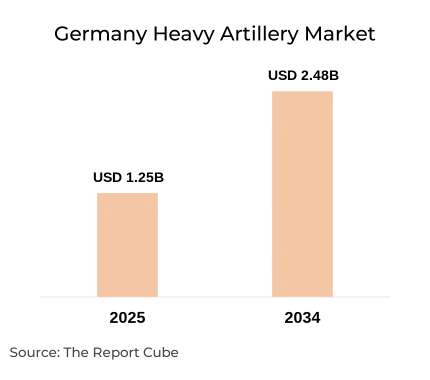
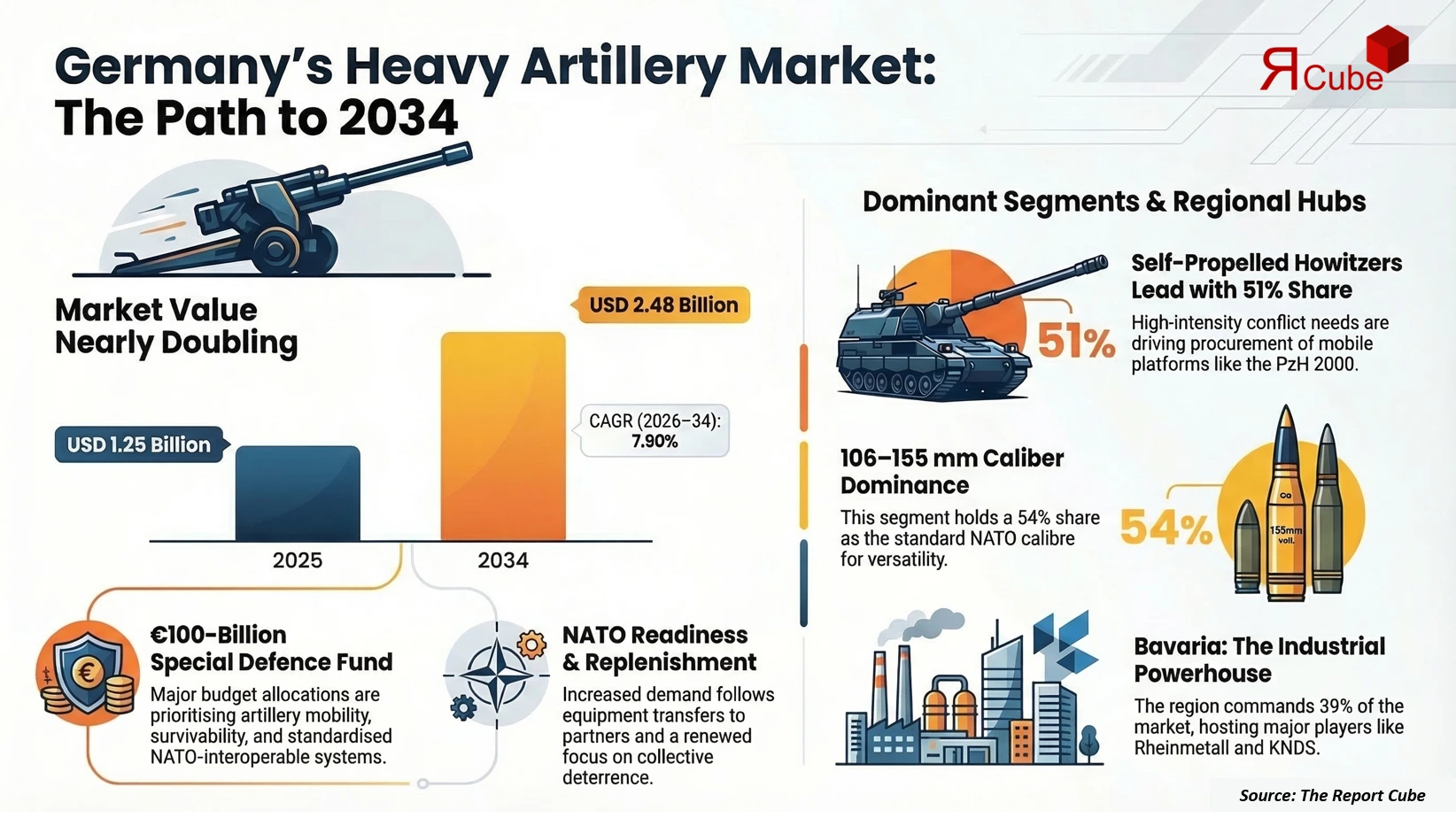
The Germany Heavy Artillery Market is projected to grow at a 7.90% CAGR during 2026-2034. The market stood at USD 1.25 billion in 2025 and is expected to reach USD 2.48 billion by 2034. Growth is driven by Germany’s renewed defense modernization agenda, accelerated procurement cycles, and expanded commitments to NATO readiness and collective deterrence. The Bundeswehr is undergoing a significant transformation through the €100-billion special defense fund, which prioritizes improved long-range firepower, rapid mobility, and advanced network-centric artillery solutions. Germany’s leading defense manufacturers Rheinmetall, KMW, and KNDS are developing upgraded self-propelled systems, automated fire-control solutions, and enhanced rocket artillery to meet evolving operational requirements amid rising geopolitical tensions in Europe.
Furthermore, Germany’s increased support for NATO allies and ongoing replenishment efforts following equipment transfers to partner nations have accelerated demand for heavy artillery platforms, spare parts, and modernization programs. Joint industrial collaborations and European Defense Fund (EDF) initiatives continue advancing next-generation artillery technologies, including extended-range munitions, precision-guided shells, and improved survivability systems. As defense procurement transparency and interoperability become central themes, the heavy artillery segment is expected to witness strong and sustained investment momentum through 2034.
Germany Heavy Artillery Market Recent Developments
- 2025: Germany accelerated procurement discussions for upgraded self-propelled howitzers and next-generation MLRS platforms to replace aging systems and support NATO rapid-response capabilities.
- 2025: Rheinmetall and KNDS initiated collaborative development work on extended-range howitzer enhancements and digital fire-control integration for future battlefield interoperability.
Government Initiatives & Policies
- Bundeswehr Modernization & €100bn Special Fund: Major budget allocations directed toward artillery mobility upgrades, improved survivability, and standardized NATO-interoperable firepower systems.
- European Defense Industrial Cooperation: Germany participates in multinational programs supporting precision artillery munitions, shared logistics, and advanced rocket artillery under EU and NATO frameworks.
Germany Heavy Artillery Market Dynamics
Driver: Strengthening NATO Commitments and Modernizing Long-Range Firepower
Germany’s obligation to NATO readiness standards and its evolving threat environment remain key drivers of heavy artillery investment. The Bundeswehr aims to enhance operational responsiveness, long-range precision, and armored fire-support capability across mechanized brigades. Upgrading existing platforms such as the PzH 2000, expanding MLRS capabilities, and introducing digital fire-control networks are essential components of Germany’s modernization push. Strategic emphasis on interoperability, rapid deployment, and enhanced mobility ensures that artillery units remain central to future conflict scenarios, particularly in Europe’s high-intensity operational landscape.
Challenge: Industrial Bottlenecks, Workforce Constraints & Complex Procurement Procedures
Despite a heightened defense budget, the heavy artillery sector faces challenges including production bottlenecks, skilled labor shortages, and lengthy procurement processes that slow system deployment. Increasing reliance on multinational supply chains for advanced subsystems adds further complexity, especially during surges in European defense demand. Modern artillery platforms also require extensive testing, certification, and integration with digital networks, which lengthen development cycles. As Germany continues balancing domestic industrial capacity with NATO requirements, reducing procurement friction and enhancing manufacturing throughput remain critical obstacles.
Opportunity: Next-Generation Howitzers, Precision Munitions & Rocket Artillery Expansion
Germany has strong opportunity to lead in next-generation artillery technologies especially extended-range self-propelled howitzers, precision-guided rocket systems, automated ammunition handling, and resilient battlefield communication networks. Increased investment from the European Defence Fund supports collaborative R&D for high-precision munitions, enabling Germany to strengthen export potential while supplying domestic requirements. Development of modular rocket systems and autonomous fire-support technologies positions German manufacturers at the forefront of advanced artillery evolution. As European forces replace legacy equipment, Germany’s industry stands to capture significant market share across NATO and beyond.
Trend: Digitalization, Autonomous Support Systems & Network-Centric Warfare Integration
A major trend shaping the German artillery landscape is the integration of AI-assisted targeting, digital fire-control, predictive logistics, and autonomous support vehicles into artillery doctrine. Network-centric warfare capabilities such as real-time battlefield awareness, integrated sensor-to-shooter links, and automated command systems are increasingly central to platform design. Digital twins, advanced simulation tools, and modular upgrades also enhance lifecycle efficiency. As the Bundeswehr accelerates digital transformation, heavy artillery platforms are being optimized for faster response times, reduced crew workload, and seamless interoperability with NATO allies.
Germany Heavy Artillery Market Segment-wise Analysis
By System Type:
- Self-Propelled Howitzers
- Towed Howitzers
- Multiple Launch Rocket Systems (MLRS)
- Coastal & Fixed Artillery
- Others
Self-Propelled Howitzers hold the largest system-type share at around 51%, driven by their mobility, rapid-fire capability, and adaptability for high-intensity conflict environments. Germany’s flagship PzH 2000 remains a benchmark system globally due to its long range, high accuracy, and robust armored protection. Current modernization initiatives aim to improve digital fire-control, survivability systems, and extended-range munitions. As the Bundeswehr prioritizes mobile, highly responsive fire-support units, self-propelled howitzers will continue to dominate procurement planning and modernization programs.
By Caliber:
- Up to 105 mm
- 106-155 mm
- Above 155 mm
- Rocket Artillery
- Others
106-155 mm artillery systems represent the leading caliber segment with approximately 54% share. This range covers standard NATO calibers used in Germany’s primary self-propelled and towed artillery units. Platforms within this caliber class deliver optimal balance between range, accuracy, logistical feasibility, and battlefield versatility. With modernization centered around improved lethality and extended-range precision shells, the 155 mm category will continue to underpin the Bundeswehr’s fire-support capabilities for the foreseeable future.
Regional Projection of Germany Heavy Artillery Industry
By Region:
- Bavaria
- Lower Saxony
- North Rhine-Westphalia
- Baden-Württemberg
- Rhineland-Palatinate
- Others
Bavaria leads the market with approximately 39% share, supported by its concentration of major defense manufacturers including Rheinmetall facilities, precision engineering clusters, and advanced testing and integration centers. Bavaria’s strong industrial base supports high-value R&D activity, manufacturing of armored systems, and collaborative development programs with national and European partners. As modernization projects expand, the region’s strategic position as a defense technology hub ensures sustained contribution to Germany’s artillery innovation and production capacity.
What Does Our Germany Heavy Artillery Market Research Study Entail?
- Provides comprehensive market sizing and forecasting from 2026-2034, highlighting the increase from USD 1.25 billion to USD 2.48 billion at a 7.90% CAGR.
- Analyzes detailed segmentation across System Types and Caliber Classes, identifying growth areas in self-propelled platforms, MLRS, and precision-caliber technologies.
- Offers regional insights across Bavaria, Lower Saxony, North Rhine-Westphalia, Baden-Württemberg, and other industrial centers supporting artillery production and testing.
- Presents competitive profiling of Rheinmetall, KMW, KNDS, and associated suppliers contributing to Germany’s artillery modernization.
- Reviews defense modernization policies, NATO interoperability needs, digital transformation trends, and strategic recommendations for procurement and industrial growth.
Table of Contents
- Introduction
- Objective of the Study
- Product/Technology Definition
- Market Segmentation
- Study Variables
- Research Methodology
- Secondary Data Points
- Breakdown of Secondary Sources
- Primary Data Points
- Breakdown of Primary Interviews
- Secondary Data Points
- Executive Summary
- Market Dynamics
- Drivers
- Challenges
- Opportunity Assessment
- Recent Trends and Developments
- Policy and Regulatory Landscape
- Germany Heavy Artillery Market Overview (2020–2034)
- Market Size, By Volume (Units) & Value (USD Million)
- Market Share, By System Type
- Self-Propelled Howitzers
- Towed Howitzers
- Multiple Launch Rocket Systems (MLRS)
- Coastal & Fixed Artillery
- Others
- Market Share, By Caliber
- Up to 105 mm
- 106–155 mm
- Above 155 mm
- Rocket Artillery
- Others
- Market Share, By End-Use
- Army
- Joint / Multinational Forces
- Training & Testing Agencies
- Others
- Market Share, By Company
- Revenue Shares
- Competitive Landscape
- Segment-wise & Industry-wise Market Forecast (2026–2034)
- By System Type
- By Caliber
- By End-User
- Competitive Outlook & Company Profiles
- Rheinmetall AG
- Company Overview
- Business Segments
- Strategic Alliances/Partnerships
- Recent Developments
- Krauss-Maffei Wegmann (KMW)
- Company Overview
- Business Segments
- Strategic Alliances/Partnerships
- Recent Developments
- KNDS (KMW + Nexter Defense Systems)
- Company Overview
- Business Segments
- Strategic Alliances/Partnerships
- Recent Developments
- Others
- Rheinmetall AG
- Contact Us / Disclaimer
Top Key Players & Market Share Outlook
- Rheinmetall AG
- Krauss-Maffei Wegmann
- KNDS
- Others
Frequently Asked Questions