



Build Your Custom Market Intelligence Report
Customize Your ReportPhilippines Hotel Market Key Highlights
By Hotel Type:
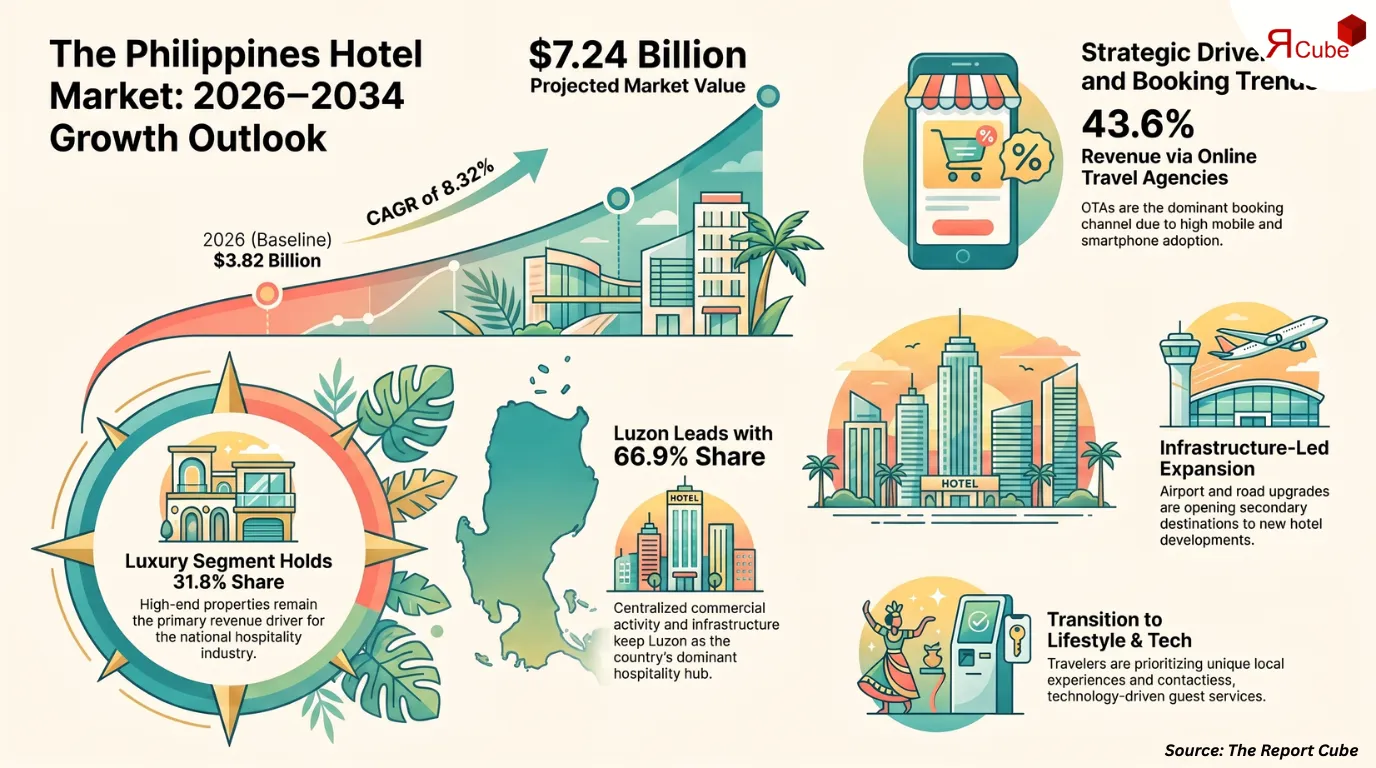
Luxury Hotels segment leads the market with approximately 31.8% market share.
By Booking Channel:
Online Travel Agencies (OTAs) dominate the market with nearly 43.6% of total booking revenue.
Regional Outlook:
Luzon dominates the Philippines Hotel Market with around 66.9% market share.
Philippines Hotel Market Insights & Analysis
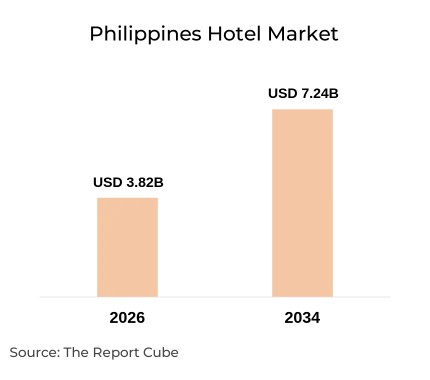
The Philippines Hotel Market is anticipated to register a CAGR of around 8.32% during the forecast period 2026-2034. The market size is valued at USD 3.82 billion in 2026 and is projected to reach USD 7.24 billion by 2034. Favorable tourism fundamentals, expanding air connectivity, and sustained investment in hospitality assets continue to strengthen industry performance across the country. International arrivals are steadily recovering, while domestic tourism remains a reliable source of occupancy throughout the year. Metro Manila, Cebu, Boracay, Palawan, Clark, and Bohol continue attracting significant hotel investments due to their established tourism ecosystems and expanding commercial activity. International hotel operators are actively introducing new brands through management contracts and franchise partnerships, while domestic developers continue integrating hotels into mixed-use developments that combine offices, retail, residences, and entertainment facilities. These investments are creating a more diversified accommodation landscape that serves luxury travelers, corporate guests, families, long-stay visitors, and budget-conscious tourists.
Industry fundamentals are also being reinforced by continued infrastructure upgrades and public sector initiatives that improve accessibility to tourism destinations. Airport modernization, expressway expansion, cruise tourism facilities, and convention infrastructure are encouraging longer visitor stays and supporting higher room demand in both established and emerging destinations. Hospitality companies are responding by investing in smart property management systems, digital guest services, energy-efficient building technologies, and personalized loyalty programs that improve operational efficiency while enhancing guest satisfaction. Demand for lifestyle hotels, serviced apartments, boutique properties, and wellness-oriented accommodations is increasing as travelers place greater emphasis on unique local experiences rather than standardized lodging. The combination of sustained tourism promotion, improving investment conditions, and evolving guest preferences is expected to support healthy occupancy levels, stronger average daily rates, and long-term revenue growth across the Philippines Hotel Industry.
Philippines Hotel Market Impact Analysis
| Factor | Type | Specific Impact on Market | Magnitude | Business Implication |
|---|---|---|---|---|
| Tourism Growth and Visitor Inflows | Market | Rising domestic and foreign arrivals lift hotel occupancy levels. | High | Supports expansion of room inventory in key leisure and business hubs. |
| Airport and Transport Infrastructure | Market | Upgraded airports and roads improve access to major and secondary destinations. | High | Enables new hotel developments beyond Metro Manila and traditional resorts. |
| Government Tourism Promotion Policies | Regulatory | National plans and incentives encourage investment and boost travel demand. | High | Creates favorable conditions for branded and midscale hotel projects. |
| Natural Disaster and Climate Risks | Environmental | Typhoons and quakes disrupt operations and can depress regional visits. | Medium | Requires robust risk planning, resilient design, and diversified location mix. |
| Rise of Digital and Online Booking | Technological | Online platforms streamline reservations and raise price transparency. | High | Hotels must optimize direct channels and manage online distribution yield. |
| Alternative Lodging and Shared Spaces | Competitive | Home sharing and hostels add options and intensify rate competition. | Medium | Pushes hotels to differentiate via service quality and unique experiences. |
| Sustainability and Eco-tourism Pressure | Environmental | Environmental reviews drive demand for greener and responsible hotels. | Medium | Encourages investment in resource-efficient operations and certification. |
Philippines Hotel Market Dynamics
Key Driver: Expanding Tourism Economy and Hospitality Investments Accelerating Hotel Development
The steady recovery of tourism has become the strongest catalyst supporting the Philippines Hotel Market. Rising domestic travel, improving international visitor arrivals, and increasing airline capacity have created favorable conditions for hotel operators across major urban centers and island destinations. Leisure destinations such as Boracay, Palawan, Cebu, Siargao, and Bohol continue recording healthy accommodation demand, while Metro Manila, Clark, and Makati benefit from corporate travel, government activities, and international business events. Domestic travelers have become an increasingly dependable revenue source, supported by rising household spending, flexible work arrangements, and greater interest in weekend vacations and short-distance travel. This balanced demand structure allows hotel operators to maintain occupancy across multiple seasons and customer segments.
Capital investment across the hospitality sector has also accelerated as international brands strengthen their presence through management agreements, strategic partnerships, and asset-light expansion models. Mixed-use developments that combine hotels with commercial, residential, and retail components are becoming increasingly common in major cities, allowing developers to diversify income streams while enhancing property values. Investors continue prioritizing locations with strong transport connectivity and established tourism infrastructure, creating new opportunities for luxury hotels, upper mid-scale properties, boutique accommodations, and serviced apartments. These investment trends are expected to strengthen the country's hospitality capacity while supporting sustainable market expansion over the forecast period.
Industry Trends: Lifestyle Hospitality and Technology-Driven Guest Experiences Reshaping Hotel Operations
Guest expectations across the Philippines hospitality sector have shifted beyond traditional accommodation, encouraging operators to differentiate through design, local culture, wellness offerings, and personalized services. Lifestyle hotels that reflect regional architecture, locally inspired dining, curated cultural activities, and community engagement are attracting both domestic and international travelers seeking authentic experiences. Hospitality brands are also expanding extended-stay concepts and serviced apartments as demand grows from business professionals, expatriates, digital nomads, and long-term visitors. This broader mix of accommodation formats allows operators to serve multiple traveler profiles while reducing dependence on seasonal tourism.
Digital transformation has become a defining feature of hotel operations throughout the country. Contactless check-in, mobile room access, cloud-based property management platforms, digital concierge services, and revenue optimization software are improving operational efficiency and guest convenience. Sustainability initiatives are advancing alongside technology investments as hotel developers incorporate renewable energy systems, water conservation measures, waste reduction programs, and green building certifications into new projects. Direct booking platforms are also becoming more sophisticated through personalized promotions and loyalty rewards, enabling operators to strengthen customer relationships while reducing distribution costs. These operational improvements continue to enhance competitiveness across the Philippines Hotel Industry.
Book your FREE 30-minute expert consultation today
Contact UsMajor Challenge: Rising Operating Expenses and Competitive Pricing Pressuring Hotel Profitability
Maintaining profitability has become increasingly challenging as operating expenses continue to rise across the hospitality sector. Labor costs, electricity prices, food procurement, maintenance requirements, insurance premiums, and building upgrades have increased the financial burden on hotel operators of every size. Premium properties face additional expenditure associated with maintaining international service standards, upgrading guest facilities, and implementing advanced digital technologies. Independent hotels often experience greater financial pressure because they lack the purchasing scale and global reservation networks available to international brands.
Competitive intensity has also increased as new domestic developments and global hotel companies continue expanding across major tourism and commercial destinations. Online booking platforms have made room pricing highly transparent, encouraging frequent promotional campaigns and narrowing pricing flexibility for many operators. Maintaining occupancy while protecting room rates requires continuous investment in guest experience, employee development, service quality, and brand differentiation. External factors including weather disruptions, global economic uncertainty, and fluctuations in international travel demand may also influence hotel performance, requiring operators to maintain flexible pricing and revenue management strategies throughout changing market conditions.
Opportunity: Growth of Emerging Tourism Destinations and Specialized Travel Segments
Hospitality investment is gradually extending beyond traditional tourism hubs as improved transport infrastructure increases accessibility to secondary cities and developing leisure destinations. Areas including Pampanga, Iloilo, Bacolod, Davao, Cagayan de Oro, and various coastal provinces are attracting greater interest from hotel developers due to expanding commercial activity, regional tourism programs, and improving connectivity. These markets offer comparatively lower development costs while benefiting from rising domestic travel and increasing business activity. Boutique hotels, mid-scale properties, and branded serviced apartments are particularly well positioned to capitalize on this regional expansion.
Additional opportunities are emerging from specialized travel segments that continue gaining momentum across the country. Medical tourism, educational travel, faith-based tourism, sports events, and meetings, incentives, conferences, and exhibitions are generating demand beyond traditional leisure accommodation. Hotels that diversify their services through wellness facilities, flexible meeting spaces, long-stay packages, and destination-focused experiences are better positioned to capture higher-value guests throughout the year. Continued foreign investment, supportive tourism policies, and improving regional infrastructure are expected to create favorable conditions for sustained growth across the Philippines Hotel Market over the coming decade.
Philippines Hotel Market Segment-wise Analysis
By Hotel Type:
- Extended Stay Hotels
- Luxury Hotels
- Economy/Budget Hotels
- Boutique Hotels
- Mid-scale Hotels
- Upper Mid-Scale Hotels
- Serviced Apartments
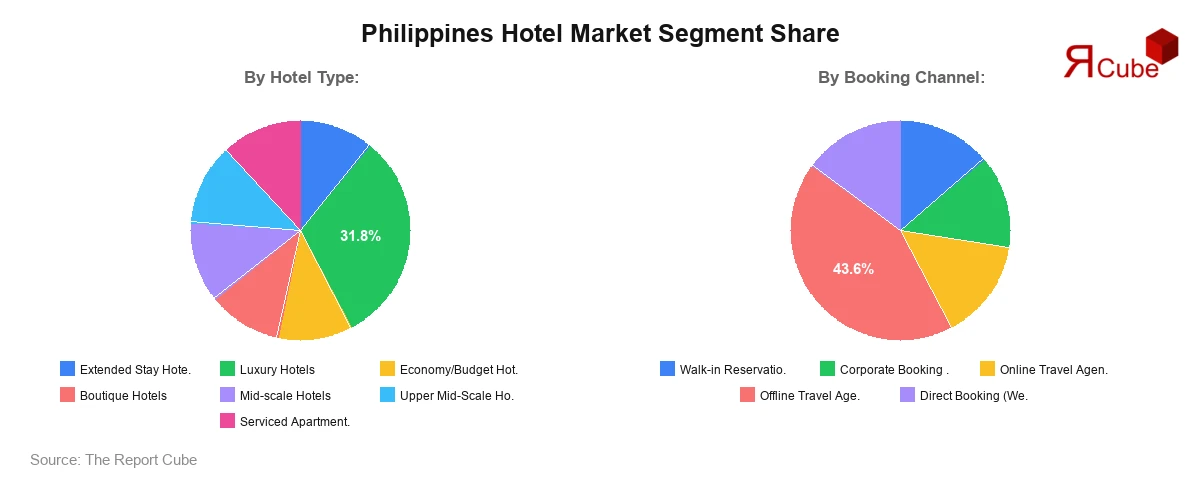
Luxury Hotels accounted for approximately 31.8% of the Philippines Hotel Market in 2026, making them the largest hotel category by revenue. The segment continues to benefit from the country's expanding premium tourism sector, increasing international visitor arrivals, and steady recovery of corporate travel. Metro Manila, Makati, Bonifacio Global City, Cebu, Boracay, and Palawan remain the primary locations for luxury hotel development due to their concentration of multinational companies, integrated resorts, convention facilities, and world-renowned leisure destinations. International operators including Hilton Worldwide, Marriott International, Shangri-La Group, and Accor Group continue expanding their luxury portfolios through new developments and management agreements, reflecting sustained investor confidence in the country's upscale hospitality sector.
Higher spending by affluent domestic travelers has also strengthened demand for premium accommodation, particularly during long holidays, weekend getaways, and destination weddings. Luxury properties are differentiating themselves through personalized concierge services, wellness facilities, fine dining concepts, private villas, executive lounges, and technology-enabled guest experiences. Sustainability has become another competitive advantage, with newly developed hotels incorporating green building certifications, renewable energy systems, and environmentally responsible operations. Continued investment in mixed-use developments integrating hotels with retail, commercial, and residential components is expected to reinforce the leadership of the luxury hotel segment throughout the forecast period.
By Booking Channel:
- Walk-in Reservations
- Corporate Booking Platforms
- Online Travel Agencies (OTAs)
- Offline Travel Agents
- Direct Booking (Websites & Apps)
Online Travel Agencies (OTAs) represented nearly 43.6% of total hotel booking revenue in 2026, making them the preferred reservation channel across the Philippines Hotel Industry. Widespread smartphone adoption, secure digital payment platforms, and improved internet accessibility have encouraged travelers to compare hotel prices, amenities, and guest reviews before making reservations. Both international and domestic tourists increasingly rely on OTA platforms because they provide flexible booking options, multilingual support, promotional discounts, and access to thousands of accommodation choices across the country. The popularity of spontaneous leisure trips and mobile-first travel planning has further accelerated online reservation growth.
Hotels continue strengthening partnerships with major OTA platforms while simultaneously enhancing their own websites and mobile applications to increase direct bookings. Loyalty rewards, exclusive member discounts, personalized offers, and seamless booking experiences are helping hotel brands improve customer retention and reduce distribution costs. Artificial intelligence-based pricing tools, real-time inventory management, and customer behavior analytics are enabling hotels to optimize occupancy and maximize revenue across peak and off-peak travel seasons. As digital travel planning becomes increasingly common among Filipino and international travelers, OTA platforms are expected to maintain their dominant position while direct digital booking channels continue expanding.
Regional Projection of Philippines Hotel Industry
- Luzon
- Visayas
- Mindanao
Luzon accounted for approximately 66.9% of the Philippines Hotel Market in 2026, supported by its strong concentration of commercial centers, transportation infrastructure, government institutions, and internationally recognized tourism destinations. Metro Manila serves as the country's largest hospitality hub, generating substantial demand from corporate travelers, government delegations, international conferences, and business events. At the same time, destinations such as Tagaytay, Baguio, Batangas, Clark, Subic, and Ilocos continue attracting millions of domestic and international visitors annually. Continuous investment in airports, expressways, rail connectivity, and mixed-use developments has further strengthened hotel demand throughout the region.
Leading international hotel operators have prioritized Luzon for expansion because of its diversified demand profile, higher occupancy rates, and stronger average daily room revenues compared with other regions. Integrated tourism estates, convention centers, casino resorts, and large-scale commercial developments continue creating opportunities for luxury hotels, upper mid-scale properties, serviced apartments, and lifestyle accommodations. Rising domestic tourism, expanding business activities, and government investment in regional infrastructure are expected to sustain Luzon's leadership position, while emerging growth corridors such as Clark, Pampanga, and CALABARZON continue attracting new hospitality investments during the forecast period.
Need insights for a specific region within this market?
Request Regional DataPhilippines Hotel Market Regional Analysis
The Philippines hotel market varies across Luzon, Visayas, and Mindanao due to distinct tourism drivers, infrastructure, and investment focus.
| Cluster | Demand Level | Key Areas | System Dominance | Core Demand Logic | Growth Nature |
|---|---|---|---|---|---|
| Luzon | Very High | Metro Manila, Clark, Baguio | Business & MICE hotels | Corporate, government, and mall-led stays | Pipeline-driven, room supply expanding fast |
| Visayas | High | Cebu, Boracay, Iloilo | Resort & leisure hotels | Beach tourism and international arrivals | Tourism-led, strong ADR and occupancy |
| Mindanao | Medium | Davao, Cagayan de Oro, General Santos | Mixed business and eco-resort hotels | Domestic travel and agro-industry visits | Emerging corridor with risk-adjusted growth |
Government Initiatives & Policies
- National Tourism Development Plan (NTDP) 2023-2028: The Philippine Department of Tourism continued implementing destination development, tourism infrastructure improvement, digital transformation, and sustainable tourism initiatives throughout 2025 and 2026 to strengthen hotel investment and visitor arrivals.
- Tourism Road Infrastructure Program (TRIP): The Department of Tourism and the Department of Public Works and Highways continued expanding road connectivity to key tourism destinations during 2025 and 2026, improving accessibility to hotels, resorts, and emerging tourist locations across the country.
Philippines Hotel Industry Recent Developments
- 2026: La Vie Hotels & Resorts entered the Philippines through management agreements for Hotel Casiana & Events Centre in Tagaytay and Grand Casiana Hotel in Pampanga. The expansion strengthens its Southeast Asian portfolio while increasing competition across both leisure and business hospitality markets. The development is expected to encourage additional foreign investment and improve service standards in secondary tourism destinations.
- 2026: Marriott International introduced the country's first AC Hotel by Marriott through the opening of AC Hotel by Marriott Manila in Ortigas. Located within the LEED Platinum-certified GLAS Tower, the property expands Marriott's lifestyle hospitality offerings while supporting increasing demand for premium business and extended-stay accommodation within Metro Manila.
- 2025: Hilton Worldwide announced the signing of Canopy by Hilton Makati in partnership with Ayala Land Hospitality. Scheduled to open in 2026, the 400-room property forms part of the One Ayala mixed-use development and reflects growing investor confidence in lifestyle hospitality, locally inspired guest experiences, and integrated urban tourism developments.
Why Choose This Report?
- Provides a comprehensive overview of the overall market analysis, encompassing key trends, consumer behavior analysis, and risk assessment to support strategic decision-making.
- Provides accurate, up-to-date insights into market size, segmentation, and emerging opportunities, helping to minimize risk while capitalizing on growth.
- Gives deep understanding of target audience preferences, investment habits, and communication channels for enhanced product development and marketing effectiveness.
- Delivers competitive analysis and benchmarking, uncovering the strengths and weaknesses of market competitors to guide strategic planning.
- Consolidates comprehensive market intelligence, reducing research efforts and improving decision-making efficiency.
- Facilitates customized market segmentation and risk mitigation strategies aligned with business objectives.
- Aids in identifying both market challenges and untapped opportunities within the industry to drive long-term business growth.
- Provides valuable information based on actual customer trends, industry developments, and market demand patterns.
Table of Contents
- Introduction
- Objective of the Study
- Product and Category Definition
- Market Segmentation
- Study Variables
- Research Methodology
- Secondary Data Points
- Breakdown of Secondary Sources
- Primary Data Points
- Breakdown of Primary Interviews
- Secondary Data Points
- Executive Summary
- Market Dynamics
- Emerging Opportunities
- Adoption Trends
- Demand Drivers
- Disruption Analysis (Challenges)
- Industry Analysis & Strategic Insights
- Supply/Value Chain Analysis
- Pricing Analysis
- Go-To-Market (GTM) Strategy
- BCG Matrix
- Recent Trends and Developments
- Regulatory and Policy Landscape
- Region-wise policies
- Government Initiatives
- Philippines Hotel Market Overview and Forecast Analysis (2021-2034)
- Market Size, By Value, By Growth Rate (CAGR/USD Billion)
- Market Share, By Hotel Type
- Extended Stay Hotels
- Luxury Hotels
- Economy/Budget Hotels
- Boutique Hotels
- Mid-scale Hotels
- Upper Mid-Scale Hotels
- Serviced Apartments
- Market Share, By Ownership
- Franchise Model
- Independent Operators
- Asset-Light Model
- Chain / Branded Hotel
- Market Share, By Booking Channel
- Walk-in Reservations
- Corporate Booking Platforms
- Online Travel Agencies (OTAs)
- Offline Travel Agents
- Direct Booking (Websites & Apps)
- Market Share, By Traveler Type
- International Travelers
- Solo Travelers
- Domestic Travelers
- Group Travelers
- Market Share, By Purpose of Travel
- Medical Tourism
- MICE (Meetings, Incentives, Conferences & Exhibitions)
- Education Tourism
- Leisure Travel
- Business Travel
- Religious Tourism
- Market Share, By End User
- Corporate Clients
- Families
- Government & Institutional Clients
- Tour Groups
- Individual Consumers
- Market Share, By Region
- Luzon
- Visayas
- Mindanao
- Market Share, By Company
- Revenue Shares & Analysis
- Competitive Landscape
- Luzon Hotel Market Overview and Forecast Analysis (2021-2034)
- Market Size, By Value, By Growth Rate (CAGR/USD Billion/Million)
- Market Share, By Hotel Type
- Market Share, By Ownership
- Market Share, By Booking Channel
- Market Share, By Traveler Type
- Market Share, By Purpose of Travel
- Market Share, By End User
- Visayas Hotel Market Overview and Forecast Analysis (2021-2034)
- Market Size, By Value, By Growth Rate (CAGR/USD Billion/Million)
- Market Share, By Hotel Type
- Market Share, By Ownership
- Market Share, By Booking Channel
- Market Share, By Traveler Type
- Market Share, By Purpose of Travel
- Market Share, By End User
- Mindanao Hotel Market Overview and Forecast Analysis (2021-2034)
- Market Size, By Value, By Growth Rate (CAGR/USD Billion/Million)
- Market Share, By Hotel Type
- Market Share, By Ownership
- Market Share, By Booking Channel
- Market Share, By Traveler Type
- Market Share, By Purpose of Travel
- Market Share, By End User
- Competitive Analysis, 2026
- Market Share of Key Players
- Competitive Mapping for Each Segment and Companies Operating Regionally
- Luzon Hotel Companies Share & Competitive Analysis, 2026
- Visayas Hotel Companies Share & Competitive Analysis, 2026
- Mindanao Hotel Companies Share & Competitive Analysis, 2026
- Company Profile (Partial List)
- Hilton Worldwide
- Company Overview
- Product Portfolio
- Strategic Alliances/Partnerships
- Recent Developments
- AyalaLand Hotels & Resorts Corp.
- Company Overview
- Product Portfolio
- Strategic Alliances/Partnerships
- Recent Developments
- DoubleDragon
- Company Overview
- Product Portfolio
- Strategic Alliances/Partnerships
- Recent Developments
- Marriott International
- Company Overview
- Product Portfolio
- Strategic Alliances/Partnerships
- Recent Developments
- SM Hotels and Conventions Corp.
- Company Overview
- Product Portfolio
- Strategic Alliances/Partnerships
- Recent Developments
- Ascott Limited
- Company Overview
- Product Portfolio
- Strategic Alliances/Partnerships
- Recent Developments
- Accor Group
- Company Overview
- Product Portfolio
- Strategic Alliances/Partnerships
- Recent Developments
- Megaworld Hotels & Resorts
- Company Overview
- Product Portfolio
- Strategic Alliances/Partnerships
- Recent Developments
- Shangri-La Group
- Company Overview
- Product Portfolio
- Strategic Alliances/Partnerships
- Recent Developments
- Robinsons Hotels & Resorts
- Company Overview
- Product Portfolio
- Strategic Alliances/Partnerships
- Recent Developments
- Others (Partial List)
- Hilton Worldwide
- Contact Us and Disclaimer
Top Key Players & Market Share Outlook
- Hilton Worldwide
- AyalaLand Hotels & Resorts Corp.
- DoubleDragon
- Marriott International
- SM Hotels and Conventions Corp.
- Ascott Limited
- Accor Group
- Megaworld Hotels & Resorts
- Shangri-La Group
- Robinsons Hotels & Resorts
- Others
Frequently Asked Questions






