



Build Your Custom Market Intelligence Report
Customize Your ReportGlobal Human Milk Bank Market Insights & Analysis
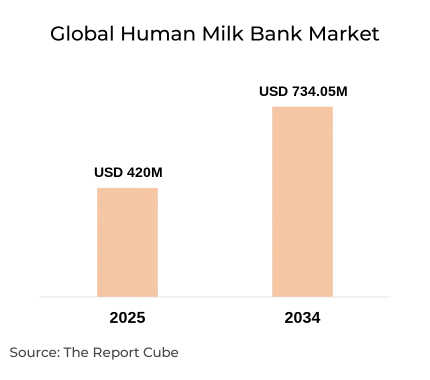
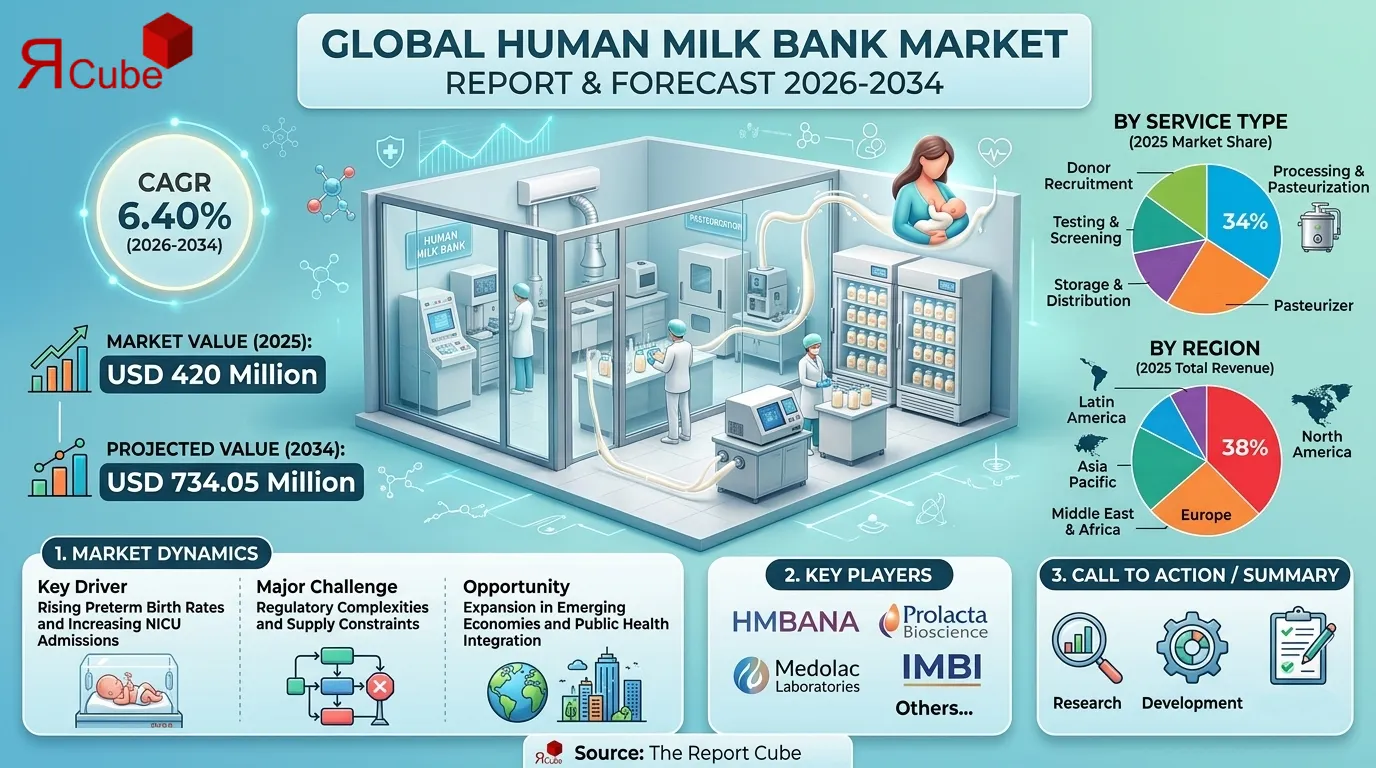
The Global Human Milk Bank Market is anticipated to register a CAGR of 6.40% during 2026-2034.The market size was valued at USD 420 Million in 2025 and is projected to reach USD 734.05 Million by 2034. The Global Human Milk Bank Market is witnessing steady growth, driven by rising awareness about the clinical benefits of donor human milk, especially for preterm and medically fragile infants. Human milk banks collect, screen, process, and distribute donated breast milk to neonates who lack access to their mother’s milk. Increasing rates of preterm births—estimated at nearly 15 million annually worldwide—have significantly strengthened demand for safe and pasteurized donor milk. Medical research consistently highlights the protective effects of human milk in reducing necrotizing enterocolitis (NEC), sepsis, and other neonatal complications, making donor milk a critical component of neonatal intensive care unit (NICU) protocols.
Healthcare institutions are expanding milk banking infrastructure to address supply-demand gaps. Technological advancements in pasteurization, microbial screening, and cold chain logistics are improving safety standards and operational efficiency. Governments and nonprofit organizations are actively promoting breastfeeding and donor milk programs to enhance infant survival rates. Additionally, growing collaboration between hospitals and specialized milk banking organizations is increasing accessibility across emerging economies. With improved regulatory frameworks, rising neonatal healthcare investments, and expanding donor networks, the Global Human Milk Bank Market is positioned for sustained growth through 2034.
Global Human Milk Bank Market Recent Developments
- 2025: Prolacta Bioscience expanded its human milk-based fortifier production capacity in North America.
- 2025: HMBANA approved new standardized screening guidelines for donor eligibility across member banks.
Government Initiatives & Policies
- WHO Global Strategy for Infant and Young Child Feeding: Promotes donor milk usage for vulnerable infants.
- U.S. CDC Breastfeeding Promotion Program: Supports human milk banking awareness initiatives.
Global Human Milk Bank Market Dynamics
Key Driver: Rising Preterm Birth Rates and Increasing NICU Admissions
The primary driver of the Global Human Milk Bank Market is the increasing incidence of preterm births and associated neonatal complications. Preterm infants are highly vulnerable to infections and digestive disorders, making access to safe donor milk critical when maternal milk is unavailable. Clinical evidence shows that donor human milk can reduce the incidence of necrotizing enterocolitis by up to 50% in very low birth weight infants. This significant health benefit has encouraged hospitals and neonatal care units to integrate donor milk programs into standard treatment protocols.
Furthermore, healthcare providers are recognizing the long-term developmental advantages associated with human milk consumption. Governments and healthcare organizations are expanding neonatal intensive care capacity, particularly in Asia Pacific and Latin America, to reduce infant mortality rates. Increased funding for maternal and child health programs has enabled the establishment of new milk banks within public hospitals. Rising awareness campaigns targeting lactating mothers have also expanded donor pools. These combined factors continue to drive stable demand growth in the market.
Industry Trends: Standardization, Technological Advancements, and Expanding Global Networks
Standardization of screening and pasteurization processes is emerging as a key industry trend. Advanced microbial testing, Holder pasteurization improvements, and automated storage systems are enhancing product safety and traceability. Digital donor management systems are improving operational transparency and regulatory compliance.
Global collaboration among milk banking associations is accelerating knowledge exchange and infrastructure development. Several regions are adopting centralized milk banking models to optimize supply chains and reduce wastage. Additionally, freeze-dried human milk products are under research to extend shelf life and facilitate distribution in remote areas. Investments in temperature-controlled logistics and cold storage solutions have reduced spoilage rates by approximately 18% over the past five years. These technological and operational enhancements are strengthening trust among healthcare providers and supporting market expansion.
Major Challenge: Regulatory Complexities and Supply Constraints
The Global Human Milk Bank Market faces regulatory and operational challenges related to donor screening, storage, and distribution standards. Compliance requirements vary significantly across regions, creating inconsistencies in operational protocols. Obtaining necessary approvals for new milk banks can be time-consuming and resource-intensive.
Supply constraints also remain a persistent concern. Donor recruitment depends heavily on awareness and voluntary participation, which may fluctuate. Seasonal variations and limited donor pools can create shortages, particularly in developing regions. Additionally, maintaining strict cold chain infrastructure requires continuous investment. Addressing these challenges through policy harmonization, donor education programs, and infrastructure support will be essential for long-term market sustainability.
Opportunity: Expansion in Emerging Economies and Public Health Integration
Emerging markets present significant opportunities due to rising healthcare investments and increasing awareness about neonatal nutrition. Governments in Asia Pacific and Africa are integrating human milk banks into national maternal and child health strategies. International health organizations are supporting funding programs to establish milk banks in underserved regions.
Public-private partnerships are facilitating infrastructure development and capacity building. Academic institutions are collaborating with healthcare providers to conduct clinical research on donor milk benefits. Additionally, awareness campaigns emphasizing breastfeeding and donor participation are expanding community-based donor networks. With growing emphasis on reducing infant mortality and improving neonatal outcomes, integration of milk banking services into public health frameworks offers strong long-term growth potential.
Global Human Milk Bank Market Segment-wise Analysis
By Service Type:
- Donor Milk Collection
- Screening & Testing
- Processing & Pasteurization
- Storage & Distribution
Processing & pasteurization holds the largest market share at approximately 34% in 2025, as safety assurance is the most critical step in milk banking operations. Hospitals prioritize certified pasteurization and microbial testing processes to ensure product safety. Screening & testing also represents a substantial portion due to stringent donor eligibility protocols. Storage & distribution services are expanding steadily, particularly in regions investing in centralized milk bank networks. The dominance of processing services reflects regulatory emphasis on quality control and neonatal safety.
By End User:
- Hospitals & Neonatal Care Units
- Standalone Human Milk Banks
- Research & Academic Institutions
Hospitals & Neonatal Care Units account for nearly 62% of total market demand in 2025, driven by rising NICU admissions and standardized donor milk protocols. Standalone human milk banks serve as centralized supply hubs supporting multiple healthcare facilities. Research & academic institutions contribute to innovation and clinical validation of donor milk benefits. The strong dominance of hospital-based utilization highlights the essential role of donor milk in neonatal critical care and reinforces consistent market demand across developed and emerging regions.
Regional Projection of Global Human Milk Bank Industry
- North America
- Europe
- Asia Pacific
- Rest of the World
North America leads the Global Human Milk Bank Market, accounting for approximately 38% of total revenue in 2025. The region benefits from well-established milk banking associations, strong regulatory frameworks, and high awareness among healthcare providers. The United States maintains a dense network of accredited milk banks and advanced neonatal care facilities. Europe follows closely with supportive public health initiatives and structured donor recruitment systems. Asia Pacific is expected to register the fastest growth, supported by expanding neonatal infrastructure and rising government support. While North America maintains leadership due to institutional maturity, emerging economies present significant expansion potential through increased public health integration and funding initiatives.
Why Choose This Report?
- Provides a comprehensive overview of the overall market analysis, encompassing key trends, consumer behavior analysis, and risk assessment to support strategic decision-making.
- Provides accurate, up-to-date insights into market size, segmentation, and emerging opportunities, helping to minimize risk & capitalizing on growth.
- Gives deep understanding of target audience preferences, investment habits, and communication channels for enhanced product development & marketing effectiveness.
- Delivers competitive analysis & benchmarking, uncovering the strengths & weaknesses of market competitors to guide strategies.
- Consolidate comprehensive market intelligence, reducing reasoning & streamlining research efforts.
- Facilitates customized market segmentation & risk mitigation strategies, fine-tuned to the business objectives.
- Aids in identifying both market challenges & untapped opportunities within the industry to drive long-term business growth.
- Provides valuable information based on actual customer data & search trends.
Table of Contents
- Introduction
- Objective of the Study
- Human Milk Bank Definition
- Market Segmentation
- Study Variables
- Research Methodology
- Secondary Data Points
- Breakdown of Secondary Sources
- Primary Data Points
- Breakdown of Primary Interviews
- Secondary Data Points
- Executive Summary
- Market Dynamics
- Drivers
- Challenges
- Opportunity Assessment
- Recent Trends and Developments
- Regulatory and Policy Landscape
- Global Human Milk Bank Market Overview (2021–2034)
- Market Size, By Value (USD Million)
- Market Share, By Service Type
- Donor Milk Collection
- Screening & Testing
- Processing & Pasteurization
- Storage & Distribution
- Market Share, By Donor Type
- Hospital-Based Donors
- Community-Based Donors
- Market Share, By Recipient Type
- Preterm Infants
- Full-Term Infants with Medical Needs
- NICU Patients
- Market Share, By End User
- Hospitals & Neonatal Care Units
- Standalone Human Milk Banks
- Research & Academic Institutions
- Market Share, By Company
- Competition Characteristics
- Revenue Shares & Analysis
- Market Share, By Region
- North America Human Milk Bank Market
- Market Size, By Value
- Market Share, By Service Type
- Market Share, By End User
- Europe Human Milk Bank Market
- Market Size, By Value
- Market Share, By Service Type
- Market Share, By End User
- Asia Pacific Human Milk Bank Market
- Market Size, By Value
- Market Share, By Service Type
- Market Share, By End User
- Middle East and Africa Human Milk Bank Market
- Market Size, By Value
- Market Share, By Service Type
- Market Share, By End User
- South America Human Milk Bank Market
- Market Size, By Value
- Market Share, By Service Type
- Market Share, By End User
- North America Human Milk Bank Market
- Competitive Outlook and Company Profiles
- Human Milk Banking Association of North America (HMBANA)
- Organization Overview
- Milk Banking Services
- Strategic Initiatives
- Recent Developments
- Prolacta Bioscience
- Company Overview
- Human Milk-Based Product Portfolio
- Strategic Alliances/Partnerships
- Recent Developments
- Medolac Laboratories
- Company Overview
- Donor Milk Products
- Strategic Alliances/Partnerships
- Recent Developments
- International Milk Banking Initiative (IMBI)
- Organization Overview
- Global Milk Banking Programs
- Strategic Initiatives
- Recent Developments
- Others
- Organization Overview
- Service Offerings
- Strategic Alliances/Partnerships
- Recent Developments
- Human Milk Banking Association of North America (HMBANA)
- Contact Us / Disclaimer
Top Key Players & Market Share Outlook
- Human Milk Banking Association of North America (HMBANA)
- Prolacta Bioscience
- Medolac Laboratories
- International Milk Banking Initiative (IMBI)
Frequently Asked Questions






