



Build Your Custom Market Intelligence Report
Customize Your ReportAustralia Hydrogen Fuel Cell Vehicle Market Key Takeaways
- Australia hydrogen fuel cell vehicle market valued at USD 0.24 billion in 2026, reflecting early-stage commercial adoption.
- Industry projected to reach USD 2.18 billion by 2034, expanding at an exceptional 31.78% CAGR.
- Market accelerating at a 31.78% CAGR through the 2034 forecast period, among the highest in clean mobility globally.
- Fuel cell stacks lead the component segment as the core electrochemical power generation unit in FCEV systems.
- Green hydrogen dominates sourcing preferences as Australia's renewable energy infrastructure scales nationally.
- Heavy transport and commercial fleet operators are the fastest-growing end-user segment driving procurement volumes.
- Toyota Motor Corporation Australia and Hyundai Motor Company Australia lead FCEV supply across domestic channels.
- Federal and state hydrogen strategies, including Australia's National Hydrogen Strategy, are accelerating commercial fleet deployment.
Australia Hydrogen Fuel Cell Vehicle Market Overview
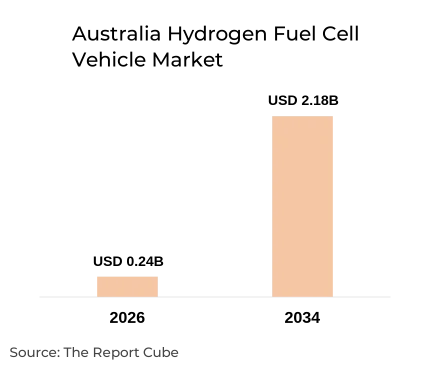
The Australia Hydrogen Fuel Cell Vehicle Market is anticipated to register a 31.78% CAGR during 2026–2034. The market size was valued at USD 0.24 billion in 2026 and is projected to reach USD 2.18 billion by 2034. Australia's exceptional renewable energy endowment - including solar, wind, and hydroelectric resources - positions the country as one of the world's most favorable environments for green hydrogen production and FCEV deployment. Federal initiatives under the National Hydrogen Strategy and the Hydrogen Headstart Program are directly funding electrolyzer capacity, refueling infrastructure, and fleet conversion programs that accelerate fuel cell vehicle adoption across commercial transport, mining, and public transit sectors. Toyota Motor Corporation Australia and Hyundai Motor Company Australia continue expanding FCEV availability through dedicated dealership networks and government fleet supply agreements.
State-level hydrogen roadmaps in New South Wales, Victoria, Queensland, and Western Australia are supplementing federal investment with targeted refueling corridor development and zero-emission fleet mandates for public bus and freight operations. BMW Group has entered the Australian market with hydrogen powertrain development partnerships targeting premium passenger and light commercial vehicle segments. Growing awareness of Australia's commitment to net-zero emissions by 2050, combined with declining green hydrogen production costs driven by economies of scale, is strengthening long-term procurement confidence among logistics operators, mining companies, and public transport authorities deploying hydrogen fuel cell vehicle fleets.
Australia Hydrogen Fuel Cell Vehicle Market Size & Forecast
|
Metric |
Details |
|---|---|
|
Market Size (2026) |
USD 0.24 Billion |
|
Market Size (2034) |
USD 2.18 Billion |
|
CAGR (2026–2034) |
31.78% |
|
Base Year |
2026 |
|
Historical Years |
2021–2025 |
|
Forecast Years |
2026–2034 |
This Australia Hydrogen Fuel Cell Vehicle Market Size study values the industry at USD 0.24 billion in 2026, with projections reaching USD 2.18 billion by 2034 at a 31.78% CAGR - a growth rate substantially outpacing the global FCEV average, underpinned by Australia's expanding green hydrogen production capacity, federal refueling infrastructure investment, and accelerating commercial fleet electrification mandates.
Australia Hydrogen Fuel Cell Vehicle Market Dynamics
Australia's hydrogen fuel cell vehicle sector is advancing rapidly as renewable energy costs decline, government infrastructure commitments deepen, and commercial fleet operators seek zero-emission alternatives to diesel across mining, logistics, and public transport operations. Federal and state hydrogen strategies, carbon-reduction legislative frameworks, and expanding international FCEV manufacturer engagement are collectively reinforcing investment confidence across the domestic supply chain.
|
Factor |
Type |
Specific Impact on Market |
Magnitude |
|---|---|---|---|
|
National Hydrogen Strategy infrastructure investment |
Driver |
Expands refueling corridor network enabling commercial FCEV fleet deployment |
High |
|
Declining green hydrogen production costs |
Driver |
Reduces total cost of ownership gap between FCEVs and diesel alternatives |
High |
|
Limited refueling station density |
Restraint |
Restricts FCEV range utility and deters non-fleet private sector adoption |
Medium |
|
Heavy transport decarbonization mandates |
Opportunity |
Opens large-volume FCEV procurement pipeline in logistics and mining sectors |
High |
|
Green hydrogen certification and supply chain traceability |
Challenge |
Raises procurement complexity and compliance costs for fleet operators |
Medium |
- Growth Drivers - Federal Infrastructure and Renewable Energy Advantage: The Australia Hydrogen Fuel Cell Vehicle Market Growth is primarily driven by federal investment commitments under the Hydrogen Headstart Program, which provides production credits reducing green hydrogen costs for fleet operators. Australia's extraordinary solar and wind resources enable low-cost renewable electricity for electrolysis, creating a structurally advantaged green hydrogen production environment. State hydrogen roadmaps in Queensland and Western Australia are accelerating refueling corridor deployment along major freight and mining logistics routes, unlocking large-volume FCEV fleet adoption across commercial transport operators, port authorities, and heavy industrial operations through 2034.
- Market Restraints - Refueling Infrastructure Density Gap: Australia's vast geographic footprint creates a structural challenge for FCEV adoption outside metropolitan and established freight corridors. Refueling station density remains critically low relative to diesel infrastructure, with fewer than 20 public hydrogen refueling stations operational nationally as of 2025. Fleet operators in regional and remote mining, agriculture, and pastoral sectors face prohibitive range constraints unless dedicated on-site hydrogen generation and refueling facilities are installed - significantly increasing upfront capital requirements and extending fleet conversion payback periods beyond commercially attractive thresholds.
- Market Opportunities - Heavy Transport and Mining Sector Decarbonization: Australia's mining sector - responsible for a substantial share of national diesel consumption across haulage, drilling, and support vehicle operations - represents the single largest near-term FCEV adoption opportunity. Mining companies including Rio Tinto and Fortescue have publicly committed to fleet decarbonization roadmaps targeting hydrogen-powered haulage by the early 2030s. Government co-investment schemes enabling on-site green hydrogen production at mine sites could unlock procurement volumes far exceeding current passenger and light commercial FCEV market projections through the 2034 forecast period.
- Industry Challenges - Green Hydrogen Supply Chain Certification Complexity: Establishing verifiable green hydrogen supply chains for commercial fleet operators requires robust certification frameworks distinguishing renewable-sourced hydrogen from gray and blue variants produced using fossil fuel processes. Australia's evolving Guarantee of Origin certification scheme is still maturing, creating procurement uncertainty for fleet operators seeking contractually assured green hydrogen supply. FCEV manufacturers and hydrogen distributors must invest in supply chain transparency systems, blockchain-enabled traceability platforms, and third-party certification partnerships to meet increasingly stringent corporate sustainability reporting requirements under Australian climate disclosure regulations.
Need Specific Data, Let’s Customize the Report for You
Request CustomizationAustralia Hydrogen Fuel Cell Vehicle Market Trends
- Emerging Trends: Among the most significant Australia Hydrogen Fuel Cell Vehicle Market Trends is the accelerating convergence of on-site green hydrogen generation with fleet refueling - particularly across remote mining operations, port authorities, and regional public transport depots where grid-connected refueling is impractical. Hydrogen hubs in Gladstone, Pilbara, and Hunter Valley are consolidating production and distribution infrastructure, attracting FCEV fleet deployments from logistics companies, government agencies, and industrial operators seeking vertically integrated zero-emission transport solutions.
- Technology Trends: Next-generation proton exchange membrane (PEM) fuel cell stacks with higher power density and extended operational durability are entering Australian commercial fleet applications, reducing maintenance intervals and improving lifecycle economics. High-pressure 700-bar hydrogen storage tank technology adopted by Toyota and Hyundai is enabling longer operational range for heavy transport FCEVs. Solid-state hydrogen storage research programs at Australian universities are expected to deliver improved volumetric energy density systems suited to space-constrained commercial vehicle configurations within the forecast period.
- Consumer / Buyer Trends: Commercial fleet procurement managers are increasingly demanding lifecycle cost modeling from FCEV suppliers, incorporating hydrogen fuel price trajectories, maintenance cost reductions, and carbon credit revenue streams into total cost of ownership calculations. Public sector buyers - including state transit authorities and federal government fleet managers - are prioritizing FCEV procurement to meet net-zero fleet targets. Private sector mining and logistics operators are evaluating FCEV adoption in conjunction with on-site renewable energy and electrolyzer investments, treating hydrogen fuel cell vehicles as integrated components of broader decarbonization infrastructure projects.
Australia Hydrogen Fuel Cell Vehicle Market Segment Analysis
Australia's hydrogen fuel cell vehicle market serves distinct technical component categories and hydrogen source classifications, each reflecting unique procurement priorities, supply chain structures, and decarbonization alignment requirements across commercial fleet and public transport applications.
By Fuel Cell Component
|
Component |
Estimated Share (2026) |
Key Characteristics |
|---|---|---|
|
Fuel Cell Stacks |
52% |
Core electrochemical unit; high-value, precision-engineered; supplied by Toyota and Hyundai OEM divisions |
|
Hydrogen Storage Tanks |
30% |
High-pressure 700-bar carbon fiber tanks; critical range determinant; growing demand from heavy transport |
|
Fuel Processing & Auxiliary Systems |
18% |
Includes humidifiers, compressors, thermal management; expanding as fleet scale increases |
Fuel cell stacks command the largest Australia Hydrogen Fuel Cell Vehicle Market Share among all component categories, representing an estimated 52% of market value in 2026. Toyota Motor Corporation Australia and Hyundai Motor Company Australia supply integrated fuel cell stack systems as part of complete FCEV powertrains, with BMW Group contributing advanced stack development through research partnerships with Australian universities and state energy agencies. Hydrogen storage tanks, accounting for approximately 30% of component market value, are experiencing rapid demand growth as heavy transport operators require extended-range storage solutions for freight and mining haulage applications. Fuel processing and auxiliary systems, representing the remaining 18%, are scaling in procurement volume as fleet operators establish centralized maintenance and refueling infrastructure across dedicated FCEV depots and on-site hydrogen generation facilities.
By Hydrogen Source Type
|
Hydrogen Source |
Estimated Share (2026) |
Key Characteristics |
|---|---|---|
|
Green Hydrogen |
55% |
Renewable electrolysis-produced; preferred for zero-emission compliance and carbon credit eligibility |
|
Gray/Blue Hydrogen |
45% |
Fossil fuel-derived; cost-competitive near-term; declining share as renewable costs fall through 2034 |
Green hydrogen leads the By Hydrogen Source Type segment with an estimated 55% market share in 2026, reflecting Australia's policy environment strongly favoring renewable-sourced hydrogen through federal production credits and state procurement mandates. Toyota Motor Corporation Australia and Hyundai Motor Company Australia both promote green hydrogen supply partnerships for their respective FCEV fleet programs, actively engaging renewable energy producers and electrolyzer operators to ensure certified supply chains. Gray and blue hydrogen, representing approximately 45% of sourced hydrogen volumes in 2026, currently maintains cost competitiveness for fleet operators in regions where green hydrogen production infrastructure remains underdeveloped. However, declining electrolyzer costs and expanding renewable energy capacity are projected to shift the sourcing balance decisively toward green hydrogen across the 2026–2034 forecast period, with BMW Group's Australian partnerships specifically targeting 100% green hydrogen-powered demonstration fleets by the early 2030s.
Australia Hydrogen Fuel Cell Vehicle Market Regional Analysis
|
Region |
Estimated Market Share |
Key Growth Factors |
Consumer Trends |
|---|---|---|---|
|
New South Wales |
32% |
Hunter Valley hydrogen hub, state ZEV strategy, public transit fleet mandates |
Government fleet FCEV procurement, bus and rail decarbonization |
|
Victoria |
25% |
State hydrogen roadmap, Melbourne transit authority fleet programs, industrial precinct growth |
Public transport electrification, commercial logistics adoption |
|
Queensland |
20% |
Gladstone hydrogen export hub, mining sector fleet conversion, renewable energy investment |
Mining decarbonization fleet, port logistics FCEV adoption |
|
Western Australia |
17% |
Pilbara mining hydrogen projects, Fortescue green hydrogen initiatives, export infrastructure |
Heavy haulage FCEV procurement, on-site hydrogen generation |
|
Rest of Australia |
6% |
South Australian hydrogen strategy, Northern Territory energy transition programs |
Regional transit fleet adoption, government pilot programs |
- New South Wales - Accounting for approximately 32% of national market demand, New South Wales leads FCEV adoption through the Hunter Hydrogen Network connecting Newcastle port hydrogen export infrastructure with domestic fleet refueling capability. The NSW Government's fleet decarbonization commitments and Sydney metropolitan bus replacement programs targeting zero-emission vehicles are generating consistent FCEV procurement volumes, with Toyota Motor Corporation Australia supplying Mirai fleet units to government agencies and Hyundai Motor Company Australia delivering NEXO vehicles to commercial operators across the state.
- Victoria - Victoria represents approximately 25% of national market demand, driven by the Victorian Hydrogen Strategy and the Public Transport Victoria fleet electrification roadmap. Melbourne's metropolitan bus network hydrogen pilot programs and growing industrial precinct hydrogen demand across Geelong and Dandenong manufacturing corridors are expanding FCEV procurement. BMW Group's Australian R&D partnerships are notably concentrated in Victoria's advanced manufacturing ecosystem.
- Queensland - Queensland accounts for an estimated 20% of market demand, with the Gladstone Hydrogen Hub emerging as a central production and distribution node supplying commercial FCEV fleet operators across Brisbane logistics corridors and regional mining operations. The Queensland Government's co-investment in hydrogen refueling infrastructure along the Bruce Highway freight corridor is enabling long-haul FCEV deployment previously constrained by refueling gaps across the state's extensive road network.
- Western Australia - Western Australia represents approximately 17% of the national market, with the Pilbara region's extraordinary renewable energy resources underpinning large-scale green hydrogen production projects led by Fortescue Future Industries and other major clean energy developers. Rio Tinto's and BHP's heavy haulage fleet decarbonization commitments in the iron ore mining sector are creating substantial FCEV procurement demand from Toyota and Hyundai's commercial fleet divisions through the 2034 forecast period.
- Rest of Australia - South Australia, the Northern Territory, and remaining states and territories collectively account for approximately 6% of market demand. South Australia's hydrogen strategy and the Whyalla green steel project's associated hydrogen transport fleet represent the most significant emerging demand nodes outside the four primary regions.
Australia Hydrogen Fuel Cell Vehicle Market Share & Competitive Landscape
The Australia Hydrogen Fuel Cell Vehicle Market competitive landscape is concentrated among global automotive OEMs with established FCEV platforms and dedicated Australian fleet supply programs. Competition centers on vehicle performance specifications, hydrogen supply chain integration, government fleet tender participation, and total cost of ownership modeling capability for commercial procurement managers.
|
Company |
Competitive Strength |
Primary Segment Served |
|---|---|---|
|
Toyota Motor Corporation Australia |
Mirai FCEV platform, government fleet partnerships, HydroGEN refueling network development |
Government fleets, commercial light vehicles |
|
Hyundai Motor Company Australia |
NEXO FCEV platform, commercial fleet supply agreements, hydrogen infrastructure partnerships |
Commercial fleets, public transport |
|
BMW Group |
Premium FCEV development, Australian R&D university partnerships, hydrogen powertrain innovation |
Premium passenger, light commercial |
|
Others |
Regional distributors, component suppliers, hydrogen refueling infrastructure developers |
Fleet support, component procurement |
Key Companies in the Australia Hydrogen Fuel Cell Vehicle Market
Toyota Motor Corporation Australia
Toyota Motor Corporation Australia, a subsidiary of Toyota Motor Corporation headquartered in Toyota City, Japan - the world's largest vehicle manufacturer by annual sales volume - leads Australian FCEV market development through the Mirai hydrogen sedan and commercial FCEV platform programs. In 2025, Toyota Australia expanded its hydrogen fleet supply agreements with state government agencies in New South Wales and Victoria, while advancing partnerships with Australian hydrogen producers to establish certified green hydrogen supply chains for fleet refueling operations across the eastern seaboard.
Hyundai Motor Company Australia
Hyundai Motor Company Australia, a subsidiary of Hyundai Motor Group headquartered in Seoul, South Korea, operates as the primary volume FCEV supplier for Australian commercial fleet operators through the NEXO hydrogen SUV and evolving heavy transport fuel cell powertrain programs. In 2025, Hyundai Australia deepened engagement with Queensland and Western Australian government fleet programs, supplying NEXO vehicles for public sector hydrogen mobility pilots while advancing technical partnerships with Australian renewable energy companies to develop green hydrogen supply agreements supporting long-term fleet operation commitments.
Australia Hydrogen Fuel Cell Vehicle Market Recent Developments
|
Year |
Company |
Development |
|---|---|---|
|
2025 |
Toyota Motor Corporation Australia |
Expanded government fleet supply agreements in NSW and Victoria; advanced green hydrogen supply chain partnerships for Mirai fleet refueling |
|
2025 |
Hyundai Motor Company Australia |
Deepened engagement with Queensland and WA government fleet programs; advanced NEXO hydrogen pilot programs for public sector mobility |
|
2025 |
BMW Group |
Announced Australian R&D partnership with University of Melbourne for next-generation hydrogen powertrain development targeting commercial vehicle applications |
Australia Hydrogen Fuel Cell Vehicle Market Future Outlook
The Australia Hydrogen Fuel Cell Vehicle Market Forecast projects a 31.78% CAGR through 2034, with market value reaching USD 2.18 billion as green hydrogen production scales, refueling infrastructure matures, and commercial fleet decarbonization procurement accelerates. Toyota Motor Corporation Australia and Hyundai Motor Company Australia are expected to expand fleet supply programs across mining, logistics, and public transport sectors, while BMW Group deepens FCEV platform development through Australian university and industry research partnerships. Federal Hydrogen Headstart production credits will progressively reduce green hydrogen costs, narrowing the total cost of ownership gap with diesel alternatives and unlocking private sector fleet conversion investment beyond government-mandated programs.
Technological advancement in PEM fuel cell stack durability, high-pressure hydrogen storage capacity, and digital fleet management integration will increasingly make FCEVs operationally competitive with battery electric alternatives in long-range, heavy-duty applications where charging infrastructure limitations constrain BEV adoption. Sustainable sourcing standards enforced through Australia's Guarantee of Origin certification scheme will become standard procurement requirements for corporate fleet operators meeting climate disclosure obligations. The convergence of declining green hydrogen production costs, expanding refueling infrastructure, and maturing FCEV platform reliability will solidify Australia's position as the Asia-Pacific region's leading hydrogen mobility market through 2034.
Australia Hydrogen Fuel Cell Vehicle Market Report Coverage
This Australia Hydrogen Fuel Cell Vehicle Market Report covers all critical dimensions of the domestic FCEV industry across the 2026–2034 forecast period, providing procurement teams, fleet operators, investors, and policy analysts with comprehensive market intelligence.
|
Report Attribute |
Details |
|---|---|
|
Market Name |
Australia Hydrogen Fuel Cell Vehicle Market |
|
Market Size (2026) |
USD 0.24 Billion |
|
Market Size (2034) |
USD 2.18 Billion |
|
Forecast Period |
2026–2034 |
|
CAGR |
31.78% |
|
Base Year |
2026 |
|
Historical Years |
2021–2025 |
|
Forecast Years |
2026–2034 |
|
Segments Covered |
By Vehicle Type, By End-User, By Fuel Cell Component, By Hydrogen Source Type |
|
Regions Covered |
New South Wales, Victoria, Queensland, Western Australia, Rest of Australia |
|
Key Companies |
Toyota Motor Corporation Australia, Hyundai Motor Company Australia, BMW Group, Others |
|
Report Format |
PDF, Excel, PPT |
|
Customization |
Available as per client requirements |
Why Choose This Australia Hydrogen Fuel Cell Vehicle Market Report?
- Comprehensive coverage of Australia's high-growth FCEV market across all five major regional demand nodes.
- Accurate market sizing from USD 0.24 billion in 2026 through the 2034 forecast at 31.78% CAGR.
- Detailed segmentation by fuel cell component type and hydrogen source classification with share estimates.
- State-level regional insights covering New South Wales, Victoria, Queensland, Western Australia, and rest of country.
- Competitive profiling of Toyota, Hyundai, BMW Group, and emerging market participants across fleet supply channels.
- Analysis of green hydrogen production cost trajectories reshaping FCEV total cost of ownership economics.
- Forecast data aligned with Australia's National Hydrogen Strategy and Hydrogen Headstart Program investment commitments.
- Research supporting strategic investment, fleet procurement planning, and infrastructure partnership decision-making through 2034.
Table of Contents
- Introduction
- Objective of the Study
- Product Definition
- Market Segmentation
- Study Variables
- Research Methodology
- Secondary Data Points
- Companies Interviewed
- Primary Data Points
- Breakdown of Primary Interviews
- Secondary Data Points
- Executive Summary
- Market Dynamics
- Drivers
- Challenges
- Opportunity Assessment
- Recent Trends and Developments
- Policy and Regulatory Landscape
- Australia Hydrogen Fuel Cell Vehicle Market Overview and Forecast Analysis (2021-2034)
- Market Size, By Value, By Growth Rate (CAGR/USD Billions)
- Demand – Supply Trends
- Market Share, By Vehicle Type
- Passenger Cars & SUVs
- Buses & Coaches
- Heavy-Duty Trucks
- Material Handling & Forklifts
- Market Share, By End-User
- Government Fleets
- Commercial & Corporate Fleets
- Market Share, By Fuel Cell Component
- Fuel Cell Stacks
- Hydrogen Storage Tanks
- Fuel Processing & Auxiliary Systems
- Market Share, By Hydrogen Source Type
- Green Hydrogen
- Gray/Blue Hydrogen
- Market Share, By Region
- New South Wales
- Victoria
- Queensland
- Western Australia
- Rest of Australia
- Market Share, By Competitors
- Competition Characteristics
- Revenue Shares
- Passenger Cars & SUVs Australia Hydrogen Fuel Cell Vehicle Market Overview, 2021-2034F
- By Value (USD Million)
- By End-User – Market Size & Forecast 2021-2034, USD Million
- Government Fleets
- Commercial & Corporate Fleets
- Buses & Coaches Australia Hydrogen Fuel Cell Vehicle Market Overview, 2021-2034F
- By Value (USD Million)
- By End-User – Market Size & Forecast 2021-2034, USD Million
- Government Fleets
- Commercial & Corporate Fleets
- Heavy-Duty Trucks Australia Hydrogen Fuel Cell Vehicle Market Overview, 2021-2034F
- By Value (USD Million)
- By End-User – Market Size & Forecast 2021-2034, USD Million
- Government Fleets
- Commercial & Corporate Fleets
- Material Handling & Forklifts Australia Hydrogen Fuel Cell Vehicle Market Overview, 2021-2034F
- By Value (USD Million)
- By End-User – Market Size & Forecast 2021-2034, USD Million
- Government Fleets
- Commercial & Corporate Fleets
- Competitive Outlook (Company Profile - Partial List)
- Toyota Motor Corporation Australia
- Company Overview
- Business Segments
- Strategic Alliances/Partnerships
- Recent Developments
- Hyundai Motor Company Australia
- Company Overview
- Business Segments
- Strategic Alliances/Partnerships
- Recent Developments
- BMW Group
- Company Overview
- Business Segments
- Strategic Alliances/Partnerships
- Recent Developments
- Others
- Toyota Motor Corporation Australia
- Contact Us & Disclaimer
Top Key Players & Market Share Outlook
- Toyota Motor Corporation Australia
- Hyundai Motor Company Australia
- BMW Group
- Others
Frequently Asked Questions






