




Build Your Custom Market Intelligence Report
Customize Your ReportUK Hydrogen Fuel Cell Train Market Key Highlights
By Technology:
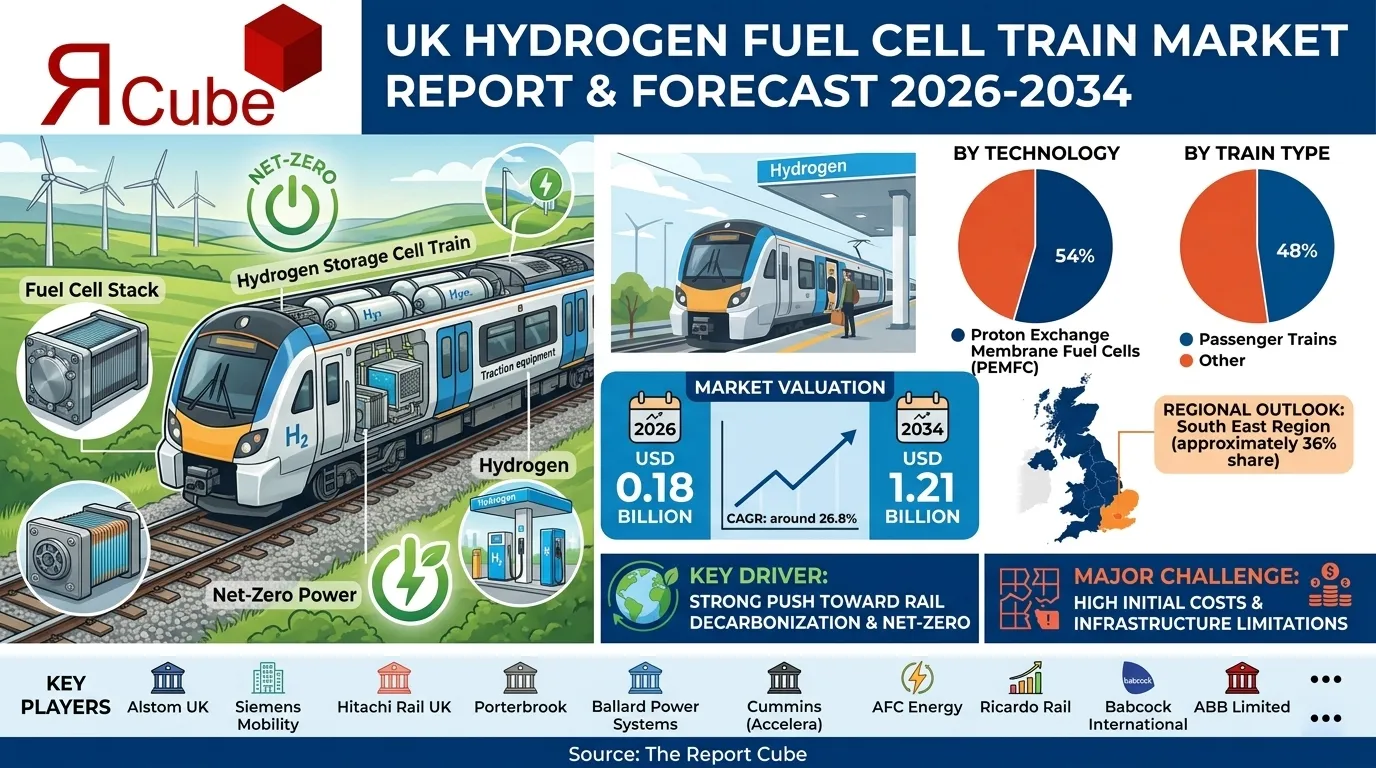
Proton Exchange Membrane Fuel Cells segment leads the market with nearly 54% share.
By Train Type:
Passenger trains segment dominates the market with around 48% of revenue.
Regional Outlook:
South East region dominates the UK Hydrogen Fuel Cell Train market with approximately 36% share.
UK Hydrogen Fuel Cell Train Market Insights & Analysis
The UK Hydrogen Fuel Cell Train Market is anticipated to register a CAGR of around 26.8% during the forecast period 2026-2034. The market size is valued at USD 0.18 billion in 2026 and is projected to reach USD 1.21 billion by 2034. The market is gaining strong traction as the UK intensifies its rail decarbonization strategy, with over 38% of rail lines still dependent on diesel traction. This creates a clear demand for alternative propulsion technologies such as hydrogen fuel cells, especially on non-electrified routes where electrification costs remain high.
Investment momentum is increasing across the hydrogen ecosystem, with more than USD 4 billion allocated toward hydrogen infrastructure and clean mobility initiatives between 2023 and 2025. Companies are actively collaborating with rail operators and infrastructure providers to deploy pilot projects. Technological advancements such as hybrid battery-fuel cell systems and rapid refueling capabilities are improving operational efficiency. Additionally, strong policy backing and regional innovation hubs are enabling faster commercialization, positioning hydrogen trains as a scalable and viable solution for the UK’s long-term rail modernization strategy.
UK Hydrogen Fuel Cell Train Market Dynamics
Key Driver: Strong Push Toward Rail Decarbonization and Net-Zero Targets
The UK’s commitment to achieving net-zero emissions by 2050 is a primary growth driver for the hydrogen fuel cell train market. Rail transport accounts for a notable share of transport emissions, with diesel trains contributing significantly on non-electrified tracks. Hydrogen fuel cell trains offer a clean alternative, emitting only water vapor. Government-backed decarbonization plans aim to eliminate diesel-only trains by 2040, which is accelerating demand for hydrogen-powered rolling stock.
Furthermore, hydrogen trains are particularly suitable for routes where electrification is not economically viable. Studies indicate that nearly 60% of UK rail routes may benefit from hydrogen adoption due to cost advantages over overhead electrification. This economic feasibility, combined with environmental benefits, is driving both public and private investments into hydrogen rail technologies.
Book your FREE 30-minute expert consultation today
Contact UsIndustry Trends: Integration of Hybrid Systems and Expansion of Hydrogen Infrastructure
The UK hydrogen fuel cell train market is witnessing rapid adoption of hybrid propulsion systems combining fuel cells with lithium-ion batteries. These systems enhance efficiency by optimizing energy usage during acceleration and braking cycles. Recent train models demonstrate extended range capabilities of up to 1,000 km per refueling cycle, making them suitable for long-distance operations.
In parallel, hydrogen refueling infrastructure is expanding across key rail corridors. By 2025, over 15 hydrogen refueling stations were planned or operational across the UK. This infrastructure growth is critical for scaling hydrogen train deployment. Additionally, digital monitoring systems and predictive maintenance technologies are being integrated to improve reliability and reduce lifecycle costs.
Major Challenge: High Initial Costs and Infrastructure Limitations
The deployment of hydrogen fuel cell trains involves substantial upfront investment in rolling stock, hydrogen production facilities, and refueling infrastructure. Initial procurement costs for hydrogen trains are estimated to be 25-35% higher than conventional diesel trains. This cost barrier can slow adoption, particularly among smaller rail operators with limited capital budgets.
Moreover, hydrogen production and storage infrastructure in the UK is still developing. Limited availability of green hydrogen and logistical challenges in transportation and storage can impact operational scalability. These factors create uncertainty in supply chains and may delay large-scale commercialization if not addressed through coordinated investment and policy support.
Opportunity: Expansion of Green Hydrogen Production and Regional Rail Projects
The rapid growth of green hydrogen production presents a significant opportunity for the UK hydrogen fuel cell train market. The UK aims to produce up to 10 GW of low-carbon hydrogen by 2030, which will directly support transportation sectors including rail. This shift toward renewable hydrogen will enhance sustainability and reduce operational emissions further.
Additionally, regional rail modernization projects are creating opportunities for hydrogen adoption. Rural and regional routes, where electrification is less feasible, are ideal candidates for hydrogen-powered trains. Public-private partnerships and demonstration projects are expected to accelerate deployment, creating a robust pipeline for future growth.
UK Hydrogen Fuel Cell Train Market Segment-wise Analysis
By Technology:
- Proton Exchange Membrane Fuel Cells
- Solid Oxide Fuel Cells
- Alkaline Fuel Cells
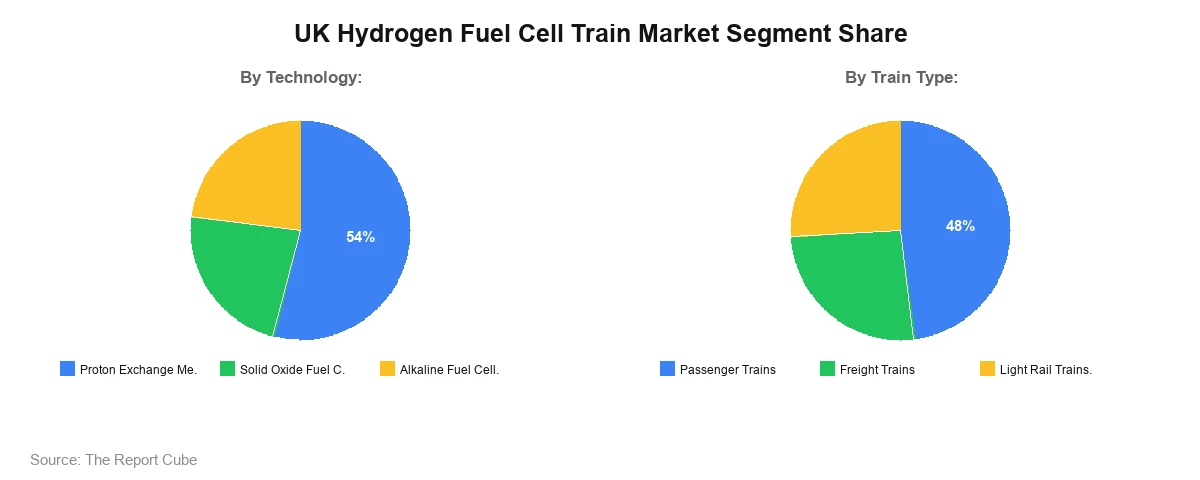
Proton Exchange Membrane fuel cells dominate the UK hydrogen fuel cell train market with an estimated share of around 54% in 2026. Their dominance is attributed to high efficiency, rapid start-up capability, and suitability for variable load conditions typical in rail operations. PEM fuel cells also offer compact design and better power density, making them ideal for modern train integration.
Industry developments show that most pilot hydrogen train projects in the UK rely on PEM technology due to its proven performance and compatibility with hybrid systems. Additionally, continuous improvements in membrane durability and cost reduction are strengthening its adoption across both passenger and freight train applications.
By Train Type:
- Passenger Trains
- Freight Trains
- Light Rail Trains
Passenger trains hold the leading position in the UK hydrogen fuel cell train market, accounting for nearly 48% of total revenue. This leadership is driven by increasing demand for sustainable public transport solutions and government initiatives promoting zero-emission mobility. Hydrogen-powered passenger trains are being deployed on regional routes where electrification is limited.
These trains provide a smooth transition from diesel without requiring extensive infrastructure changes. Growing urbanization and rising passenger volumes are further supporting this segment. Additionally, passenger-focused pilot programs are receiving higher funding and visibility, accelerating adoption compared to freight and light rail applications.
Regional Projection of UK Hydrogen Fuel Cell Train Industry
- North East
- North West
- South East
- South West
- Others
The South East region leads the UK hydrogen fuel cell train market with an estimated share of approximately 36%. This dominance is supported by strong infrastructure development, higher passenger traffic, and proximity to key innovation hubs. The region benefits from early adoption of hydrogen pilot projects and strong government backing for sustainable transport initiatives.
Additionally, the presence of major rail networks and funding availability has accelerated deployment. Investment in hydrogen refueling infrastructure and partnerships between public agencies and private companies further strengthen the region’s leadership position in the market.
Government Initiatives & Policies
- UK Hydrogen Strategy (2025 Update): The UK government expanded hydrogen infrastructure funding to support rail decarbonization, targeting low-carbon hydrogen production and adoption across transport sectors.
- Net Zero Rail Plan 2025: The UK Department for Transport introduced hydrogen train trials and funding programs to replace diesel fleets, accelerating zero-emission rail adoption nationwide.
UK Hydrogen Fuel Cell Train Industry Recent Developments
- 2025: Siemens Mobility began manufacturing Mireo Plus H hydrogen trains with advanced fuel cell systems, enabling long-distance travel and fast refueling, strengthening hydrogen rail adoption potential.
- 2025: Vanguard Sustainable Transport Solutions advanced HydroShunter hydrogen-powered shunter project in the UK, demonstrating zero-emission freight rail operations using hybrid fuel cell and battery systems.
Need insights for a specific region within this market?
Request Regional DataWhy Choose This Report?
- Provides a comprehensive overview of the overall market analysis, encompassing key trends, consumer behavior analysis, and risk assessment to support strategic decision-making.
- Provides accurate, up-to-date insights into market size, segmentation, and emerging opportunities, helping to minimize risk & capitalizing on growth.
- Gives deep understanding of target audience preferences, investment habits, and communication channels for enhanced product development & marketing effectiveness.
- Delivers competitive analysis & benchmarking, uncovering the strengths & weaknesses of market competitors to guide strategies.
- Consolidate comprehensive market intelligence, reducing reasoning & streamlining research efforts.
- Facilitates customized market segmentation & risk mitigation strategies, fine-tuned to the business objectives.
- Aids in identifying both market challenges & untapped opportunities within the industry to drive long-term business growth.
- Provides valuable information based on actual customer data & search trends.
Table of Contents
- Introduction
- Objective of the Study
- Product and Category Definition
- Market Segmentation
- Study Variables
- Research Methodology
- Secondary Data Points
- Breakdown of Secondary Sources
- Primary Data Points
- Breakdown of Primary Interviews
- Secondary Data Points
- Executive Summary
- Market Dynamics
- Drivers
- Challenges
- Opportunity Assessment
- Recent Trends and Developments
- Regulatory and Policy Landscape
- UK Hydrogen Fuel Cell Train Market Overview (2021-2034)
- Market Size, By Value (USD Billion)
- Market Share, By Technology
- Proton Exchange Membrane Fuel Cells
- Solid Oxide Fuel Cells
- Alkaline Fuel Cells
- Market Share, By Train Type
- Passenger Trains
- Freight Trains
- Light Rail Trains
- Market Share, By Power Output
- Below 500 kW
- 500 kW to 1 MW
- Above 1 MW
- Market Share, By Application
- Urban Transportation
- Intercity Transportation
- Specialized Cargo Transport
- Market Share, By Fuel Source
- Green Hydrogen
- Blue Hydrogen
- Hydrogen from Natural Gas
- Market Share, By Region
- North East
- North West
- South East
- South West
- Others
- Market Share, By Company
- Revenue Shares and Analysis
- Competitive Landscape
- North East UK Hydrogen Fuel Cell Train Market
- Market Size, By Value (USD Billion/Million)
- Market Share, By Technology
- Market Share, By Train Type
- Market Share, By Power Output
- Market Share, By Application
- Market Share, By Fuel Source
- North West UK Hydrogen Fuel Cell Train Market
- Market Size, By Value (USD Billion/Million)
- Market Share, By Technology
- Market Share, By Train Type
- Market Share, By Power Output
- Market Share, By Application
- Market Share, By Fuel Source
- South East UK Hydrogen Fuel Cell Train Market
- Market Size, By Value (USD Billion/Million)
- Market Share, By Technology
- Market Share, By Train Type
- Market Share, By Power Output
- Market Share, By Application
- Market Share, By Fuel Source
- South West UK Hydrogen Fuel Cell Train Market
- Market Size, By Value (USD Billion/Million)
- Market Share, By Technology
- Market Share, By Train Type
- Market Share, By Power Output
- Market Share, By Application
- Market Share, By Fuel Source
- Competitive Outlook and Company Profiles
- Alstom UK
- Company Overview
- Product Portfolio
- Strategic Alliances/Partnerships
- Recent Developments
- Siemens Mobility
- Company Overview
- Product Portfolio
- Strategic Alliances/Partnerships
- Recent Developments
- Hitachi Rail UK
- Company Overview
- Product Portfolio
- Strategic Alliances/Partnerships
- Recent Developments
- Porterbrook
- Company Overview
- Product Portfolio
- Strategic Alliances/Partnerships
- Recent Developments
- Ballard Power Systems
- Company Overview
- Product Portfolio
- Strategic Alliances/Partnerships
- Recent Developments
- Cummins (Accelera)
- Company Overview
- Product Portfolio
- Strategic Alliances/Partnerships
- Recent Developments
- AFC Energy
- Company Overview
- Product Portfolio
- Strategic Alliances/Partnerships
- Recent Developments
- Ricardo Rail
- Company Overview
- Product Portfolio
- Strategic Alliances/Partnerships
- Recent Developments
- Babcock International
- Company Overview
- Product Portfolio
- Strategic Alliances/Partnerships
- Recent Developments
- ABB Limited
- Company Overview
- Product Portfolio
- Strategic Alliances/Partnerships
- Recent Developments
- Fuel Cell Systems
- Company Overview
- Product Portfolio
- Strategic Alliances/Partnerships
- Recent Developments
- BOC (Linde)
- Company Overview
- Product Portfolio
- Strategic Alliances/Partnerships
- Recent Developments
- Talgo UK
- Company Overview
- Product Portfolio
- Strategic Alliances/Partnerships
- Recent Developments
- Vanguard Renewables
- Company Overview
- Product Portfolio
- Strategic Alliances/Partnerships
- Recent Developments
- Luxfer Gas Cylinders
- Company Overview
- Product Portfolio
- Strategic Alliances/Partnerships
- Recent Developments
- Vivarail
- Company Overview
- Product Portfolio
- Strategic Alliances/Partnerships
- Recent Developments
- Others
- Alstom UK
- Contact Us and Disclaimer
Top Key Players & Market Share Outlook
- Alstom UK
- Siemens Mobility
- Hitachi Rail UK
- Porterbrook
- Ballard Power Systems
- Cummins (Accelera)
- AFC Energy
- Ricardo Rail
- Babcock International
- ABB Limited
- Fuel Cell Systems
- BOC (Linde)
- Talgo UK
- Vanguard Renewables
- Luxfer Gas Cylinders
- Vivarail
Frequently Asked Questions






