




Build Your Custom Market Intelligence Report
Customize Your ReportSouth Korea Hydrogen Fuel Cell Vehicle Market Insights & Analysis
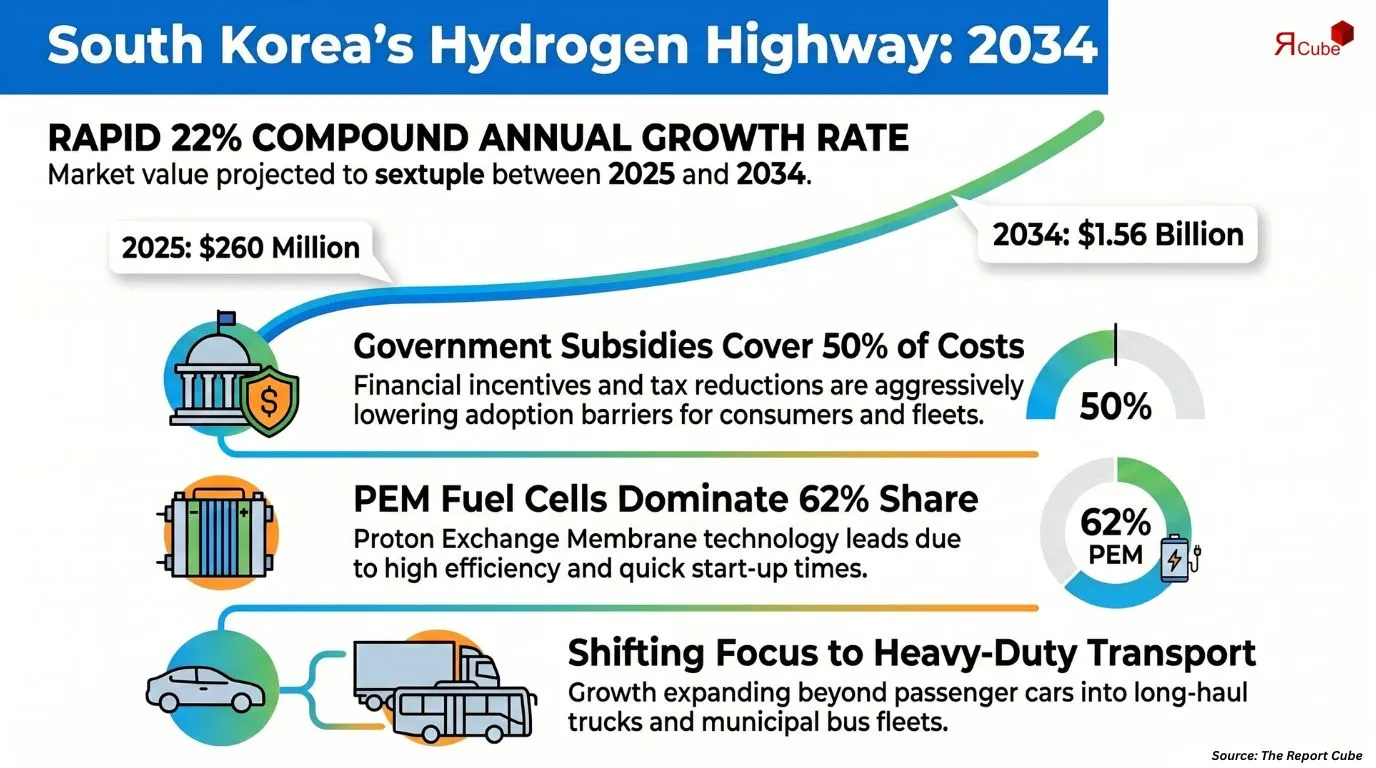
The South Korea Hydrogen Fuel Cell Vehicle Market is anticipated to register a CAGR of 22.0% during the forecast period 2026-2034. The market size was valued at USD 260 million in 2025 and is projected to reach USD 1,556.72 million by 2034. This rapid expansion is driven by South Korea’s strong national hydrogen economy roadmap, aggressive decarbonization targets, and early leadership in fuel cell vehicle manufacturing and infrastructure deployment.
South Korea has positioned hydrogen mobility as a core pillar of its long-term energy transition strategy, with fuel cell vehicles (FCVs) playing a critical role in reducing emissions from road transport. Government-backed subsidies, consumer incentives, and public-private partnerships have accelerated the adoption of hydrogen-powered vehicles, particularly passenger cars and buses. Automakers are scaling production capacities while investing in next-generation fuel cell stacks that offer higher efficiency, longer lifespans, and reduced costs.
At the same time, the country’s expanding hydrogen refueling network is improving consumer confidence and operational feasibility. Integration between hydrogen production, storage, and distribution is strengthening the overall value chain, creating a favorable ecosystem for sustained growth. As commercial fleets and municipal transport systems increasingly shift toward zero-emission alternatives, the South Korean hydrogen Fuel Cell Vehicle Market is expected to witness transformative growth throughout the forecast period.
South Korea Hydrogen Fuel Cell Vehicle Market Recent Developments
- 2025: Hyundai expanded domestic FCV production capacity to meet rising demand from passenger and fleet segments.
- 2025: Doosan Fuel Cell advanced high-efficiency fuel cell systems for heavy-duty mobility applications.
Government Initiatives & Policies
- Korean Hydrogen Economy Roadmap: National strategy promoting hydrogen vehicles, refueling stations, and clean hydrogen supply.
- Carbon Neutrality 2050 Plan: Policy framework supporting zero-emission vehicles and clean mobility solutions.
South Korea Hydrogen Fuel Cell Vehicle Market Dynamics
Key Driver: Strong Government Support for Hydrogen Mobility
The most significant driver of the South Korea Hydrogen Fuel Cell Vehicle Market is robust government support aimed at establishing a comprehensive hydrogen economy. Financial incentives for FCV purchases, tax reductions, and subsidies for hydrogen refueling infrastructure have lowered adoption barriers for both consumers and fleet operators. In 2024, government incentives covered up to 50% of the incremental cost of hydrogen vehicles compared to conventional alternatives. These measures are closely aligned with national carbon reduction targets, making hydrogen mobility a strategic priority. Furthermore, coordinated efforts between central and regional governments ensure consistent policy implementation, enabling automakers and infrastructure providers to plan long-term investments with greater certainty.
Book your FREE 30-minute expert consultation today
Contact UsIndustry Trends: Expansion into Commercial and Heavy-Duty Vehicles
An important trend shaping the market is the expansion of hydrogen fuel cell technology beyond passenger vehicles into commercial vehicles, buses, and trucks. Public transportation agencies are increasingly deploying hydrogen buses to reduce urban emissions, while logistics companies are piloting hydrogen-powered trucks for long-haul operations. These applications benefit from hydrogen’s fast refueling times and longer driving ranges compared to battery-electric alternatives. As a result, demand for higher-capacity fuel cell systems is rising, encouraging suppliers to innovate in stack durability and power density. This diversification across vehicle categories is strengthening the market’s resilience and broadening its revenue base.
Major Challenge: High Infrastructure and Production Costs
Despite strong momentum, high infrastructure and hydrogen production costs remain a key challenge for the market. Establishing hydrogen refueling stations requires significant capital investment, while green hydrogen production is still costlier than fossil fuel-based alternatives. These factors can slow adoption, particularly in regions with limited infrastructure coverage. Additionally, achieving economies of scale in fuel cell manufacturing remains a work in progress, impacting vehicle pricing. Addressing these cost challenges through technological innovation and scaling will be critical for sustaining long-term market growth.
Opportunity: Integration of Green Hydrogen and Renewable Energy
The growing focus on green hydrogen presents a major opportunity for the South Korea Hydrogen Fuel Cell Vehicle Market. Investments in renewable energy-based hydrogen production are expected to lower lifecycle emissions and improve the environmental credibility of FCVs. As renewable capacity expands, the cost gap between green and conventional hydrogen is projected to narrow. This integration supports national decarbonization goals while enhancing energy security. Companies that align vehicle development with clean hydrogen supply chains are well-positioned to capture emerging opportunities across passenger and commercial mobility segments.
South Korea Hydrogen Fuel Cell Vehicle Market Segment-wise Analysis
By Vehicle Type:
- Passenger Vehicles
- Commercial Vehicles
- Buses
- Trucks
Passenger Vehicles dominate the market, accounting for nearly 48% of total market share in 2025, driven by early consumer adoption and strong manufacturer focus. Hydrogen-powered buses follow, supported by government-led public transport electrification initiatives. Commercial vehicles and trucks are gaining momentum as fleet operators seek zero-emission solutions for logistics and delivery. The growing penetration across multiple vehicle categories highlights the scalability of hydrogen fuel cell technology within South Korea’s mobility landscape.
By Fuel Cell Type:
- PEM Fuel Cells
- SOFC Fuel Cells
- AFC Fuel Cells
PEM Fuel Cells lead the market with an estimated 62% share, owing to their high efficiency, quick start-up times, and suitability for automotive applications. SOFC Fuel Cells are primarily used in stationary and auxiliary power applications but are gradually finding niche roles in heavy-duty mobility. AFC Fuel Cells remain limited due to sensitivity to impurities. Continuous R&D in PEM technology is expected to further strengthen its dominance throughout the forecast period.
Regional Projection of South Korea Hydrogen Fuel Cell Vehicle Industry
- Greater
- Central
- Eastern
- Western
- Southern
The Greater region leads the market, accounting for approximately 41% of total demand, driven by higher population density, advanced infrastructure, and early adoption of clean mobility solutions. Central and Southern regions follow, supported by industrial activity and public transportation initiatives. Regional government support and infrastructure availability play a decisive role in adoption rates, with expansion into Eastern and Western regions expected as refueling networks mature.
Need insights for a specific region within this market?
Request Regional DataWhy Choose This Report?
- Provides a comprehensive overview of the overall market analysis, encompassing key trends, consumer behavior analysis, and risk assessment to support strategic decision-making.
- Provides accurate, up-to-date insights into market size, segmentation, and emerging opportunities, helping to minimize risk & capitalizing on growth.
- Gives deep understanding of target audience preferences, investment habits, and communication channels for enhanced product development & marketing effectiveness.
- Delivers competitive analysis & benchmarking, uncovering the strengths & weaknesses of market competitors to guide strategies.
- Consolidate comprehensive market intelligence, reducing reasoning & streamlining research efforts.
- Facilitates customized market segmentation & risk mitigation strategies, fine-tuned to the business objectives.
- Aids in identifying both market challenges & untapped opportunities within the industry to drive long-term business growth.
- Provides valuable information based on actual customer data & search trends.
Table of Contents
- Introduction
- Objective of the Study
- Product and Category Definition
- Market Segmentation
- Study Variables
- Research Methodology
- Secondary Data Points
- Breakdown of Secondary Sources
- Primary Data Points
- Breakdown of Primary Interviews
- Secondary Data Points
- Executive Summary
- Market Dynamics
- Drivers
- Challenges
- Opportunity Assessment
- Recent Trends and Developments
- Regulatory and Policy Landscape
- South Korea Hydrogen Fuel Cell Vehicle Market Overview (2020-2034)
- Market Size, By Value (USD Million)
- Market Share, By Vehicle Type
- Passenger Vehicles
- Commercial Vehicles
- Buses
- Trucks
- Market Share, By Fuel Cell Type
- PEM Fuel Cells
- SOFC Fuel Cells
- AFC Fuel Cells
- Market Share, By Range
- Below 300 km
- 300-500 km
- Above 500 km
- More than 250 KW
- Market Share, By Power Output
- Less than 150 KW
- 150-250 KW
- Market Share, By End User
- Private Users
- Fleet Operators
- Public Transit
- Logistics Fleets
- Market Share, By Region
- Greater
- Central
- Eastern
- Western
- Southern
- Market Share, By Company
- Competition Characteristics
- Revenue Shares & Analysis
- Greater Seoul Hydrogen Fuel Cell Vehicle Market
- Market Size, By Value (USD Million)
- Market Share, By Vehicle Type
- Market Share, By Fuel Cell Type
- Market Share, By Range
- Market Share, By Power Output
- Market Share, By End User
- Central Korea Hydrogen Fuel Cell Vehicle Market
- Market Size, By Value (USD Million)
- Market Share, By Vehicle Type
- Market Share, By Fuel Cell Type
- Market Share, By Range
- Market Share, By Power Output
- Market Share, By End User
- Eastern Korea Hydrogen Fuel Cell Vehicle Market
- Market Size, By Value (USD Million)
- Market Share, By Vehicle Type
- Market Share, By Fuel Cell Type
- Market Share, By Range
- Market Share, By Power Output
- Market Share, By End User
- Western Korea Hydrogen Fuel Cell Vehicle Market
- Market Size, By Value (USD Million)
- Market Share, By Vehicle Type
- Market Share, By Fuel Cell Type
- Market Share, By Range
- Market Share, By Power Output
- Market Share, By End User
- Southern Korea Hydrogen Fuel Cell Vehicle Market
- Market Size, By Value (USD Million)
- Market Share, By Vehicle Type
- Market Share, By Fuel Cell Type
- Market Share, By Range
- Market Share, By Power Output
- Market Share, By End User
- Competitive Outlook and Company Profiles
- Hyundai Motor Company
- Company Overview
- Product Portfolio
- Strategic Alliances/Partnerships
- Recent Developments
- Kia Corporation
- Company Overview
- Product Portfolio
- Strategic Alliances/Partnerships
- Recent Developments
- Hyundai Mobis
- Company Overview
- Product Portfolio
- Strategic Alliances/Partnerships
- Recent Developments
- Doosan Fuel Cell
- Company Overview
- Product Portfolio
- Strategic Alliances/Partnerships
- Recent Developments
- SK E&S
- Company Overview
- Product Portfolio
- Strategic Alliances/Partnerships
- Recent Developments
- POSCO Energy
- Company Overview
- Product Portfolio
- Strategic Alliances/Partnerships
- Recent Developments
- Hanwha Solutions
- Company Overview
- Product Portfolio
- Strategic Alliances/Partnerships
- Recent Developments
- Hyosung Heavy Industries
- Company Overview
- Product Portfolio
- Strategic Alliances/Partnerships
- Recent Developments
- Iljin Hysolus
- Company Overview
- Product Portfolio
- Strategic Alliances/Partnerships
- Recent Developments
- Korea Gas Corporation (KOGAS)
- Company Overview
- Product Portfolio
- Strategic Alliances/Partnerships
- Recent Developments
- Others
- Hyundai Motor Company
- Contact Us and Disclaimer
Top Key Players & Market Share Outlook
- Hyundai Motor Company
- Kia Corporation
- Hyundai Mobis
- Doosan Fuel Cell
- SK E&S
- POSCO Energy
- Hanwha Solutions
- Hyosung Heavy Industries
- Iljin Hysolus
- Korea Gas Corporation (KOGAS)
- Others
Frequently Asked Questions






