




Build Your Custom Market Intelligence Report
Customize Your ReportGlobal Hydrogen Truck Market Key Takeaways
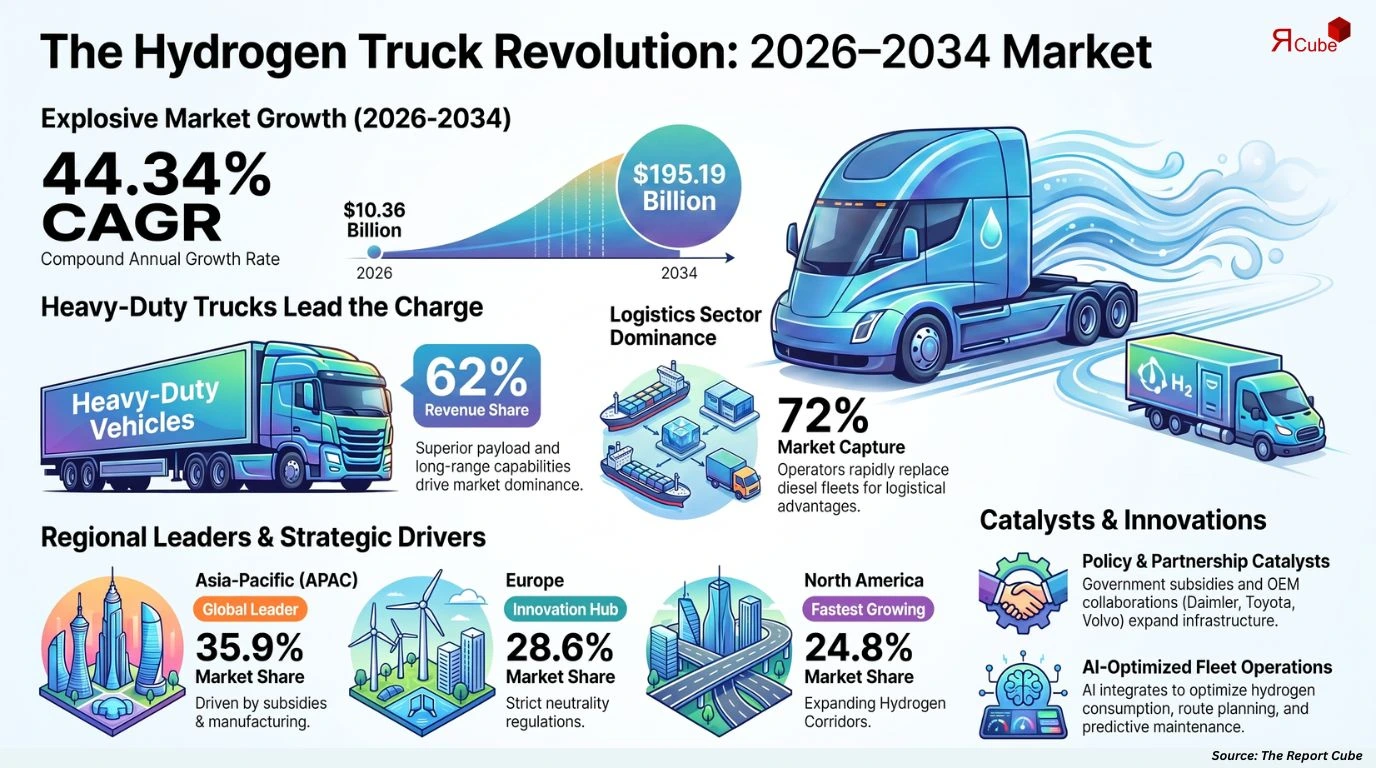
- Global Hydrogen Truck Market valued at USD 10.36 billion during 2026.
- Market projected to reach USD 195.19 billion by 2034.
- Market is anticipated to expand at a robust 44.34% CAGR.
- Daimler Truck, Toyota, Hyundai, Nikola, and Volvo remain leading innovators.
- Heavy-duty trucks dominate product demand across commercial freight applications.
- Asia-Pacific represents the leading regional market for hydrogen truck deployment.
- North America is expected to register the fastest market expansion.
- Government-backed hydrogen infrastructure investments accelerate commercial fleet electrification.
Global Hydrogen Truck Market Insights & Analysis
The Global Hydrogen Truck Market is anticipated to register a 44.34% CAGR during 2026–2034. The market size was valued at USD 10.36 billion in 2026 and is projected to reach USD 195.19 billion by 2034. The market is witnessing strong momentum as governments intensify decarbonization strategies for heavy-duty transportation and logistics. Public funding for hydrogen production, refueling infrastructure, and fuel-cell vehicle commercialization is strengthening market confidence. Commercial fleet operators are increasingly evaluating hydrogen-powered trucks for long-haul operations due to faster refueling times and extended driving ranges compared with battery-electric alternatives.
Strategic partnerships among leading automotive manufacturers and hydrogen technology developers are accelerating commercialization across global freight corridors. Daimler Truck, Toyota, and Volvo continue expanding collaborative fuel-cell development programs, while Hyundai and other manufacturers are increasing pilot deployments in North America, Europe, and Asia-Pacific. Governments across Germany, Japan, South Korea, China, and the United States are supporting hydrogen mobility through grants, infrastructure investments, and clean transportation incentives, creating favorable conditions for large-scale fleet adoption over the forecast period.
Global Hydrogen Truck Market Dynamics
The Global Hydrogen Truck Market is expanding rapidly as governments and private stakeholders prioritize zero-emission freight transportation. Increasing investments in green hydrogen production, fuel-cell technology, and hydrogen refueling infrastructure are reshaping commercial transportation. Rising pressure to reduce logistics-related emissions, combined with supportive regulations and public-private partnerships, is encouraging fleet operators to adopt hydrogen-powered heavy-duty vehicles for regional and long-haul transportation applications worldwide.
|
Factor |
Type |
Specific Impact on Market |
Magnitude |
|---|---|---|---|
|
Government hydrogen strategies |
Driver |
Accelerates commercial deployment and infrastructure expansion |
High |
|
Fuel-cell technological advancement |
Opportunity |
Improves vehicle efficiency and driving range |
High |
|
Hydrogen refueling network expansion |
Opportunity |
Enhances fleet operational feasibility |
High |
|
Limited hydrogen infrastructure |
Challenge |
Restricts commercial deployment across emerging markets |
Medium |
|
OEM strategic collaborations |
Trend |
Accelerates product commercialization and innovation |
High |
Government Policies Accelerate Hydrogen Adoption
National hydrogen strategies, stringent carbon reduction targets, and zero-emission freight regulations are becoming primary growth catalysts. Several governments are funding hydrogen production, fueling stations, and commercial vehicle demonstrations to encourage market adoption. Germany has allocated substantial funding for fuel-cell truck development under the IPCEI Hydrogen initiative, while Japan, South Korea, China, and the United States continue supporting hydrogen mobility through subsidies and infrastructure investments. These initiatives significantly improve investor confidence and accelerate commercialization of hydrogen-powered trucking solutions across international freight networks.
Hydrogen Infrastructure Deployment Remains Uneven
Although hydrogen truck technology has matured considerably, the availability of large-scale refueling infrastructure remains geographically concentrated. Long-distance commercial transport requires reliable hydrogen supply corridors supported by production, storage, and distribution facilities. Infrastructure expansion is progressing in Europe, China, Japan, South Korea, and selected North American regions, yet deployment remains limited across developing markets. Addressing these infrastructure gaps will be essential to supporting large-scale fleet operations and maximizing utilization of hydrogen-powered commercial vehicles throughout the forecast period.
Strategic Partnerships Transform Competitive Landscape
Leading automotive manufacturers increasingly rely on strategic collaborations to accelerate hydrogen commercialization. Joint ventures between truck manufacturers, fuel-cell developers, and energy companies are improving technology development while reducing commercialization timelines. Partnerships involving Daimler Truck, Toyota, Volvo, Hyundai, and hydrogen infrastructure providers demonstrate growing industry commitment toward standardized fuel-cell platforms and integrated hydrogen ecosystems. Such collaborations are expected to strengthen supply chains, improve technology scalability, and expand commercial adoption across global logistics and freight transportation industries.
Need Specific Data, Let’s Customize the Report for You
Request CustomizationGlobal Hydrogen Truck Market Segment-wise Analysis
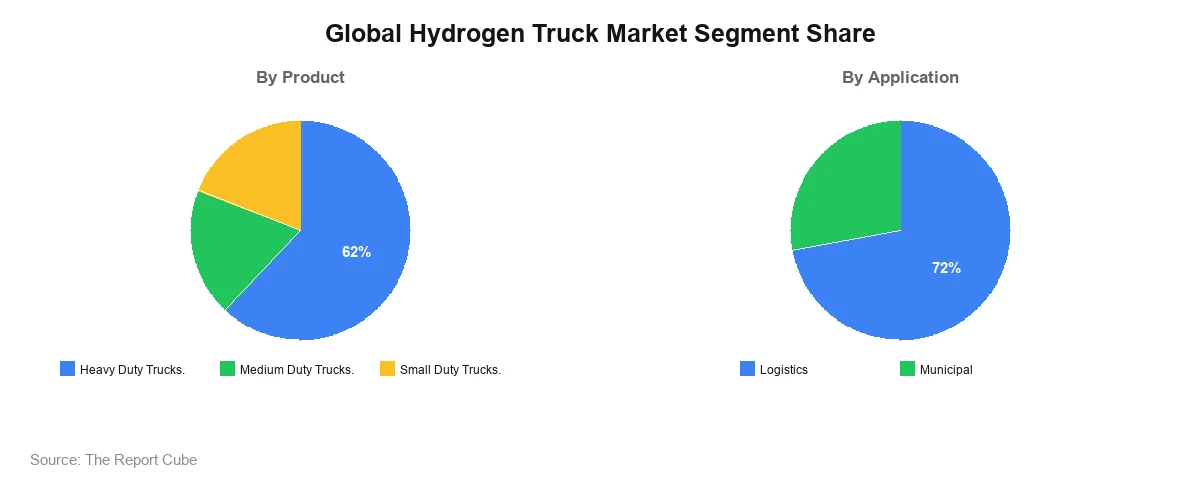
The Global Hydrogen Truck Market is segmented by product into Heavy Duty Trucks, Medium Duty Trucks, and Small Duty Trucks. Growing freight transportation demand, stricter emission regulations, and continuous improvements in hydrogen fuel-cell technology are influencing product adoption patterns across commercial transportation industries.
By Product
- Heavy Duty Trucks
- Medium Duty Trucks
- Small Duty Trucks
Heavy Duty Trucks dominate the Global Hydrogen Truck Market, accounting for approximately 62% of total revenue in 2026. Their leadership is attributed to superior payload capacity, extended driving range exceeding conventional battery-electric alternatives, and rapid hydrogen refueling capability. Long-haul logistics companies increasingly favor heavy-duty hydrogen trucks to reduce operational downtime while meeting stringent emissions regulations. Government-backed pilot programs and commercial fleet demonstrations across Europe, China, Japan, and North America continue supporting large-scale deployment of heavy-duty fuel-cell trucks for freight transportation.
Medium Duty Trucks are projected to register the fastest growth throughout the forecast period due to increasing adoption in regional distribution, municipal operations, and urban freight services. Small Duty Trucks are steadily gaining traction in last-mile logistics, warehouse transportation, and commercial delivery applications where operational efficiency and environmental compliance are becoming critical purchasing factors. Continuous improvements in hydrogen storage systems, fuel-cell durability, and refueling infrastructure are expected to strengthen adoption across both medium- and small-duty vehicle categories over the coming decade.
By Application
- Logistics
- Municipal
The Logistics segment dominates the Global Hydrogen Truck Market, accounting for approximately 72% of total market revenue in 2026. Long-haul freight operators increasingly prefer hydrogen fuel-cell trucks because they offer driving ranges exceeding 700 km, rapid refueling, and high payload capacity. Large logistics companies are actively participating in commercial pilot programs across Europe, North America, China, and Japan. Government-backed hydrogen freight corridors and strategic collaborations between truck manufacturers and logistics providers are further strengthening adoption while supporting carbon-neutral freight transportation objectives.
The Municipal segment is expected to witness the fastest growth throughout the forecast period. Hydrogen-powered trucks are increasingly deployed for waste collection, street maintenance, construction support, and public utility operations where zero-emission transportation aligns with urban sustainability objectives. Municipal authorities across Europe and Asia-Pacific continue investing in hydrogen mobility through clean transportation programs and public procurement initiatives. Growing investment in localized hydrogen production and refueling infrastructure is expected to improve operational feasibility and accelerate adoption among municipal fleet operators.
Regional Projection of Global Hydrogen Truck Market
Regional market performance varies according to hydrogen infrastructure maturity, government funding, industrial decarbonization policies, and commercial fleet adoption. Asia-Pacific currently leads global deployment through strong government support and manufacturing capacity, while North America is expected to record the fastest growth owing to expanding infrastructure investments and commercialization initiatives.
|
Region |
Estimated Market Share |
Key Growth Factors |
Consumer Trends |
|---|---|---|---|
|
North America |
24.8% |
Clean transportation incentives, hydrogen corridors |
Rising fleet replacement |
|
Europe |
28.6% |
Carbon neutrality regulations, hydrogen funding |
Commercial freight decarbonization |
|
Asia-Pacific |
35.9% |
Large-scale manufacturing, government subsidies |
Heavy-duty fleet expansion |
|
Latin America |
5.2% |
Emerging hydrogen investments |
Pilot commercial projects |
|
Middle East & Africa |
5.5% |
Green hydrogen production initiatives |
Industrial logistics adoption |
- North America: North America is projected to be the fastest-growing regional market owing to expanding hydrogen infrastructure, state-backed clean freight initiatives, commercial fleet demonstrations, and increasing investments from Toyota, Hyundai, Nikola, and other manufacturers developing Class-8 hydrogen trucks.
- Europe: Europe remains a major commercialization hub, supported by stringent emission regulations, IPCEI Hydrogen funding, Daimler Truck development programs, and rapidly expanding hydrogen refueling infrastructure serving long-haul logistics operations.
- Asia-Pacific: Asia-Pacific leads the global market with approximately 35.9% revenue share due to strong government incentives, domestic hydrogen production, large commercial vehicle manufacturing capacity, and extensive deployment programs across China, Japan, and South Korea.
- Latin America: Latin America is gradually adopting hydrogen-powered commercial transportation through pilot freight projects, renewable hydrogen investments, and partnerships aimed at reducing logistics-sector emissions.
- Middle East & Africa (MEA): The Middle East & Africa market is supported by large-scale green hydrogen production projects, industrial diversification strategies, and increasing interest in zero-emission commercial transportation for regional logistics.
Global Hydrogen Truck Market: Recent Development (2025)
- Hyundai unveiled the new XCIENT Fuel Cell truck alongside North American commercialization partnerships during ACT Expo 2025.
- Toyota introduced Class 8 hydrogen trucks and expanded hydrogen infrastructure investments supporting commercial freight fleet decarbonization initiatives.
- Toyota deployed fuel-cell heavy-duty logistics trucks across European supply chains through collaboration with VDL and logistics partners.
- Daimler Truck advanced GenH2 customer trials, surpassing 225,000 kilometers while validating hydrogen trucking performance under commercial operations.
Global Hydrogen Truck Market Future Outlook (2034)
The Global Hydrogen Truck Market is expected to reach USD 195.19 billion by 2034, expanding at a 44.34% CAGR throughout the forecast period. Growing investment in green hydrogen production, high-capacity refueling networks, and next-generation fuel-cell technologies will continue transforming commercial transportation. Increasing collaboration among truck manufacturers, hydrogen suppliers, logistics companies, and government agencies is expected to accelerate fleet commercialization while improving vehicle reliability and infrastructure accessibility. Continued regulatory support for zero-emission freight transportation will strengthen long-term industry growth.
Artificial intelligence will increasingly optimize hydrogen fleet operations through predictive maintenance, intelligent route planning, fuel consumption optimization, and real-time fleet management. Autonomous driving integration with hydrogen fuel-cell platforms is also expected to enhance freight efficiency, particularly for long-haul logistics applications. Expanding hydrogen ecosystems across North America, Europe, and Asia-Pacific, combined with declining fuel-cell costs and broader infrastructure deployment, will create substantial growth opportunities for manufacturers, component suppliers, hydrogen producers, and commercial fleet operators through 2034.
Global Hydrogen Truck Market Report Coverage
|
Report Attribute |
Details |
|---|---|
|
Market Name |
Global Hydrogen Truck Market |
|
Market Size (2026) |
USD 10.36 Billion |
|
Market Size (2034) |
USD 195.19 Billion |
|
Forecast Period |
2026–2034 |
|
CAGR |
44.34% |
|
Base Year |
2025 |
|
Historical Years |
2021–2025 |
|
Forecast Years |
2026-2034 |
|
Segments Covered |
By Product, By Application, By Range, and By Region |
|
Regions Covered |
North America, Europe, Asia-Pacific, Latin America, Middle East & Africa |
|
Key Companies |
Nikola, Daimler Truck, Cummins, Hyzon Motors, Toyota, Volvo, Honda Motors, Hyundai Motors, SAIC, Others |
|
Report Format |
PDF, Excel, PPT, Interactive Dashboard |
|
Customization |
Up to 20% customization available according to client requirements |
Why Choose This Report?
- Comprehensive market sizing with validated historical and forecast market estimates.
- Detailed competitive benchmarking across leading hydrogen truck manufacturers globally.
- Extensive regional assessment covering mature and emerging hydrogen economies.
- Insightful evaluation of technology trends influencing commercial vehicle adoption.
- Strategic analysis of government initiatives supporting hydrogen mobility expansion.
- Comprehensive segmentation highlighting dominant and fastest-growing revenue opportunities.
- Actionable intelligence supporting investment, expansion, and strategic business decisions.
- Reliable research methodology supported by industry developments and market evidence.
Table of Contents
- Introduction
- Objective of the Study
- Product Definition
- Market Segmentation
- Study Variables
- Research Methodology
- Secondary Data Points
- Companies Interviewed
- Primary Data Points
- Breakdown of Primary Interviews
- Secondary Data Points
- Executive Summary
- Market Dynamics
- Drivers
- Challenges
- Opportunity Assessment
- Recent Trends and Developments
- Policy and Regulatory Landscape
- Global Hydrogen Truck Market Overview and Forecast Analysis (2021-2034)
- Market Size, By Value, By Growth Rate (CAGR/USD Billions)
- Demand – Supply Trends
- Market Share, By Product
- Heavy Duty trucks
- Medium Duty Trucks
- Small Duty Trucks
- Market Share, By Application
- Logistics
- Municipal
- Market Share, By Range
- Above 400 Km
- Below 400 Km
- Market Share, By Region
- North America
- Europe
- Asia-Pacific
- Latin America
- Middle East & Africa (MEA)
- Market Share, By Competitors
- Competition Characteristics
- Revenue Shares
- Heavy Duty trucks Global Hydrogen Truck Market Overview, 2021-2034F
- By Value (USD Million)
- By Application – Market Size & Forecast 2021-2034, USD Million
- Logistics
- Municipal
- Medium Duty Trucks Global Hydrogen Truck Market Overview, 2021-2034F
- By Value (USD Million)
- By Application – Market Size & Forecast 2021-2034, USD Million
- Logistics
- Municipal
- Small Duty Trucks Global Hydrogen Truck Market Overview, 2021-2034F
- By Value (USD Million)
- By Application – Market Size & Forecast 2021-2034, USD Million
- Logistics
- Municipal
- Competitive Outlook (Company Profile – Partial List)
- Nikola
- Company Overview
- Business Segments
- Strategic Alliances/Partnerships
- Recent Developments
- Daimler trucks
- Company Overview
- Business Segments
- Strategic Alliances/Partnerships
- Recent Developments
- Cummins
- Company Overview
- Business Segments
- Strategic Alliances/Partnerships
- Recent Developments
- Hyzonmotors
- Company Overview
- Business Segments
- Strategic Alliances/Partnerships
- Recent Developments
- Toyota
- Company Overview
- Business Segments
- Strategic Alliances/Partnerships
- Recent Developments
- Volvo
- Company Overview
- Business Segments
- Strategic Alliances/Partnerships
- Recent Developments
- Honda motors
- Company Overview
- Business Segments
- Strategic Alliances/Partnerships
- Recent Developments
- Hyundai motors
- Company Overview
- Business Segments
- Strategic Alliances/Partnerships
- Recent Developments
- SAIC
- Company Overview
- Business Segments
- Strategic Alliances/Partnerships
- Recent Developments
- Others
- Nikola
- Contact Us & Disclaimer
Top Key Players & Market Share Outlook
- Nikola
- Daimler trucks
- Cummins
- Hyzonmotors
- Toyota
- Volvo
- Honda motors
- Hyundai motors
- SAIC
- Others
Frequently Asked Questions