



Build Your Custom Market Intelligence Report
Customize Your ReportGlobal Hyperlocal FMCG Supply Chain Market Key Highlights
By Service Model:
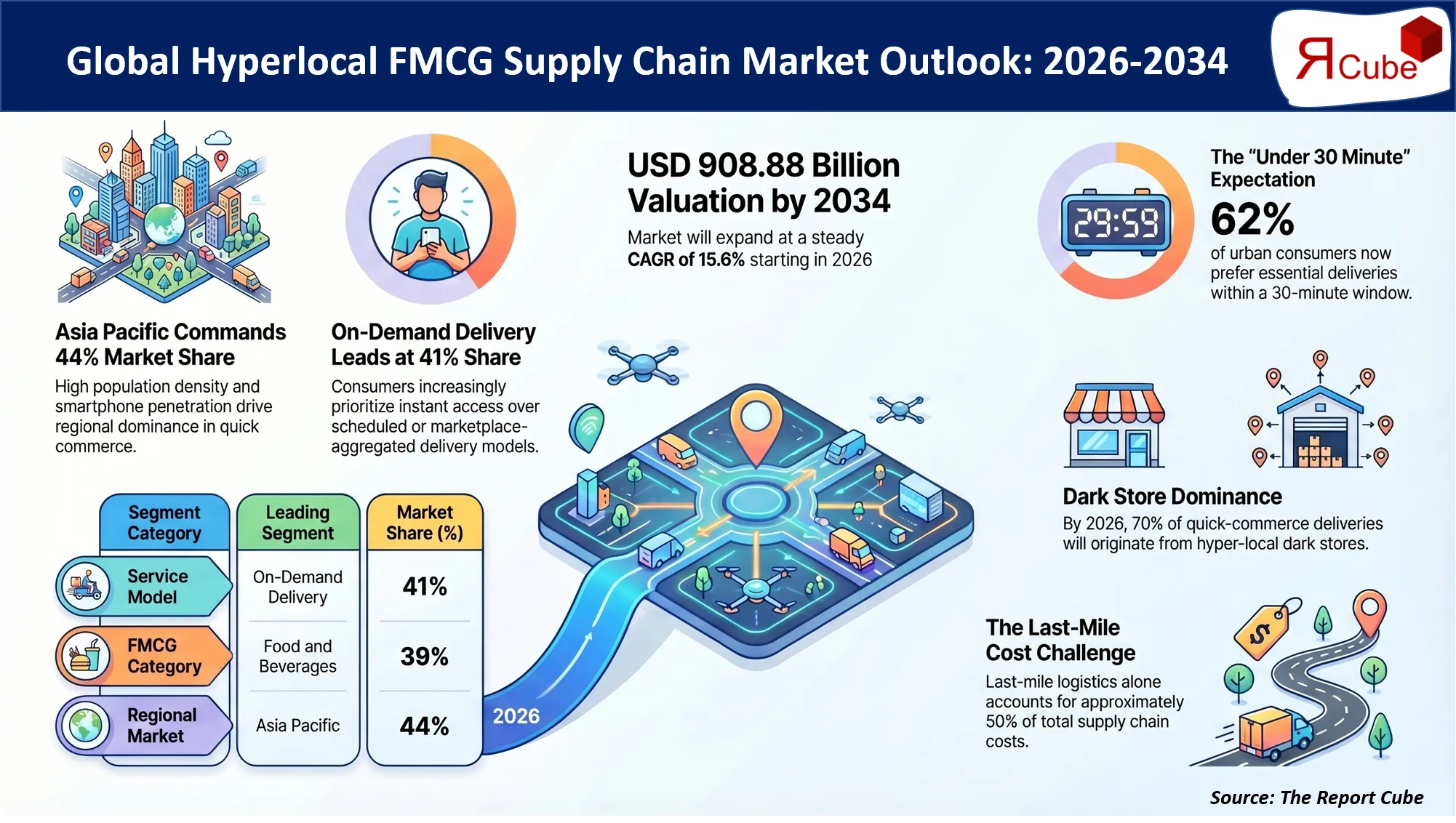
On-Demand Delivery segment leads the market with around 41% share.
By FMCG Category:
Food and Beverages segment dominates the market with nearly 39% of revenue.
Regional Outlook:
Asia Pacific region dominates the Global Hyperlocal FMCG Supply Chain Market with approximately 44% share.
Global Hyperlocal FMCG Supply Chain Market Insights & Analysis
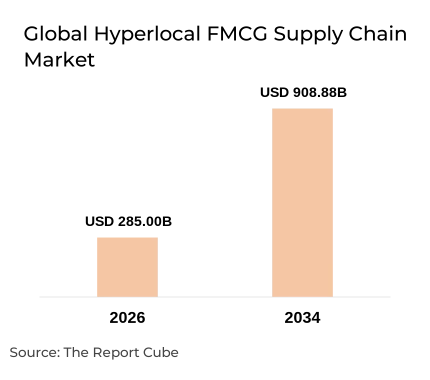
The Global Hyperlocal FMCG Supply Chain Market is anticipated to register a CAGR of around 15.6% during the forecast period 2026–2034. The market size is valued at USD 285.0 billion in 2026 and is projected to reach USD 908.88 billion by 2034. The rapid evolution of last-mile logistics, combined with rising urban population density, is transforming how fast-moving consumer goods are distributed and consumed. Increasing smartphone penetration, which crossed 78% globally in 2025, has accelerated mobile-first ordering behaviors, directly boosting the Hyperlocal FMCG Supply Chain Market size and revenue.
Investment activity across micro-fulfillment infrastructure has intensified, with companies deploying dark stores within 2–3 km radiuses to enable ultra-fast delivery. Governments across Asia and Europe are also supporting digital commerce ecosystems, encouraging real-time logistics innovation. In addition, partnerships between retailers and logistics platforms are reshaping supply chain agility. The Hyperlocal FMCG Supply Chain Market growth is further supported by demand for convenience-driven consumption, where over 62% of urban consumers prefer deliveries within 30 minutes for daily essentials, indicating a structural shift in retail supply chains.
Global Hyperlocal FMCG Supply Chain Market Dynamics
Key Driver: Rapid Urbanization and Demand for Instant Fulfillment
Urbanization continues to reshape consumption patterns, with over 56% of the global population living in cities as of 2025. This shift is directly increasing demand for rapid delivery of essential goods. Consumers now prioritize convenience, leading to higher adoption of hyperlocal delivery platforms. The Hyperlocal FMCG Supply Chain Market trends show that orders for daily essentials have increased by nearly 35% year-over-year in major metropolitan areas.
Additionally, the rise of dual-income households has reduced time available for traditional shopping. This behavioral change is pushing demand toward instant fulfillment services such as on-demand delivery and quick commerce. Retailers and logistics providers are responding by optimizing last-mile networks and reducing delivery time windows, thereby strengthening overall market growth and operational efficiency.
Book your FREE 30-minute expert consultation today
Contact UsIndustry Trends: Expansion of Dark Stores and AI-Driven Logistics
The expansion of dark store networks is a defining trend shaping the Hyperlocal FMCG Supply Chain Market value. Companies are investing heavily in localized warehouses that enable faster picking and packing. By 2026, over 70% of quick-commerce deliveries are expected to originate from dark stores, reflecting a strong shift from traditional retail outlets.
Furthermore, AI-driven demand forecasting and route optimization are improving supply chain accuracy. Predictive analytics tools are reducing stockouts by nearly 28% and improving delivery efficiency. Integration of automation technologies within fulfillment centers is also lowering operational costs while enhancing scalability, supporting long-term market revenue growth.
Major Challenge: High Operational Costs and Profitability Pressure
The Hyperlocal FMCG Supply Chain Market faces significant cost challenges due to the need for dense infrastructure and rapid delivery commitments. Maintaining dark stores, managing inventory turnover, and ensuring last-mile efficiency require substantial capital investment. Industry estimates indicate that last-mile delivery alone accounts for nearly 50% of total logistics costs.
Additionally, maintaining profitability remains difficult as companies compete on delivery speed and pricing. Heavy discounting strategies and customer acquisition costs further strain margins. Smaller players often struggle to sustain operations, leading to consolidation within the market, which may impact competition and innovation.
Opportunity: Integration of Retail Ecosystems and B2B Expansion
A major opportunity lies in the integration of hyperlocal supply chains with traditional retail ecosystems. Retailers are increasingly partnering with logistics platforms to offer hybrid fulfillment models, enhancing reach and efficiency. This approach is expected to expand the Hyperlocal FMCG Supply Chain Market share significantly in the coming years.
Moreover, the B2B segment is gaining traction, with small businesses and foodservice outlets relying on hyperlocal networks for inventory replenishment. This shift is opening new revenue streams and diversifying market applications beyond individual consumers, strengthening long-term growth prospects.
Global Hyperlocal FMCG Supply Chain Market Segment-wise Analysis
By Service Model:
- On-Demand Delivery
- Scheduled Delivery
- Dark Store Fulfillment
- Marketplace Aggregation
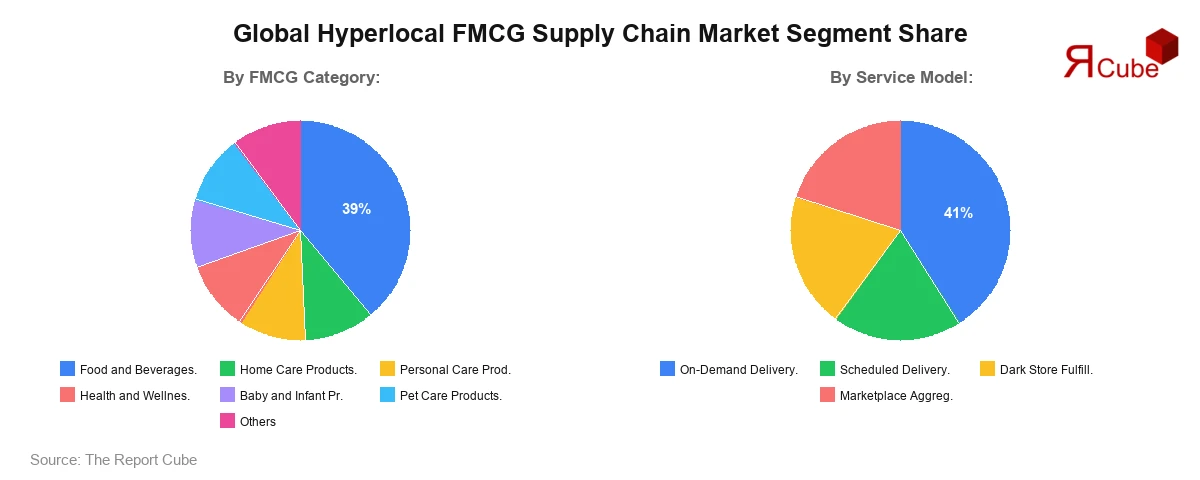
On-demand delivery dominates the Hyperlocal FMCG Supply Chain Market with an estimated 41% share in 2026, driven by the increasing need for instant access to daily essentials. Consumers prefer real-time delivery for groceries, beverages, and household items, leading to higher adoption rates. Platforms offering under 30-minute delivery have witnessed order frequency growth exceeding 45% annually in urban regions.
This segment benefits from strong technology integration, including real-time tracking and dynamic routing systems. Companies are focusing on expanding delivery fleets and optimizing fulfillment nodes to meet growing demand. The rising popularity of quick commerce models continues to reinforce the leadership of on-demand delivery within the market.
By FMCG Category:
- Food and Beverages
- Home Care Products
- Personal Care Products
- Health and Wellness Products
- Baby and Infant Products
- Pet Care Products
- Others
Food and beverages hold the largest share of around 39% in the Hyperlocal FMCG Supply Chain Market, as these products are frequently purchased and time-sensitive. The demand for fresh produce, ready-to-eat meals, and beverages drives continuous order cycles, contributing significantly to market revenue.
Consumers increasingly rely on hyperlocal platforms for daily grocery needs, especially in densely populated cities. This segment also benefits from partnerships between food brands and delivery platforms, ensuring consistent product availability and faster replenishment cycles, thereby sustaining strong market growth.
Regional Projection of Global Hyperlocal FMCG Supply Chain Industry
- North America
- Europe
- Asia Pacific
- Middle East and Africa
- South America
Asia Pacific leads the Hyperlocal FMCG Supply Chain Market with approximately 44% share, driven by high population density, rapid urbanization, and widespread smartphone usage. Countries such as China and India have witnessed significant adoption of quick commerce platforms, with order volumes increasing by over 50% annually in key cities.
The region’s dominance is further supported by strong investments in logistics infrastructure and digital payment systems. Local players are aggressively expanding dark store networks, while global companies are entering the market through partnerships and acquisitions, reinforcing the region’s leadership position.
Need insights for a specific region within this market?
Request Regional DataGovernment Initiatives & Policies
- India ONDC Initiative: Open Network for Digital Commerce enhances hyperlocal retail access and logistics interoperability.
- EU Digital Markets Act Implementation: Regulates digital platforms to ensure fair competition in e-commerce and logistics ecosystems.
Global Hyperlocal FMCG Supply Chain Industry Recent Developments
- 2025: DoorDash launched DashMart Fulfillment Services, enabling retailers like CVS and Party City to leverage its micro-fulfillment network for faster FMCG distribution.
- 2026: Flink secured $100 million funding to expand local fulfillment hubs across Germany, strengthening its quick commerce infrastructure and delivery efficiency.
- 2025: Meituan expanded grocery operations and planned acquisition of Dingdong assets, improving supply chain density and hyperlocal delivery capabilities in China.
Why Choose This Report?
- Provides a comprehensive overview of the overall market analysis, encompassing key trends, consumer behavior analysis, and risk assessment to support strategic decision-making.
- Provides accurate, up-to-date insights into market size, segmentation, and emerging opportunities, helping to minimize risk & capitalizing on growth.
- Gives deep understanding of target audience preferences, investment habits, and communication channels for enhanced product development & marketing effectiveness.
- Delivers competitive analysis & benchmarking, uncovering the strengths & weaknesses of market competitors to guide strategies.
- Consolidate comprehensive market intelligence, reducing reasoning & streamlining research efforts.
- Facilitates customized market segmentation & risk mitigation strategies, fine-tuned to the business objectives.
- Aids in identifying both market challenges & untapped opportunities within the industry to drive long-term business growth.
- Provides valuable information based on actual customer data & search trends.
Table of Contents
- Introduction
- Objective of the Study
- Product and Category Definition
- Market Segmentation
- Study Variables
- Research Methodology
- Secondary Data Points
- Breakdown of Secondary Sources
- Primary Data Points
- Breakdown of Primary Interviews
- Secondary Data Points
- Executive Summary
- Market Dynamics
- Drivers
- Challenges
- Opportunity Assessment
- Recent Trends and Developments
- Regulatory and Policy Landscape
- Global Hyperlocal FMCG Supply Chain Market Overview (2021-2034)
- Market Size, By Value (USD Billion)
- Market Share, By Service Model
- On-Demand Delivery
- Scheduled Delivery
- Dark Store Fulfillment
- Marketplace Aggregation
- Market Share, By FMCG Category
- Food and Beverages
- Home Care Products
- Personal Care Products
- Health and Wellness Products
- Baby and Infant Products
- Pet Care Products
- Others
- Market Share, By Fulfillment Mode
- Dark Stores
- Retail Partner Stores
- Hybrid Fulfillment
- Market Share, By Delivery Time Window
- Under 15 Minutes
- 15-30 Minutes
- 30-60 Minutes
- Above 60 Minutes
- Market Share, By Order Channel
- Mobile Applications
- Web Platforms
- Third-Party Integrations
- Market Share, By End User
- Individual Consumers
- Small and Medium Businesses
- Foodservice Outlets
- Corporate Customers
- Market Share, By Region
- North America
- Europe
- Asia Pacific
- Middle East and Africa
- South America
- Market Share, By Company
- Revenue Shares and Analysis
- Competitive Landscape
- North America Hyperlocal FMCG Supply Chain Market
- Market Size, By Value (USD Billion/Million)
- Market Share, By Service Model
- Market Share, By FMCG Category
- Market Share, By Fulfillment Mode
- Market Share, By Delivery Time Window
- Market Share, By End User
- Market Share, By Country
- United States
- Canada
- Mexico
- Europe Hyperlocal FMCG Supply Chain Market
- Market Size, By Value (USD Billion/Million)
- Market Share, By Service Model
- Market Share, By FMCG Category
- Market Share, By Fulfillment Mode
- Market Share, By Delivery Time Window
- Market Share, By End User
- Market Share, By Country
- Germany
- France
- United Kingdom
- Italy
- Spain
- Northern and Nordic Countries
- BENELUX
- Rest of Europe
- Asia Pacific Hyperlocal FMCG Supply Chain Market
- Market Size, By Value (USD Billion/Million)
- Market Share, By Service Model
- Market Share, By FMCG Category
- Market Share, By Fulfillment Mode
- Market Share, By Delivery Time Window
- Market Share, By End User
- Market Share, By Country
- China
- India
- Japan
- South Korea
- Australia
- Rest of Asia Pacific
- Middle East and Africa Hyperlocal FMCG Supply Chain Market
- Market Size, By Value (USD Billion/Million)
- Market Share, By Service Model
- Market Share, By FMCG Category
- Market Share, By Fulfillment Mode
- Market Share, By Delivery Time Window
- Market Share, By End User
- Market Share, By Country
- Turkey
- Saudi Arabia
- United Arab Emirates
- South Africa
- Rest of Middle East and Africa
- South America Hyperlocal FMCG Supply Chain Market
- Market Size, By Value (USD Billion/Million)
- Market Share, By Service Model
- Market Share, By FMCG Category
- Market Share, By Fulfillment Mode
- Market Share, By Delivery Time Window
- Market Share, By End User
- Market Share, By Country
- Brazil
- Argentina
- Chile
- Rest of South America
- Competitive Outlook and Company Profiles
- Grab (GrabMart)
- Company Overview
- Product Portfolio
- Strategic Alliances/Partnerships
- Recent Developments
- Flink
- Company Overview
- Product Portfolio
- Strategic Alliances/Partnerships
- Recent Developments
- Instacart
- Company Overview
- Product Portfolio
- Strategic Alliances/Partnerships
- Recent Developments
- Zepto
- Company Overview
- Product Portfolio
- Strategic Alliances/Partnerships
- Recent Developments
- DoorDash (DashMart)
- Company Overview
- Product Portfolio
- Strategic Alliances/Partnerships
- Recent Developments
- JOKR
- Company Overview
- Product Portfolio
- Strategic Alliances/Partnerships
- Recent Developments
- Glovo
- Company Overview
- Product Portfolio
- Strategic Alliances/Partnerships
- Recent Developments
- Amazon (Amazon Fresh)
- Company Overview
- Product Portfolio
- Strategic Alliances/Partnerships
- Recent Developments
- Delivery Hero
- Company Overview
- Product Portfolio
- Strategic Alliances/Partnerships
- Recent Developments
- Meituan
- Company Overview
- Product Portfolio
- Strategic Alliances/Partnerships
- Recent Developments
- Swiggy (Instamart)
- Company Overview
- Product Portfolio
- Strategic Alliances/Partnerships
- Recent Developments
- Uber Eats
- Company Overview
- Product Portfolio
- Strategic Alliances/Partnerships
- Recent Developments
- Rappi
- Company Overview
- Product Portfolio
- Strategic Alliances/Partnerships
- Recent Developments
- Just Eat Takeaway
- Company Overview
- Product Portfolio
- Strategic Alliances/Partnerships
- Recent Developments
- Gopuff
- Company Overview
- Product Portfolio
- Strategic Alliances/Partnerships
- Recent Developments
- Getir
- Company Overview
- Product Portfolio
- Strategic Alliances/Partnerships
- Recent Developments
- Deliveroo (Hop)
- Company Overview
- Product Portfolio
- Strategic Alliances/Partnerships
- Recent Developments
- Zomato
- Company Overview
- Product Portfolio
- Strategic Alliances/Partnerships
- Recent Developments
- Others
- Grab (GrabMart)
- Contact Us and Disclaimer
Top Key Players & Market Share Outlook
- Grab (GrabMart)
- Flink
- Instacart
- Zepto
- DoorDash (DashMart)
- JOKR
- Glovo
- Amazon (Amazon Fresh)
- Delivery Hero
- Meituan
- Swiggy (Instamart)
- Uber Eats
- Rappi
- Just Eat Takeaway
- Gopuff
- Getir
- Deliveroo (Hop)
- Zomato (Blinkit)
- Others
Frequently Asked Questions






